
Mark 1:10
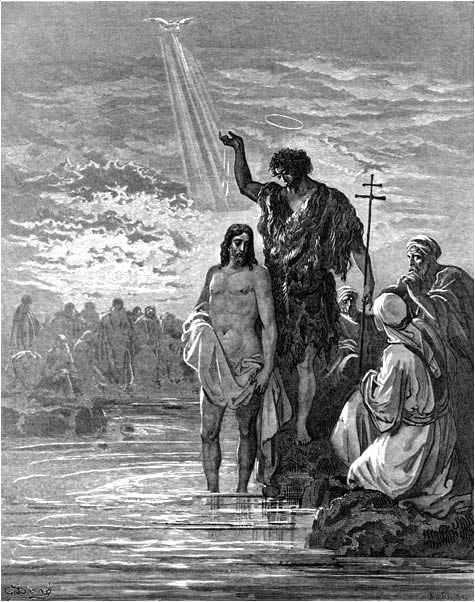
in Mark 1As soon as Jesus came up out of the water, He saw the heavens breaking open and the Spirit descending on Him like a dove.
BSB
The same verse in ASV and KJV ▾
ASV
And straightway coming up out of the water, he saw the heavens rent asunder, and the Spirit as a dove descending upon him:
KJV
And straightway coming up out of the water, he saw the heavens opened, and the Spirit like a dove descending upon him:
⋯
This verse in Mark 1
Commentary
23 notes on this verseChrist descended, and John stood who was baptizing, and behold, as if a dove the Holy Spirit descended. It was not a dove that descended, but as if a dove. Remember what I said: Christ took on flesh, not like flesh; but he took on the truth of that flesh, true flesh Christ took on: But the Holy Spirit did not descend in the truth of a dove, but in the likeness of a dove from heaven. Therefore, John saw and believed. Christ descended, the Holy Spirit descended as well.
This site's exposition
He saw the heavens breaking open
on Mark 1:10-11
Jesus saw the heavens breaking open, and the Greek verb behind those words returns once more in Mark, at 15:38. There it describes the temple veil torn in two.
The record, by era
The Church Fathers5 voices
A commentator
Gregory of NeocaesareaTHE FOURTH HOMILY, ON THE HOLY THEOPHANY, OR OF CHRIST'S BAPTISM · Written before 270.
proposed
And stretching forth slowly his right hand, which seemed both to tremble and to rejoice, John baptized the Lord. Then his detractors who were present, with those in the vicinity and those from a distance, connived together, and spoke among themselves asking: "Was John then …
Those who receive the baptism of Christ need not seek the baptism of John. Those who received the baptism of John did indeed seek the baptism of Christ.… No baptism was necessary for Christ, but he freely received the baptism of a servant (John) to draw us toward his baptism.
Why did the Son of God appear as a man and the Holy Spirit as a dove? Because the Son of God came to show humanity a pattern for living, whereas the Holy Spirit made his appearance to bestow the gift which enables excellent living. Moreover, both appearances surely came in a visible manner for the sake of carnal eyes. For we must pass by degrees through the visible sacraments from those things which are seen with the physical eyes to those things which are understood spiritually by the mind. For human words make a sound and then pass away. But when the divine Word is expressed, that which is signified by the words does not pass away.
The dove is not for sale; it is given gratis. Hence it is called grace.
Do you see, beloved, how many and how great blessings we would have lost if the Lord had yielded to the exhortation of John and declined baptism? For the heavens had been shut before this. The region above was inaccessible. We might descend to the lower parts, but not ascend to the upper. So it happened not only that the Lord was being baptized—he also was making new the old creation. He was bringing the alienated under the scepter of adoption. For straightway "the heavens were opened to him." A reconciliation took place between the visible and the invisible. The celestial orders were filled with joy, the diseases of earth were healed, secret things made known, those at enmity restored to amity. For you have heard the word of the Evangelist, saying, "The heavens were opened to him," on account of three wonders. At the baptism of Christ the Bridegroom, it was fitting that the heavenly chamber should open its glorious gates. So when the Holy Spirit descended in the form of a dove, and the Father's voice spread everywhere, it was fitting that "the gates of heaven should be lifted up."
16 more voices on this verse
The Church Fathers4 voices
A dove—a tame, innocent and simple bird. Hence we are taught to copy the innocence of doves.
The Holy Spirit came in the form of a dove in order that the nature of the Holy Spirit might be made plain by means of a creature of utter simplicity and innocence. For the dove's body has no gall in it. So after the deluge, by which the iniquity of the old world was purged away, after, so to speak, the baptism of the world, the dove as herald proclaimed to the earth the tempering of the wrath of heaven—sent forth from the ark and returning with an olive branch, which is a sign of peace among the nations.
(Vict. Ant. e Cat. in Marc.) Or else, that from heaven sanctification might be given to men, and earthly things be joined to heavenly. But the Holy Spirit is said to have descended upon Him, not as if He then first came to Him, for He never had left Him; but that He might show forth the Christ, Who was preached by John, and point Him out to all, as it were by the finger of faith.
But why in the form of a dove? The dove is a gentle and pure creature. Since then the Spirit, too, is "a Spirit of gentleness," he appears in the form of a dove, reminding us of Noah, to whom, when once a common disaster had overtaken the whole world and humanity was in danger of perishing, the dove appeared as a sign of deliverance from the tempest, and bearing an olive branch, published the good tidings of a serene presence over the whole world. All these things were given as a type of things to come.… In this case the dove also appeared, not bearing an olive branch, but pointing to our Deliverer from all evils, bringing hope filled with grace. For this dove does not simply lead one family out of an ark, but the whole world toward heaven at her appearing. And instead of a branch of peace from an olive tree, she conveys the possibility of adoption for all the world's offspring in common.
The Medieval Church9 voices
To appear denotes a sensible effect with express signification, as the Holy Spirit appeared in a dove. And since, just as the divine persons are distinct, so they can be distinctly signified both by signs and by names, therefore any person can appear by itself, …
But this is the anointing of Christ according to the flesh, namely, the Holy Ghost, of which anointing it is said, God, even thy God, hath anointed thee with the oil of gladness above thy fellows. (Ps. 45:8) Again, the Holy Ghost came down in the shape of a dove, because in the Canticles it is sung of the Church: (Cant. passim.) My bride, my love, my beloved, my dove. Bride in the Patriarchs, love in the Prophets, near of kin in Joseph and Mary, beloved in John the Baptist, dove in Christ and His Apostles: to whom it is said, Be ye wise as serpents, and harmless as doves. (Mat. 10:16)
The image of a dove is placed before us by God so that we may learn the simplicity favored by him. So let us meditate on the nature of the dove, that from each one of its features of innocence we may learn the principles …
And immediately ascending out of the water He saw the heavens opened, etc. The mystery of the Trinity is demonstrated in the baptism of the Lord. The Lord is baptized, the Spirit descends in the form of a dove, and the voice of the Father …
(in Marc. i. 4) And straightway coming up out of the water, he saw the heavens opened, and the Holy Spirit like a dove descending, and resting upon him. But the heavens are opened, not by the unclosing of the elements, but to the eyes of the spirit, to which Ezekiel in the beginning of his book relates that they were opened; (Ezek. 1.) or this His seeing the heavens opened after baptism was done for our sakes, to whom the door of the kingdom of heaven is opened by the laver of regeneration.
(ubi sup.) This event also, in which the Holy Ghost was seen to come down upon baptism, was a sign of spiritual grace to be given to us in baptism.
(ubi sup.) Well indeed in the shape of a dove did the Holy Ghost come down, for it is an animal of great simplicity, and far removed from the malice of gall, that in a figure He might show us that He looks out for simple hearts, and deigns not to dwell in the minds of the wicked.
The Spirit descends not because Christ had need of this (for by nature He abides in Him), but so that you might know that the Holy Spirit descends upon you also at baptism. And the heavens are opened so that we might know that they …
Morally also it may be interpreted; we also, drawn aside from the fleeting world by the smell and purity of flowers, run with the young maidens after the bridegroom, (v. Cant. 1:2. 3.) and are washed in the sacrament of baptism, from the two fountains of the love of God, and of our neighbour, by the grace of remission, and mounting up by hope gaze upon heavenly mysteries with the eyes of a clean heart. Then we receive in a contrite and lowly spirit, with simplicity of heart, the Holy Spirit, who comes down to the meek, and abides in us, by a never-failing charity. And the voice of the Lord from heaven is directed to us the beloved of God; Blessed are the peacemakers, for they shall be called the sons of God; (Matt. 5:9) and then the Father, with the Son and the Holy Spirit, is well-pleased with us, when we are made one spirit with God.
The Puritans and the Awakening1 voice
And straightway coming up out of the water,....
The Nineteenth Century2 voices
A commentator
J.C. Ryle1816–1900
Expository Thoughts on the Gospels: Mark (lightly modernized text, Grace Gems edition) (1857)
This passage is singularly full of matter. It is a striking instance of that brevity of style, which is the peculiar characteristic of Mark's Gospel. The baptism of our Lord, His temptation in the wilderness, the commencement of his preaching, and the calling of His first disciples are related here in eleven verses. Let us notice, in the first place, the voice from heaven which was heard at our Lord's baptism. We read, "There came a voice from heaven, saying, You are my beloved Son, in whom I am well pleased." That voice was the voice of God the Father.
A commentator
J.C. Ryle1816–1900
Expository Thoughts on the Gospels: Mark (lightly modernized text, Grace Gems edition) (1857)
proposed
This passage is singularly full of matter. It is a striking instance of that brevity of style, which is the peculiar characteristic of Mark's Gospel. The baptism of our Lord, His temptation in the wilderness, the commencement of his preaching, and the calling of His first disciples are related here in eleven verses. Let us notice, in the first place, the voice from heaven which was heard at our Lord's baptism. We read, "There came a voice from heaven, saying, You are my beloved Son, in whom I am well pleased." That voice was the voice of God the Father. It declared the wondrous and ineffable love which has existed between the Father and the Son from all eternity. "The Father loves the Son, and has given all things into His hand." (John 3:35.) It proclaimed the Father's full and complete approbation of Christ's mission to seek and save the lost. It announced the Father's acceptance of the Son as the Mediator, Substitute, and Surety of the new covenant. There is a rich mine of comfort, in these words, for all Christ's believing members. In themselves, and in their own doings, they see nothing to please God. They are daily sensible of weakness, shortcoming, and imperfection in all their ways. But let them recollect that the Father regards them as members of His beloved Son Jesus Christ. He sees no spot in them. (Cant. 4:7.) He beholds them as "in Christ," clothed in His righteousness, and invested with His merit. They are "accepted in the Beloved," and when the holy eye of God looks at them, He is "well pleased." Let us notice, in the second place, the nature of Christ's preaching. We read that he came saying, "Repent, and believe the Gospel." This is that old sermon which all the faithful witnesses of God have continually preached, from the very beginning of the world.
The words behind it
18 Greek wordsEvery Greek word of this verse in the order it stands, with what it means and the door to its own study. The last column counts the times a word stands in the whole Bible: the rarer the word, the more the places it appears belong together.
| Greek | Sound | Meaning | Word study | In the Bible |
|---|---|---|---|---|
| καὶ | kai | And | G2532 → | 9120 times |
| εὐθὺς | euthus | immediately | G2112 → | 87 times |
| ἀναβαίνων | anabainon | going up | G305 → | 82 times |
| ἐκ | ek | from | G1537 → | 911 times |
| τοῦ | tou | the | G3588 → | 19766 times |
| ὕδατος | hudatos | water | G5204 → | 76 times |
| εἶδεν | eiden | he saw | G1492 → | 374 times |
| σχιζομένους | schizomenous | tearing open | G4977 → | |
| τοὺς | tous | the | G3588 → | 19766 times |
| οὐρανοὺς | ouranous | heavens | G3772 → | 272 times |
| καὶ | kai | and | G2532 → | 9120 times |
| τὸ | to | the | G3588 → | 19766 times |
| πνεῦμα | pneuma | Spirit | G4151 → | 378 times |
| ὡς | hos | as | G5613 → | 500 times |
| περιστερὰν | peristeran | a dove | G4058 → | |
| καταβαῖνον | katabainon | descending | G2597 → | 81 times |
| εἰς | eis | upon | G1519 → | 1755 times |
| αὐτόν· | auton | Him; | G846 → | 5565 times |
καὶAnd
kaiG2532 →9120 times
εὐθὺςimmediately
euthusG2112 →87 times
ἀναβαίνωνgoing up
anabainonG305 →82 times
ἐκfrom
ekG1537 →911 times
τοῦthe
touG3588 →19766 times
ὕδατοςwater
hudatosG5204 →76 times
εἶδενhe saw
eidenG1492 →374 times
σχιζομένουςtearing open
schizomenousG4977 →
τοὺςthe
tousG3588 →19766 times
οὐρανοὺςheavens
ouranousG3772 →272 times
καὶand
kaiG2532 →9120 times
τὸthe
toG3588 →19766 times
πνεῦμαSpirit
pneumaG4151 →378 times
ὡςas
hosG5613 →500 times
περιστερὰνa dove
peristeranG4058 →
καταβαῖνονdescending
katabainonG2597 →81 times
εἰςupon
eisG1519 →1755 times
αὐτόν·Him;
autonG846 →5565 times
A shaded row is a word that stands 400 times or fewer in the Bible.
The walk
8 stopsEach card is a verse this one points to, and under it the verses that one points to in turn. Where several paths arrive at the same place, that place is listed first: the text keeps returning to it.
Through
Luke 3:22and the Holy Spirit descended on Him in a bodily form like a dove. And a voice came from heaven: “You are My beloved Son; in You I am well pleased.”
it leads to
- Isaiah 42:1
“Here is My Servant, whom I uphold, My Chosen One, in whom My soul delights. I will put My Spirit on Him, and He will bring justice to the nations.
Reached by 2 separate paths from here.
- Psalms 2:7
I will proclaim the decree spoken to Me by the LORD: “You are My Son; today I have become Your Father.
- 2 Peter 1:17–18
For He received honor and glory from God the Father when the voice came to Him from the Majestic Glory, saying, “This is My beloved Son, in whom I am well pleased.”
- Isaiah 42:1
Through
Isaiah 42:1“Here is My Servant, whom I uphold, My Chosen One, in whom My soul delights. I will put My Spirit on Him, and He will bring justice to the nations.
it leads to
- Matthew 12:18–21
“Here is My Servant, whom I have chosen, My beloved, in whom My soul delights. I will put My Spirit on Him, and He will proclaim justice to the nations.
- Isaiah 61:1
The Spirit of the Lord GOD is on Me, because the LORD has anointed Me to preach good news to the poor. He has sent Me to bind up the brokenhearted, to proclaim liberty…
Reached by 2 separate paths from here.
- Luke 3:22
and the Holy Spirit descended on Him in a bodily form like a dove. And a voice came from heaven: “You are My beloved Son; in You I am well pleased.”
- Isaiah 52:13
Behold, My Servant will prosper; He will be raised and lifted up and highly exalted.
- Matthew 12:18–21
Through
Matthew 3:16As soon as Jesus was baptized, He went up out of the water. Suddenly the heavens were opened, and He saw the Spirit of God descending like a dove and resting on Him.
it leads to
- Isaiah 11:2
The Spirit of the LORD will rest on Him—the Spirit of wisdom and understanding, the Spirit of counsel and strength, the Spirit of knowledge and fear of the LORD.
- Isaiah 11:2
Where this verse is studied
On this page
Studies22
On this verse
On this chapter
Show the next 6 titles
About Mark
This page draws on 20 works. Open the list of works
This page draws on Adam Clarke, Commentary on the Bible; Alexander Maclaren, Expositions of Holy Scripture, Mark; Ambrose of Milan, On the Sacraments, Book 1, Chapter 5; Augustine of Hippo, TRACTATE ON JOHN 5.5.3, 4; Augustine of Hippo, QUESTIONS, QUESTION 43; Augustine of Hippo, TRACTATE ON JOHN 10.6.3; Bede, Homilies on the Gospels 1.12; Bede, On the Gospel of Mark; Bede, Catena Aurea by Aquinas; Bonaventure, Breviloquium; Gregory of Neocaesarea, THE FOURTH HOMILY, ON THE HOLY THEOPHANY, OR OF CHRIST'S BAPTISM; Hippolytus of Rome, THE DISCOURSE ON THE HOLY THEOPHANY 6; J.C. Ryle, Expository Thoughts on the Gospels: Mark (lightly modernized text, Grace Gems edition); John Chrysostom, THE GOSPEL OF ST. MATTHEW, HOMILY 12.3; John Gill, Exposition of the New Testament (1746-1748); Origen of Alexandria, HOMILIES ON LUKE, HOMILY 27; Pseudo-Chrysostom, Catena Aurea by Aquinas; Pseudo-Jerome, Catena Aurea by Aquinas; Tertullian, ON BAPTISM 8 and Theophylact of Ohrid, Commentary on Mark.