
Mark 1:16
in Mark 1As Jesus was walking beside the Sea of Galilee, He saw Simon and his brother Andrew. They were casting a net into the sea, for they were fishermen.
BSB
The same verse in ASV and KJV ▾
ASV
And passing along by the sea of Galilee, he saw Simon and Andrew the brother of Simon casting a net in the sea; for they were fishers.
KJV
Now as he walked by the sea of Galilee, he saw Simon and Andrew his brother casting a net into the sea: for they were fishers.
⋯
This verse in Mark 1
Commentary
14 notes on this verseAnd you yourself may realize the divine elements of this power, if you reflect on the nature and grandeur of a Being who could associate with Himself poor men of the lowly fisherman's class, and use them as agents in carrying through a work that transcends all reason.
This site's exposition
he saw Simon and Andrew his brother
on Mark 1:16-18
Jesus calls working fishermen mid-cast, not idle men found waiting, and the call itself supplies the new trade, fishers of men built directly from the old one they already knew. Straightway they forsook their nets is the immediate obedience Mark's pace word demands of disciples exactly as it demands it of demons and diseases, and the bench reads the abandoned nets as the cost stated without commentary, since Mark rarely explains what he shows. Peter's own memory, on the usual reckoning behind this Gospel, likely supplies the plain fact that a boat and a family's business were left running.
The record, by era
The Medieval Church5 voices
Peter and Andrew were first disciples of the Forerunner, and when they saw Jesus, to whom John had borne witness, they joined Him. Then, when John was betrayed, they sorrowfully returned again to their former occupation. So Christ calls them now a second time, for …
(ubi sup.) It may be asked, how he could call two fishers from each of the boats, (first, Peter and Andrew, then having gone a little further, the two others, sons of Zebedee,) when Luke says that James and John were called to help Peter and Andrew, and that it was to Peter only that Christ said, Fear not, from this time thou shalt catch men; (Luke 5:10) he also says, that at the same time, when they had brought their ships to land, they followed him. We must therefore understand that that transaction which Luke intimates happened first, and afterwards that they, as their custom was, had returned to their fishing. So that what Mark here relates happened afterwards; for in this case they followed the Lord, without drawing their boats ashore, (which they would have done had they meant to return,) and followed Him, as one calling them, and ordering them to follow.
We must know also, that action is first called, then contemplation; for Peter is the type of the active life, for he was more ardent than the others, just as the active life is the more bustling; but John is the type of the contemplative life, for he speaks more fully of divine things.
(non occ.) The Evangelist, having mentioned the preaching of Christ to the multitude, goes on to the calling of the disciples, whom he made ministers of his preaching, whence it follows, And passing along the sea of Galilee, &c.
Further, we are mystically carried away to heaven, like Elias, by this chariot, drawn by these fishers, as by four horses. On these four corner-stones the first Church is built; in these, as in the four Hebrew letters, (יהוה) we acknowledge the tetragrammaton, the name of the Lord, we who are commanded, after their example, to hear the voice of the Lord, and to forget (Ps. 45:11) the people of wickedness, and the house of our fathers' conversation, which is folly before God, and the spider's net, in the meshes of which we, like gnats, were all but fallen, and were confined by things vain as the air, which hangs on nothing; loathing also the ship of our former walk. For Adam, our forefather according to the flesh, is clothed with the skins of dead beasts; but now, having put off the old man, with his deeds, following the new man we are clothed with those skins of Solomon, with which the bride rejoices that she has been made beautiful. (Cant. 1:4. Vulg.) Again, Simon, means obedient; Andrew, manly; James, supplanter;f John, grace; by which four names, we are knit together into God's host;g by obedience, that we may listen; by manliness, that we do battle; by overthrowing, that we may persevere; by grace, that we may be preserved. (supplantatione) Which four virtues are called cardinal; for by prudence, we obey; by justice, we bear ourselves manfully; by temperance, we tread the serpent underfoot; by fortitude, we earn the grace of God.
7 more voices on this verse
The Medieval Church2 voices
And passing along the Sea of Galilee, He saw Simon and Andrew, etc. These were the first to be called to follow the Lord. Fishermen and unlearned men are sent to preach, so that the faith of believers would not be thought to rest in …
As the Evangelist John relates, Peter and Andrew were disciples of the Forerunner, but seeing that John had borne witness to Jesus, they joined themselves to him; afterwards, grieving that John had been cast into prison, they returned to their trade. Wherefore there follows, casting nets into the sea, for they were fishers.
The Puritans and the Awakening2 voices
Now as he walked by the sea of Galilee,.... The same with the sea of Tiberias, Joh 6:1, he saw Simon: whose surname was Peter, the son of Jonas: and Andrew his brother; the brother of Simon, casting a net into the sea; of Galilee, in order to catch fish: for they were fishers: by occupation, this was their trade and business, by which they got their livelihood; See Gill on Mat 4:18.
But Christ taught as one that had authority, as one that knew the mind of God, and was commissioned to declare it. There is much in the doctrine of Christ, that is astonishing; the more we hear it, the more cause we shall see to admire it.
The Nineteenth Century3 voices
As he walked by the sea, etc. - See on Mat 4:18-22 (note). Andrew his brother - Instead of the common reading, αδελφον αυτου, his brother, the best MSS. and versions have αδελφου του Σιμωνος, the brother of Simon, which should be received into the text. The most eminent critics approve of this reading.
A commentator
J.C. Ryle1816–1900
Expository Thoughts on the Gospels: Mark (lightly modernized text, Grace Gems edition) (1857)
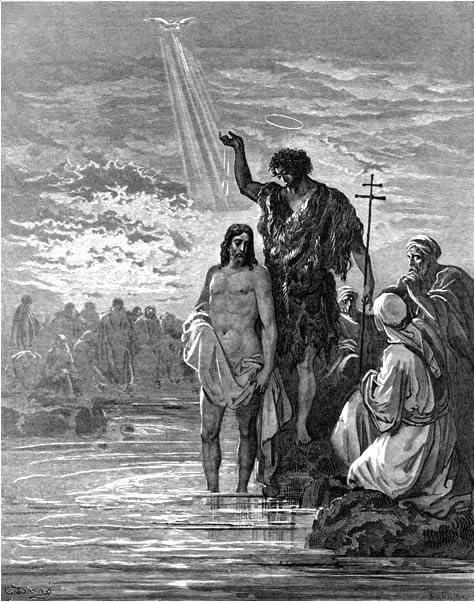
This passage is singularly full of matter. It is a striking instance of that brevity of style, which is the peculiar characteristic of Mark's Gospel. The baptism of our Lord, His temptation in the wilderness, the commencement of his preaching, and the calling of His first disciples are related here in eleven verses. Let us notice, in the first place, the voice from heaven which was heard at our Lord's baptism. We read, "There came a voice from heaven, saying, You are my beloved Son, in whom I am well pleased." That voice was the voice of God the Father.
A commentator
J.C. Ryle1816–1900
Expository Thoughts on the Gospels: Mark (lightly modernized text, Grace Gems edition) (1857)
proposed
This passage is singularly full of matter. It is a striking instance of that brevity of style, which is the peculiar characteristic of Mark's Gospel. The baptism of our Lord, His temptation in the wilderness, the commencement of his preaching, and the calling of His first disciples are related here in eleven verses. Let us notice, in the first place, the voice from heaven which was heard at our Lord's baptism. We read, "There came a voice from heaven, saying, You are my beloved Son, in whom I am well pleased." That voice was the voice of God the Father. It declared the wondrous and ineffable love which has existed between the Father and the Son from all eternity. "The Father loves the Son, and has given all things into His hand." (John 3:35.) It proclaimed the Father's full and complete approbation of Christ's mission to seek and save the lost. It announced the Father's acceptance of the Son as the Mediator, Substitute, and Surety of the new covenant. There is a rich mine of comfort, in these words, for all Christ's believing members. In themselves, and in their own doings, they see nothing to please God. They are daily sensible of weakness, shortcoming, and imperfection in all their ways. But let them recollect that the Father regards them as members of His beloved Son Jesus Christ. He sees no spot in them. (Cant. 4:7.) He beholds them as "in Christ," clothed in His righteousness, and invested with His merit. They are "accepted in the Beloved," and when the holy eye of God looks at them, He is "well pleased." Let us notice, in the second place, the nature of Christ's preaching. We read that he came saying, "Repent, and believe the Gospel." This is that old sermon which all the faithful witnesses of God have continually preached, from the very beginning of the world.
The words behind it
21 Greek wordsEvery Greek word of this verse in the order it stands, with what it means and the door to its own study. The last column counts the times a word stands in the whole Bible: the rarer the word, the more the places it appears belong together.
| Greek | Sound | Meaning | Word study | In the Bible |
|---|---|---|---|---|
| Καὶ | kai | And | G2532 → | 9120 times |
| παράγων | paragon | passing | G3855 → | 10 times |
| παρὰ | para | by | G3844 → | 192 times |
| τὴν | ten | the | G3588 → | 19766 times |
| θάλασσαν | thalassan | Sea | G2281 → | 90 times |
| τῆς | tes | <the> | G3588 → | 19766 times |
| Γαλιλαίας | galilaias | of Galilee | G1056 → | 61 times |
| εἶδεν | eiden | He saw | G1492 → | 374 times |
| Σίμωνα | simona | Simon | G4613 → | 75 times |
| καὶ | kai | and | G2532 → | 9120 times |
| Ἀνδρέαν | andrean | Andrew | G406 → | 13 times |
| τὸν | ton | the | G3588 → | 19766 times |
| ἀδελφὸν | adelphon | brother | G80 → | 343 times |
| Σίμωνος | simonos | of Simon | G4613 → | 75 times |
| ἀμφιβάλλοντας | amphiballontas | net-casting | ||
| ἐν | en | into | G1722 → | 2738 times |
| τῇ | tea | the | G3588 → | 19766 times |
| θαλάσσῃ· | thalasse | sea; | G2281 → | 90 times |
| ἦσαν | esan | they were | G1510 → | 2333 times |
| γὰρ | gar | for | G1063 → | 1039 times |
| ἁλιεῖς. | halieis | fishermen. | G231 → |
ΚαὶAnd
kaiG2532 →9120 times
παράγωνpassing
paragonG3855 →10 times
παρὰby
paraG3844 →192 times
τὴνthe
tenG3588 →19766 times
θάλασσανSea
thalassanG2281 →90 times
τῆς<the>
tesG3588 →19766 times
Γαλιλαίαςof Galilee
galilaiasG1056 →61 times
εἶδενHe saw
eidenG1492 →374 times
ΣίμωναSimon
simonaG4613 →75 times
καὶand
kaiG2532 →9120 times
ἈνδρέανAndrew
andreanG406 →13 times
τὸνthe
tonG3588 →19766 times
ἀδελφὸνbrother
adelphonG80 →343 times
Σίμωνοςof Simon
simonosG4613 →75 times
ἀμφιβάλλονταςnet-casting
amphiballontas
ἐνinto
enG1722 →2738 times
τῇthe
teaG3588 →19766 times
θαλάσσῃ·sea;
thalasseG2281 →90 times
ἦσανthey were
esanG1510 →2333 times
γὰρfor
garG1063 →1039 times
ἁλιεῖς.fishermen.
halieisG231 →
A shaded row is a word that stands 400 times or fewer in the Bible.
The walk
8 stopsEach card is a verse this one points to, and under it the verses that one points to in turn. Where several paths arrive at the same place, that place is listed first: the text keeps returning to it.
Through
Acts 1:13When they arrived, they went to the upper room where they were staying: Peter and John, James and Andrew, Philip and Thomas, Bartholomew and Matthew, James son of Alphaeus, Simon the Zealot, and Judas…
it leads to
- Acts 20:8
Now there were many lamps in the upper room where we were gathered.
- Luke 22:12
And he will show you a large upper room, already furnished. Make preparations there.”
- Mark 14:15
And he will show you a large upper room, furnished and ready. Make preparations for us there.”
- Mark 2:14
As He was walking along, He saw Levi son of Alphaeus sitting at the tax booth. “Follow Me,” He told him, and Levi got up and followed Him.
- Matthew 10:2–4
These are the names of the twelve apostles: first Simon, called Peter, and his brother Andrew; James son of Zebedee, and his brother John;
- Acts 20:8
Through
Luke 6:14Simon, whom He named Peter, and his brother Andrew; James and John; Philip and Bartholomew;
it leads to
- Matthew 4:18
As Jesus was walking beside the Sea of Galilee, He saw two brothers, Simon called Peter and his brother Andrew. They were casting a net into the sea, for they were fishermen.
Reached by 2 separate paths from here.
- Acts 1:13
When they arrived, they went to the upper room where they were staying: Peter and John, James and Andrew, Philip and Thomas, Bartholomew and Matthew, James son of Alphaeus, Simon the Zealot, and Judas…
- Matthew 4:21
Going on from there, He saw two other brothers, James son of Zebedee and his brother John. They were in a boat with their father Zebedee, mending their nets. Jesus called them,
- Matthew 4:18
Where this verse is studied
On this page
About Mark
Who and where
1 name in this verse with a page on the site.
This page draws on 12 works. Open the list of works
This page draws on Adam Clarke, Commentary on the Bible; Bede, Catena Aurea by Aquinas; Bede, On the Gospel of Mark; Eusebius of Caesarea, The Proof of the Gospel, Book 3; Glossa Ordinaria, Catena Aurea by Aquinas; J. C. Ryle, Expository Thoughts on the Gospels, Mark; J.C. Ryle, Expository Thoughts on the Gospels: Mark (lightly modernized text, Grace Gems edition); John Gill, Exposition of the New Testament (1746-1748); Matthew Henry, Commentary on the Whole Bible; Pseudo-Jerome, Catena Aurea by Aquinas; Theophylact of Ohrid, Commentary on Mark and Theophylact of Ohrid, Catena Aurea by Aquinas.