
Mark 1:9
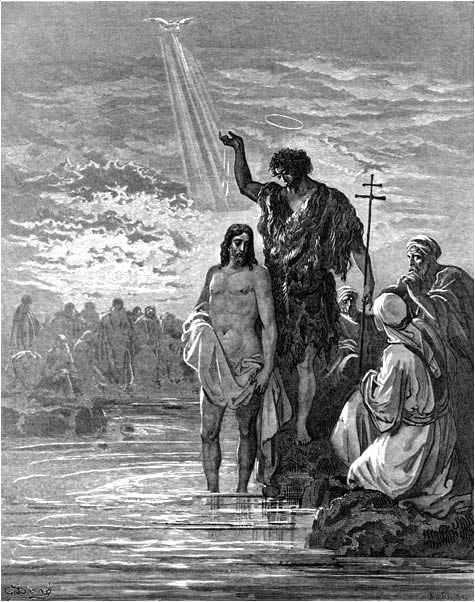
in Mark 1In those days Jesus came from Nazareth in Galilee and was baptized by John in the Jordan.
BSB
The same verse in ASV and KJV ▾
ASV
And it came to pass in those days, that Jesus came from Nazareth of Galilee, and was baptized of John in the Jordan.
KJV
And it came to pass in those days, that Jesus came from Nazareth of Galilee, and was baptized of John in Jordan.
⋯
This verse in Mark 1
Commentary
13 notes on this verseAs man he was baptized, but he absolved sins as God. He needed no purifying rites himself—his purpose was to hallow water.
This site's exposition
Jesus came from Nazareth in Galilee
In those days Jesus came from Nazareth in Galilee, a walk of roughly seventy miles to the Jordan, for a baptism He did not need. Mark states the fact in one line, that He was baptized by John in the Jordan, while Matthew also records the hesitation of John.
The record, by era
The Church Fathers2 voices
In fact, they say that Jesus Christ descended, that is, that the dove came down on Jesus; and, since the dove is styled by the Greek name peristera/-(peristera), it has in itself this number DCCCI.
(Vict. Ant. e Cat. in Marc.) Forasmuch as He was ordaining a new baptism, He came to the baptism of John, which, in respect of His own baptism, was incomplete, but different from the Jewish baptism, as being between both. He did this that He might show, by the nature of His baptism, that He was not baptized for the remission of sins, nor as wanting the reception of the Holy Ghost: for the baptism of John was destitute of both these. But He was baptized that He might be made known to all, that they might believe on Him and fulfil all righteousness, which is keeping of the commandments: for it had been commanded to men that they should submit to the Prophet's baptism.
The Medieval Church3 voices
And it came to pass in those days, etc. The Savior received baptism from John for three reasons. First, because He was born a man, He might fulfill all righteousness and humility of the law. Second, that by His baptism He might approve the baptism …
(in Marc. i. 4) He was baptized, that by being baptized Himself He might show His approval of John's baptisme, and that, by sanctifying the waters of Jordan through the descent of the dove, He might show the coming of the Holy Ghost in the laver of believers.
Morally also it may be interpreted; we also, drawn aside from the fleeting world by the smell and purity of flowers, run with the young maidens after the bridegroom, (v. Cant. 1:2. 3.) and are washed in the sacrament of baptism, from the two fountains of the love of God, and of our neighbour, by the grace of remission, and mounting up by hope gaze upon heavenly mysteries with the eyes of a clean heart. Then we receive in a contrite and lowly spirit, with simplicity of heart, the Holy Spirit, who comes down to the meek, and abides in us, by a never-failing charity. And the voice of the Lord from heaven is directed to us the beloved of God; Blessed are the peacemakers, for they shall be called the sons of God; (Matt. 5:9) and then the Father, with the Son and the Holy Spirit, is well-pleased with us, when we are made one spirit with God.
6 more voices on this verse
The Medieval Church2 voices
Mark the Evangelist, like a hart, longing after the fountains of water, leaps forward over places, smooth and steep; and, as a bee laden with honey, he sips the tops of the flowers. Wherefore he hath shown us in his narrative Jesus coming from Nazareth, saying, And it came to pass in those days, &c.
Jesus does not come to baptism for the remission of sins, for He committed no sin, nor for the receiving of the Holy Spirit, for how could John's baptism bestow the Spirit when it did not cleanse sins, as I have said? Nor does He …
The Puritans and the Awakening1 voice
And it came to pass in those days,....
The Nineteenth Century3 voices
A commentator
J.C. Ryle1816–1900
Expository Thoughts on the Gospels: Mark (lightly modernized text, Grace Gems edition) (1857)
This passage is singularly full of matter. It is a striking instance of that brevity of style, which is the peculiar characteristic of Mark's Gospel. The baptism of our Lord, His temptation in the wilderness, the commencement of his preaching, and the calling of His first disciples are related here in eleven verses. Let us notice, in the first place, the voice from heaven which was heard at our Lord's baptism. We read, "There came a voice from heaven, saying, You are my beloved Son, in whom I am well pleased." That voice was the voice of God the Father.
A commentator
J.C. Ryle1816–1900
Expository Thoughts on the Gospels: Mark (lightly modernized text, Grace Gems edition) (1857)
proposed
This passage is singularly full of matter. It is a striking instance of that brevity of style, which is the peculiar characteristic of Mark's Gospel. The baptism of our Lord, His temptation in the wilderness, the commencement of his preaching, and the calling of His first disciples are related here in eleven verses. Let us notice, in the first place, the voice from heaven which was heard at our Lord's baptism. We read, "There came a voice from heaven, saying, You are my beloved Son, in whom I am well pleased." That voice was the voice of God the Father. It declared the wondrous and ineffable love which has existed between the Father and the Son from all eternity. "The Father loves the Son, and has given all things into His hand." (John 3:35.) It proclaimed the Father's full and complete approbation of Christ's mission to seek and save the lost. It announced the Father's acceptance of the Son as the Mediator, Substitute, and Surety of the new covenant. There is a rich mine of comfort, in these words, for all Christ's believing members. In themselves, and in their own doings, they see nothing to please God. They are daily sensible of weakness, shortcoming, and imperfection in all their ways. But let them recollect that the Father regards them as members of His beloved Son Jesus Christ. He sees no spot in them. (Cant. 4:7.) He beholds them as "in Christ," clothed in His righteousness, and invested with His merit. They are "accepted in the Beloved," and when the holy eye of God looks at them, He is "well pleased." Let us notice, in the second place, the nature of Christ's preaching. We read that he came saying, "Repent, and believe the Gospel." This is that old sermon which all the faithful witnesses of God have continually preached, from the very beginning of the world.
See the subject of these verses which contain the account of our Lord’s baptism, explained. Mat 3:13-17 (note).
The words behind it
19 Greek wordsEvery Greek word of this verse in the order it stands, with what it means and the door to its own study. The last column counts the times a word stands in the whole Bible: the rarer the word, the more the places it appears belong together.
| Greek | Sound | Meaning | Word study | In the Bible |
|---|---|---|---|---|
| Καὶ | kai | And | G2532 → | 9120 times |
| ἐγένετο | egeneto | it came to pass | G1096 → | 667 times |
| ἐν | en | in | G1722 → | 2738 times |
| ἐκείναις | ekeinais | those | G1565 → | 260 times |
| ταῖς | tais | <the> | G3588 → | 19766 times |
| ἡμέραις | hemerais | days | G2250 → | 389 times |
| ἦλθεν | elthen | [that] came | G2064 → | 628 times |
| Ἰησοῦς | iesous | Jesus | G2424 → | 908 times |
| ἀπὸ | apo | from | G575 → | 640 times |
| Ναζαρὲτ | nazaret | Nazareth | G3478 → | |
| τῆς | tes | <the> | G3588 → | 19766 times |
| Γαλιλαίας | galilaias | of Galilee | G1056 → | 61 times |
| καὶ | kai | and | G2532 → | 9120 times |
| ἐβαπτίσθη | ebaptisthe | was baptized | G907 → | 76 times |
| εἰς | eis | in | G1519 → | 1755 times |
| τὸν | ton | the | G3588 → | 19766 times |
| Ἰορδάνην | iordanen | Jordan | G2446 → | 15 times |
| ὑπὸ | hupo | by | G5259 → | 219 times |
| Ἰωάννου. | ioannou | John. | G2491 → | 134 times |
ΚαὶAnd
kaiG2532 →9120 times
ἐγένετοit came to pass
egenetoG1096 →667 times
ἐνin
enG1722 →2738 times
ἐκείναιςthose
ekeinaisG1565 →260 times
ταῖς<the>
taisG3588 →19766 times
ἡμέραιςdays
hemeraisG2250 →389 times
ἦλθεν[that] came
elthenG2064 →628 times
ἸησοῦςJesus
iesousG2424 →908 times
ἀπὸfrom
apoG575 →640 times
ΝαζαρὲτNazareth
nazaretG3478 →
τῆς<the>
tesG3588 →19766 times
Γαλιλαίαςof Galilee
galilaiasG1056 →61 times
καὶand
kaiG2532 →9120 times
ἐβαπτίσθηwas baptized
ebaptistheG907 →76 times
εἰςin
eisG1519 →1755 times
τὸνthe
tonG3588 →19766 times
ἸορδάνηνJordan
iordanenG2446 →15 times
ὑπὸby
hupoG5259 →219 times
Ἰωάννου.John.
ioannouG2491 →134 times
A shaded row is a word that stands 400 times or fewer in the Bible.
The walk
5 stopsEach card is a verse this one points to, and under it the verses that one points to in turn. Where several paths arrive at the same place, that place is listed first: the text keeps returning to it.
Through
Matthew 2:23and he went and lived in a town called Nazareth. So was fulfilled what was spoken through the prophets: “He will be called a Nazarene.”
it leads to
- Judges 13:5
For behold, you will conceive and give birth to a son. And no razor shall come over his head, because the boy will be a Nazirite to God from the womb, and he will…
- John 1:45–46
Philip found Nathanael and told him, “We have found the One Moses wrote about in the Law, the One the prophets foretold—Jesus of Nazareth, the son of Joseph.”
- Mark 1:24
“What do You want with us, Jesus of Nazareth? Have You come to destroy us? I know who You are—the Holy One of God!”
- Acts 24:5
We have found this man to be a pestilence, stirring up dissension among the Jews all over the world. He is a ringleader of the sect of the Nazarenes,
- Luke 2:39
When Jesus’ parents had done everything required by the Law of the Lord, they returned to Galilee, to their own town of Nazareth.
- Judges 13:5
Where this verse is studied
On this page
Studies22
On this verse
On this chapter
Show the next 6 titles
What the record shows
1 entry- Jesus of Nazareth — attested outside the Biblewell-supported
Tacitus Annals 15.44; Josephus Ant. 18.3.3 (Testimonium, partial interpolation) and 20.9.1 (James passage, widely accepted); Pliny Ep. 10.96
Biblical figure (Jewish teacher, crucified under Pilate, ca. 4 BC-AD 30/33) identified in extra-biblical epigraphy.
Counterpoint: None of these is an inscription — they are Roman and Jewish writings from decades after the events. Nearly all scholars hold that Josephus's fuller passage about Jesus was reworked by later Christian copyists (a minority, such as Ken Olson, argue it is wholly Christian in origin), and critics note that Tacitus may be repeating what Christians of his day said rather than consulting Roman records.
About Mark
Who and where
1 name in this verse with a page on the site.
This page draws on 12 works. Open the list of works
This page draws on Adam Clarke, Commentary on the Bible; Bede, On the Gospel of Mark; Bede, Catena Aurea by Aquinas; Gregory of Nazianzus, ORATION 29, ON THE SON; J.C. Ryle, Expository Thoughts on the Gospels: Mark (lightly modernized text, Grace Gems edition); John Calvin, Commentary on a Harmony of the Evangelists; John Gill, Exposition of the New Testament (1746-1748); Matthew Henry, Commentary on the Whole Bible; Pseudo-Chrysostom, Catena Aurea by Aquinas; Pseudo-Jerome, Catena Aurea by Aquinas; Tertullian, Pseudo-Tertullian Against All Heresies and Theophylact of Ohrid, Commentary on Mark.