
Mark 1:20
in Mark 1Immediately Jesus called them, and they left their father Zebedee in the boat with the hired men and followed Him.
BSB
The same verse in ASV and KJV ▾
ASV
And straightway he called them: and they left their father Zebedee in the boat with the hired servants, and went after him.
KJV
And straightway he called them: and they left their father Zebedee in the ship with the hired servants, and went after him.
⋯
This verse in Mark 1
Commentary
13 notes on this verseThere must have been something divinely compelling in the face of the Savior. Otherwise they would not have acted so irrationally as to follow a man whom they had never seen before. Does one leave a father to follow a man in whom he sees nothing more than he sees in his father? They left their father of the flesh to follow the Father of the spirit. They did not leave a father; they found a Father. What is the point of this digression?
This site's exposition
he saw James the son of Zebedee
on Mark 1:19-20
James and John are found mending nets, ordinary maintenance work, and the call costs them more visibly than Simon and Andrew, since they leave their father Zebedee in the boat with the hired servants. The detail of hired servants tells the bench this was a family business substantial enough to employ help, so the sacrifice is measured, not poverty walking away from nothing. Jesus later surnames these two Boanerges, sons of thunder, at 3:17, and the exposition marks the seed of that name being planted here in the boat they left.
The record, by era
The Church Fathers1 voice
A beginning is made by detaching oneself from all external goods: property, selfimportance, social class and useless desire, following the holy example of the Lord's disciples. James and John left their father Zebedee and the very boat upon which their whole livelihood depended. Matthew left his counting house and followed the Lord, not merely leaving behind the profits of his occupation, but also paying no heed to the dangers which were sure to befall both himself and his family at the hands of the magistrates because he had left the tax accounts unfinished. Paul speaks of the whole world being crucified to him, and he to the world. Thus, those who are strongly seized with the desire of following Christ can no longer be concerned with anything pertaining to this life, not even with the love of their parents or other relatives insofar as this runs counter to the calling of the Lord. The Long Rules, Question
The Medieval Church4 voices
We must know also, that action is first called, then contemplation; for Peter is the type of the active life, for he was more ardent than the others, just as the active life is the more bustling; but John is the type of the contemplative life, for he speaks more fully of divine things.
But they left their father, because he would have hindered them in following Christ. Do thou, also, when thou art hindered by thy parents, leave them, and come to God. It is shown by this that Zebedee was not a believer; but the mother of the Apostles believed, for she followed Christ, when Zebedee was dead.
You have heard, dearest brothers, that at the voice of a single command, Peter and Andrew, leaving their nets, followed the Redeemer. They had seen him perform no miracles yet, they had heard nothing from him about the reward of eternal recompense; and yet at one command of the Lord they forgot what they seemed to possess. How many of his miracles do we see, with how many scourges are we afflicted, by how many harsh threats are we deterred, and yet we disdain to follow him when he calls? He who admonishes us about conversion already sits in heaven; he has already subjected the necks of the nations to the yoke of faith, he has already laid low the glory of the world, he already announces, as its ruins multiply, that the day of his strict judgment draws near; and yet our proud mind does not wish to abandon willingly what it loses daily against its will. What then, dearest ones, what shall we say at his judgment, we who are neither bent by commands nor corrected by blows from the love of the present age? But perhaps someone may say to himself in silent thoughts: At the Lord's voice, what or how much did each of these fishermen leave behind, who had almost nothing? But in this matter, dearest brothers, we ought to weigh the affection rather than the wealth. He left much who retained nothing for himself; he left much who, however little it was, abandoned everything. Certainly we both possess what we have with love, and seek from desire those things we do not have at all. Therefore Peter and Andrew left much, since each also abandoned the desires of having. He left much who renounced his longings along with the thing he possessed. Therefore those who followed gave up as much as could be desired by those who did not follow.
(ubi sup.) It may be asked, how he could call two fishers from each of the boats, (first, Peter and Andrew, then having gone a little further, the two others, sons of Zebedee,) when Luke says that James and John were called to help Peter and Andrew, and that it was to Peter only that Christ said, Fear not, from this time thou shalt catch men; (Luke 5:10) he also says, that at the same time, when they had brought their ships to land, they followed him. We must therefore understand that that transaction which Luke intimates happened first, and afterwards that they, as their custom was, had returned to their fishing. So that what Mark here relates happened afterwards; for in this case they followed the Lord, without drawing their boats ashore, (which they would have done had they meant to return,) and followed Him, as one calling them, and ordering them to follow.
6 more voices on this verse
The Medieval Church2 voices
After these He catches James and John. And these, although they themselves were poor, nevertheless supported their aged father. But they did not leave their father because abandoning parents is a good thing, but because he wanted to hinder them from following the Lord. So …
Further, we are mystically carried away to heaven, like Elias, by this chariot, drawn by these fishers, as by four horses. On these four corner-stones the first Church is built; in these, as in the four Hebrew letters, (יהוה) we acknowledge the tetragrammaton, the name of the Lord, we who are commanded, after their example, to hear the voice of the Lord, and to forget (Ps. 45:11) the people of wickedness, and the house of our fathers' conversation, which is folly before God, and the spider's net, in the meshes of which we, like gnats, were all but fallen, and were confined by things vain as the air, which hangs on nothing; loathing also the ship of our former walk. For Adam, our forefather according to the flesh, is clothed with the skins of dead beasts; but now, having put off the old man, with his deeds, following the new man we are clothed with those skins of Solomon, with which the bride rejoices that she has been made beautiful. (Cant. 1:4. Vulg.) Again, Simon, means obedient; Andrew, manly; James, supplanter;f John, grace; by which four names, we are knit together into God's host;g by obedience, that we may listen; by manliness, that we do battle; by overthrowing, that we may persevere; by grace, that we may be preserved. (supplantatione) Which four virtues are called cardinal; for by prudence, we obey; by justice, we bear ourselves manfully; by temperance, we tread the serpent underfoot; by fortitude, we earn the grace of God.
The Puritans and the Awakening2 voices
And straightway he called them,.... As soon as he saw them; for he was looking out for them, having appointed them long before to the service he now called them to; and they left their father Zebedee with the hired servants, and went after him.
But Christ taught as one that had authority, as one that knew the mind of God, and was commissioned to declare it. There is much in the doctrine of Christ, that is astonishing; the more we hear it, the more cause we shall see to admire it.
The Nineteenth Century2 voices
A commentator
J.C. Ryle1816–1900
Expository Thoughts on the Gospels: Mark (lightly modernized text, Grace Gems edition) (1857)
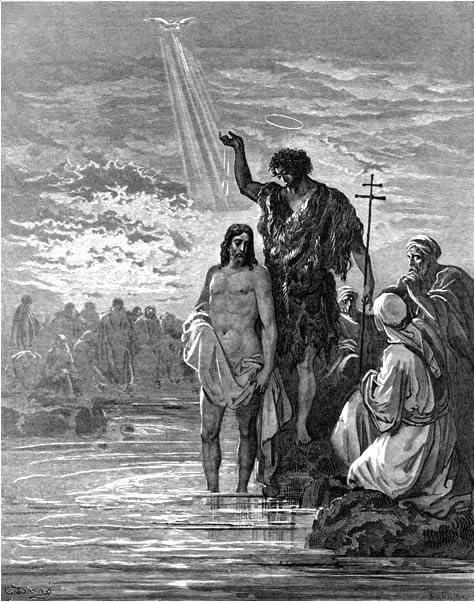
This passage is singularly full of matter. It is a striking instance of that brevity of style, which is the peculiar characteristic of Mark's Gospel. The baptism of our Lord, His temptation in the wilderness, the commencement of his preaching, and the calling of His first disciples are related here in eleven verses. Let us notice, in the first place, the voice from heaven which was heard at our Lord's baptism. We read, "There came a voice from heaven, saying, You are my beloved Son, in whom I am well pleased." That voice was the voice of God the Father.
A commentator
J.C. Ryle1816–1900
Expository Thoughts on the Gospels: Mark (lightly modernized text, Grace Gems edition) (1857)
proposed
This passage is singularly full of matter. It is a striking instance of that brevity of style, which is the peculiar characteristic of Mark's Gospel. The baptism of our Lord, His temptation in the wilderness, the commencement of his preaching, and the calling of His first disciples are related here in eleven verses. Let us notice, in the first place, the voice from heaven which was heard at our Lord's baptism. We read, "There came a voice from heaven, saying, You are my beloved Son, in whom I am well pleased." That voice was the voice of God the Father. It declared the wondrous and ineffable love which has existed between the Father and the Son from all eternity. "The Father loves the Son, and has given all things into His hand." (John 3:35.) It proclaimed the Father's full and complete approbation of Christ's mission to seek and save the lost. It announced the Father's acceptance of the Son as the Mediator, Substitute, and Surety of the new covenant. There is a rich mine of comfort, in these words, for all Christ's believing members. In themselves, and in their own doings, they see nothing to please God. They are daily sensible of weakness, shortcoming, and imperfection in all their ways. But let them recollect that the Father regards them as members of His beloved Son Jesus Christ. He sees no spot in them. (Cant. 4:7.) He beholds them as "in Christ," clothed in His righteousness, and invested with His merit. They are "accepted in the Beloved," and when the holy eye of God looks at them, He is "well pleased." Let us notice, in the second place, the nature of Christ's preaching. We read that he came saying, "Repent, and believe the Gospel." This is that old sermon which all the faithful witnesses of God have continually preached, from the very beginning of the world.
The words behind it
19 Greek wordsEvery Greek word of this verse in the order it stands, with what it means and the door to its own study. The last column counts the times a word stands in the whole Bible: the rarer the word, the more the places it appears belong together.
| Greek | Sound | Meaning | Word study | In the Bible |
|---|---|---|---|---|
| καὶ | kai | And | G2532 → | 9120 times |
| εὐθὺς | euthus | immediately | G2112 → | 87 times |
| ἐκάλεσεν | ekalesen | He called | G2564 → | 147 times |
| αὐτούς. | autous | them. | G846 → | 5565 times |
| καὶ | kai | and | G2532 → | 9120 times |
| ἀφέντες | aphentes | having left | G863 → | 143 times |
| τὸν | ton | the | G3588 → | 19766 times |
| πατέρα | patera | father | G3962 → | 410 times |
| αὐτῶν | auton | of them | G846 → | 5565 times |
| Ζεβεδαῖον | zebedaion | Zebedee | G2199 → | 12 times |
| ἐν | en | in | G1722 → | 2738 times |
| τῷ | to | the | G3588 → | 19766 times |
| πλοίῳ | ploio | boat | G4143 → | 67 times |
| μετὰ | meta | with | G3326 → | 461 times |
| τῶν | ton | the | G3588 → | 19766 times |
| μισθωτῶν | misthoton | hired servants | G3411 → | |
| ἀπῆλθον | apelthon | they went away | G565 → | 115 times |
| ὀπίσω | opiso | after | G3694 → | 35 times |
| αὐτοῦ.¶ | autou | Him. | G846 → | 5565 times |
καὶAnd
kaiG2532 →9120 times
εὐθὺςimmediately
euthusG2112 →87 times
ἐκάλεσενHe called
ekalesenG2564 →147 times
αὐτούς.them.
autousG846 →5565 times
καὶand
kaiG2532 →9120 times
ἀφέντεςhaving left
aphentesG863 →143 times
τὸνthe
tonG3588 →19766 times
πατέραfather
pateraG3962 →410 times
αὐτῶνof them
autonG846 →5565 times
ΖεβεδαῖονZebedee
zebedaionG2199 →12 times
ἐνin
enG1722 →2738 times
τῷthe
toG3588 →19766 times
πλοίῳboat
ploioG4143 →67 times
μετὰwith
metaG3326 →461 times
τῶνthe
tonG3588 →19766 times
μισθωτῶνhired servants
misthotonG3411 →
ἀπῆλθονthey went away
apelthonG565 →115 times
ὀπίσωafter
opisoG3694 →35 times
αὐτοῦ.¶Him.
autouG846 →5565 times
A shaded row is a word that stands 400 times or fewer in the Bible.
The walk
8 stopsEach card is a verse this one points to, and under it the verses that one points to in turn. Where several paths arrive at the same place, that place is listed first: the text keeps returning to it.
Through
Luke 14:26“If anyone comes to Me and does not hate his father and mother and wife and children and brothers and sisters—yes, even his own life—he cannot be My disciple.
it leads to
- Matthew 10:37
Anyone who loves his father or mother more than Me is not worthy of Me; anyone who loves his son or daughter more than Me is not worthy of Me;
- John 12:25
Whoever loves his life will lose it, but whoever hates his life in this world will keep it for eternal life.
- Philippians 3:8
More than that, I count all things as loss compared to the surpassing excellence of knowing Christ Jesus my Lord, for whom I have lost all things. I consider them rubbish, that I may…
- Acts 20:24
But I consider my life of no value to me, if only I may finish my course and complete the ministry I have received from the Lord Jesus—the ministry of testifying to the good…
- Psalms 73:25–26
Whom have I in heaven but You? And on earth I desire no one besides You.
- Matthew 10:37
Through
Matthew 10:37Anyone who loves his father or mother more than Me is not worthy of Me; anyone who loves his son or daughter more than Me is not worthy of Me;
it leads to
- Luke 14:26
“If anyone comes to Me and does not hate his father and mother and wife and children and brothers and sisters—yes, even his own life—he cannot be My disciple.
- Matthew 22:37
Jesus declared, “‘Love the Lord your God with all your heart and with all your soul and with all your mind.’
- Philippians 3:7–9
But whatever was gain to me I count as loss for the sake of Christ.
- Luke 14:26
Where this verse is studied
On this page
About Mark
This page draws on 12 works. Open the list of works
This page draws on Adam Clarke, Commentary on the Bible; Basil of Caesarea, Commentary (church-history corpus); Bede, Catena Aurea by Aquinas; Gregory the Dialogist, Forty Gospel Homilies, Homily 5; J.C. Ryle, Expository Thoughts on the Gospels: Mark (lightly modernized text, Grace Gems edition); Jamieson, Fausset & Brown, Commentary Critical and Explanatory on the Whole Bible; Jerome, Commentary (church-history corpus); John Gill, Exposition of the New Testament (1746-1748); Matthew Henry, Commentary on the Whole Bible; Pseudo-Jerome, Catena Aurea by Aquinas; Theophylact of Ohrid, Catena Aurea by Aquinas and Theophylact of Ohrid, Commentary on Mark.