
The Gospel of Action · Mark
The Servant Who Acts
Mark spends sixteen chapters earning his own opening line. He asserts it at the top — the Son of God — and then makes you watch Jesus prove it: over demons, disease, storm and death, at a pace so relentless the narrative barely breathes. Everyone keeps asking who then is this? And the first human being to answer correctly is not a disciple but the Roman executioner who watches how he dies — because this King reigns by giving his life a ransom for many.
The Sprint
— sixteen chapters drawn to scale — the brackets over the top, the hinge in the middleGalilee — the Servant revealed
The Way — the turn
Jerusalem — the Servant suffers
The empty tomb
Galilee — the Servant revealed
Mark 1:14–8:26
Authority in motion: the kingdom proclaimed, four fishermen called, a day in Capernaum, five controversies that end in a death-plot, the parables, and four authorities — storm, Legion, hemorrhage, death.
The Way — the turn
Mark 8:27–10:52
Bracketed by the only two blindness-healings in Mark. Peter's confession, then three passion predictions, each fuller, each met with incomprehension — and the ransom saying at the end of the road.
Jerusalem — the Servant suffers
Mark 11:1–15:47
Nearly forty per cent of the book is this final week: the entry, the temple, the Olivet Discourse, the Supper, Gethsemane, the trials, the denial, the cross, the torn veil, the centurion.
The empty tomb
Mark 16:1–8
'He is risen; he is not here' — and then the oldest text stops, mid-sentence, on three frightened women. The longer ending has its own page.
The thesis line: the gospel of Jesus Christ, the Son of God.
Mark 1:10The heavens torn open at the baptism — schizō, the violent verb.
Mark 8:29'Thou art the Christ' — the hinge, and instantly redefined.
Mark 10:45A ransom for many — the theological centre of the book.
Mark 14:62'I am' — under oath, the Danielic Son of man, and the verdict.
Mark 15:38The veil torn from top to bottom — the bracket closes.
Mark 15:39'Truly this man was the Son of God' — a Gentile soldier, at last.
Mark 16:6'He is risen; he is not here.'
The Pulse
— euthys — the word that will not let the Gospel sit downεὐθύς
euthys
"Immediately, straightway." Forty-three occurrences across sixteen chapters, counting its cognate adverb eutheōs— verified against the Greek floor. No other New Testament writer uses it like this. Mark's plain, strung-together Greek (and… and… and) plus this one adverb is what gives the book its running pulse.
The word study — g2117 →These are the occurrences named in the MannaFest verse-by-verse analysis of Mark, not the complete list — the full concordance sits on the word page. Note where they cluster: the Greek floor counts twelve in chapter 1 alone, which is exactly how the Gospel feels when you read it in one sitting. A second cognate adverb, eutheōs (g2112), carries the same sense and is counted with it.
The Hinge
— 8:27–33 — where the Gospel turns and faces JerusalemThe question the whole book has been asking
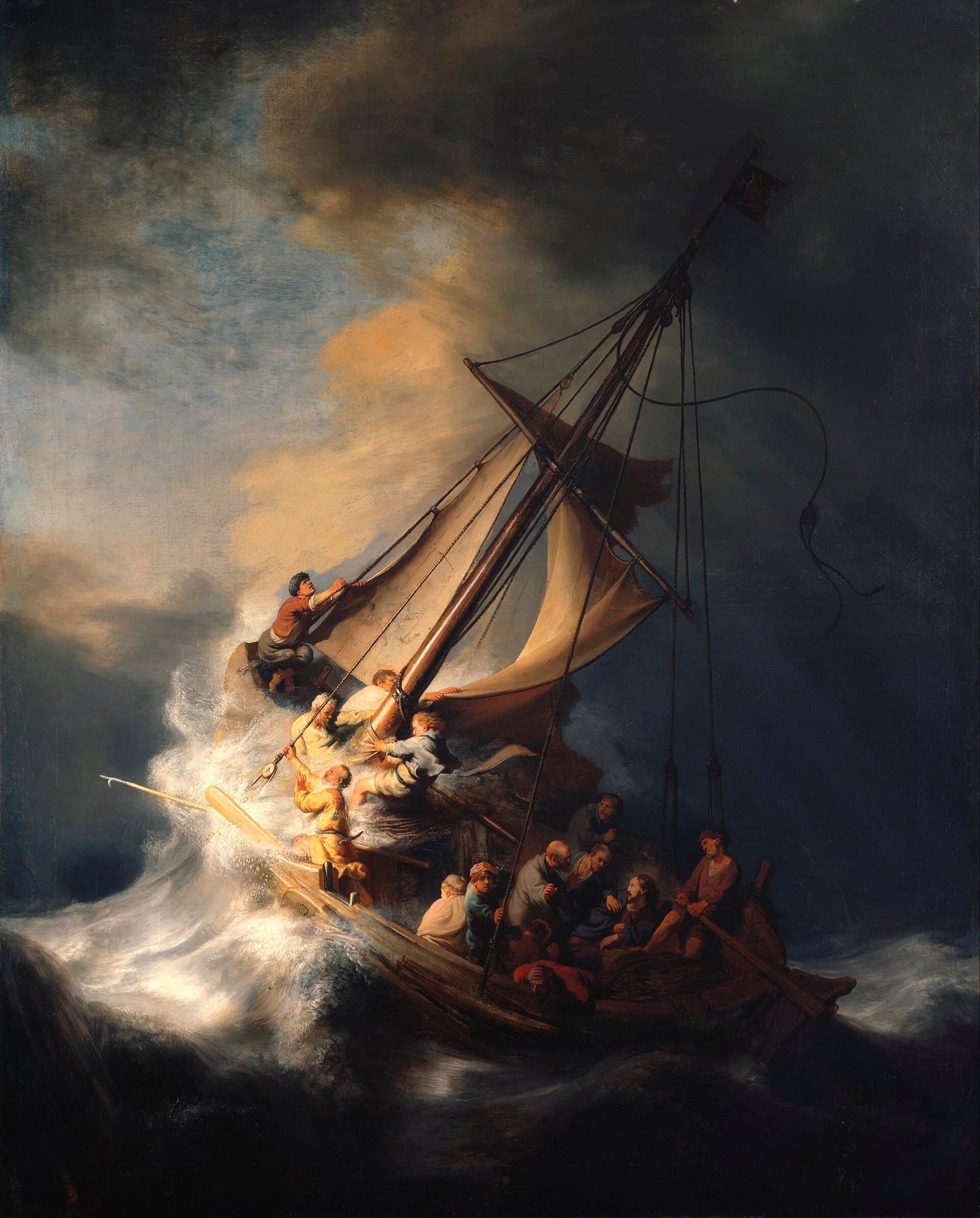
"Who then is this, that even the wind and the sea obey him?"
— Mark 4:41 (ASV)
For eight chapters the crowd asks it, the disciples ask it, Herod's court speculates about it, and only the demons answer accurately. Then, at the exact centre of the book, under the shadow of a pagan cult-centre at Caesarea Philippi, Jesus asks it himself — and Peter gets it right.
And the answer is instantly redefined
"Thou art the Christ."
— Mark 8:29 (ASV)
The confession is true. It is also, in Peter's mouth, dangerously incomplete — so Jesus charges them to tell no one and immediately begins to teach that the Son of man must suffer, be killed, and after three days rise again. Peter rebukes him for it. From that verse on, the road runs one way.
Rejected by the elders, chief priests and scribes; killed; after three days rise. Peter rebukes him — and is called Satan for it.
Delivered into the hands of men. They do not understand and are afraid to ask — then argue about which of them is greatest.
The fullest: Jerusalem, the Gentiles, mocking, spitting, scourging, death. James and John respond by asking for the two best thrones.
Mark's only two blindness-healings sit at the two ends of this middle section, and they are not there by accident. At 8:22–26 a man at Bethsaida receives his sight in two stages — men like trees, walking, and then clearly. At 10:46–52 blind Bartimaeus is healed at once and follows him in the way. Between the two, the disciples see who Jesus is — and then see it properly. The frame is an acted parable of the reader's own progress.
Christ in Mark
— Daniel's enthroned Son of man and Isaiah's crushed Servant, fused onto one JesusMark isthe Christ-connection — the book has no other subject. Its distinctive contribution to the canon's testimony is that it holds two Old Testament figures together in one person: the coming, enthroned Son of man of Daniel 7 and the Servant of Isaiah 53 who is crushed for the many. Authority and suffering, refusing to be separated.
- 01Mark 1:1
the gospel of Jesus Christ, the Son of God — the claim, stated before it is earned
- 02Mark 1:11
the Father's own voice through the torn heavens: 'Thou art my beloved Son'
- 03Mark 2:10
authority on earth to forgive sins — a prerogative the scribes rightly reserve to God
- 04Mark 3:27
the strong man bound and his house plundered — the exorcisms as spoils of a war already won
- 05Mark 4:39
'Peace, be still' — what the Old Testament reserves to YHWH alone (Ps 89:9; 107:29)
- 06Mark 8:29
'Thou art the Christ' — true, and immediately corrected toward the cross
- 07Mark 9:7
the voice again, on the mountain: 'This is my beloved Son: hear ye him'
- 08Mark 10:45
a ransom for many — Isaiah's Servant and Daniel's Son of man fused in one sentence
- 09Mark 14:24
his blood of the covenant, poured out for many (cf. Exo 24:8; Jer 31:31–34)
- 10Mark 14:62
'I am' — the enthroned, coming Son of man of Daniel 7, and the blasphemy verdict
- 11Mark 15:38
the veil torn from the top downward — access secured by the death, not by the worshipper
- 12Mark 15:39
'Truly this man was the Son of God' — the inclusio closes in a Gentile mouth
- 13Mark 16:6
'He is risen; he is not here' — the sign of Jonah, kept
The Markan Sandwich
— intercalation — one story split open, another inserted, each interpreting the otherHis own family set out to seize him — 'He is beside himself'
BThe scribes charge him with casting out demons by Beelzebul
A′'Who is my mother and my brethren?' — the true family is whoever does God's will
Two verdicts on the same man, laid side by side: madness and demonic collusion. The insert names the real family line — obedience, not blood.
Jairus, a synagogue ruler, begs for his dying twelve-year-old
BA woman twelve years unclean touches him in the crowd and is healed
A′The girl is dead — 'Talitha cumi' — and she rises
Twelve years of life and twelve years of bleeding; the top of the social order and the bottom of it. Faith reaches him from both ends, and death is treated as sleep.
The Twelve are sent out two by two with authority
BHerod's birthday feast, and John the Baptist beheaded
A′The Twelve return and report everything
The cost of the errand is inserted into the errand. Mark tells you what happens to God's messengers before he tells you the mission went well.
A fig tree in leaf, but fruitless, is cursed
BThe temple is cleansed — 'a house of prayer for all the nations'
A′The next morning the fig tree is withered from the roots
The withered tree is Mark's verdict on the temple: full foliage, no fruit, and the sentence already passed.
The chief priests look for a way to take him by craft
BA woman breaks an alabaster flask over his head at Bethany
A′Judas goes to the chief priests to betray him for money
Extravagance and calculation, framed against each other. One pours out a year's wages; the other prices the Lord.
Peter follows at a distance into the high priest's courtyard
BJesus, before the Sanhedrin, confesses who he is under oath
A′Peter, before a servant girl, denies that he knows him
The two trials run at once, one floor apart: the Master confesses at the cost of his life; the disciple denies to save his.
Original Language
— five keynote words, and the Aramaic Mark refused to translate awayTalitha cumi
Mark 5:41
'Damsel, arise' — spoken over a dead twelve-year-old
Ephphatha
Mark 7:34
'Be opened' — over a deaf man with an impeded tongue
Abba
Mark 14:36
'Father' — in Gethsemane, the most intimate address in the Gospel
Eloi, Eloi, lama sabachthani
Mark 15:34
'My God, my God, why hast thou forsaken me?' — Psalm 22:1 from the cross
Mark writes for Rome: he translates every Aramaic phrase, explains Jewish custom for outsiders (7:3–4), and carries Latin loanwords straight into his Greek — kentyriōn (centurion, 15:39), legiōn (5:9), dēnarion, speira (the cohort, 15:16). But he keeps the Aramaic first and then renders it — the fingerprint of someone repeating words he actually heard.
The Voices
— the founder's roster on this book — Marcus Brown's own commentary leads above allhis own commentary on Mark — reserved
The founder's voice leads above every entry below. This slot stays open until he fills it; everything else on this page is raw material compiled for that purpose.
Expository Thoughts on the Gospels: Mark (1857, public domain)
The closest public-domain commentary in temperament to what MannaFest is after on this book — short, warm, direct, and relentlessly practical, pressing every paragraph of Mark toward the reader's own discipleship rather than toward a controversy.
Metropolitan Tabernacle Pulpit — the sermons on the ransom
Spurgeon preaches Mark 10:45 as substitution and stakes the gospel on the preposition: take away the 'in the place of' and, on his reading, the atonement has gone with it. The Down-Grade conviction in one verse.
Learn the Bible in 24 Hours (2002) and the KHouse Mark series (cite-only)
Marcus Brown's formative teacher reads Mark as integrated design: the two feedings — five thousand in Jewish Galilee, four thousand in Gentile Decapolis, twelve baskets then seven — as a deliberate diptych of one bread for Jew and Gentile. Carried as literary-theological design, not as a hidden code.
Discipleship / The Cost of Discipleship (1937, cite-only)
The register of Mark 8:34: Christ's call is a call to come and die, and 'cheap grace' — grace without the cross, discipleship without obedience — is the church's deadliest enemy. The roster's ★★★ anchor on the cost of following.
What Did the Cross Achieve? The Logic of Penal Substitution (1974, cite-only)
Packer argues penal substitution is not one theory among several but the controlling category that makes the others — Christus Victor, ransom, example — hold together. The frame in which 10:45 and the wrath-bearing cross belong to one another.
The Holiness of God (1985, cite-only)
The cross is unintelligible apart from God's holiness and justice: the ransom answers the justice it satisfies. Sproul's Reformed register stands beside the charismatic voices on this roster rather than against them.
They Shall Expel Demons (1998, cite-only)
Mark front-loads exorcism as the kingdom's first public sign, and Prince — Cambridge-trained, and the founder's foundational deliverance voice — treats that ministry as normative pastoral work with a disciplined method: confession, repentance, renunciation, command, follow-up.
The Case for Christ (1998, cite-only)
For 16:1–8: the minimal-facts case — death by crucifixion, the empty tomb, the appearances, the sudden rise of Christian belief — argued to converge on an actual resurrection as the best explanation.
Harmony of the Evangelists · Commentary on the Whole Bible (1710) · Commentary Critical and Explanatory (1871) · Explanatory Notes (1765)
The working public-domain floor beneath the MannaFest verse-by-verse analysis of Mark. All four are quotable in full once their exact wording is confirmed against the printed text; on this page they are summarized, not quoted.
Modern, in-copyright authors are summarized and cited, never quoted at length. The public-domain voices are summarized here too; their exact wording is pulled to the sources page as it is verified against the printed text.
Contested Points
— the dissent at full strength first, then MannaFest's flagAuthorship — John Mark, the interpreter of Peter
MannaFest flag: The Gospel records Peter's preaching, written by John Mark
The other side, at full strength
The text is formally anonymous, and some critics judge the Papias tradition a later harmonizing guess, pointing to occasional geographical looseness.
Why MannaFest lands where it does
The external testimony is early (Papias, c. AD 110–140, via Eusebius, Hist. Eccl. 3.39), explicit, and unanimous across independent lines — Irenaeus, Clement of Alexandria, the anti-Marcionite prologue. A church inventing an author would not pick a non-apostle of modest reputation.
The longer ending (16:9–20)
the full study →MannaFest flag: Almost certainly not part of Mark's autograph — presented openly, not hidden
The other side, at full strength
The ending is very early (2nd century), quoted by Irenaeus c. AD 180, stands in the great majority of later Greek manuscripts and the Byzantine tradition, and was received liturgically for centuries.
Why MannaFest lands where it does
Age and breadth of later attestation cannot outweigh the oldest witnesses (ℵ, B) plus Eusebius, Jerome, the style break and the rough seam at 16:8→9. The honest verdict: a genuine, early appendix. Nothing in the faith rests on these twelve verses.
Date — c. AD 55–65, before the fall of Jerusalem
MannaFest flag: Written within a generation of the events, tied to Peter's Roman ministry
The other side, at full strength
Some date it just after AD 70, reading chapter 13's specificity as composed with hindsight.
Why MannaFest lands where it does
The Olivet Discourse notably does not describe the temple's actual burning, which Josephus records — that fits genuine prophecy better than retrojection. The live persecution-expectation reads as pre-70, and the patristic tradition ties composition to Peter's Roman period.
The Messianic Secret
the full study →MannaFest flag: A real feature of Jesus' ministry — controlled disclosure, not a literary fiction
The other side, at full strength
William Wrede (1901) argued the secret is a device the early church imposed on the tradition to explain why Jesus was not widely acknowledged as Messiah in his lifetime.
Why MannaFest lands where it does
The motif follows the narrative's own logic — Peter's confession is true and immediately corrected — and it is not absolute: the delivered Gerasene is expressly sent to publish what the Lord had done, which is hard to square with a uniform fiction.
The Synoptic Problem — Markan priority
the full study →MannaFest flag: Held loosely: an open literary question, never a doctrine
The other side, at full strength
The dominant modern view is that Mark came first and Matthew and Luke used him, with (on the two-source view) a sayings source 'Q'.
Why MannaFest lands where it does
MannaFest binds no reader to a hypothesis. The four accounts are independently inspired, historical and complementary; the live options — two-source, Farrer, Griesbach, Augustinian, independence — are laid out at full strength on the four-gospels page.
People and Places
— the figures and the ground Mark keeps returning toFirst-called (1:16), confessor (8:29), denier (14:66–72), and named for grace (16:7).
John the BaptistThe Elijah-forerunner (1:6; 9:13) whose beheading previews the fate of God's messenger.
CapernaumHis base of operations — the day that sets the Gospel's pace (1:21–34).
Gethsemane'Abba, Father' — the agony, and the sleeping inner three (14:32–42).
Golgotha'The place of a skull' — the torn veil and the centurion (15:22–39).
Read Mark
— the featured studies, and all sixteen chaptersSixteen chapters, 678 verses — the shortest Gospel, and the one most worth reading in a single sitting. Start at chapter 1 and let the pace do its work.
