
Genesischapter 24
67 verses · Moses, by tradition · 15th to 13th century BC · The Law
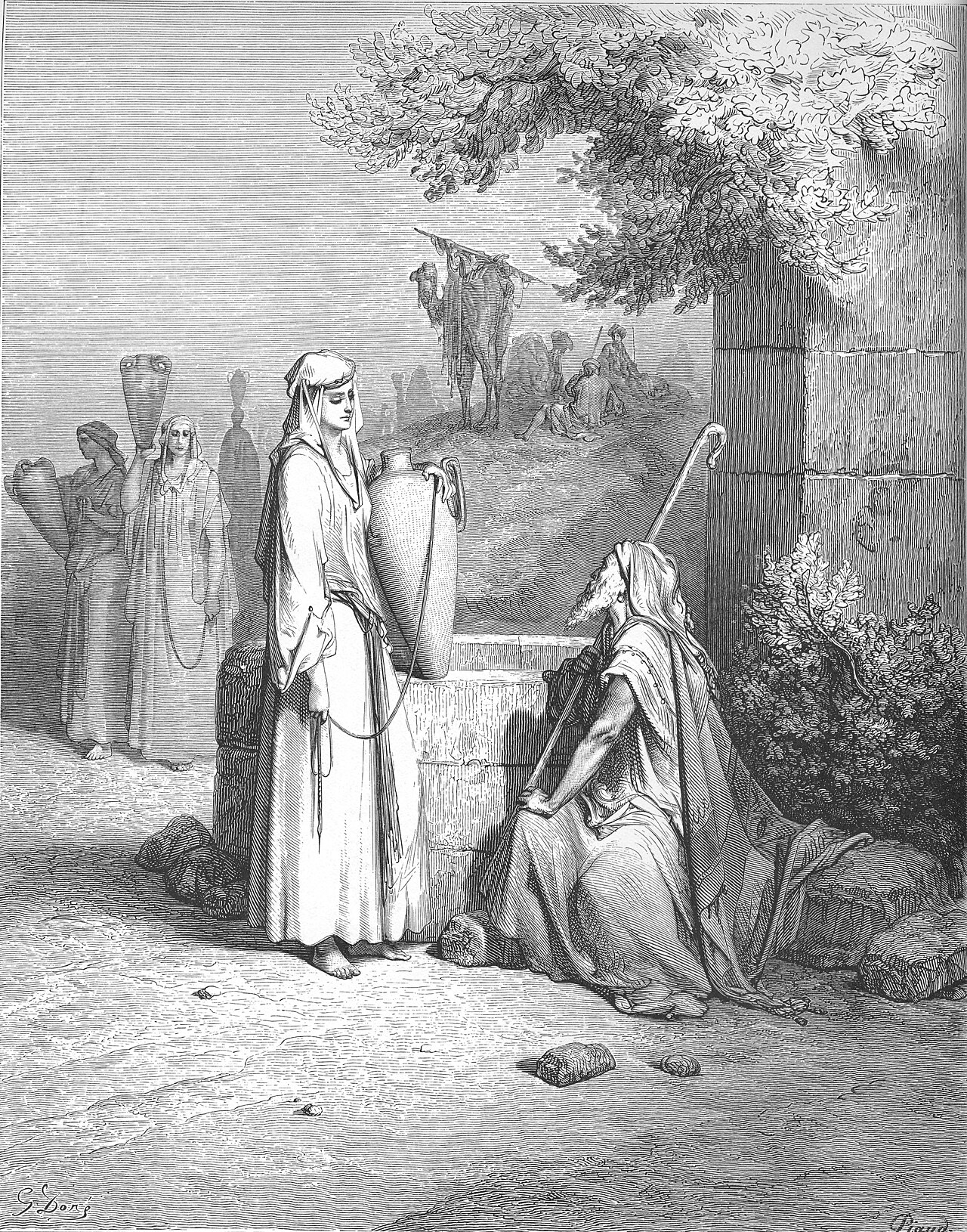
Before the servant had finished praying, Rebekah came out with her jar on her shoulder. She was the daughter of Bethuel son of Milcah, the wife of Abraham’s brother Nahor.
Introduction
Moses, by tradition, The Law, Genesis Overview.
Moses, by tradition, Narrative, The Law, The Abraham cycle, Genesis Overview. Genesis was given to a people told to take no wives from the nations of Canaan, and this is the longest chapter in the book. Almost all of it follows one errand, carried out by a servant whose name is never given. The first hearers knew how a marriage was arranged, with the bride's family, with gifts recorded by weight and with the bride's own consent asked. Listen for the prayer spoken at the well before anything happens, and for the way the servant tells the whole story a second time to a new audience. Read it as guidance that looks ordinary from the outside.
Context
- Who
- Israel in the wilderness, under a standing command to take no wives from the peoples of the land
- What
- A narrative of the search for a wife for Isaac, in which Abraham's servant travels north and brings Rebekah back from Nahor's family.
- Where
- Abraham's camp in Canaan, the road north to the town of Nahor in Aram-naharaim, and the well outside it.
- When
- The patriarchal age, about 2026 BC on the traditional dating, when Isaac was forty.
- Why
- To show God guiding an ordinary errand step by step and keeping the next generation inside the covenant family.
Historical context
The chapter belongs to a servant who is never named in it, described as the man who managed everything Abraham owned, and to Rebekah, a granddaughter of Abraham's brother Nahor.
Show the rest of the historical context, 6 more paragraphs
The date is about 2026 BC on the traditional reckoning, with Abraham near the end of his life and Isaac at forty, which the next chapter confirms at Genesis 25:20.
The places are Abraham's camp in Canaan, the long road north to the town of Nahor in Aram-naharaim, and the well outside that town at the hour the women came to draw water.
The occasion is a marriage that has to be arranged before Abraham dies, and it has to be arranged outside Canaan and without moving Isaac out of the land.
A first hearer knew the marriage practice the chapter follows. Negotiation ran with the bride's family and especially her brother, gifts went to the family as well as to the bride, the bride's own consent was asked, and she left with her nurse and her maids.
He also knew how hard the test at the well was. Ten camels that have crossed desert country drink an enormous quantity, and a woman drawing that by hand from a well and carrying it to a trough is at it for hours. Rebekah offers it before she is asked.
The gifts are recorded the way a household account would record them, by weight: a gold ring of half a shekel and two bracelets of ten shekels.
Significance
Israel was forbidden to marry into the peoples of Canaan, and this chapter showed them the reason acted out, a family taking great trouble and travelling hundreds of miles to keep the next generation inside the covenant.
Show the rest of the significance, 1 more paragraph
It also showed them guidance that looked like nothing at all from the outside: a servant, a road, a well and a woman with a jar, with God ahead of every step of it.
This chapter in Jewish lifeWhat this chapter is in Jewish life and reading.
What is done
This chapter is heard inside the fifth portion of the annual cycle, in the same sitting as the death of Sarah and the buying of the cave (src/lib/hebraic/readings.ts). It is the longest chapter of Genesis, and a congregation hears the whole errand for a wife for Isaac at one reading. The card above carries the portion and the prophetic reading set beside it.
How it is read
The corpus holds the English text of two comments on this chapter and the reference alone for twenty two more. Radak is quoted from the CC-BY translation of Eliyahu Munk, HaChut Hameshulash.
Radak reads the meeting at the well as an answer beyond what was asked. The first girl the servant spoke to "met all the qualifications he had stipulated". She was of the family of Abraham, she was fair to look at, she showed her character at once, and she was unmarried (Radak on Genesis 24:15:1).
Rashi comments on fifteen verses of this chapter in a version the corpus holds by reference alone, because the licence Sefaria reports for that English version keeps the text out. They run from Rashi on Genesis 24:1:1 on the blessing of Abraham in all things to Rashi on Genesis 24:24:1 on the answer of Rebecca about her father. They cover the oath under the thigh in the second verse and the rule against a wife from the daughters of Canaan in the third. They cover the sign the servant asked for in the fourteenth verse and the gold he gave her in the twenty second.
Ibn Ezra carries six comments the corpus holds the same way, at Ibn Ezra on Genesis 24:3:1, 24:4:1, 24:5:1, 24:6:1 and 24:12:1, and Malbim one, at Malbim on Genesis 24:13:1. The weight of those comments falls on the terms of the errand and on the prayer at the well.
What the rabbis say
The corpus records forty places where the Midrash and the Talmud cite this chapter, thirty five under Midrash and five under Talmud. It carries the locator for each one with no text, so the references stand here and the sayings are read at the source.
Bereshit Rabbah reads the second verse at 59:8, the fifth at 59:9, the sixth at 59:10 and the seventh at 75:4. It reads the eleventh verse at 59:12, the twelfth at 60:1, the thirteenth at 60:3 and the sixteenth at 60:5. It reads the twenty third verse at 60:9, the twenty eighth at 60:7 and the thirty second at 60:8.
Midrash Lekach Tov reads eight verses of the errand, at Genesis 24:3:1, 24:19:1, 24:20:1, 24:26:1, 24:30:1, 24:35:1, 24:36:1 and 24:40:1. Midrash Sekhel Tov reads the fourth, ninth, thirty seventh and thirty ninth verses at the locators of the same names. Aggadat Bereshit reads the first verse at 28:1, the tenth at 46:3, the fourteenth at 38:3, the twenty seventh at 18:1 and the thirty eighth at 37:4. Bamidbar Rabbah reads the seventeenth verse at 21:20, the twenty second at 20:23 and the twenty ninth at 10:5. Bereshit Rabbati reads the eighteenth verse at Parashat Chayei Sarah 15, the twenty fifth at Parashat Miketz 47 and the thirty third at Parashat Chayei Sarah 6.
The five Talmud locators are Kiddushin 61b:12 on the eighth verse, Avodah Zarah 29a:5 on the fifteenth and Avot DeRabbi Natan 8:8 on the thirty first. The other two are Bava Kamma 92b:6 on the thirty fourth verse and Jerusalem Talmud Rosh Hashanah 1:8:2 on the twenty first.
Sources: Radak, Radak on Genesis 24:9:1 and 24:15:1, in HaChut Hameshulash, translated by Eliyahu Munk, CC-BY, about 1200; Rashi, Ibn Ezra and Malbim, their twenty two comments on Genesis 24, cited by reference; the licence Sefaria reports for the English versions keeps the text out of the corpus; The Midrash and the Talmud, the forty locators on Genesis 24 in scripts/data/sources/sefaria/genesis/24.json; MannaFest, the annual cycle table at src/lib/hebraic/readings.ts, 2026.
The heads below are this chapter's scenes. The numbered points under each are its verses.
A Servant Sent for a Bride
Genesis 24:1-2
old and well along in years: This is the last act of Abraham's life the book tells at length, and it is about his son's marriage. Sarah is buried, and the son the promise runs through has no wife. The oath is sworn with a hand under his thigh. The gesture touches the sign of the covenant carried in his own body, the sign the promised seed was to come through.
Genesis 24:1
“The care he took of a good son, to get him married, well married. It was high time to think of it now, for Isaac was about forty years old, and it had been customary with his ancestors to marry at thirty, or sooner, ch. xi. Abraham believed the promise of the building up of his family, and therefore did not make haste; not more haste than good speed.”
Matthew Henry · Commentary on the Whole Bible (1707-1721)puritan
2 more voices on this verseWhat preachers and commentators have said about this verse, in their own words.
Genesis 24:1
“The old age of Abraham was indeed yet green, as we shall see hereafter; but when he reckoned up his own years he deemed it time to consult for the welfare of his son.”
John Calvin · Commentaries (1554)reformed
Genesis 24:1
“And Abraham was old . . . take a wife--His anxiety to see his son married was natural to his position as a pastoral chief interested in preserving the honor of his tribe, and still more as a patriarch who had regard to the divine promise of a numerous posterity.”
Jamieson, Fausset & Brown · Commentary Critical and Explanatory on the Whole Bible (1871)reformed
who managed all he owned: The servant is never named in this chapter. Adam Clarke took the man who managed all Abraham owned to be Eliezer, the steward of 15:2. If Clarke is right, Abraham sends on this errand the man he had once expected to be his heir, before Isaac was born.
Genesis 24:2
“Thus God swears his servants to their work, that, having sworn, they may perform it. Honour is here done to the eternal God; for he it is that is sworn by, to whom alone these appeals ought to be made. And some think honour is done to the covenant of circumcision by the ceremony here used of putting his hand under his thigh.”
Matthew Henry · Commentary on the Whole Bible (1707-1721)puritan
2 more voices on this verse
Genesis 24:2
“Eldest servant - As this eldest servant is stated to have been the ruler over all that he had, it is very likely that Eliezer is meant. See Gen 15:2, Gen 15:3. Put, I pray thee, thy hand - See note on Gen 24:9.”
Adam Clarke · Commentary on the Bible (1810-1826)evangelical
Genesis 24:2
“And Abraham said unto his eldest servant. Abraham here fulfils the common duty of parents, in laboring for and being solicitous about the choice of a wife for his son: but he looks somewhat further; for since God had separated him from the Canaanites by a sacred covenant, he justly fears lest Isaac, by joining himself in affinity with them, should shake off the yoke of God.”
John Calvin · Commentaries (1554)reformed
Genesis 24:3-4
a wife for my son from the daughters of the Canaanites: The bar on Canaanite wives becomes house policy for three generations, and Isaac lays the same charge on Jacob in chapter 28. Abraham is guarding the line the promise runs through. The family he sends back to serves other gods, and Joshua 24:2 says so of the fathers beyond the River.
Genesis 24:3
“I will make thee swear - See note on Gen 24:9. Of the Canaanites - Because these had already been devoted to slavery, etc., and it would have been utterly inconsistent as well with prudence as with the design of God to have united the child and heir of the promise with one who was under a curse, though that curse might be considered to be only of a political nature. See the curse of Canaan, Gen 9:25 (note).”
Adam Clarke · Commentary on the Bible (1810-1826)evangelical
go to my country and my kindred: Abraham calls the region of Haran my country and my kindred, though the family had come there from Ur of the Chaldeans at 11:31. Adam Clarke explained the phrase: his brother's family had settled there, and Abraham had stayed there a long time with his father Terah. The kindred he means are Nahor's line, listed at 22:20.
Genesis 24:4
“My country - Mesopotamia, called here Abraham’s country, because it was the place where the family of Haran, his brother, had settled; and where himself had remained a considerable time with his father Terah.”
Adam Clarke · Commentary on the Bible (1810-1826)evangelical
Genesis 24:5-6
The servant raises the practical problem and Abraham answers with an absolute. The woman may refuse, and the oath lapses with her refusal. Isaac is never to be taken back to that land. The promise is tied to the land, and the son stays in it.
Genesis 24:5
“Peradventure the woman will not be willing - We may see, says Calmet, by this and other passages of Scripture, Jos 9:18, what the sentiments of the ancients were relative to an oath. They believed they were bound precisely by what was spoken, and had no liberty to interpret the intentions of those to whom the oath was made.”
Adam Clarke · Commentary on the Bible (1810-1826)evangelical
The servant raised his question before he swore. Adam Clarke, citing Calmet at verse 5, gave the reason: the ancients held that an oath bound them by its exact words, with no liberty to interpret the intent afterward. So the limit of the oath is fixed before the hand goes under the thigh.
Genesis 24:6
“The patriarch, on the other hand, delivered an adequate direction to his servant and put him under oath. But let us now see the servant's sense of duty in imitating his master's godliness; when he saw the good man directing him with great earnestness, he said to him, "If the woman does not want to accompany me, do you want me to take your son back to the country you came from?"”
John Chrysostom · written before 407 · HOMILIES ON GENESIS 48.10patristic
Genesis 24:7-8
The LORD, the God of heaven, who brought me from my father’s house: Abraham quotes his own call back at the servant, the God who brought him from his father's house and his native land. He rests the whole errand on the oath about the land, that God would give it to his offspring. An angel goes ahead of the servant.
Genesis 24:7
“The Lord God, etc. - He expresses the strongest confidence in God, that the great designs for which he had brought him from his own kindred to propagate the true religion in the earth would be accomplished; and that therefore, when earthly instruments failed, heavenly ones should be employed. He shall send his angel, probably meaning the Angel of the Covenant, of whom see Gen 15:7.”
Adam Clarke · Commentary on the Bible (1810-1826)evangelical
1 more voice on this verse
Genesis 24:7
“God will cause that to issue in our comfort in which we sincerely aim at his glory. God's promises, and our own experiences, are sufficient to encourage our dependence upon God, and our expectations from him, in all the affairs of this life. God's angels are ministering spirits, sent forth, not only for the protection, but for the guidance, of the heirs of promise, Heb. i.”
Matthew Henry · Commentary on the Whole Bible (1707-1721)puritan
you are released from this oath: Matthew Henry drew a rule from the exchange: the matter of an oath should be understood and limited before it is sworn, because inquiry made after a vow is a snare. The servant had asked first, and Abraham fixed the one condition. Even the release repeats the ban on taking Isaac back.
Genesis 24:8
“Note, Oaths are to be taken with great caution, and the matter sworn to should be rightly understood and limited, because it is a snare to devour that which is holy, and, after vows, to make the enquiry which should have been made before.”
Matthew Henry · Commentary on the Whole Bible (1707-1721)puritan
Genesis 24:9-10
the servant placed his hand under the thigh of his master Abraham: The oath is sworn and the man leaves with ten camels and all manner of good things in hand. He rides for Nahor's hometown in Aram-naharaim. Rebekah's birth had already been reported to Abraham at 22:23, in the notice about Nahor's children. The bride was named in the same breath as the son he had received back.
Genesis 24:9
“Put his hand under the thigh of Abraham - This form of swearing has greatly puzzled the commentators; but it is useless to detail opinions which I neither believe myself, nor would wish my readers to credit. I believe the true sense is given in the Targum of Jonathan ben Uzziel, and that called the Jerusalem Targum. In the former it is said, Put now thy hand בגזית מהולתי bigzirath mehulathi, in sectione circumcisionis meoe; in the latter תחות ירך קימי techoth yerech keyami, sub femore foederis mei.”
Adam Clarke · Commentary on the Bible (1810-1826)evangelical
The Sign at the Well
all manner of good things: Adam Clarke read all manner of good things in hand as a free hand over the whole business, with the retinue and the gifts left to the servant's judgment. In those times, he noted, the husband's side gave a dowry for a wife. The gifts at verses 22 and 53 come from these packs.
Genesis 24:10
“Took ten camels - It appears that Abraham had left the whole management of this business to the discretion of his servant, to take with him what retinue and what dowry he pleased; for it is added, All the goods of his master were in his hand; and in those times it was customary to give a dowry for a wife, and not to receive one with her.”
Adam Clarke · Commentary on the Bible (1810-1826)evangelical
1 more voice on this verse
Genesis 24:10
“And the servant took ten camels, of the camels of his master, and departed,.... Camels were much in use in the eastern countries; where, as Pliny (o) says, they were brought up among their herds of cattle, and their riches much consisted in them. Arabia abounded with them; Job had three thousand of them, Job 1:3; how many Abraham had is not said, only ten of them his servant took, being sufficient for his present purpose, and which he took with his master's leave, and by his order.”
he made the camels kneel down near the well outside the town: This is the first well meeting in Scripture. A traveller reaches the ancestral country, stops at a well, a woman draws water, she runs home with the news, and the traveller is taken into the house. Jacob meets Rachel this way in chapter 29 and Moses meets Zipporah in Exodus 2. John 4 opens with Jesus at a well asking a Samaritan woman for a drink.
Genesis 24:11
“He made his camels to kneel down - To rest themselves, or lie down, as the Septuagint has very properly expressed it, Και εκοιμισε τας καμηλους. The time that women go out to draw water - In Bengal it is the universal practice for the women to go to pools and rivers to fetch water. Companies of four, six, ten, or more, may be seen in every town daily going to fetch water, with the pitchers resting upon their sides; and, on their return from bathing, women frequently bring water home - Ward.”
Adam Clarke · Commentary on the Bible (1810-1826)evangelical
Genesis 24:12-14
This is the first prayer in Genesis that asks God for a sign of guidance, and the man asks nothing for himself. The sign tests work: watering ten camels after a long stage is hours at a stone trough. He asks God to show kindness to his master. The word behind kindness is hesed, the covenant word for steady loyal love.
Genesis 24:12
"Lord," he says, "the God of my master Abraham, be my guide today, and have compassion on my master Abraham," as if to say, "Bring his wishes to effect, and conduct everything according to his intention." "Have compassion on my master Abraham": what does "have compassion" mean? Fulfill his desire. Then he said, "Lo, I am standing at the spring, and the daughters of the inhabitants of the city are coming out to draw water.
John Chrysostom · written before 407 · HOMILIES ON GENESIS 48.14patristic
1 more voice on this verse
Genesis 24:12
“And he said, O Lord God, etc. - “The conduct of this servant,” says Dr. Dodd, “appears no less pious than rational.”
Adam Clarke · Commentary on the Bible (1810-1826)Methodist
standing beside the spring: He stands beside the spring at the hour the daughters of the townspeople come to draw water. John Gill noted that drawing water was the usual custom of women in those parts, and that Homer tells of a traveller meeting a girl fetching water before a city. Moses meets his wife at a well in Exodus 2.
Genesis 24:13
“Behold, I stand here by the well of water,.... Wishing, hoping, and expecting that something would turn out that would direct and instruct what further to do, and that would lead on to the business he came about: and the daughters of the men of the city came out to draw water; which was the usual custom in those parts about that time. So Homer speaks (w) of meeting a girl before the city υδρευουση, drawing or fetching water.”
The servant sets the test in the girl's own mouth: she must offer to water his camels too, and that offer will mark the one the LORD has appointed for Isaac. John Wesley granted that God sometimes answers such a prayer even in small things. He also warned against being over bold in prescribing to God.
Genesis 24:14
“And let it come to pass, that the damsel to whom I shall say, let down thy pitcher, I pray thee, that I may drink,....”
1 more voice on this verse
Genesis 24:14
“Now, dearly beloved, let us briefly see, as far as we can, what these facts mean. When blessed Abraham directed his servant to take a wife for his son, he portrayed an image of God the Father.”
Caesarius of Arles · written before 542 · SERMON 85.3patristic
Genesis 24:15-16
Before the servant had finished praying: The answer arrives before the prayer is finished. Her whole descent is given in the sentence that introduces her, daughter of Bethuel, whose mother was Milcah, the wife of Abraham's brother Nahor. The reader knows she is inside the family before the servant does. She goes down to the spring and back up without a word to the stranger beside it.
Genesis 24:15
“Rebekah came to the wells daily; she drew water daily. And because she spent time at the wells daily, therefore, she could be found by Abraham's servant and be united in marriage with Isaac.Do you think these are tales and that the Holy Spirit tells stories in the Scripture? This is instruction for souls and spiritual teaching which instructs and teaches you to come daily to the wells of the Scripture, to the waters of the Holy Spirit, and always to draw water and carry home a full vessel just as also holy Rebekah used to do.”
Origen of Alexandria · written before 253 · HOMILIES ON GENESIS 10.2patristic
1 more voice on this verse
Genesis 24:15
“God, in his providence, doth sometimes wonderfully own the prayer of faith, and gratify the innocent desires of his praying people even in little things, that he may shew the extent of his care, and may encourage them at all times, to seek him, and trust in him; yet we must take heed of being over bold in prescribing to God, lest the event should weaken our faith rather than strengthen it.”
John Wesley · Explanatory Notes upon the Old Testament (1765)evangelical
a virgin who had not had relations: The verse gives her two descriptions, very beautiful and a virgin, and the clause after the second makes it plain. John Gill noted that she went down to the spring and came up again, so the water lay low, with a descent to it and a climb back. Every jar for ten camels came up that slope.
Genesis 24:16
“And the damsel was very fair to look upon,.... Of a good countenance and beautiful aspect: a virgin: neither had any man known her; not only was reckoned a virgin, but was really one, pure and incorrupt: and she went down to the well and filled her pitcher, and came up; by which it appears the well lay low, there was a descent unto it, and an ascent from it.”
1 more voice on this verse
Genesis 24:16
“Secondly, It is good to take all opportunities of showing a humble, courteous, charitable, disposition, because, some time or other, it may turn more to our honour and benefit than we think of; some hereby have entertained angels, and Rebekah hereby, quite beyond her expectation at this time, was brought into the line of Christ and the covenant.”
Matthew Henry · Commentary on the Whole Bible (1707-1721)puritan
Genesis 24:17-20
the servant ran to meet her: He runs, and after that every verb of action belongs to her. She lowered her jar, gave him a drink, emptied the jar into the trough, ran back to the well, and drew water for all his camels. She offers the camels before he asks, which is the thing he had prayed for. The work is counted in trips.
she quickly lowered her jar to her hands: She answers a stranger as lord, quickly lowers her jar to her hands, and gives him a drink. Matthew Henry drew from her courtesy that a humble, charitable habit can bring more honour than anyone expects. Hers brought her into the line of Christ and the covenant.
Genesis 24:18
“And she said, drink, my lord,.... Signifying at once that he was welcome to drink what he would, giving him a very honourable title, observing that he had a pretty large retinue with him of men and camels; so that she took him for some considerable personage: and she hasted, and let down her pitcher upon her hand; from off her shoulder, and let it rest upon her hand or arm: and gave him drink; let him drink what he would of it.”
John Gill · Exposition of the Old Testament (1748-1763)Reformed Baptist
The sign was met and then exceeded. She promises water until the camels have had enough to drink. Adam Clarke saw the point: had she done only what was prayed for, she might seem moved without choice, and doing more shows the kindness was her own.
Genesis 24:19
“I will draw water for thy camels also - Had Rebekah done no more than Eliezer had prayed for, we might have supposed that she acted not as a free agent, but was impelled to it by the absolutely controlling power of God; but as she exceeds all that was requested, we see that it sprang from her native benevolence, and sets her conduct in the most amiable point of view.”
Adam Clarke · Commentary on the Bible (1810-1826)evangelical
emptied her jar into the trough: She runs back and forth to the well until every camel has drunk, and the servant does not help. Adam Clarke could not decide which to admire more, her kindness or what he called the apparently stupid indifference of the servant. The man's silence belongs to his test, as verse 21 explains.
Genesis 24:20
“The loving God, you see, granted the patriarch's prayers, sent his angel on ahead and saw to the outcome of all these events; everything turned out as the servant requested. Then when he saw the power of the patriarch's prayers in the event and chanced upon the maiden as he desired, he also saw her surpassing hospitality. "She hastened" the text goes on, remember, "to empty the water jar into the trough, and ran to draw more at the well, and watered all the camels." See her heightened enthusiasm.”
John Chrysostom · written before 407 · HOMILIES ON GENESIS 48.16patristic
1 more voice on this verse
Genesis 24:20
“Rebekah is found "at a well." Rebekah in turn finds Isaac "at a well." There she gazed upon his countenance for the first time. There "she dismounted from the camels." There she sees Isaac, who was pointed out to her by the servant. Do you think these are the only words related about wells?”
Origen of Alexandria · written before 253 · HOMILIES ON GENESIS 10.5patristic
Genesis 24:21-23
the man watched her silently: He says nothing while she works, watching to see if the LORD had brought the errand off. When the camels have finished he puts a gold ring and two gold bracelets on her. He has asked nothing about her family yet. Only then does he ask whose daughter she is, and whether there is room in her father's house.
Genesis 24:21
“The man, wondering at her - And he was so lost in wonder and astonishment at her simplicity, innocence, and benevolence, that he permitted this delicate female to draw water for ten camels, without ever attempting to afford her any kind of assistance! I know not which to admire most, the benevolence and condescension of Rebekah, or the cold and apparently stupid indifference of the servant of Abraham. Surely they are both of an uncommon cast.”
Adam Clarke · Commentary on the Bible (1810-1826)evangelical
a gold ring weighing a beka: The Hebrew word for the ring is nezem, and Adam Clarke argued from its singular form that it was a nose ring, common among young women of Arabia and Persia. Verse 47 confirms where it went. A beka is half a shekel, the weight later set for each man's sanctuary tax at Exodus 38:26.
Genesis 24:22
“The man took a golden ear-ring - נזם זהב nezem zahab. That this could not be an ear-ring is very probable from its being in the singular number. The margin calls it a jewel for the forehead; but it most likely means a jewel for the nose, or nose-ring, which is in universal use through all parts of Arabia and Persia, particularly among young women. They are generally worn in the left nostril. The word is very properly translated επιρῥινιον, an ornament for the nose, by Symmachus.”
Adam Clarke · Commentary on the Bible (1810-1826)evangelical
The first question tests the sign against Abraham's condition, that the wife come from his own kindred. Matthew Henry saw providence here directing those who seek guidance by faith and prayer in the choice of a spouse. Her answer settles the matter.
Genesis 24:23
“Note, Providence sometimes wonderfully directs those that by faith and prayer seek direction from heaven in the choice of suitable yoke-fellows: happy marriages those are likely to be that are made in the fear of God; and these, we are sure, are made in heaven.”
Matthew Henry · Commentary on the Whole Bible (1707-1721)puritan
Genesis 24:24-25
She names Milcah. That is the link the reader was handed at 11:29 and again at 22:23. Then she answers a question he had not asked, offering straw and feed and a place for the night. She speaks for her father's house before anyone in it knows a stranger is at the well.
Genesis 24:24
“And she said unto him, I am the daughter of Bethuel the son of Milcah,.... Which Milcah was the daughter of Haran, Abraham's elder brother, and, as thought by many, sister to Sarah, Abraham's wife, see Gen 11:29, which she bare unto Nahor; Abraham's brother; so that her father was Nahor's son, not by his concubine Reumah, but by his lawful wife Milcah, which sets Rebekah's descent in a true light, see Gen 22:20; whether she told her own name is not certain, it may be, since the servant bade it, Gen 24:45.”
The servant bows his head as soon as she offers lodging. Adam Clarke read two acts in verse 26 from two Hebrew verbs: the bow of the head was thanks to Rebekah for her invitation, and the prostration was worship given to the LORD.
Genesis 24:25
Consider here too the maiden's response. As with the water, she not only provided what was asked but also watered the camels after giving him something to drink, so here too, when the servant inquired if there was merely room and whose daughter she was, the maiden replied, "I am daughter of Bethuel, son of Milcah, whom she bore to Nahor himself." She mentioned her father and grandfather so that this knowledge would further arouse the servant's interest. Observe the child's candor: asked about her father, she not only tells the truth about him but also about her father's father.
John Chrysostom · written before 407 · HOMILIES ON GENESIS 48.18patristic
1 more voice on this verse
Genesis 24:25
“She said moreover unto him,.... In answer to the second question: we have both straw and provender enough; for the camels, straw for their litter, and provender for their food, as hay, barley, &c. and room to lodge in; for him and his men; this she could venture to say, and invite him to come and take up his quarters in her father's house, without going home to relate the question put to her, and to have leave to give the invitation, knowing full well the generosity, liberality, and hospitable spirit of her father.”
John Gill · Exposition of the Old Testament (1748-1763)Reformed Baptist
Genesis 24:26-27
the man bowed down and worshiped the LORD: He worships at the well before anything is arranged. His blessing is about his master's God, who has kept His kindness and faithfulness toward his master. He says the LORD led him to the house of his master's relatives. The leading came to a man already on the road.
Genesis 24:26
“Bowed down his head, and worshipped - Two acts of adoration are mentioned here; 1. Bowing the head, יקד yikkod; and 2. Prostration upon the earth, וישתחו vaiyishtaehu. The bowing of the head was to Rebekah, to return her thanks for her kind invitation. The prostration was to Jehovah, in gratitude for the success with which he had favored him.”
Adam Clarke · Commentary on the Bible (1810-1826)evangelical
who has not withheld His kindness: The servant blesses God for keeping faith with his master, and Matthew Henry explained why the praise fits. God had promised to build Abraham's family, yet until now the house had seemed destitute of that promise, with a grown son and no wife. At this well the promise began to move again.
Genesis 24:27
“When God's favours are coming towards us; we must meet them with our praises. The Lord led me to the house of my master's brethren -- those of them that were come out of Ur of the Chaldees, though they were not come to Canaan, but staid in Haran. They were not idolaters, but worshippers of the true God, and inclinable to the religion of Abraham's family.”
John Wesley · Explanatory Notes upon the Old Testament (1765)evangelical
2 more voices on this verse
Genesis 24:27
“The Lord led me - By desire of his master he went out on this journey; and as he acknowledged God in all his ways, the Lord directed all his steps.”
Adam Clarke · Commentary on the Bible (1810-1826)evangelical
Genesis 24:27
“Note, God is to be acknowledged in providing suitable yoke-fellows, especially such as are agreeable in religion. (6.) He acknowledges that God, herein, had not left his master destitute of his mercy and truth. God had promised to build up Abraham's family, yet it seemed destitute of the benefit of that promise; but now Providence is working towards the accomplishing of it.”
Matthew Henry · Commentary on the Whole Bible (1707-1721)puritan
The Servant Tells His Errand
Genesis 24:28-31
The girl ran and told her mother’s household: Laban enters the book here. He rushed out to the man, and the reason follows next, that he had seen the ring and her bracelets. Then comes the welcome: you who are blessed by the LORD. He will bargain over Jacob's wages for twenty years in chapters 29 to 31.
Genesis 24:28
“Her mother’s house - Some have conjectured from this that her father Bethuel was dead; and the person called Bethuel, Gen 24:50, was a younger brother. This is possible, but the mother’s house might be mentioned were even the father alive; for in Asiatic countries the women have apartments entirely separate from those of the men, in which their little children and grown-up daughters reside with them. This was probably the case here, though it is very likely that Bethuel was dead, as the whole business appears to be conducted by Rebekah’s brothers.”
Adam Clarke · Commentary on the Bible (1810-1826)evangelical
he rushed out to the man: Three people run in this part of the chapter. The servant ran to meet her at verse 17, Rebekah ran home at verse 28, and Laban rushes out here. Jamieson, Fausset and Brown judged from his later dealings that the dazzling presents added to Laban's haste.
Genesis 24:29
“Rebekah had a brother . . . Laban ran out--From what we know of his character, there is reason to believe that the sight of the dazzling presents increased both his haste and his invitation.”
Jamieson, Fausset & Brown · Commentary Critical and Explanatory on the Whole Bible (1871)reformed
As soon as he saw the ring: Laban sees before he hears. The verse lists the ring and bracelets on her wrists first, and her report of the man's words second. Matthew Henry imagined Laban's thought as a rich and generous man to be welcomed for what could be got from him.
Genesis 24:30
"O," thinks Laban, "here is a man that there is something to be got by, a man that is rich and generous; we will be sure to bid him welcome!"
Matthew Henry · Commentary on the Whole Bible (1707-1721)puritan
Laban greets the servant as blessed by the LORD, the covenant name, and says he has a house ready and a place for the camels. Jamieson, Fausset and Brown took the family's words in this chapter as a sign that they worshipped the LORD. Laban also keeps household gods, at 31:19.
Genesis 24:31
“Thou blessed of the Lord - Probably a usual mode of wishing prosperity, as he that is blessed of the Lord is worthy of all respect; for, enjoying the Divine favor, he is in possession of the sum of happiness.”
Adam Clarke · Commentary on the Bible (1810-1826)evangelical
Genesis 24:32-33
So the man came to the house: The camels are unloaded, feet are washed, and a meal is set before a man who has ridden a long way. He leaves it until the errand has been spoken. Genesis gives the whole exchange in two lines, and the answer he gets is Please speak.
Genesis 24:32
“Provender for the camels - These were the first objects of his care; for a good man is merciful to his beast. Water to wash his feet - Thus it thus appears that he had servants with him; and as the fatigues of the journey must have fallen as heavily upon them as upon himself, so we find no distinction made, but water is provided to wash their feet also.”
Adam Clarke · Commentary on the Bible (1810-1826)evangelical
1 more voice on this verse
Genesis 24:32
“Both the house and stable were well furnished, and Abraham's servant was invited to the free use of both. Particular care was taken of the camels; for a good man regardeth the life of his beast, Prov. xii. If the ox knows his owner to serve him, the owner should know his ox to provide for him that which is fitting for him.”
Matthew Henry · Commentary on the Whole Bible (1707-1721)puritan
Adam Clarke compared a custom he knew from India, where a Brahmin would enter a house and refuse food until his errand was granted. For Clarke the refusal showed a servant who put his master's business before his own need. He eats at verse 54, once he has his answer.
Genesis 24:33
“I will not eat until I have told - In Hindoostan it is not unusual for a Brahmin to enter a house and sit down, and when meat is offered, refuse to eat till he has obtained the object of his errand. Here is a servant who had his master’s interest more at heart than his own. He refuses to take even necessary refreshment till he knows whether he is likely to accomplish the object of his journey.”
Adam Clarke · Commentary on the Bible (1810-1826)evangelical
1 more voice on this verse
Genesis 24:33
“How ingenious he was in the management of it; he approved himself, in this matter, both a prudent man and a man of integrity, faithful to his master by whom he was trusted, and just to those with whom he now treated.”
Matthew Henry · Commentary on the Whole Bible (1707-1721)puritan
Genesis 24:34-36
He opens with his master's name and never gives his own. The chapter calls him the servant or the man from first to last, and the name Eliezer belongs to chapter 15. Origen read the errand as a picture of the church brought to Christ: a servant sent by a father to fetch a bride for the son, carrying the father's goods and speaking only of the son.
Genesis 24:34
“He was welcome before, but we may suppose him doubly welcome when he said, I am Abraham's servant. Abraham's name, no doubt, was well known among them and respected, and we might suppose them not altogether ignorant of his state, for Abraham knew theirs, ch. xxii.”
Matthew Henry · Commentary on the Whole Bible (1707-1721)puritan
He begins with the wealth before the son, and the list runs from sheep and cattle to camels and donkeys. Adam Clarke read the account as a case put to the family, showing that his master's son was a fitting match in station. Every item was given by the LORD, the servant says.
borne him a son in her old age: He adds two facts the family needed: the son was born to Sarah in her old age, and his father has already given him everything he owns. Adam Clarke took the second as naming Isaac sole heir. Chapter 25 carries out the same settlement at verse 5.
Genesis 24:36
“Unto him hath he given all that he hath - He has made Isaac his sole heir. These things appear to be spoken to show the relatives of Rebekah that his master’s son was a proper match for her; for even in those primitive times there was regard had to the suitableness of station and rank in life, as well as of education, in order to render a match comfortable. Persons of dissimilar habits, as well as of dissimilar religious principles, are never likely to be very happy in a married life.”
Adam Clarke · Commentary on the Bible (1810-1826)evangelical
Genesis 24:37-41
My master made me swear an oath: The servant repeats the oath exactly: no wife from the daughters of the Canaanites, and a wife from his master's kindred and his father's house. He includes the clause that sets him free if the family refuses to give her. He tells them an angel was promised for the road. The retelling runs to sixteen verses in a book that can cover a century in a line.
Genesis 24:37
He likewise obviates an objection, That, if Isaac were deserving, he needed not send so far off for a wife: why did he not marry nearer home? "For a good reason," says he; "my master's son must not match with a Canaanite."
Matthew Henry · Commentary on the Whole Bible (1707-1721)puritan
to my kindred to take a wife: The country of verse 4 becomes my father's house in the retelling, a family claim on the people listening. Matthew Henry saw the servant answering a question before they could ask it, why a son so well placed had to take a wife from so far. The answer is the ban on the Canaanites.
Genesis 24:38
“But thou shalt go unto my father's house, and to my kindred, and take a wife unto my son. See Gill on Gen 24:4.”
His question is shorter here than at verse 5. There he also asked whether he should take Isaac back to Abraham's country, and Abraham forbade it twice; to this family he gives only the question of her consent. Matthew Henry noticed the servant answering their objections in advance at verse 37.
Genesis 24:39
“And I said unto my master, Peradventure the woman will not follow me. See Gill on Gen 24:5.”
John Gill · Exposition of the Old Testament (1748-1763)Reformed Baptist
Abraham's words gain a clause in the retelling: the LORD before whom I have walked. The phrase answers the charge God gave him at 17:1. Adam Clarke noted at verse 42 that the servant leans on his master's standing with God to give weight to what he asks.
Genesis 24:40
“And he said unto me, the Lord, before whom I walk, will send his angel with thee. See Gill on Gen 24:7.”
John Gill · Exposition of the Old Testament (1748-1763)Reformed Baptist
1 more voice on this verse
Genesis 24:40
“Note, While we make conscience of our part of the covenant, we may take the comfort of God's part of it; and we should learn to apply general promises of particular cases, as there is occasion.”
Matthew Henry · Commentary on the Whole Bible (1707-1721)puritan
if they refuse to give her to you: The release clause shifts in the retelling. At verse 8 the servant was freed if the woman was unwilling, and here he is freed if her kindred refuse to give her. Adam Clarke, citing Calmet at verse 5, said the ancients were bound by the exact words of an oath, so the wording put the choice before this family.
Genesis 24:41
“Then shalt thou be clear from this my oath,.... See Gill on Gen 24:8.”
John Gill · Exposition of the Old Testament (1748-1763)Reformed Baptist
Genesis 24:42-44
when I came to the spring today, I prayed: He gives them the sign he asked for before he tells them how it turned out. In that order the family hears a test no traveller could have arranged. Then they hear their own daughter fulfil it word for word. Every detail matches what the reader watched at the well.
Genesis 24:42
“O Lord God of my master - As Abraham was the friend of God, Eliezer makes use of this to give weight and consequence to his petitions.”
Adam Clarke · Commentary on the Bible (1810-1826)evangelical
if a maiden comes out to draw water: The word for maiden here is almah, where verse 16 used bethulah for virgin. Adam Clarke tied the two together, reading almah as a young woman kept hidden from men, and he pointed to Isaiah 7:14, where the same word stands. Rebekah is called by both.
Genesis 24:43
“When the virgin - העלמה haalmah, from עלם alam, to hide, cover, or conceal; a pure virgin, a woman not uncovered, and in this respect still concealed from man. The same as בתולה bethulah, Gen 24:16, which, from the explanation there given, incontestably means a virgin in the proper sense of the word - a young woman, not that is covered or kept at home, the common gloss, but who was not uncovered in the delicate sense in which the Scripture uses this word. See this interpretation vindicated on Isa 7:14 (note).”
Adam Clarke · Commentary on the Bible (1810-1826)evangelical
may she be the woman the LORD: No one at the well had heard this prayer. Adam Clarke said the whole petition, given at verses 12 to 14 and again here, was spoken silently to God. He thought public prayer would have been out of place, for the men with the servant carried none of the charge of the mission.
Genesis 24:44
“And she say to me, both drink thou, and I will also draw for thy camels,.... See Gill on Gen 24:14.”
John Gill · Exposition of the Old Testament (1748-1763)Reformed Baptist
Genesis 24:45-48
before I had finished praying in my heart: He prayed in his heart, so no one at the well heard the words. The first account left that out, and it leaves out where the ring went. Here he says he put it on her nose. He tells the family he worshipped on the spot, before asking them for anything.
Genesis 24:45
“Before I had done speaking in mine heart - So we find that the whole of this prayer, so circumstantially related Gen 24:12-14, and again Gen 24:42-44, was mental, and heard only by that God to whom it was directed. It would have been improper to have used public prayer on the occasion, as his servants could have felt no particular interest in the accomplishment of his petitions, because they were not concerned in them, having none of the responsibility of this mission.”
Adam Clarke · Commentary on the Bible (1810-1826)evangelical
So I drank, and she also watered: In the retelling she quickly lowers her jar from her shoulder, says Drink, and waters the camels, all in one verse. The servant leaves out his own silent watching at verse 21, which Adam Clarke found hard to admire. The family hears her kindness and none of his doubt.
Genesis 24:46
“And she made haste, and let down her pitcher from her shoulder,.... See Gill on Gen 24:18. And said, drink, and I will give thy camels drink also. See Gill on Gen 24:19. so I drank, and she made the camels drink also. See Gill on Gen 24:20.”
So I put the ring on her nose: In the retelling he asks whose daughter she is before he puts on the ring, the reverse of the order at verses 22 and 23. Told this way, the gifts follow proof of kinship. John Gill noted that her answer traced her father to Milcah, Nahor's wife, in place of Reumah, his concubine, named at 22:24.
Genesis 24:47
“And I asked her, and said, Whose daughter art thou?.... See Gill on Gen 24:23. And she said, The daughter of Bethuel, Nahor's son, whom Milcah bare unto him: See Gill on Gen 24:24. and I put the earring upon her face, and the bracelets upon her hands. See Gill on Gen 24:22.”
1 more voice on this verse
Genesis 24:47
“The servant swore the oath to his master and went off with many choice gifts. He sat beside a well, prayed and asked for a sign.”
Ephrem the Syrian · written before 373 · Commentary (church-history corpus)patristic
led me on the right road: He ends the story as the day at the well ended. Who led me on the right road repeats the thanks of verse 27, and Adam Clarke said there that the LORD directs the steps of a man who acknowledges Him in all his ways.
Genesis 24:48
“And I bowed down my head, and worshipped the Lord,.... See Gill on Gen 24:26. And blessed the Lord God of my master Abraham, which had led me in the right way to take my master's brother's daughter unto his son. See Gill on Gen 24:27.”
1 more voice on this verse
Genesis 24:48
"Seeing now God's providence so manifestly in action, I asked whose daughter she was. Learning from what she said that she belonged not to alien people but to the household of Nahor, my master's brother, I was bold enough to 'put earrings and bracelets on her. In my satisfaction I prayed to the Lord and praised the God of my master Abraham for bringing my journey to a successful conclusion so as to take the daughter of my master's brother.'
John Chrysostom · written before 407 · HOMILIES ON GENESIS 48.24patristic
Genesis 24:49-51
if you will show kindness and faithfulness to my master: He asks for the kindness and faithfulness he had blessed God for at verse 27. Laban and Bethuel answer that the thing is from the LORD and that they have no say in it. They tell him to take her and go. The answer comes from the family, and no one has asked Rebekah yet.
Genesis 24:49
“That I may turn to the right hand or to the left - That is, That I may go elsewhere and seek a proper match for the son of my master. Some have imagined that Eliezer intimated by these expressions that if he did not succeed in obtaining Rebekah, he would go and seek for a wife either among the descendants of Ishmael or the descendants of Lot. This interpretation is fanciful.”
Adam Clarke · Commentary on the Bible (1810-1826)evangelical
1 more voice on this verse
Genesis 24:49
“THE chapter from which the text is taken bristles with points. There is a remarkable parallel between Eliezer seeking a wife for Isaac and the ministers of Christ seeking souls for Jesus. It is something more than an allegory. It is really a very instructive parable of how we are to deal for our Master with the souls of men and women.”
Will You Go with This Man?
Laban and Bethuel answered: Bethuel speaks here for the only time, and after Laban. Adam Clarke followed Josephus in holding that the father had died and that this Bethuel was a brother of Laban. Jamieson, Fausset and Brown took the father to be probably dead, with the brothers leading the talks.
Genesis 24:50
“Then Laban and Bethuel answered--The brothers conduct all the marriage negotiations, their father being probably dead, and without consulting their sister. Their language seems to indicate they were worshippers of the true God.”
Jamieson, Fausset & Brown · Commentary Critical and Explanatory on the Whole Bible (1871)reformed
2 more voices on this verse
Genesis 24:50
“The thing proceedeth from the Lord - Providence smiles upon it, and we have nothing to say against it. A marriage is then likely to be comfortable when it appears to proceed from the Lord.”
John Wesley · Explanatory Notes upon the Old Testament (1765)evangelical
Genesis 24:50
“Laban and Bethuel - These seem both to be brothers, of whom Laban was the eldest and chief; for the opinion of Josephus appears to be very correct, viz., that Bethuel, the father, had been some time dead. See note Gen 24:28. Bad or good - We can neither speak for nor against; it seems to be entirely the work of God, and we cordially submit: consult Rebekah; if she be willing, take her and go. See note Gen 24:58.”
Adam Clarke · Commentary on the Bible (1810-1826)evangelical
Take her and go: Rebekah is before him, and her family tells the servant to take her and go, as the LORD has decreed. John Wesley read their answer as consent to a providence that smiled on the match, and held that a marriage is likely to be comfortable when it comes from the LORD. Rebekah herself speaks at verse 58.
Genesis 24:51
“Behold, Rebekah is before thee,.... Not only was present, but she was delivered to him, or his request was granted: take her, and go, and let her be thy master's son's wife; not that they meant he should go away directly with her; for they afterwards solicit her stay with them some time; but they agreed that he should bare her and conduct her to Isaac, to be taken by him for his wife: as the Lord hath spoken; for so they understood the token given to the servant to know her by, as the determination of God.”
Genesis 24:52-53
he bowed down to the ground before the LORD: He bows to the ground before he opens the bags. Jewels of silver and gold go to Rebekah, with articles of clothing, and precious gifts go to her brother and her mother. Bethuel is absent from the list of who was paid. The household is run by the brother, and the chapter describes it that way whenever it acts.
Genesis 24:52
“Observe, First, As his good success went on, he went on to bless God. Those that pray without ceasing should in every thing give thanks, and own God in every step of mercy.”
Matthew Henry · Commentary on the Whole Bible (1707-1721)puritan
jewels of silver and gold: Adam Clarke separated the two sets of gifts. The ring and bracelets at the well were a token of respect, and these jewels and clothes were the dowry, which Jamieson, Fausset and Brown called the usual dowry among pastoral tribes. The word behind precious gifts, migdanot, is used of choice fruits at Deuteronomy 33:13 to 16.
Genesis 24:53
“Jewels of silver, and jewels of gold - The word כלי keley, which we here translate jewels signifies properly vessels or instruments; and those presented by Eliezer might have been of various kinds. What he had given before, Gen 24:22, was in token of respect, what he gave now appears to have been in the way of dowry. Precious things - מגדנת migdanoth. This word is used to express exquisite fruits or delicacies, Deu 33:13-16; precious plants or flowers, Son 4:16; Son 7:13. But it may mean gifts in general, though rather of an inferior kind to those mentioned above.”
Adam Clarke · Commentary on the Bible (1810-1826)evangelical
1 more voice on this verse
Genesis 24:53
“And the servant brought forth jewels of silver, and . . . gold--These are the usual articles, with money, that form a woman's dowry among the pastoral tribes. Rebekah was betrothed and accompanied the servant to Canaan.”
Jamieson, Fausset & Brown · Commentary Critical and Explanatory on the Whole Bible (1871)reformed
Genesis 24:54-56
he and the men with him ate and drank: He eats once the matter is settled, which finishes the refusal of the night before. In the morning he asks to be sent on his way, and the family asks for ten days. His answer is that the LORD has already made the errand succeed. A delay now stands against something already given.
Genesis 24:54
“And they did eat and drink - When Eliezer had got a favorable answer, then he and his servants sat down to meat; this he had refused to do till he had told his message, Gen 24:33.”
Adam Clarke · Commentary on the Bible (1810-1826)evangelical
Her brother and mother ask that the girl remain ten days or so, a phrase Adam Clarke found abrupt in the Hebrew. He weighed a year or ten months against a week or ten days, and chose the shorter, as they had already consented. Matthew Henry saw a family loath to part with her.
Genesis 24:55
“Let the damsel abide with us a few days, at the least ten - The original is very abrupt and obscure, because we are not acquainted with the precise meaning of the form of speech which is here used; ימים או עשור yamim o asor Days or Ten, probably meaning a year or ten months, as the margin reads it, or a week or ten days. This latter is the most likely sense, as there would be no propriety after having given their consent that she should go, in detaining her for a year or ten months.”
Adam Clarke · Commentary on the Bible (1810-1826)evangelical
1 more voice on this verse
Genesis 24:55
“They had consented to the marriage, and yet were loth to part with her. Note, It is an instance of the vanity of this world that there is nothing in it so agreeable but it has its alloy. Nulla est sincera voluptas--There is no unmingled pleasure.”
Matthew Henry · Commentary on the Whole Bible (1707-1721)puritan
Matthew Henry thought the servant knew his master would be waiting with some impatience, and that business at home needed him. Abraham was already old and well along in years at verse 1. He put his work before his pleasure, Henry said.
Genesis 24:56
“He knew his master would expect him home with some impatience; he had business to do at home which wanted him, and therefore, as one that preferred his work before his pleasure, he was for hastening home.”
Matthew Henry · Commentary on the Whole Bible (1707-1721)puritan
Genesis 24:57-58
The question is put to Rebekah herself, and her answer is one word in the Hebrew. She leaves country and kindred and her father's house on the word of a stranger. Those are the three separations Abraham was commanded to make in chapter 12. She has never seen the man.
Genesis 24:57
“And they said, we will call the damsel,.... Who perhaps through modesty had withdrawn herself to her own apartment, while the man and her friends were discoursing on this subject: and inquire at her mouth; what she says to it, whether willing to go directly or not; the matter in question was referred to her, and left to her decision.”
Readers differ on what she was asked. Adam Clarke took it as her choice whether to accept the marriage at all, though he allowed it might only mean whether to leave now or stay longer. Matthew Henry thought the servant's piety had shown her a household where godliness prevailed, and made her eager to go.
Genesis 24:58
“Wilt thou go with this man? - So it appears it was left ultimately to the choice of Rebekah whether she would accept the proposals now made to her, unless we suppose that the question meant, Wilt thou go immediately, or stay with us a month longer? She said, I will go - It fully appears to be the will of God that it should be so, and I consent. This at once determined the whole business.”
Adam Clarke · Commentary on the Bible (1810-1826)evangelical
1 more voice on this verse
Genesis 24:58
“We may hope that the notice she had taken of the servant's piety and devotion gave her such an idea of the prevalence of religion and godliness in the family she was to go to made her desirous to hasten thither, and willing to forget her own people and her father's house, where religion had not so much the ascendant.”
Matthew Henry · Commentary on the Whole Bible (1707-1721)puritan
Genesis 24:59-60
they sent their sister Rebekah on her way, along with her nurse: The nurse goes unnamed here and is called Deborah at 35:8, where she dies and is buried under an oak that gets a name of its own. The family blessing repeats the angel's oath to Abraham on the mountain, that his offspring would possess the gates of their enemies. They call her the mother of thousands upon thousands.
Genesis 24:59
“And her nurse - Whose name, we learn from Gen 35:8, was Deborah, and who, as a second mother, was deemed proper to accompany Rebekah. This was a measure dictated by good sense and prudence. Rebekah had other female attendants. See Gen 24:61.”
Adam Clarke · Commentary on the Bible (1810-1826)evangelical
may you become the mother of thousands: The blessing asks two things, many descendants and victory over enemies, and Matthew Henry named them so. Adam Clarke rendered the Hebrew as thousands of ten thousands and noted that a large family was taken in ancient times as a mark of God's favour. Her sons become two nations at 25:23.
Genesis 24:60
“Be thou the mother of thousands of millions - לאלפי רבבה lealphey rebabah, for thousands ten thousand, or for myriads of thousands, a large family being ever considered, in ancient times, as a proof of the peculiar blessing and favor of God. Similar addresses to a daughter, when she is going from her father’s house to live with her husband, are very common among the Hindoos; such as, “Be thou the mother of a son,” “Be thou the wife of a king,” etc. See Ward.”
Adam Clarke · Commentary on the Bible (1810-1826)evangelical
1 more voice on this verse
Genesis 24:60
“Note, When our relations are entering into a new condition, we ought by prayer to recommend them to the blessing and grace of God. Now that she was going to be a wife, they prayed that she might be a mother both of a numerous and of a victorious progeny.”
Matthew Henry · Commentary on the Whole Bible (1707-1721)puritan
Genesis 24:61-62
Rebekah and her servant girls got ready, mounted the camels: She rides south with a man she met the day before. Isaac is coming from Beer-lahai-roi, the well Hagar named at 16:14 when the angel found her in the wilderness. The name means the well of the Living One who sees. The son the promise runs through is living beside it.
Genesis 24:61
“It seems, then, that when she went to the well for water it was not because she had not servants at command, but because she took a pleasure in works of humble industry. Now that she was going among strangers, it was fit she should take those with her with whom she was acquainted.”
Matthew Henry · Commentary on the Whole Bible (1707-1721)puritan
Isaac Meets Rebekah at Evening
Isaac had just returned from Beer-lahai-roi: Isaac comes back from Beer-lahai-roi, living in the Negev. Adam Clarke reported the guess that he came from that well to his father at Beersheba to wait for the bride. John Gill passed on the Targums' tradition that Isaac was returning from the school of Shem.
Genesis 24:62
“And Isaac came - Concerning this well see Gen 16:13, Gen 16:14, etc. As it appears from Gen 25:11, that Isaac dwelt at the well Lahai-roi, it has been conjectured that he had now come on a visit to his aged father at Beersheba, where he waited in expectation of his bride. For he dwelt in the south country - The southern part of the land of Canaan. See Gen 12:9.”
Adam Clarke · Commentary on the Bible (1810-1826)evangelical
1 more voice on this verse
Genesis 24:62
“And Isaac came from the way of the well Lahairoi,.... The well at which the angel met with Hagar, when she fled from her mistress, Gen 16:7. The Targums of Jonathan and Jerusalem say, that Isaac came from the school of Shem the great: for he dwelt in the south country: at Beersheba, to which Abraham, it seems, was returned again; for that they dwelt together as yet, is clear from his mother Sarah's tent, into which he introduced Rebekah, Gen 24:67; see Gen 22:19.”
Genesis 24:63-65
Isaac went out to the field to meditate: Isaac has barely spoken since chapter 22, and here he walks alone in a field at dusk. Looking up, he saw the camels, which is what his father did twice on the day of the offering, at 22:4 and 22:13. Rebekah gets down from her camel the moment she learns who he is. She takes her veil and covers herself.
Genesis 24:63
“Isaac went out to meditate - לשוח lasuach, to bend down the body, or the mind, or both. He was probably in deep thought, with his eyes fixed upon the ground. What the subject of his meditation was it is useless to inquire; he was a pious man, and could not be triflingly employed.”
Adam Clarke · Commentary on the Bible (1810-1826)evangelical
2 more voices on this verse
Genesis 24:63
“Merciful providences are then doubly comfortable, when they find us in the way of our duty: some think Isaac was now praying for good success in this affair, and meditating upon that which was proper to encourage his hope in God concerning it; and now when he sets himself, as it were, upon his watch-tower, to see what God would answer him, he sees the camels coming.”
John Wesley · Explanatory Notes upon the Old Testament (1765)evangelical
Genesis 24:63
“Meditation and prayer ought to be both our business and our delight when we are alone; while we have a God, a Christ, and a heaven, to acquaint ourselves with, and to secure our interest in, we need not want matter either for meditation or prayer, which, if they go together, will mutually befriend each other.”
Matthew Henry · Commentary on the Whole Bible (1707-1721)puritan
she got down from her camel: Rebekah gets down from the camel as soon as she sees him, before she knows who he is. Origen read the meeting as the church coming to Christ. He noted that Rebekah was found at a well and in turn found Isaac at one.
Genesis 24:64
Rebekah followed the servant and comes to Isaac. The church followed the prophetic word, to be sure, and comes to Christ. Where does she find him? "Walking," the text says, "at the well of the oath." On no occasion is one withdrawn from wells; on no occasion does one stand apart from waters. Rebekah is found "at a well." Rebekah in turn finds Isaac "at a well." There she gazed upon his countenance for the first time. There "she dismounted from the camels."
Origen of Alexandria · written before 253 · HOMILIES ON GENESIS 10.5patristic
she took her veil and covered herself: The word for veil, tsaif, appears here for the first time in the Bible, and Adam Clarke called its meaning doubtful, a veil or a cloak. He preferred veil, worn by women in the east as a sign of modesty. Tamar covers herself with one at 38:14.
Genesis 24:65
“She took a veil - הצעיף hatstsaaif. This is the first time this word occurs, and it is of doubtful signification; but most agree to render it a veil or a cloak. The former is the most likely, as it was generally used by women in the east as a sign of chastity, modesty, and subjection.”
Adam Clarke · Commentary on the Bible (1810-1826)evangelical
1 more voice on this verse
Genesis 24:65
“Those that by faith are espoused to Christ, and would be presented as chaste virgins to him, must, in conformity to his example, humble themselves, as Rebekah, who alighted when she saw Isaac on foot, and must put themselves into subjection to him who is their head ( Eph. v. 24 ), as Rebekah, signifying it by the veil she put on, 1 Cor. xi.”
Matthew Henry · Commentary on the Whole Bible (1707-1721)puritan
Genesis 24:66-67
the servant told Isaac all that he had done: The servant makes his report and goes out of the book. Isaac brings her to the tent of his mother Sarah, three years after Sarah was buried at Machpelah. The writer says Isaac loved her, and that he was comforted after his mother's death. This is the first place in Genesis where a husband loves his wife.
Genesis 24:66
“And the servant told Isaac all things that he had done. By what means he found out the person designed for his wife, and got knowledge of her father's house, to which he was introduced, and where he was made welcome; and what agreement he had made with the parents and relations of Rebekah to be his wife, whom he had brought with him.”
Isaac loved her and was comforted: Sarah's tent now passes to Rebekah, as Adam Clarke observed. The marriage is told in three verbs: Isaac brought her in, took her as his wife, and loved her. Matthew Henry saw an affectionate son whose grief for his mother was healed only when God brought him into this new relation.
Genesis 24:67
“Sarah’s tent - Sarah being dead, her tent became now appropriated to the use of Rebekah. And took Rebekah, etc. - After what form this was done we are not told; or whether there was any form used on the occasion, more than solemnly receiving her as the person whom God had chosen to be his wife; for it appears from Gen 24:66 that the servant told him all the especial providential circumstances which had marked his journey.”
Adam Clarke · Commentary on the Bible (1810-1826)evangelical
2 more voices on this verse
Genesis 24:67
“By the joy [which he received] from Rebekah, who came three years later, Isaac was comforted from the mourning of his mother with which he had been shrouded for three years.”
Ephrem the Syrian · written before 373 · COMMENTARY ON GENESIS 21:4patristic
Genesis 24:67
“What an affectionate son he was to his mother: it was about three years since her death, and yet he was not, till now, comforted concerning it; the wound which that affliction gave to his tender spirit bled so long, and was never healed till God brought him into this new relation.”
Matthew Henry · Commentary on the Whole Bible (1707-1721)puritan
How this psalm is built
The form: The last act of Abraham's life told at length, a father discharging the common duty of parents over a son's marriage, as Calvin classes it.
The patterns in this chapter
| Device | What it does | Where to see it |
|---|---|---|
| The errand told twice | Verses 34 to 49 retell verses 2 to 27 in the servant's own mouth, sixteen verses of repetition in a book that can cover a century in a line. The retelling changes the order so that the family hears the sign before they hear that Rebekah met it, and it adds two things the first account left out, that the prayer was said in his heart and that the ring went on her nose. Adam Clarke marks the first of those, that the whole prayer was made silently.Adam Clarke, Commentary on the Bible, 1832, on Genesis 24:45. | Genesis 24:34, Genesis 24:45, Genesis 24:47, Genesis 24:49 |
| Kindness and faithfulness, asked and blessed and asked again | The servant asks God to show kindness to his master at verse 12, makes kindness the test of the sign at verse 14, blesses God at verse 27 for kindness and faithfulness withheld from no one, and then asks the family for the same two things at verse 49. The word behind kindness is the covenant word for steady loyal love. The whole errand is conducted in its terms. | Genesis 24:12, Genesis 24:14, Genesis 24:27, Genesis 24:49 |
| A servant who never gives his own name | The chapter calls him the servant or the man from first to last, and when he finally speaks at the door he opens with his master's name rather than his own. Adam Clarke holds it very likely that Eliezer is meant, since Genesis 15:2 names Eliezer of Damascus as the heir of the house and this man is described as ruler over all Abraham owned. Matthew Henry notes that the welcome doubled once he said whose servant he was.Adam Clarke, Commentary on the Bible, 1832, on Genesis 24:2. | Genesis 24:2, Genesis 24:34, Genesis 24:52 |
| What he carried and what he gave | Ten camels and all manner of good things leave with him at verse 10, a gold ring weighing a beka and two bracelets of ten shekels go on Rebekah at verse 22, and jewels of silver and gold with articles of clothing go to her at verse 53, with precious gifts to her brother and her mother. Adam Clarke argues from the singular that the ring of verse 22 was no ear-ring, which the servant's own account at verse 47 settles by putting it on her nose. Jamieson, Fausset and Brown read the silver and gold as the usual articles of a woman's dowry in that country.Adam Clarke, Commentary on the Bible, 1832, on Genesis 24:22. | Genesis 24:10, Genesis 24:22, Genesis 24:53 |
The debated concept
9 more paragraphs on the patterns
The first question is who the servant was. The chapter never names him. Adam Clarke holds it very likely to be Eliezer, on the ground that this man is called the ruler over all Abraham owned and Genesis 15:2 names Eliezer of Damascus as the heir of the house. The text's own silence is the counterweight, since a chapter that names Bethuel, Milcah, Nahor, Laban and Deborah's mistress declines to name its own main actor.
The second is where the ring went. Verse 22 has the servant produce a single gold ring weighing a beka, and Adam Clarke argues from the singular that it could not have been an ear-ring. The servant's own retelling settles it at verse 47, where he says he put it on her nose, and the difference between the two accounts is one of the clearest places in Genesis where the second telling adds what the first left out.
The third is whether Bethuel was alive. Jamieson, Fausset and Brown read the brothers conducting the negotiations as a sign that the father was dead. Adam Clarke notes the same difficulty from verse 28, where Rebekah runs to her mother's household, and reports the conjecture that the Bethuel of verse 50 was a younger brother rather than the father. Against both stands the plain wording of verse 50, which names Laban and Bethuel together as the ones who answered.
The fourth is how far the errand may be read as a figure. Matthew Henry records the reading, that Isaac is a type of Christ and the fetching of a wife signifies the espousing of the church by the agency of a servant, and he records it as something some make of it rather than as the chapter's own claim. Origen, cited in the chapter's exposition, read it as the church brought to Christ by a servant who carries the father's goods and speaks only of the son. Charles Spurgeon preached the parallel in 1891. The limit is that the chapter's own stated interest is the oath, the land and the line, and it never draws the figure itself.
The fifth is what the family asked for at verse 55. Adam Clarke says the original is very abrupt and obscure, and that the difficulty is a want of acquaintance with the phrase rather than with the words. The Berean text in the store reads it as ten days or so.
The divine connection
The chapter is the clearest account in Genesis of how guidance was sought and recognised. The servant asks for a sign, and the sign he chooses tests character through work, since watering ten camels at a stone trough is hours of it. He asks nothing for himself and asks God to show kindness to his master. The answer arrives before he has finished praying, and Rebekah offers the camels before he asks.
What the chapter does with that is as careful as the request. The servant watches in silence to see whether the LORD had made the errand succeed, and only when the camels are done does he give the gold and ask her name. He bows and worships at the well before anything is arranged, and bows again when the family consents. Matthew Henry reads the sequence as the rule for anyone who prays, that the one who asks should watch for the answer and then return the praise.
Abraham's own words at verse 7 are the ground under all of it. He quotes his own call back, the LORD who brought him from his father's house and promised the land to his offspring, and rests the errand on that promise rather than on the sign. The sign confirms a thing already sworn.
Keep studying
Studies5
Sources for this chapter
The summary
Jamieson, Fausset & Brown, Commentary Critical and Explanatory; John Calvin, Commentaries; John Wesley, Notes on the Old Testament and Matthew Henry, Complete Commentary.
The context
Jamieson, Fausset & Brown, Commentary Critical and Explanatory on the Whole Bible and Matthew Henry, Commentary on the Whole Bible.
The form and classifications
Charles Spurgeon, The Metropolitan Tabernacle Pulpit, Sermon No. 2231, 1891; John Calvin, Commentaries, 1554, on Genesis 24:2 and Matthew Henry.
The exposition
Adam Clarke, Commentary on the Bible; Chuck Missler, The Book of Genesis; Jamieson, Fausset & Brown, Commentary Critical and Explanatory on the Whole Bible; John Calvin, Commentary on Genesis; John Gill, Exposition of the Old Testament; John Wesley, Explanatory Notes upon the Old Testament; Matthew Henry, Commentary on the Whole Bible and Origen of Alexandria.