
Genesis 24:16
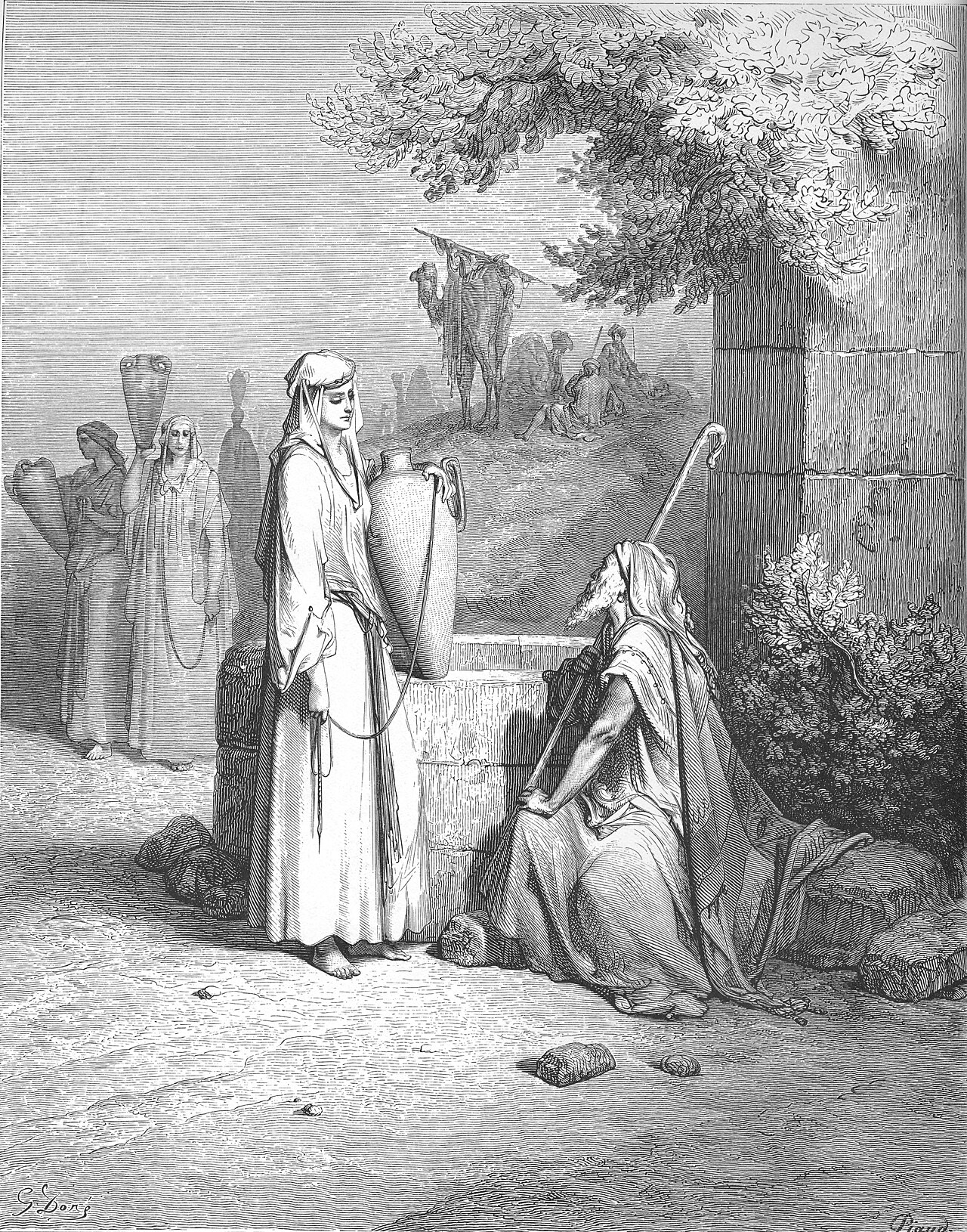
in Genesis 24Now the girl was very beautiful, a virgin who had not had relations with any man. She went down to the spring, filled her jar, and came up again.
BSB
The same verse in ASV and KJV ▾
ASV
And the damsel was very fair to look upon, a virgin, neither had any man known her: and she went down to the fountain, and filled her pitcher, and came up.
KJV
And the damsel was very fair to look upon, a virgin, neither had any man known her: and she went down to the well, and filled her pitcher, and came up.
⋯
This verse in Genesis 24
Commentary
10 notes on this verseAnd the damsel was very fair to look upon,.... Of a good countenance and beautiful aspect: a virgin: neither had any man known her; not only was reckoned a virgin, but was really one, pure and incorrupt: and she went down to the well and filled her pitcher, and came up; by which it appears the well lay low, there was a descent unto it, and an ascent from it.
This site's exposition
Before the servant had finished praying
on Genesis 24:15-16
The answer arrives before the prayer is finished. Her whole descent is given in the sentence that introduces her, daughter of Bethuel, whose mother was Milcah, the wife of Abraham's brother Nahor. The reader knows she is inside the family before the servant does. She goes down to the spring and back up without a word to the stranger beside it.
This site's exposition
a virgin who had not had relations
The verse gives her two descriptions, very beautiful and a virgin, and the clause after the second makes it plain. John Gill noted that she went down to the spring and came up again, so the water lay low, with a descent to it and a climb back. Every jar for ten camels came up that slope.
The record, by era
The Church Fathers2 voices
This is not written of her in vain. Nevertheless the meaning of the statement disturbs me: "She was a virgin, whom no man had known." It is indeed as if a virgin were something other than one whom a man has not touched. And what does the addition seem to mean in reference to a virgin that it should be said, "A man had not known her"? Is there indeed another virgin whom a man has touched?I have often said already that in these stories history is not being narrated but mysteries are interwoven. I think therefore that something such as this is indicated in this story. Just as Christ is said to be the husband of the soul, to whom the soul is married when it comes to faith, so also, contrary to this, he who also is called "an enemy" when "he sows tares among the wheat" is called the husband to whom the soul is married when it turns away to faithlessness. It is not sufficient, therefore, for the soul to be pure in body; it is necessary also that this most wicked man "has not known it." For it can happen that someone may possess virginity in body, and knowing that most wicked man, the devil, and receiving darts of concupiscence from him in the heart destroy the purity of the soul. Because, therefore, Rebekah was a virgin "holy in body and spirit," for this reason the Scripture doubles her praise and says, "She was a virgin; a man had not known her."
Therefore, Isaac is a true blessing, full of grace, and a source of joy. To this source, Rebecca came to fill her water jug. For the Scripture says that as she went down to the spring, she filled her jug and went up again (Gen. XXIV, 16). So she went down to the fountain of wisdom, whether the Church or the soul, to fill her entire vessel and to draw from the pure disciplines of wisdom that the Jews refused to draw from the flowing fountain.
The Puritans and the Awakening3 voices
Secondly, It is good to take all opportunities of showing a humble, courteous, charitable, disposition, because, some time or other, it may turn more to our honour and benefit than we think of; some hereby have entertained angels, and Rebekah hereby, quite beyond her expectation at this time, was brought into the line of Christ and the covenant.
But when he has the desired success, he worships God, not the angel. Whatever benefit we have by the ministration of angels, all the glory must be given to the Lord of the angels, Rev. xxii.
Thus God swears his servants to their work, that, having sworn, they may perform it. Swearing being an ordinance, not peculiar to the church, but common to mankind, is to be performed by such signs as are the common usages of our country. God's angels are ministering spirits, sent forth, not only for the protection, but guidance of the heirs of promise, Heb. i, 14.
2 more voices on this verse
The Puritans and the Awakening1 voice
Secondly, It is good to take all opportunities of showing a humble, courteous, charitable, disposition, because, some time or other, it may turn more to our honour and benefit than we think of; some hereby have entertained angels, and Rebekah hereby, quite beyond her expectation at this time, was brought into the line of Christ and the covenant.
The Nineteenth Century1 voice
A commentator
Jamieson, Fausset & Brown1802–1910
Commentary Critical and Explanatory on the Whole Bible (1871)
proposed
Her comely appearance, her affable manners, her obliging courtesy in going down the steps to fetch water not only to him but to pour it into the trough for his camels, afforded him the most agreeable surprise. She was the very person his imagination had pictured, and he proceeded to reward her civility.
How the passage was read
What the Jewish commentators add
On the verses either side of this one
WHO WAS BORN TO BETHUEL THE SON OF MILCAH THE WIFE OF NAHOR, ABRAHAM’s BROTHER. Because Nahor also had children from his concubine Reumah, 113 Above,:24. they always described the lineage of Bethuel by saying that he was the son of Milcah who was the mistress of the household.
This section is reception history: how the passage was read and kept in the Jewish tradition. Where a reading parts from an essential of the Christian faith, the section says so at that point.
Texts and citation data: Sefaria; each excerpt follows its version’s licence. 3 further sources are cited on this chapter that carry no English text this site may quote or only restate the verse.
The words behind it
13 Hebrew wordsEvery Hebrew word of this verse in the order it stands, with what it means and the door to its own study. The last column counts the times a word stands in the whole Bible: the rarer the word, the more the places it appears belong together.
| Hebrew | Sound | Meaning | Word study | In the Bible |
|---|---|---|---|---|
| וְהַֽנַּעֲרָ֗ | vehanaara | and the young woman | H5291 → | 63 times |
| טֹבַ֤ת | tovat | [was] good of | H2896 → | 538 times |
| מַרְאֶה֙ | mareh | appearance | H4758 → | 103 times |
| מְאֹ֔ד | meod | exceedingly | H3966 → | 300 times |
| בְּתוּלָ֕ה | betulah | a virgin | H1330 → | |
| וְאִ֖ישׁ | veish | and a man | H376 → | 1663 times |
| לֹ֣א | lo' | not | H3808 → | 5168 times |
| יְדָעָ֑הּ | yedaah | he had known her | H3045 → | 945 times |
| וַתֵּ֣רֶד | vatered | and she went down | H3381 → | 381 times |
| הָעַ֔יְנָה | haaynah | the spring towards | H5869 → | 887 times |
| וַתְּמַלֵּ֥א | vatemale' | and she filled | H4390 → | 249 times |
| כַדָּ֖הּ | khadah | jar her | H3537 → | 18 times |
| וַתָּֽעַל׃ | vataal | and she came up | H5927 → | 890 times |
וְהַֽנַּעֲרָ֗and the young woman
vehanaaraH5291 →63 times
טֹבַ֤ת[was] good of
tovatH2896 →538 times
מַרְאֶה֙appearance
marehH4758 →103 times
מְאֹ֔דexceedingly
meodH3966 →300 times
בְּתוּלָ֕הa virgin
betulahH1330 →
וְאִ֖ישׁand a man
veishH376 →1663 times
לֹ֣אnot
lo'H3808 →5168 times
יְדָעָ֑הּhe had known her
yedaahH3045 →945 times
וַתֵּ֣רֶדand she went down
vateredH3381 →381 times
הָעַ֔יְנָהthe spring towards
haaynahH5869 →887 times
וַתְּמַלֵּ֥אand she filled
vatemale'H4390 →249 times
כַדָּ֖הּjar her
khadahH3537 →18 times
וַתָּֽעַל׃and she came up
vataalH5927 →890 times
A shaded row is a word that stands 400 times or fewer in the Bible.
The walk
8 stopsEach card is a verse this one points to, and under it the verses that one points to in turn. Where several paths arrive at the same place, that place is listed first: the text keeps returning to it.
Through
Genesis 4:1And Adam had relations with his wife Eve, and she conceived and gave birth to Cain. “With the help of the LORD I have brought forth a man,” she said.
it leads to
- 1 John 3:12
Do not be like Cain, who belonged to the evil one and murdered his brother. And why did Cain slay him? Because his own deeds were evil, while those of his brother were righteous.
- 1 John 3:12
Through
Genesis 26:7But when the men of that place asked about his wife, he said, “She is my sister.” For he was afraid to say, “She is my wife,” since he thought to himself, “The men…
it leads to
- Proverbs 29:25
The fear of man is a snare, but whoever trusts in the LORD is set securely on high.
- Genesis 20:2
Abraham said of his wife Sarah, “She is my sister.” So Abimelech king of Gerar had Sarah brought to him.
- Genesis 12:13
Please say you are my sister, so that I will be treated well for your sake, and on account of you my life will be spared.”
- Proverbs 29:25
Through
Song of Solomon 5:2I sleep, but my heart is awake. A sound! My beloved is knocking: “Open to me, my sister, my darling, my dove, my flawless one. My head is drenched with dew, my hair with…
it leads to
- Revelation 3:20
Behold, I stand at the door and knock. If anyone hears My voice and opens the door, I will come in and dine with him, and he with Me.
- Song of Solomon 2:14
O my dove in the clefts of the rock, in the crevices of the cliff, let me see your face, let me hear your voice; for your voice is sweet, and your countenance is…
- Revelation 3:20
Through
Genesis 39:6So Potiphar left all that he owned in Joseph’s care; he did not concern himself with anything except the food he ate. Now Joseph was well-built and handsome,
it leads to
- 1 Samuel 16:12
So Jesse sent for his youngest son and brought him in. He was ruddy, with beautiful eyes and a handsome appearance. And the LORD said, “Rise and anoint him, for he is the one.”
- Proverbs 31:11
The heart of her husband trusts in her, and he lacks nothing of value.
- 1 Samuel 16:12
Where this verse is studied
On this page
Studies4
About Genesis
This page draws on Ambrose of Milan, On Isaac and the Soul; Jamieson, Fausset & Brown, Commentary Critical and Explanatory on the Whole Bible; John Calvin, Commentary on Genesis; John Gill, Exposition of the Old Testament (1748-1763); John Gill, Exposition of the Old Testament; John Wesley, Explanatory Notes upon the Old Testament; Matthew Henry, Commentary on the Whole Bible and Origen of Alexandria, HOMILIES ON GENESIS 10.4.