
Genesis 24:18
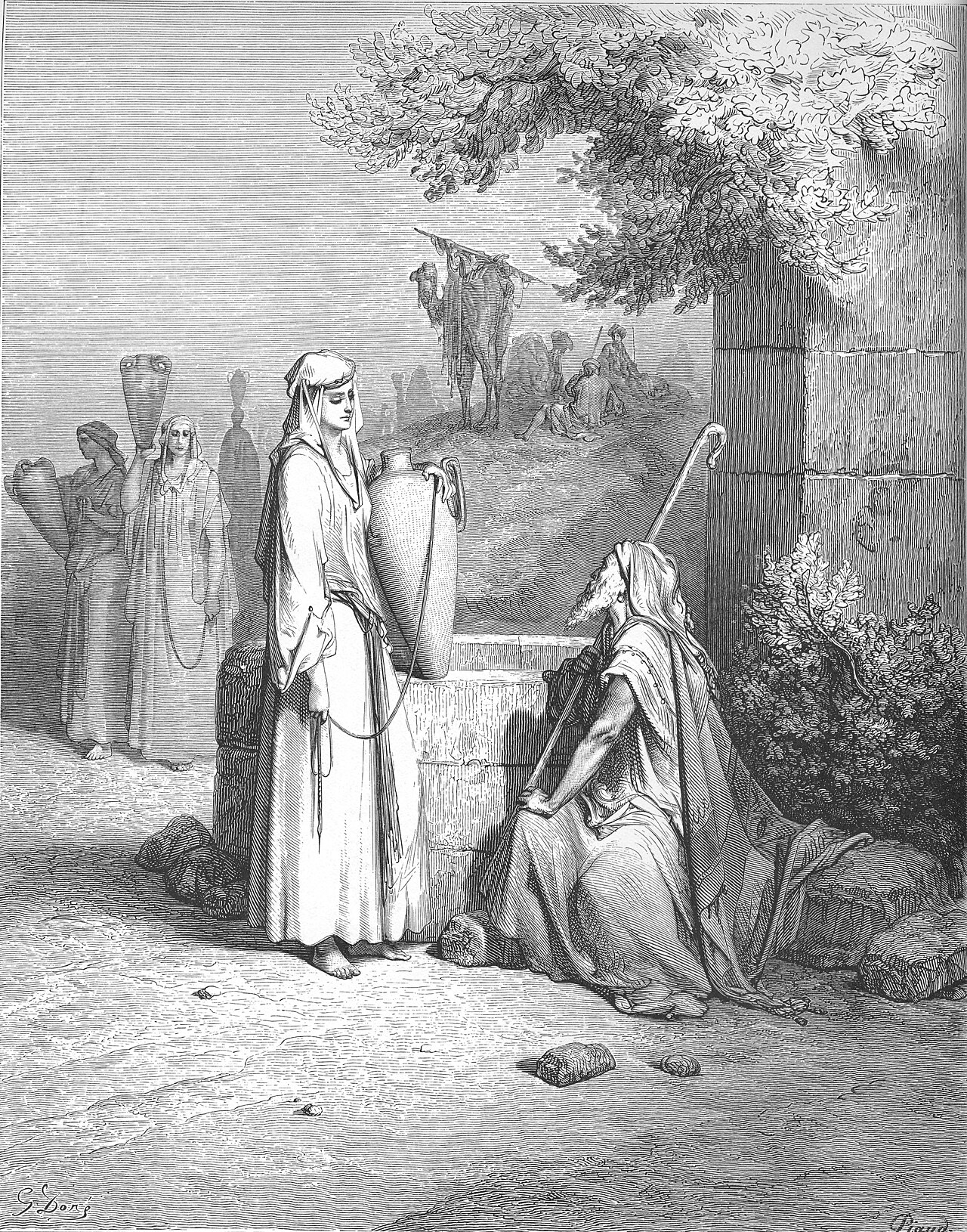
in Genesis 24“Drink, my lord,” she replied, and she quickly lowered her jar to her hands and gave him a drink.
BSB
The same verse in ASV and KJV ▾
ASV
And she said, Drink, my lord: and she hasted, and let down her pitcher upon her hand, and gave him drink.
KJV
And she said, Drink, my lord: and she hasted, and let down her pitcher upon her hand, and gave him drink.
⋯
This verse in Genesis 24
Commentary
7 notes on this verseBut when he has the desired success, he worships God, not the angel. Whatever benefit we have by the ministration of angels, all the glory must be given to the Lord of the angels, Rev. xxii.
This site's exposition
the servant ran to meet her
on Genesis 24:17-20
He runs, and after that every verb belongs to her. She lowered her jar, gave him a drink, emptied the jar into the trough, ran to the well, and drew water for all his camels. She offers the camels before he asks, which is the thing he had prayed for.
This site's exposition
she quickly lowered her jar to her hands
She answers a stranger as lord, quickly lowers her jar to her hands, and gives him a drink. Matthew Henry drew from her courtesy that a humble, charitable habit can bring more honour than anyone expects. Hers brought her into the line of Christ and the covenant.
The record, by era
The Puritans and the Awakening3 voices
Thus God swears his servants to their work, that, having sworn, they may perform it. Swearing being an ordinance, not peculiar to the church, but common to mankind, is to be performed by such signs as are the common usages of our country. God's angels are ministering spirits, sent forth, not only for the protection, but guidance of the heirs of promise, Heb. i, 14.
And she said, drink, my lord,.... Signifying at once that he was welcome to drink what he would, giving him a very honourable title, observing that he had a pretty large retinue with him of men and camels; so that she took him for some considerable personage: and she hasted, and let down her pitcher upon her hand; from off her shoulder, and let it rest upon her hand or arm: and gave him drink; let him drink what he would of it.
And she said, drink, my lord,.... Signifying at once that he was welcome to drink what he would, giving him a very honourable title, observing that he had a pretty large retinue with him of men and camels; so that she took him for some considerable personage: and she hasted, and let down her pitcher upon her hand; from off her shoulder, and let it rest upon her hand or arm: and gave him drink; let him drink what he would of it.
The Nineteenth Century1 voice
A commentator
Jamieson, Fausset & Brown1802–1910
Commentary Critical and Explanatory on the Whole Bible (1871)
proposed
Her comely appearance, her affable manners, her obliging courtesy in going down the steps to fetch water not only to him but to pour it into the trough for his camels, afforded him the most agreeable surprise. She was the very person his imagination had pictured, and he proceeded to reward her civility.
The words behind it
9 Hebrew wordsEvery Hebrew word of this verse in the order it stands, with what it means and the door to its own study. The last column counts the times a word stands in the whole Bible: the rarer the word, the more the places it appears belong together.
| Hebrew | Sound | Meaning | Word study | In the Bible |
|---|---|---|---|---|
| וַתֹּ֖אמֶר | vatomer | and she said | H559 → | 5305 times |
| שְׁתֵ֣ה | sheteh | drink | H8354 → | 217 times |
| אֲדֹנִ֑י | ʾadoni | O lord my | H113 → | 333 times |
| וַתְּמַהֵ֗ר | vatemaher | and she hurried | H4116 → | 68 times |
| וַתֹּ֧רֶד | vatored | and she put down | H3381 → | 381 times |
| כַּדָּ֛הּ | kadah | jar her | H3537 → | 18 times |
| עַל־ | ʾal- | on | H5921 → | 5755 times |
| יָדָ֖הּ | yadah | hand her | H3027 → | 1618 times |
| וַתַּשְׁקֵֽהוּ׃ | vatashkehu | and she gave a drink him | H8248 → | 61 times |
וַתֹּ֖אמֶרand she said
vatomerH559 →5305 times
שְׁתֵ֣הdrink
shetehH8354 →217 times
אֲדֹנִ֑יO lord my
ʾadoniH113 →333 times
וַתְּמַהֵ֗רand she hurried
vatemaherH4116 →68 times
וַתֹּ֧רֶדand she put down
vatoredH3381 →381 times
כַּדָּ֛הּjar her
kadahH3537 →18 times
עַל־on
ʾal-H5921 →5755 times
יָדָ֖הּhand her
yadahH3027 →1618 times
וַתַּשְׁקֵֽהוּ׃and she gave a drink him
vatashkehuH8248 →61 times
A shaded row is a word that stands 400 times or fewer in the Bible.
The walk
8 stopsEach card is a verse this one points to, and under it the verses that one points to in turn. Where several paths arrive at the same place, that place is listed first: the text keeps returning to it.
Through
1 Peter 3:8Finally, all of you, be like-minded and sympathetic, love as brothers, be tenderhearted and humble.
it leads to
- Romans 12:10
Be devoted to one another in brotherly love. Outdo yourselves in honoring one another.
- Ephesians 4:31
Get rid of all bitterness, rage and anger, outcry and slander, along with every form of malice.
- 1 Peter 1:22
Since you have purified your souls by obedience to the truth so that you have a genuine love for your brothers, love one another deeply, from a pure heart.
- Philippians 4:8–9
Finally, brothers, whatever is true, whatever is honorable, whatever is right, whatever is pure, whatever is lovely, whatever is admirable—if anything is excellent or praiseworthy—think on these things.
- James 3:17
But the wisdom from above is first of all pure, then peace-loving, gentle, accommodating, full of mercy and good fruit, impartial, and sincere.
- Romans 12:10
Through
Proverbs 31:26She opens her mouth with wisdom, and faithful instruction is on her tongue.
it leads to
- Ephesians 4:29
Let no unwholesome talk come out of your mouths, but only what is helpful for building up the one in need and bringing grace to those who listen.
- Proverbs 16:24
Pleasant words are a honeycomb, sweet to the soul and healing to the bones.
- Proverbs 10:31
The mouth of the righteous brings forth wisdom, but a perverse tongue will be cut out.
- Ephesians 4:29
Where this verse is studied
On this page
Studies5
About Genesis
This page draws on Adam Clarke, Commentary on the Bible; Jamieson, Fausset & Brown, Commentary Critical and Explanatory on the Whole Bible; John Gill, Exposition of the Old Testament (1748-1763); John Wesley, Explanatory Notes upon the Old Testament and Matthew Henry, Commentary on the Whole Bible.