
Genesis 24:11
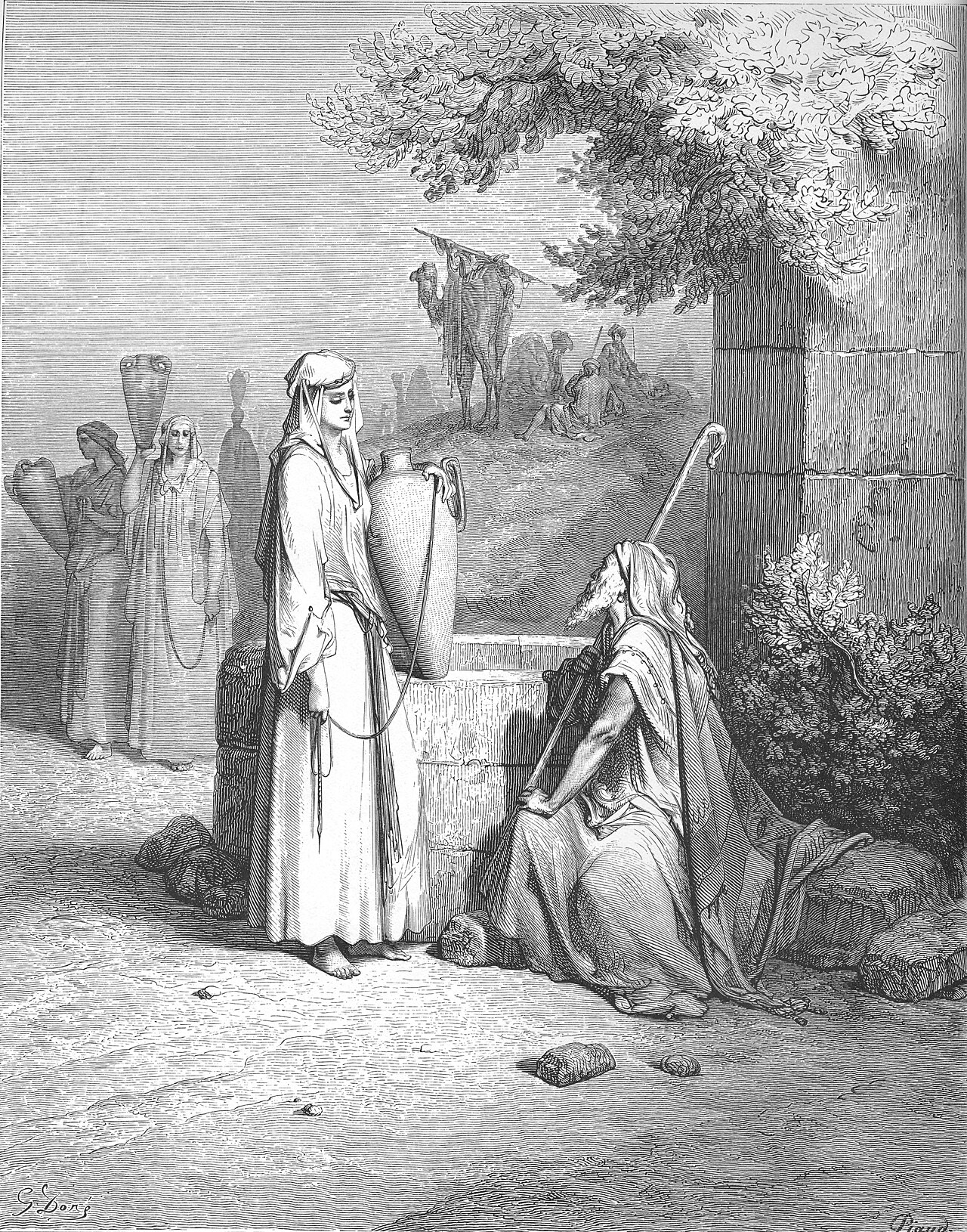
in Genesis 24As evening approached, he made the camels kneel down near the well outside the town at the time when the women went out to draw water.
BSB
The same verse in ASV and KJV ▾
ASV
And he made the camels to kneel down without the city by the well of water at the time of evening, the time that women go out to draw water.
KJV
And he made his camels to kneel down without the city by a well of water at the time of the evening, even the time that women go out to draw water.
⋯
This verse in Genesis 24
Commentary
5 notes on this verseHe made his camels to kneel down - To rest themselves, or lie down, as the Septuagint has very properly expressed it, Και εκοιμισε τας καμηλους. The time that women go out to draw water - In Bengal it is the universal practice for the women to go to pools and rivers to fetch water. Companies of four, six, ten, or more, may be seen in every town daily going to fetch water, with the pitchers resting upon their sides; and, on their return from bathing, women frequently bring water home - Ward.
This site's exposition
he made the camels kneel down near the well outside the town
This is the first well meeting in Scripture. A traveller reaches the ancestral country, stops at a well, a woman draws water, she runs home with the news, and the traveller is taken into the house. Jacob meets Rachel this way in chapter 29 and Moses meets Zipporah in Exodus 2. John 4 opens with Jesus at a well asking a Samaritan woman for a drink.
The record, by era
The Church Fathers1 voice
"In the evening," therefore, she came to the waters. We have already spoken above about evening. But behold the prudence of the servant. He does not wish to take a bride for his master, Isaac, unless he finds a virgin becoming and beautiful in appearance, and not only a virgin, but one whom a man has not touched. She must be one whom he should discover drawing water. He does not wish to betroth another to his master.He does not give her jewelry unless she is such a person. He does not give "earrings"; he does not give "bracelets."
The Puritans and the Awakening2 voices
But when he has the desired success, he worships God, not the angel. Whatever benefit we have by the ministration of angels, all the glory must be given to the Lord of the angels, Rev. xxii.
And he made his camels to kneel down,.... Which these creatures are used to do when they are loaded and unloaded, and also when they take rest, and it was for the sake of the latter they were now made to kneel.
How the passage was read
What the Jewish commentators add
On the verses either side of this one
Rashi comments: “This refers to a deed of gift of all his possessions which he wrote in favor of Isaac so that they would be eager to send him their daughter.” And so it is also stated in Bereshith Rabbah, 106:15. “He carried with him a disposition of property.
This section is reception history: how the passage was read and kept in the Jewish tradition. Where a reading parts from an essential of the Christian faith, the section says so at that point.
Texts and citation data: Sefaria; each excerpt follows its version’s licence. 3 further sources are cited on this chapter that carry no English text this site may quote or only restate the verse.
The words behind it
12 Hebrew wordsEvery Hebrew word of this verse in the order it stands, with what it means and the door to its own study. The last column counts the times a word stands in the whole Bible: the rarer the word, the more the places it appears belong together.
| Hebrew | Sound | Meaning | Word study | In the Bible |
|---|---|---|---|---|
| וַיַּבְרֵ֧ךְ | vaiyavrekh | and he made kneel | H1288 → | 330 times |
| הַגְּמַלִּ֛ים | hagemalim | the camels | H1581 → | 54 times |
| מִח֥וּץ | michutz | from [the] outside | H2351 → | 164 times |
| לָעִ֖יר | lair | of the city | H5892 → | 1090 times |
| אֶל־ | ʾel- | to | H413 → | 5510 times |
| בְּאֵ֣ר | beer | [the] well of | H875 → | 38 times |
| הַמָּ֑יִם | hamayim | the water | H4325 → | 581 times |
| לְעֵ֣ת | leet | to [the] time of | H6256 → | 296 times |
| עֶ֔רֶב | ʾerev | evening | H6153 → | 134 times |
| לְעֵ֖ת | leet | to [the] time of | H6256 → | 296 times |
| צֵ֥את | tzet | [the] going out of | H3318 → | 1067 times |
| הַשֹּׁאֲבֹֽת׃ | hashoavot | the [women who] draw water | H7579 → | 19 times |
וַיַּבְרֵ֧ךְand he made kneel
vaiyavrekhH1288 →330 times
הַגְּמַלִּ֛יםthe camels
hagemalimH1581 →54 times
מִח֥וּץfrom [the] outside
michutzH2351 →164 times
לָעִ֖ירof the city
lairH5892 →1090 times
אֶל־to
ʾel-H413 →5510 times
בְּאֵ֣ר[the] well of
beerH875 →38 times
הַמָּ֑יִםthe water
hamayimH4325 →581 times
לְעֵ֣תto [the] time of
leetH6256 →296 times
עֶ֔רֶבevening
ʾerevH6153 →134 times
לְעֵ֖תto [the] time of
leetH6256 →296 times
צֵ֥את[the] going out of
tzetH3318 →1067 times
הַשֹּׁאֲבֹֽת׃the [women who] draw water
hashoavotH7579 →19 times
A shaded row is a word that stands 400 times or fewer in the Bible.
The walk
8 stopsEach card is a verse this one points to, and under it the verses that one points to in turn. Where several paths arrive at the same place, that place is listed first: the text keeps returning to it.
Through
Proverbs 12:10A righteous man regards the life of his animal, but the tender mercies of the wicked are only cruelty.
it leads to
- Deuteronomy 25:4
Do not muzzle an ox while it is treading out the grain.
- Numbers 22:28–32
Then the LORD opened the donkey’s mouth, and she said to Balaam, “What have I done to you that you have beaten me these three times?”
- Genesis 33:13–14
But Jacob replied, “My lord knows that the children are frail, and I must care for sheep and cattle that are nursing their young. If they are driven hard for even a day, all…
- Deuteronomy 25:4
Through
Exodus 2:16Now the priest of Midian had seven daughters, and they came to draw water and fill the troughs to water their father’s flock.
it leads to
- Exodus 3:1
Meanwhile, Moses was shepherding the flock of his father-in-law Jethro, the priest of Midian. He led the flock to the far side of the wilderness and came to Horeb, the mountain of God.
- 1 Samuel 9:11
And as they were climbing the hill to the city, they met some young women coming out to draw water and asked, “Is the seer here?”
- Genesis 24:14–20
Now may it happen that the girl to whom I say, ‘Please let down your jar that I may drink,’ and who responds, ‘Drink, and I will water your camels as well’—let her be…
- Exodus 3:1
Through
John 4:7When a Samaritan woman came to draw water, Jesus said to her, “Give Me a drink.”
it leads to
- Matthew 10:42
And if anyone gives even a cup of cold water to one of these little ones because he is My disciple, truly I tell you, he will never lose his reward.”
- 1 Kings 17:10
So Elijah got up and went to Zarephath. When he arrived at the city gate, there was a widow gathering sticks. Elijah called to her and said, “Please bring me a little water in…
- Matthew 10:42
Where this verse is studied
About Genesis
This page draws on Adam Clarke, Commentary on the Bible; Chuck Missler, The Book of Genesis; John Gill, Exposition of the Old Testament (1748-1763); Matthew Henry, Commentary on the Whole Bible and Origen of Alexandria, HOMILIES ON GENESIS 10.4.