Historical Books · 2 Chronicles
Seek Him, and He Will Be Found
Solomon builds the temple at Judah's high-water mark, and the glory of the LORD fills it so completely the priests cannot stand to minister (5:13–14) — then fire falls from heaven to prove it was no illusion (7:1–3). From there the Chronicler measures king after king of Judah alone by one test — did he seek the LORD (darash) or forsake him (azab) — with blessing and judgment following inside a single reign, not centuries later. And when the temple finally burns and the land pays its unkept sabbaths (36:19–21), the book's last two verses hand the ruins to a pagan king with one line: “let him go up.”

The Reigns of Judah
— a court chronicle shaped by the book's own proportions — every reign a door2 Chronicles narrates only Judah — the north appears just where its history intersects the south's — so the spine below is a single ledger, not twin thrones. Its rows are not equal in size on purpose: Solomon, Hezekiah and Josiah get the wide panels the book itself gives them; the last four kings are compressed into one strip, because the Chronicler visibly is too.
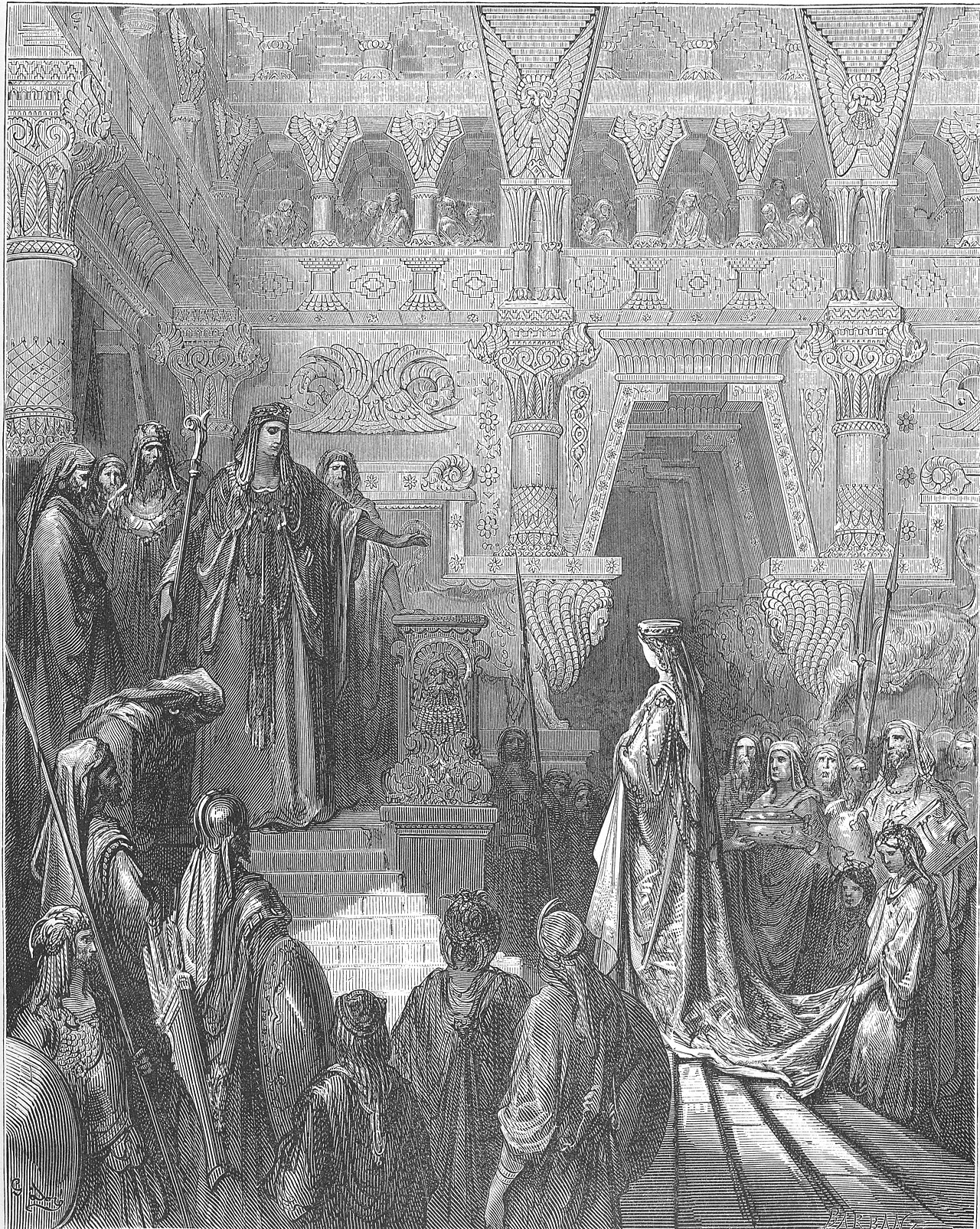
The Gibeon sacrifice and the gift of wisdom (1:1–17) open the reign; the temple rises through the alliance with Huram of Tyre (2:1–5:1). The ark is brought in, and the glory-cloud fills the house so completely “the priests could not stand to minister” (5:13–14) — then fire falls from heaven to consume the sacrifice (7:1–3), a detail this book adds that the 1 Kings parallel does not have. Solomon's dedication prayer and the LORD's night-answer, climaxing at 7:14, is the book's theological center. And in a literary choice the Chronicler makes on purpose, not by oversight, this reign never mentions Solomon's later apostasy (1 Kgs 11:1–8) — an unclouded ideal for a rebuilding people to look back toward.
- Rehoboam2 Chr 10:1–12:16
Forsook the law after the kingdom split at Shechem (10:1–19); Shishak of Egypt invades in his fifth year (12:2–9) — but when king and princes “humbled themselves,” the LORD grants “some deliverance” (12:6–7), the 7:14 pattern already operating two chapters after the temple prayer.
- Abijah2 Chr 13:1–22
Israel's aggressor, Judah's underdog — his battle-speech at Zemaraim, largely unique to Chronicles, stakes everything on “God is with us at our head” before the LORD routs Jeroboam's larger army.
- Asa2 Chr 14:1–16:14
Sought the LORD (darash) through reform and the Zerah-the-Cushite deliverance (14:9–15) — then, in his last illness, “sought not to Jehovah, but to the physicians” (16:12), after imprisoning the seer Hanani for rebuking his Syrian alliance.
- Jehoshaphat2 Chr 17:1–20:37
Reforms and teaching Levites sent through Judah (17:7–9); the chapter 20 prayer and the Spirit-given oracle through Jahaziel — “the battle is not yours, but God's” (20:15) — is the book's set-piece deliverance. The Ezion-geber fleet is wrecked specifically because he “joined thyself with Ahaziah” (20:35–37).
- Jehoram2 Chr 21:1–20
Married into Ahab's house and killed his own brothers; Elijah's letter — found nowhere else in Scripture — pronounces the judgment that follows (21:12–15). Even so, the LORD “would not destroy the house of David... to give a lamp to him and to his children alway” (21:7).
- Ahaziah2 Chr 22:1–9
A one-year reign in his mother Athaliah's shadow — the opening move of the usurpation crisis the next chapter narrates in full.
- Athaliah2 Chr 22:10–23:15
The book's only reigning queen — seizes the throne by destroying the royal seed, until Jehoiada the priest hides the infant Joash six years and stages the restoration.
- Joash2 Chr 23:1–24:27
Right throughout Jehoiada's life; after the priest's death, turns to the Asherim and has Jehoiada's own son Zechariah stoned in the temple court for rebuking the apostasy (24:20–22) — the murder Jesus himself cites centuries later (Luke 11:51).
- Amaziah2 Chr 25:1–28
A mixed reign, in the Chronicler's own verdict (25:1–28) — early promise the book does not carry to full detail here.
- Uzziah2 Chr 26:1–23
“Sought God” in his youth and prospered “till he was strong” (26:5) — then in his strength “trespassed against Jehovah his God” by presuming to burn incense in the temple, and was struck with leprosy in the same scene (26:16–21).
- Jotham2 Chr 27:1–9
Nine verses between Uzziah's judgment and Ahaz's apostasy — the outline's briefest reign.
- Ahaz2 Chr 28:1–27
Apostasy and Assyrian vassalage — the reign immediately preceding the book's second high point, his son Hezekiah's reform.
Temple cleansing and reconsecration (29:1–36) open a reign the Chronicler gives disproportionate space relative to Kings. The reunification Passover (30:1–27) — an invitation sent even to the remnant of the fallen northern tribes — is unique to this book and its clearest “all Israel” appeal. Sennacherib's invasion and Jerusalem's deliverance (32:1–23) parallel 2 Kings 18–19; the summary of Hezekiah's illness, pride, and humbling closes the reign (32:24–33). “After him was none like him among all the kings of Judah” is Kings' verdict on this king; here, the Chronicler lets a whole Passover prove it.
Reform begun in youth, then the temple repair that turns up “the book of the law” (34:1–33) — authenticated by Huldah the prophetess. No passover like it had been kept in Israel “from the days of Samuel the prophet” (35:1–19). The reign ends abruptly: Josiah dies at Megiddo against Pharaoh Necho (35:20–27) — the last bright reign before the compressed fall that closes the book.
The worst sin, and the deepest repentance — 33:1–20Manasseh — altars “for all the host of heaven,” divination, a son made “to pass through the fire” (33:1–9) — followed by material found nowhere in 2 Kings: captivity in Babylon, and a king who “humbled himself greatly... and he prayed unto him; and he was entreated of him... and brought him again to Jerusalem into his kingdom” (33:12–13). Fifty-five years on the throne — the longest reign of any Davidic king. His son Amon took none of the second half: two years, purely evil, no recorded turn (33:21–25).The last four — 36:1–21Jehoahaz · Jehoiakim · Jehoiachin · ZedekiahFour reigns compressed into twenty-one verses — the Chronicler visibly in a hurry now. The verdict is collective: “all the chiefs of the priests, and the people, trespassed very greatly” (ma'al) — “till there was no remedy” (36:14–16). The temple burns; the vessels go to Babylon; and the Chronicler adds a gloss Kings never makes — the land finally enjoying “her sabbaths... to fulfil threescore and ten years” (36:21).The hinge — 36:22–23The book's — and, in Hebrew canon order, the whole Old Testament's — closing words: a pagan king commissioned to say “let him go up,” nearly verbatim the opening of Ezra. The Cyrus Cylinder corroborates the general Persian policy of restoring displaced peoples' cults; it never names Judah, Jerusalem, or the temple, so it backs the policy Cyrus is known to have practiced, not the specific decree this text records.The Argument
— the whole book in three sentences- Author
- Anonymous in the text; Jewish tradition credits Ezra
- Date
- Post-exilic; traditionally c. 450–400 BC, some scholarship later still
- Genre
- Priestly-theological historiography — a restoration charter
- Span
- 36 chapters · Judah alone · c. 970–539 BC narrated
- 1
Solomon inherits David's kingdom at its most united and builds the temple, where the glory of the LORD descends so visibly the priests cannot minister and fire falls from heaven to consume the sacrifice — the book's high-water mark.
- 2
Through three and a half centuries of Judah's kings alone, the Chronicler measures each reign by a single test — did the king seek the LORD or forsake him — with blessing and judgment following swiftly within each reign, not merely at the story's end.
- 3
The book closes with the temple burned and the land finally paying its unkept sabbaths, then pivots, in its very last two verses, to Cyrus of Persia proclaiming “let him go up” — the hinge directly into Ezra.
The Keystone — 7:14
— one verse, four steps down, four steps back — the pattern the rest of the book appliesIf my people...
This is not an isolated proof-text — it is the pattern the Chronicler then applies, king by king, for the rest of the book: Rehoboam's princes humbling themselves (12:6–7), Manasseh's captivity-prayer (33:12–13), and the whole rest of 2 Chronicles reads as an extended demonstration that 7:14 is operative history, not merely liturgy.
Open 2 Chronicles 7:14 →Christ in 2 Chronicles
— six lines run from this book to HimThe glory-filled house is the OT's dwelling-chain peak, and 2 Chronicles is more concentrated on the glory-event itself than the 1 Kings parallel — adding the fire-from-heaven detail at 7:1–3. Solomon's own prayer relativizes the building: “will God in very deed dwell with men on the earth?... how much less this house” (6:18) — read forward through John's identification of Christ's own body as the true temple.
Humble, pray, seek, turn — then hear, forgive, heal. The covenant-nation pattern anticipates the individual gospel shape of repentance leading to forgiveness; James 4's “Humble yourselves in the sight of the Lord, and he shall exalt you” is verbally close enough to be a live cross-link.
The explicit statement that the LORD spared David's house “because of the covenant that he had made with David... to give a lamp to him and to his children alway” is this book's own witness to the unconditional promise Gabriel announces fulfilled in Jesus — a throne that, unlike every Chronicles king's, cannot be forfeited by unfaithfulness.
Open the study →A king who built altars “for all the host of heaven” and made his son “pass through the fire” — the single worst apostasy of any Davidic king — “humbled himself greatly... and he prayed unto him; and he was entreated of him.” Material found nowhere in 2 Kings, and the OT's nearest analogue to the thief on the cross or Paul's “chief” of sinners shown mercy “for an ensample.”
The book's closing verses hand Judah's future to a pagan king Isaiah, writing before the fact, had already named “his anointed” (mashiach). God raising an outsider to accomplish covenant deliverance is a recurring OT shape the incarnation completes in a different register — not an outsider used by God, but God himself entering the outsider's place.
As with 1 Kings, Solomon's own prayer guards against over-localizing God's presence in the building itself. Read forward, that guard is answered rather than abandoned — the Word became flesh and “tabernacled” among us, the true temple John 2 says Jesus himself is.
Themes
— six load-bearing lines through the bookSeek and forsake, the controlling verbs
Darash and azab govern nearly every regnal verdict in the book — not abstract virtues but the single axis every king is measured on, again and again.
Immediate retribution, compressed
Where Kings lets Deuteronomy 28's curses unfold over centuries, Chronicles narrates cause and effect inside a single reign — vivid, instructive, and, per critical scholarship, sometimes supplying detail Kings omits.
The temple as center of gravity
Construction, dedication, cleansing, and two great Passovers receive chapter-length treatment Kings compresses to a verse or two — because the temple's restoration IS the returning community's restoration.
7:14 as operative history
Not an isolated proof-text — the humble/pray/seek/turn pattern is what the Chronicler then shows happening, king by king, for the rest of the book.
“All Israel,” an ideal not surrendered
Despite narrating only Judah's kings, Hezekiah's Passover invitation reaches for the whole twelve-tribe people, including the northern remnant — the returning community's founding self-understanding.
The Davidic covenant, unconditional beneath conditional kings
Even Jehoram's Baal apostasy cannot break the promise to David's house — the same unconditional grant Luke 1:32–33 announces fulfilled.
Original Language
— eight keynotes — the book's own evaluative grammarIsaiah names Cyrus “his anointed” — mashiach, h4899 — before the fact (Isa 45:1). That word belongs to Isaiah's own text, not this book's, and is carried here only as the cross-book note the dossier flags it as.
The Approved Voices on 2 Chronicles
— the roster applied — the specific work named where confirmedIntercessory Prayer (1996)
“Intercessory prayer is an extension of the ministry of Jesus through His Body, the Church” — his covenant-prayer theology draws in part on 7:14's pattern. The roster's single most direct modern voice for this book.
the Hebrides Revival framework (per the roster's node)
Reads “covenant-prayer methodology drawn from 2 Chronicles 7:14” as revival's “operational foundation” — the roster's clearest citation naming this book's central verse.
work title unconfirmed this session
“Prayer is foundational and non-negotiable for revival” — the natural pairing voice for 7:14's “then will I hear” as the pattern's answering half.
method only — no confirmed dedicated work on 2 Chronicles or Cyrus
Marcus Brown's formative teacher; his typology and numerical-design method applies naturally to the temple's dedication numerics, shared ground with 1 Kings.
The Holiness of God (1985)
“If we lose our awe of God, we lose our dependence upon Him” — applied to 5:13–14/7:1–3's glory-and-fire scene, and to Uzziah's incense judgment (26:16–21) alike.
the manifest-presence corpus
God's manifest presence is the church's true currency (paraphrase) — the warning behind the gap between the temple's built magnificence and its later-departed glory (36:19).
work/chapter unconfirmed this session
The natural apologetics voice for Manasseh's attestation in Assyrian vassal-lists and the Cyrus Cylinder's corroboration-with-caveats (see Contested Points).
specific works unconfirmed this session
Applicable to Manasseh's own confession-and-restoration (33:12–13) and the corporate-confession pattern shared with Ezra 9, Nehemiah 9, and Daniel 9.
Commentary on the Whole Bible, on 2 Chronicles
Reads the fourfold condition of 7:14 as a pattern for “national repentance” whenever a professing people fall into sin — while grounding it first in Israel's own temple-covenant.
A Commentary, Critical and Explanatory, on the Whole Bible
Concise notes strongest on the Chronicles/Kings parallel-passage cross-references this book invites at nearly every chapter; guards 6:18 against over-localizing God's presence in the building.
Biblical Commentary on the Old Testament: The Books of the Chronicles
The standard philological defense of Chronicles as independent, reliable historiography rather than late theological fiction — the source behind this page's Hebrew keynotes.
Explanatory Notes upon the Old Testament
Reads Manasseh's captivity and restoration (33:12–13) as proof that none are excluded from mercy who sincerely turn to God — the Arminian-friendly reading of the chapter.
Two honest absences, worth naming so nobody goes looking: Calvin's surviving Old Testament commentary corpus does not appear to include a formal commentary on Chronicles. And while Spurgeon very likely preached directly on “if my people” given 7:14's enormous popular currency, no specific sermon is confirmed against the primary index this session — his documented position affirming the future national restoration of Israel is the relevant background this page carries instead. Marcus Brown's own commentary leads above all; within a tier, all voices are equal.
Contested Points
— presented at full strength, then MannaFest's flag2 Chronicles 7:14 — a promise to Israel, or a pattern for any nation?
The covenant-specific reading
In its own context, 7:14 answers Solomon's temple-dedication prayer, addressed to “my people, who are called by my name” — Israel under the Mosaic/Davidic covenant, praying toward this house (7:15–16). A conditional national promise tied to Deuteronomy 28–30's land-and-temple structure, not a generic civic-religion formula detachable from Israel.
The typological/applicational reading
The pattern itself — humbling, prayer, seeking God's face, turning, answered by hearing, forgiveness, healing — recurs across Scripture as God's disposition toward any repenting covenant people (Jonah 3; Daniel 9), and roster voices read it operationally: Rev. Owen Murphy treats it as revival prayer's “operational foundation,” and Dutch Sheets builds his covenant-prayer theology on it.
MannaFest flag — MannaFest presents both readings side by side — the text's own address to Israel, and the church's/revivalist tradition's longstanding typological application — without collapsing one into the other, and flags the popularized civic-religion usage as the point most likely to overclaim beyond the text.
Immediate-retribution theology — pedagogy, or overreading of the sources?
The pedagogical reading
The Chronicler's tight cause-effect narration — Asa's disease, Uzziah's leprosy, the Ezion-geber fleet's wreck tied explicitly to the Ahaziah alliance where the 1 Kings parallel gives no reason — is deliberate theological commentary, making moral cause-and-effect vivid for a community that needed to understand why the exile happened.
The critical reading
Critical scholarship (e.g. Sara Japhet) has argued the Chronicler at points supplies additional sins not present in Kings specifically to explain judgments Kings leaves unexplained — retrospective theological midrash rather than independent historical reportage. Job and Ecclesiastes themselves resist a flat immediate-retribution law.
MannaFest flag — MannaFest reads Chronicles as inspired, purposeful theological retelling — selecting and arranging true material for didactic effect is not fabrication — while naming the critical observation as a real feature of the text's compositional method, not adopting its skepticism about the underlying events.
Manasseh's Babylonian captivity (33:11–13) — corroborated history, or a Chronicler-only construction?
The historical-plausibility case
Manasseh is independently attested in Assyrian records — Esarhaddon's and Ashurbanipal's annals list him among tribute-paying vassal kings — confirming his reign and unusually long tenure (55 years), and Assyrian practice of summoning or detaining vassal kings for loyalty-enforcement makes a Babylon-detention episode plausible even without a record naming it specifically.
The construction hypothesis
No Assyrian or Babylonian text independently records Manasseh's arrest, transport, or captivity by name; some critical readers treat the episode as the Chronicler's theological invention, engineered to explain the awkward fact of a 55-year reign for the worst-apostasy king under the book's own retribution logic.
MannaFest flag — MannaFest presents the narrative as historical — Manasseh's attested vassal-king status makes the broader Assyrian-summons scenario credible — while stating plainly that no artifact names the specific captivity episode: corroboration of plausibility, not direct confirmation.
The Cast
— beyond the kings — the prophets, priests, and the one gentile who closes the bookPlaces