
Genesis 27:2
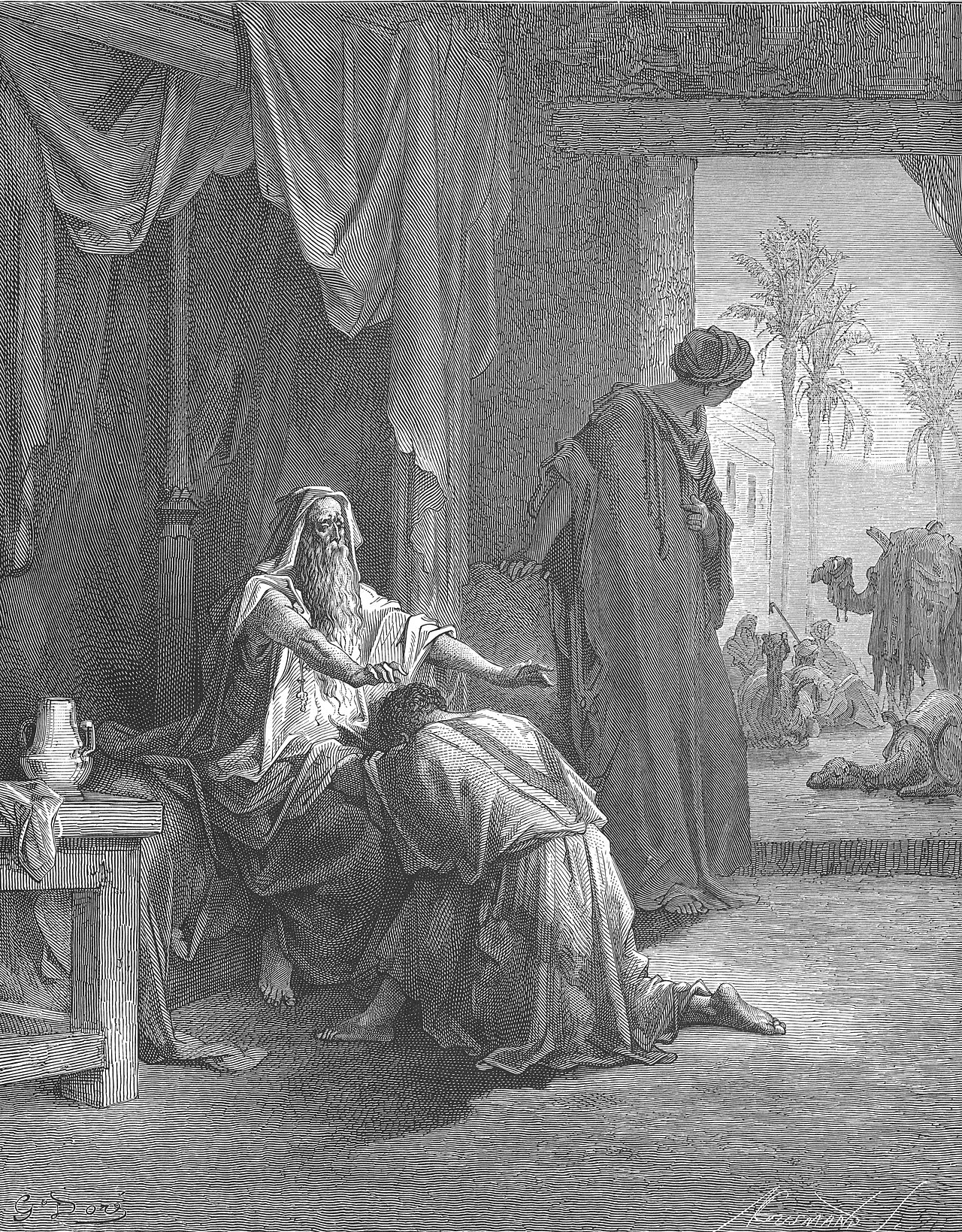
in Genesis 27“Look,” said Isaac, “I am now old, and I do not know the day of my death.
BSB
The same verse in ASV and KJV ▾
ASV
And he said, Behold now, I am old, I know not the day of my death.
KJV
And he said, Behold now, I am old, I know not the day of my death:
⋯
This verse in Genesis 27
Commentary
5 notes on this verseI know not the day of my death - From his present weakness he had reason to suppose that his death could not be at any great distance, and therefore would leave no act undone which he believed it his duty to perform. He who lives not in reference to eternity, lives not at all.
This site's exposition
his eyes were so weak
on Genesis 27:1-2
Isaac is old, and his eyes are too weak to see. He calls his older son Esau and tells him he does not know the day of his death. He asks for a tasty dish of the game Esau hunts, and says he will bless him before he dies. Isaac lives on many years, and 35:28 gives his age at death as a hundred and eighty.
This site's exposition
the day of my death
Isaac is old and cannot see, and he does not know the day of his death, so he moves to bless his son now. Adam Clarke read this as a weak man settling his last duty. Albert Barnes counted forty-four more years of life for Isaac.
The record, by era
The Puritans and the Awakening2 voices
And he said, behold, now I am old,.... See Gill on Gen 27:1, I know not the day of my death; how soon it will be; everyone knows he must die, but the day and hour he knows not, neither young nor old; and though young men may promise themselves many days and years, an old man cannot, but must or should live in the constant expectation of death.
The heart and the house should both be set, and kept, in order, because at such an hour as we think not the Son of man comes; because we know not the day of our death, we are concerned to mind the business of life.
How the passage was read
What the Jewish commentators add
On the verses either side of this one
And when Yitzchok grew old his eyesight faded and he could not see.
This section is reception history: how the passage was read and kept in the Jewish tradition. Where a reading parts from an essential of the Christian faith, the section says so at that point.
Texts and citation data: Sefaria; each excerpt follows its version’s licence. 3 further sources are cited on this chapter that carry no English text this site may quote or only restate the verse.
The words behind it
8 Hebrew wordsEvery Hebrew word of this verse in the order it stands, with what it means and the door to its own study. The last column counts the times a word stands in the whole Bible: the rarer the word, the more the places it appears belong together.
| Hebrew | Sound | Meaning | Word study | In the Bible |
|---|---|---|---|---|
| וַיֹּ֕אמֶר | vaiyomer | and he said | H559 → | 5305 times |
| הִנֵּה־ | hineh- | here! | H2009 → | 843 times |
| נָ֖א | na' | please | H4994 → | 404 times |
| זָקַ֑נְתִּי | zakanti | I am old | H2204 → | 27 times |
| לֹ֥א | lo' | not | H3808 → | 5168 times |
| יָדַ֖עְתִּי | yada'ti | I know | H3045 → | 945 times |
| י֥וֹם | yom | [the] day of | H3117 → | 2304 times |
| מוֹתִֽי׃ | moti | death my | H4194 → | 156 times |
וַיֹּ֕אמֶרand he said
vaiyomerH559 →5305 times
הִנֵּה־here!
hineh-H2009 →843 times
נָ֖אplease
na'H4994 →404 times
זָקַ֑נְתִּיI am old
zakantiH2204 →27 times
לֹ֥אnot
lo'H3808 →5168 times
יָדַ֖עְתִּיI know
yada'tiH3045 →945 times
י֥וֹם[the] day of
yomH3117 →2304 times
מוֹתִֽי׃death my
motiH4194 →156 times
A shaded row is a word that stands 400 times or fewer in the Bible.
The walk
8 stopsEach card is a verse this one points to, and under it the verses that one points to in turn. Where several paths arrive at the same place, that place is listed first: the text keeps returning to it.
Through
Ecclesiastes 9:10Whatever you find to do with your hands, do it with all your might, for in Sheol, where you are going, there is no work or planning or knowledge or wisdom.
it leads to
- Colossians 3:23
Whatever you do, work at it with your whole being, for the Lord and not for men,
- Ephesians 5:16
redeeming the time, because the days are evil.
- Romans 12:11
Do not let your zeal subside; keep your spiritual fervor, serving the Lord.
- Psalms 6:5
For there is no mention of You in death; who can praise You from Sheol?
- Ecclesiastes 11:6
Sow your seed in the morning, and do not rest your hands in the evening, for you do not know which will succeed, whether this or that, or if both will equally prosper.
- Colossians 3:23
Through
James 4:14You do not even know what will happen tomorrow! What is your life? You are a mist that appears for a little while and then vanishes.
it leads to
- 1 Peter 1:24
For, “All flesh is like grass, and all its glory like the flowers of the field; the grass withers and the flowers fall,
- Psalms 39:5
You, indeed, have made my days as handbreadths, and my lifetime as nothing before You. Truly each man at his best exists as but a breath. Selah
- 1 Peter 1:24
Through
Proverbs 27:1Do not boast about tomorrow, for you do not know what a day may bring.
it leads to
- James 4:13–16
Come now, you who say, “Today or tomorrow we will go to this or that city, spend a year there, carry on business, and make a profit.”
- James 4:13–16
Where this verse is studied
About Genesis
Who and where
1 name in this verse with a page on the site.
This page draws on Adam Clarke, Commentary on the Bible; Albert Barnes, Notes, Explanatory and Practical, on the Old and New Testaments (1832-1869); John Gill, Exposition of the Old Testament (1748-1763) and Matthew Henry, Commentary on the Whole Bible.