
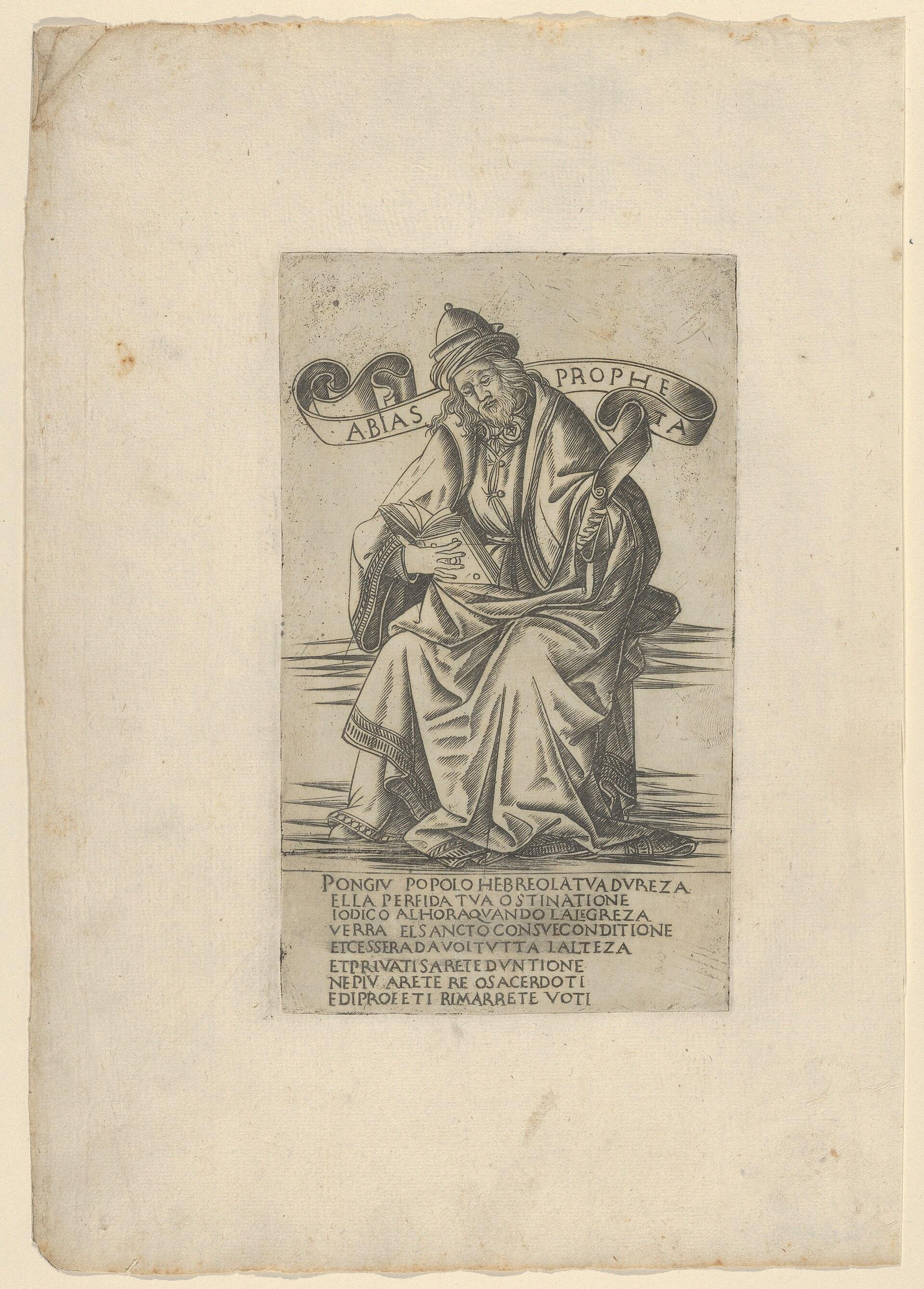
The Prophet Obadiah, from Prophets and Sibyls, Florence, 1480 to 1490. CC0.
Obadiah 1:1 and Obadiah 1:21 · Person · Featured Study
Obadiah the Prophet: Who He Was
Everything known of the prophet comes from the twenty-one verses that carry his name.
Obadiah's name says what he was, a servant of the LORD.
The deliverers will ascend Mount Zion to rule over the mountains of Esau. And the kingdom will belong to the LORD.
The deliverers will ascend Mount Zion to rule over the mountains of Esau. And the kingdom will belong to the LORD.
- The name means
- servant of the LORD
- Places
- Jerusalem, Edom
- First named
- Obadiah 1:1 “This is the vision of Obadiah: This is…”
Summary
Obadiah's book is one vision against Edom. Edom came from Esau, Jacob's brother. It turned on Judah, its brother nation, in Judah's worst hour.
- The name Obadiah stands in nineteen verses, and only one of them names the prophet.
- Jewish tradition took him to be the steward who hid a hundred prophets from Jezebel.
- Keil and Gill put him in two different centuries.
The Vision of Obadiah
The book's first verse names its prophet and calls his message a vision.
This is the vision of Obadiah: This is what the Lord GOD says about Edom—We have heard a message from the LORD; an envoy has been sent among the nations to say, “Rise up, and let us go to battle against her!”—Every later word of the book stands under this heading.
Strong's lexicon, the numbered index of the Bible's Hebrew and Greek words, counts thirteen men in Israel who bore the name (H5662). Albert Barnes, in his Notes on 1 Kings 18:3, compared it with the Arabic name Abdallah.
The History Behind His Vision
Obadiah's charge against Edom rests on a quarrel between brothers that runs from Genesis to the fall of Jerusalem.
Edom turned on Jacob's house at the border, in a revolt and on the day the city fell.
- Twin brothersEsau and Jacob are born to Rebekah, two nations in one wombGenesis 25:23 to 26
- The grudgeEsau plans to kill his brother JacobGenesis 27:41
- The road refusedEdom refuses Israel passage on the way from EgyptNumbers 20:18 to 21
- The revoltEdom rebels against Judah in the days of Jehoram2 Kings 8:20 to 22
- The fall of JerusalemThe sons of Edom cry, tear it down to its foundationsPsalm 137:7
Five moments in the story of Edom and Israel, in the order of the events, each with its verse.
What His Vision Says
Obadiah's twenty-one verses turn from Edom's pride to its charge, and then to the Day of the LORD on all the nations.
Edom brought downObadiah 1:1 to 9
The pride of your heart has deceived you, O dwellers in the clefts of the rocks whose habitation is the heights, who say in your heart, ‘Who can bring me down to the ground?’ Though you soar like the eagle and make your nest among the stars, even from there I will bring you down,” declares the LORD.The book opens its charge with Edom's trust in its high home.
The charge against EdomObadiah 1:10 to 14
Because of the violence against your brother Jacob, you will be covered with shame and cut off forever. On the day you stood aloof while strangers carried off his wealth and foreigners entered his gate and cast lots for Jerusalem, you were just like one of them.These verses give the reason for the judgment.
The Day of the LORDObadiah 1:15 to 21
But on Mount Zion there will be deliverance, and it will be holy, and the house of Jacob will reclaim their possession.The last part of the book sets Zion's future against Edom's.
Was He Ahab's Steward?
An Obadiah in charge of King Ahab's palace hid a hundred prophets of the LORD from Jezebel.
and Ahab summoned Obadiah, who was in charge of the palace. (Now Obadiah greatly feared the LORD, for when Jezebel had slaughtered the prophets of the LORD, Obadiah had taken a hundred prophets and hidden them, fifty men per cave, providing them with food and water.)Six verses of 1 Kings 18 name this Obadiah, more than any other man of the name.
John Gill, in his Exposition on 1 Kings 18:3, reports that the Jews took the steward to be Obadiah the prophet. His note cites the Babylonian Talmud, tractate Sanhedrin, folio 39.
The identification rests on the tradition that Gill reports.
The Brothers of His Oracle
Obadiah's oracle argues from the family of Isaac.
Obadiah calls Jacob the brother of Edom, because the two nations came from Isaac's twin sons.
Generation 1
- IsaacThe father of the twins
Generation 2
- Esau, called EdomThe father of the nation of Edom
- JacobThe brother Edom wronged
Isaac's household and the two nations that came from it.
The Places in His Book
Obadiah names Edom's heights, Mount Zion and the lands that the house of Jacob will possess.
Five places mark the three parts of Obadiah's book.
| Place | What he says of it | Part of the book |
|---|---|---|
| The clefts of the rocks | Edom lives there and says, Who can bring me down? | Edom brought down |
| Teman | Its mighty men will be terrified. | Edom brought down |
| Jerusalem's gate | Foreigners entered it and cast lots for the city. | The charge against Edom |
| Mount Zion | A holy place of rescue for the house of Jacob. | The Day of the LORD |
| The Negev and Zarephath | The exiles will possess the land as far as Zarephath. | The Day of the LORD |
The Kingdom Will Belong to the LORD
Obadiah's last line gives the kingdom to the LORD, and Revelation gives the kingdom of the world to Christ.
The deliverers of Obadiah 1:21 take their name from the verb yasha (H3467), to save. Albert Barnes, in his Notes on the verse, read them as saviours like those God raised up in the days of the judges.
Then the seventh angel sounded his trumpet, and loud voices called out in heaven: “The kingdom of the world has become the kingdom of our Lord and of His Christ, and He will reign forever and ever.”John hears the claim of Obadiah's last line called out in heaven.
Voices on Obadiah
Matthew Henry and Cyril of Alexandria wrote on Edom's fall and on the feast Edom held over Jerusalem.
Cyril of Alexandria (died 444)
Cyril of Alexandria, in his commentary on Obadiah, pictured the victors' feast of Obadiah 1:16.
“These words ‘as you have drunk’ indicate, I think, that the victors insolently gloried in victory. They had a festive celebration where they got drunk with their friends, boasting in praise of their part in the victory while they got drunk. And while they were drinking and singing songs and causing all manner of damage at this party, they got drunk and began to insult the other nations. ‘And they will descend against you,’ that is, the neighboring regions will attack these parties.”
Cyril of Alexandria · Commentary on Obadiah · on Obadiah 1:16Patristic
Matthew Henry (1662 to 1714)
Matthew Henry heard a lament inside the threat of Obadiah 1:5 to 6.
“How art thou fallen, and how great is thy fall! How art thou stupefied! so the Chaldee words it. How senseless art thou under these desolating judgments, as if they were but common strokes!”
Matthew Henry · Commentary on the Whole Bible · on Obadiah 1:5 to 6Puritan
When Did Obadiah Prophesy?
Obadiah 1:11 describes a day when strangers entered Jerusalem's gate, and readers place that day in two different centuries.
Under King Jehoram of JudahCarl Friedrich Keil, Commentary on the Minor Prophets
Keil fixed Obadiah's ministry in the reign of Jehoram. He read Obadiah 1:11 to 14 as the taking of Jerusalem by the Philistines and Arabians, and he held that Jeremiah read and used Obadiah.
Then the LORD stirred against Jehoram the spirit of the Philistines and Arabs who lived near the Cushites. So they went to war against Judah, invaded it, and carried off all the possessions found in the king’s palace, along with his sons and wives; not a son was left to him except Jehoahaz, his youngest.Keil took this raid as the day of Obadiah 1:11.
Against this reading, John Gill pointed to the agreement of Obadiah with Jeremiah 49.
After Babylon took JerusalemJohn Gill, Exposition; Jamieson, Fausset and Brown
Gill held that Obadiah lived and prophesied after the destruction of Jerusalem by the Chaldeans. Jamieson, Fausset and Brown dated the prophecy just after Nebuchadnezzar took the city.
Against this reading, Keil held that the verses describe a plundering of Jerusalem and lack the destruction of the city by the Chaldeans.
A Servant and His Word
Cosmas Indicopleustes, in his Christian Topography, called Obadiah the fourth in order of the prophets he listed.
Sources
Scripture is the Berean Standard Bible.
- Strong's Concordance, entries H5662 (Obadiah) and H3467 (yasha)
- Albert Barnes, Notes, Explanatory and Practical (1832 to 1869), on 1 Kings 18:3 and on Obadiah 1:21.
- Cosmas Indicopleustes, The Christian Topography, Book 5.
- John Gill, Exposition of the Old Testament (1748 to 1763), on 1 Kings 18:3 and the preface to Obadiah.
- Carl Friedrich Keil, Biblical Commentary on the Old Testament: The Twelve Minor Prophets, Introduction to Obadiah.
- Jamieson, Fausset and Brown, Commentary Critical and Explanatory on the Whole Bible (1871), introduction to Obadiah.
- Matthew Henry, Commentary on the Whole Bible (1710), on Obadiah 1:5 to 6.
- Cyril of Alexandria, Commentary on Obadiah, on Obadiah 1:16.
Keep Studying
Studies2
People and groups6
Symbols1
Doctrines1