
Genesis 27:1
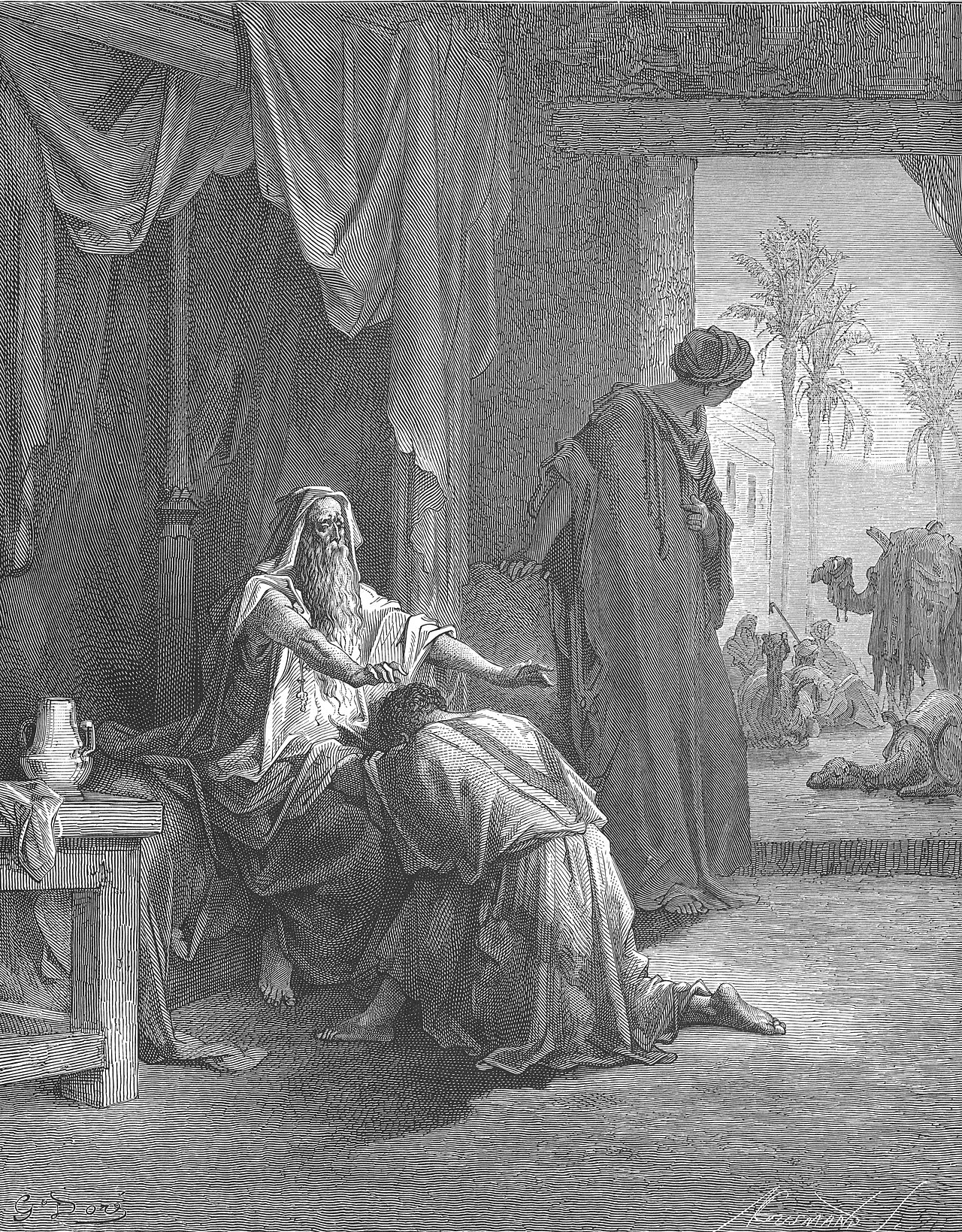
in Genesis 27When Isaac was old and his eyes were so weak that he could no longer see, he called his older son Esau and said to him, “My son.” “Here I am,” Esau replied.
BSB
The same verse in ASV and KJV ▾
ASV
And it came to pass, that when Isaac was old, and his eyes were dim, so that he could not see, he called Esau his elder son, and said unto him, My son: and he said unto him, Here am I.
KJV
And it came to pass, that when Isaac was old, and his eyes were dim, so that he could not see, he called Esau his eldest son, and said unto him, My son: and he said unto him, Behold, here am I.
⋯
This verse in Genesis 27
Commentary
7 notes on this verseA commentator
Albert Barnes1798–1870
Notes, Explanatory and Practical, on the Old and New Testaments (1832-1869)
- Isaac Blessing His Sons The life of Isaac falls into three periods. During the first seventy-five years he is contemporary with his father. For sixty-one years more his son Jacob remains under the paternal roof. The remaining forty-four years are passed in the retirement of old age. The chapter before us narrates the last solemn acts of the middle period of his life. Gen 27:1-4 Isaac was old. - Joseph was in his thirtieth year when he stood before Pharaoh, and therefore thirty-nine when Jacob came down to Egypt at the age of one hundred and thirty.
This site's exposition
his eyes were so weak
on Genesis 27:1-2
Isaac is old, and his eyes are too weak to see. He calls his older son Esau and tells him he does not know the day of his death. He asks for a tasty dish of the game Esau hunts, and says he will bless him before he dies. Isaac lives on many years, and 35:28 gives his age at death as a hundred and eighty.
The record, by era
The Puritans and the Awakening3 voices
Here is Isaac's design to declare Esau his heir. The promise of the Messiah and the land of Canaan was a great trust first committed to Abraham, inclusive and typical of spiritual and eternal blessings; this by divine direction he transmitted to Isaac.
For Esau, though married, had not yet removed; and, though he had greatly grieved his parents by his marriage, yet they had not expelled him, but it seems were pretty well reconciled to him, and made the best of it. Note, Parents that are justly offended at their children yet must not be implacable towards them.
And it came to pass, that when Isaac was old,....
The Nineteenth Century2 voices
A commentator
Jamieson, Fausset & Brown1802–1910
Commentary Critical and Explanatory on the Whole Bible (1871)
proposed
when Isaac was old, and his eyes were dim--He was in his hundred thirty-seventh year; and apprehending death to be near, Isaac prepared to make his last will--an act of the gravest importance, especially as it included the conveyance through a prophetic spirit of the patriarchal blessing.
quarantine:debris (2026-07-29) — starts-lowercase
Isaac was old - It is conjectured, on good grounds, that Isaac was now about one hundred and seventeen years of age, and Jacob about fifty-seven; though the commonly received opinion makes Isaac one hundred and thirty-seven, and Jacob seventy-seven; but see note on Gen 31:55, etc. And his eyes were dim - This was probably the effect of that affliction, of what kind we know not, under which Isaac now labored; and from which, as well as from the affliction, he probably recovered, as it is certain he lived forty if not forty-three years after this time, for he lived till the return of Jacob from Padan-aram; Gen 35:27-29.
How the passage was read
What the Jewish commentators add
And when Yitzchok grew old his eyesight faded and he could not see.
This section is reception history: how the passage was read and kept in the Jewish tradition. Where a reading parts from an essential of the Christian faith, the section says so at that point.
Texts and citation data: Sefaria; each excerpt follows its version’s licence. 3 further sources are cited on this chapter that carry no English text this site may quote or only restate the verse.
The words behind it
18 Hebrew wordsEvery Hebrew word of this verse in the order it stands, with what it means and the door to its own study. The last column counts the times a word stands in the whole Bible: the rarer the word, the more the places it appears belong together.
| Hebrew | Sound | Meaning | Word study | In the Bible |
|---|---|---|---|---|
| וַיְהִי֙ | vayhi | and it was | H1961 → | 3559 times |
| כִּֽי־ | ki- | for | H3588 → | 4482 times |
| זָקֵ֣ן | zaken | he was old | H2204 → | 27 times |
| יִצְחָ֔ק | yitzchak | Isaac | H3327 → | 108 times |
| וַתִּכְהֶ֥יןָ | vatikhheina | and they were [too] dim | H3543 → | |
| עֵינָ֖יו | ʾeinav | eyes his | H5869 → | 887 times |
| מֵרְאֹ֑ת | mereot | for seeing | H7200 → | 1300 times |
| וַיִּקְרָ֞א | vaiyikra' | and he summoned | H7121 → | 733 times |
| אֶת־ | ʾet- | <obj.> | H853 → | 10935 times |
| עֵשָׂ֣ו׀ | ʾesav | Esau | H6215 → | 97 times |
| בְּנ֣וֹ | beno | son his | H1121 → | 4930 times |
| הַגָּדֹ֗ל | hagadol | <the> old | H1419 → | 526 times |
| וַיֹּ֤אמֶר | vaiyomer | and he said | H559 → | 5305 times |
| אֵלָיו֙ | ʾelav | to him | H413 → | 5510 times |
| בְּנִ֔י | beni | O son my | H1121 → | 4930 times |
| וַיֹּ֥אמֶר | vaiyomer | and he said | H559 → | 5305 times |
| אֵלָ֖יו | ʾelav | to him | H413 → | 5510 times |
| הִנֵּֽנִי׃ | hineni | here [am] I | H2009 → | 843 times |
וַיְהִי֙and it was
vayhiH1961 →3559 times
כִּֽי־for
ki-H3588 →4482 times
זָקֵ֣ןhe was old
zakenH2204 →27 times
יִצְחָ֔קIsaac
yitzchakH3327 →108 times
וַתִּכְהֶ֥יןָand they were [too] dim
vatikhheinaH3543 →
עֵינָ֖יוeyes his
ʾeinavH5869 →887 times
מֵרְאֹ֑תfor seeing
mereotH7200 →1300 times
וַיִּקְרָ֞אand he summoned
vaiyikra'H7121 →733 times
אֶת־<obj.>
ʾet-H853 →10935 times
עֵשָׂ֣ו׀Esau
ʾesavH6215 →97 times
בְּנ֣וֹson his
benoH1121 →4930 times
הַגָּדֹ֗ל<the> old
hagadolH1419 →526 times
וַיֹּ֤אמֶרand he said
vaiyomerH559 →5305 times
אֵלָיו֙to him
ʾelavH413 →5510 times
בְּנִ֔יO son my
beniH1121 →4930 times
וַיֹּ֥אמֶרand he said
vaiyomerH559 →5305 times
אֵלָ֖יוto him
ʾelavH413 →5510 times
הִנֵּֽנִי׃here [am] I
hineniH2009 →843 times
A shaded row is a word that stands 400 times or fewer in the Bible.
The walk
8 stopsEach card is a verse this one points to, and under it the verses that one points to in turn. Where several paths arrive at the same place, that place is listed first: the text keeps returning to it.
Through
John 9:3Jesus answered, “Neither this man nor his parents sinned, but this happened so that the works of God would be displayed in him.
it leads to
- John 11:4
When Jesus heard this, He said, “This sickness will not end in death. No, it is for the glory of God, so that the Son of God may be glorified through it.”
- John 11:40
Jesus replied, “Did I not tell you that if you believed, you would see the glory of God?”
- Ecclesiastes 9:1–2
So I took all this to heart and concluded that the righteous and the wise, as well as their deeds, are in God’s hands. Man does not know what lies ahead, whether love or…
- Matthew 11:5
The blind receive sight, the lame walk, the lepers are cleansed, the deaf hear, the dead are raised, and the good news is preached to the poor.
- John 11:4
Through
1 Samuel 3:2And at that time Eli, whose eyesight had grown so dim that he could not see, was lying in his room.
it leads to
- 1 Samuel 4:15
Now Eli was ninety-eight years old, and his gaze was fixed because he could not see.
Reached by 2 separate paths from here.
- 1 Samuel 4:15
Through
Ecclesiastes 12:3on the day the keepers of the house tremble and the strong men stoop, when those grinding cease because they are few and those watching through windows see dimly,
it leads to
- Psalms 90:9–10
For all our days decline in Your fury; we finish our years with a sigh.
- Psalms 102:23
He has broken my strength on the way; He has cut short my days.
- Psalms 90:9–10
Through
Genesis 48:10Now Israel’s eyesight was poor because of old age; he could hardly see. Joseph brought his sons to him, and his father kissed them and embraced them.
it leads to
- Genesis 27:27
So he came near and kissed him. When Isaac smelled his clothing, he blessed him and said: “Ah, the smell of my son is like the smell of a field that the LORD has…
- Genesis 27:27
Where this verse is studied
About Genesis
Who and where
2 names in this verse with a page on the site.
This page draws on Adam Clarke, Commentary on the Bible; Albert Barnes, Notes, Explanatory and Practical, on the Old and New Testaments (1832-1869); Jamieson, Fausset & Brown, Commentary Critical and Explanatory on the Whole Bible; John Gill, Exposition of the Old Testament (1748-1763); John Wesley, Explanatory Notes upon the Old Testament and Matthew Henry, Commentary on the Whole Bible.