
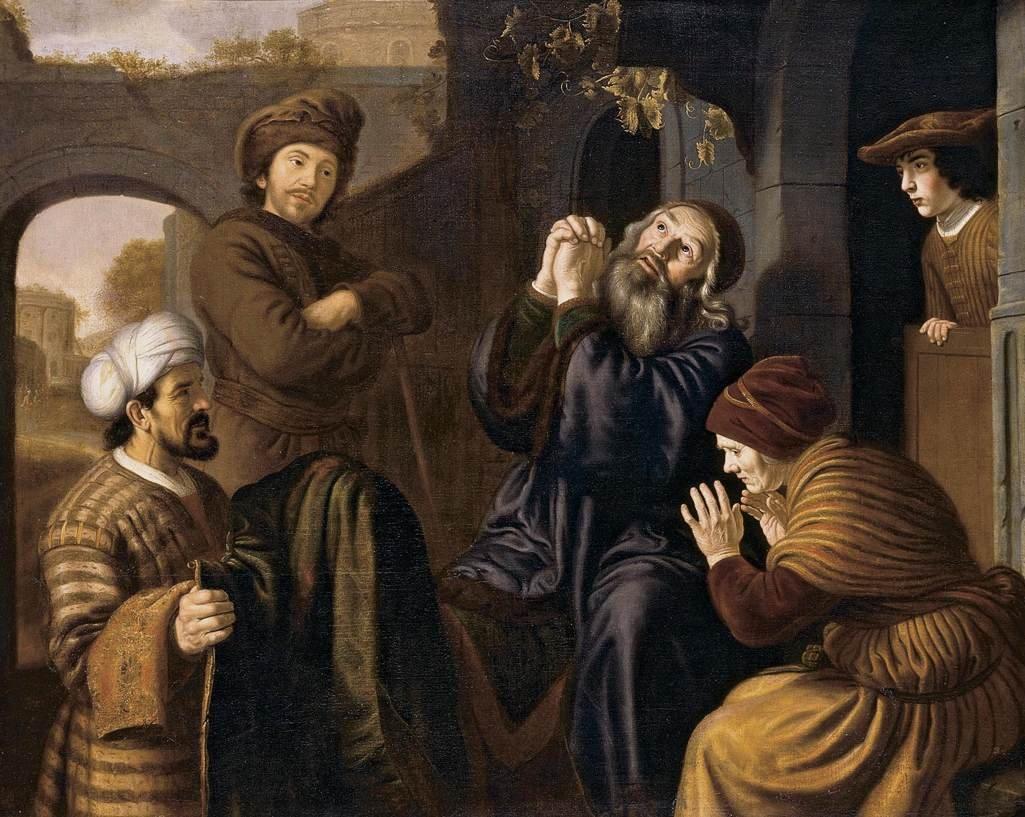
Jan Victors, Jacob Being Shown Joseph's Robe, 1651 to 1653. Public domain.
Genesis 37:3 to 35 · Story · Featured Study
Joseph's Coat
In Genesis 37 the words robe of many colors stand in verses 3, 23 and 32.
Now Israel loved Joseph more than his other sons, because Joseph had been born to him in his old age; so he made him a robe of many colors.
- Where
- Dothan
- Who
- Joseph, Jacob
The robe Jacob made to honor his son came back to him dipped in a young goat's blood.
Summary
Joseph's Coat follows the robe through Genesis 37. It reads the two Hebrew words for the robe and sets it beside the goat of Genesis 27. It also gives the readings that see Christ in it. The chapter ends with Jacob in mourning and Joseph sold in Egypt.
- Joseph was seventeen when the brothers took the robe from him (Genesis 37:2).
- The brothers sold him for twenty shekels of silver (Genesis 37:28).
- Readers differ over whether the robe was striped with colors, long and sleeved, or embroidered.
The Robe in Genesis 37
The robe's one stated reason is Jacob's love, and its one result is hatred.
When Joseph’s brothers saw that their father loved him more than any of them, they hated him and could not speak a kind word to him.The robe made the father's favor visible to the other sons.
The Robe from Gift to Proof
Seven verses of Genesis 37 carry the robe's story.
The robe is a gift at the first step and false proof at the sixth.
- Jacob makes the robeA gift to Joseph aloneGenesis 37:3
- The brothers hate JosephTheir hatred beginsGenesis 37:4
- Jacob sends him to his brothersJoseph is sent from the Valley of HebronGenesis 37:14
- They strip him of the robeAt Dothan, before the pitGenesis 37:23
- They dip it in bloodA young goat is killed for itGenesis 37:31
- They send it to JacobSent from the field to the fatherGenesis 37:32
- Jacob mournsHe tears his clothes and puts on sackclothGenesis 37:34
A timeline of seven steps in Genesis 37 in their order, each card naming its verse.
The Story Told in Order
Genesis 37 gives the robe's story in three scenes.
A father's favorGenesis 37:2 to 4
Joseph tended the flock with the sons of Bilhah and Zilpah and brought his father a bad report about them (Genesis 37:2).
Ambrose of Milan wrote of what Jacob's favor teaches about a parent's love.
“And so we are taught the proper nature of parental love and filial gratitude. It is pleasant to love one's children and very pleasant to love them exceedingly, but often even parental love does harm to the children unless it is practiced with restraint; for it may give the beloved child free rein out of excessive indulgence or, by preference shown to one child, may alienate the others from the spirit of brotherly love. That son gains more who gains the love of his brothers.”
Ambrose of Milan · On Joseph the Patriarch · on Genesis 37:3Patristic
Stripped at DothanGenesis 37:17 to 28
So when Joseph came to his brothers, they stripped him of his robe—the robe of many colors he was wearing—The narrator names the robe twice in one verse, as the first thing the brothers take.
and they took him and threw him into the pit. Now the pit was empty, with no water in it.Reuben had proposed the pit so that he could rescue Joseph later (Genesis 37:22).
Judah proposed the sale with two reasons: killing Joseph would bring no profit, and he was their own flesh (Genesis 37:26 to 27).
The robe brought to JacobGenesis 37:31 to 35
They sent the robe of many colors to their father and said, “We found this. Examine it to see whether it is your son’s robe or not.” His father recognized it and said, “It is my son’s robe! A vicious animal has devoured him. Joseph has surely been torn to pieces!”The brothers name no death, and Jacob names it himself.
Matthew Henry wrote on the moment the robe reached Jacob.
“They pretended they had found it in the fields, and Jacob himself must be scornfully asked, Is this thy son's coat? Now the badge of his honour is the discovery of his fate; and it is rashly inferred from the bloody coat that Joseph, without doubt, is rent in pieces.”
Matthew Henry · Commentary on the Whole Bible · on Genesis 37:32Puritan
All his sons and daughters tried to comfort him, but he refused to be comforted. “No,” he said. “I will go down to Sheol mourning for my son.” So his father wept for him.Jacob speaks of Sheol here for the first of four times in Genesis.
Read Joseph and Potiphar's Wife, where a second garment is carried as false evidence
What the Hebrew Calls It
Two Hebrew words name the robe, and James Strong's Hebrew dictionary defines each.
The first word, kethoneth, is rendered a shirt in Strong's dictionary, and the King James translators gave it as coat, garment or robe.
The second word, passim, is the plural of pas, and its word study gives Strong's definition.
So Amnon’s attendant threw her out and bolted the door behind her. Now Tamar was wearing a robe of many colors, because this is what the king’s virgin daughters wore.Adam Clarke, on this verse, notes that the same words occur as in Joseph's story.
A Young Goat Twice
Genesis uses a young goat in the deception Jacob worked on his father and in the one his sons worked on him.
She also put the skins of the young goats on his hands and on the smooth part of his neck.The goat skins made the younger son pass for the elder before a father who could not see.
Then they took Joseph’s robe, slaughtered a young goat, and dipped the robe in its blood.A goat again serves to deceive a father, and this time the father is Jacob.
In Genesis 27 Jacob wore his brother's finest clothes as well as the goat skins (Genesis 27:15). Isaac did not recognize him, and in Genesis 37 Jacob recognized the robe and believed what it seemed to tell him (Genesis 27:23; Genesis 37:33).
The Robe as a Picture of Christ
Teachers from the fourth century on read the robe, the stripping and the blood as pictures of Christ.
Ambrose of Milan read the stripping as a figure of the cross.
“Accordingly, even at that time, the cross that was to come was prefigured in sign; and at the same time that he was stripped of his tunic, that is, of the flesh he took on, he was stripped of the handsome diversity of colors that represented the virtues. Therefore his tunic, that is, his flesh, was stained with blood, but not his divinity; and his enemies were able to take from him his covering of flesh but not his immortal life.”
Ambrose of Milan · On Joseph the Patriarch · on Genesis 37:23Patristic
Cyril of Alexandria read the brothers' envy as a figure of the envy Christ met.
“And Joseph was loved by his father a great deal. And he gave him a multicolored garment as an excellent gift and a proof of the love with which he accompanied him. And this was an incentive to envy for his brothers and a cause of hatred, as the following events will demonstrate. In fact, the Pharisees were inflamed with anger against the beloved, that is, Christ, because he had been clothed by God the Father with a multiform glory.”
Cyril of Alexandria · Glaphyra on Genesis, 6. 4 · on Genesis 37:4Patristic
Matthew Henry compared the stripping of Joseph with the stripping of Christ.
“‘Now, Joseph, where is the fine coat?’ Thus our Lord Jesus was stripped of his seamless coat, and thus his suffering saints have first been industriously divested of their privileges and honours, and then made the off-scouring of all things.”
Matthew Henry · Commentary on the Whole Bible · on Genesis 37:23Puritan
When the soldiers had crucified Jesus, they divided His garments into four parts, one for each soldier, with the tunic remaining. It was seamless, woven in one piece from top to bottom.Matthew Henry's comparison rests on this verse.
What Kind of Robe Was It?
Commentators from Jerome to the nineteenth century read kethoneth passim in three ways.
Three readings of the robe in Genesis 37:3, each with its holders and the work that gives it.
| Reading | Held by | Tradition | Representative work |
|---|---|---|---|
| A robe of colored stripes | Adam Clarke; Jamieson, Fausset and Brown | Methodist commentary; Protestant commentary | Commentary on the Bible; Commentary Critical and Explanatory on the Whole Bible |
| A long tunic with sleeves | Aquila and Symmachus, as Jerome reports them; noted by Albert Barnes | Early interpreters reported by Jerome; Protestant commentary | Jerome, Hebrew Questions on Genesis; Barnes, Notes, on 2 Samuel 13:18 |
| A robe of embroidered work | John Gill | Baptist commentary | Exposition of the Old Testament, on 2 Samuel 13:18 |
A robe of colored stripesAdam Clarke, Commentary on the Bible; Jamieson, Fausset and Brown, Commentary Critical and Explanatory
Adam Clarke took it as a coat of stripes of differently colored cloth. He compared it to the toga praetexta that a Roman youth wore until seventeen, white, striped or fringed with purple.
Jamieson, Fausset and Brown compared the coats of colors worn in the East in their day to the varieties of tartan.
The objection: Strong gives the second word's sense from its cut and its root, and lists colours only among the King James renderings.
A long tunic with sleevesJerome, Hebrew Questions on Genesis; Albert Barnes, on 2 Samuel 13:18
Jerome, in his Hebrew Questions on Genesis, reports that Aquila rendered the words by a garment reaching to the ankles, and Symmachus by a garment with sleeves.
Albert Barnes, on 2 Samuel 13:18, records that some prefer this reading there and in Joseph's story: a garment reaching to the hands and feet, worn over the common one.
The objection: Symmachus, as Jerome gives him, also allows that the robe was marked by the variety of the craftsman's work.
A robe of embroidered workJohn Gill, on 2 Samuel 13:18
John Gill, on 2 Samuel 13:18, held that Tamar's garment made her the more observable, and so her shame the more manifest.
The objection: Gill himself leaves it uncertain whether the colors were woven, embroidered, painted or pieced together.
God Intended It for Good
Joseph's own word at the end of Genesis looks back on what began with the robe.
The brothers' hatred of the favored son sent him into Egypt. Years later, after their father's death, Joseph spoke to them of it.
As for you, what you intended against me for evil, God intended for good, in order to accomplish a day like this—to preserve the lives of many people.The verse answers the robe, the pit and the sale with God's purpose.
Sources
Scripture is the Berean Standard Bible.
- James Strong, Exhaustive Concordance of the Bible, Hebrew dictionary, entries H3801 and H6446.
- Ambrose of Milan, On Joseph the Patriarch (fourth century)
- Jerome, Hebrew Questions on Genesis, on Genesis 37:3.
- Cyril of Alexandria, Glaphyra on Genesis 6.4 (fifth century)
- Matthew Henry, Commentary on the Whole Bible (1710), on Genesis 37:23 and Genesis 37:32.
- John Gill, Exposition of the Old Testament (1748 to 1763), on 2 Samuel 13:18.
- Adam Clarke, Commentary on the Bible (1832), on Genesis 37:3 and 2 Samuel 13:18.
- Albert Barnes, Notes, Explanatory and Practical, on the Old Testament, on 2 Samuel 13:18.
- Jamieson, Fausset and Brown, Commentary Critical and Explanatory on the Whole Bible (1871), on Genesis 37:3.
Keep Studying
People and groups4
Places1
Symbols1
Go further8