
Genesis 27:39
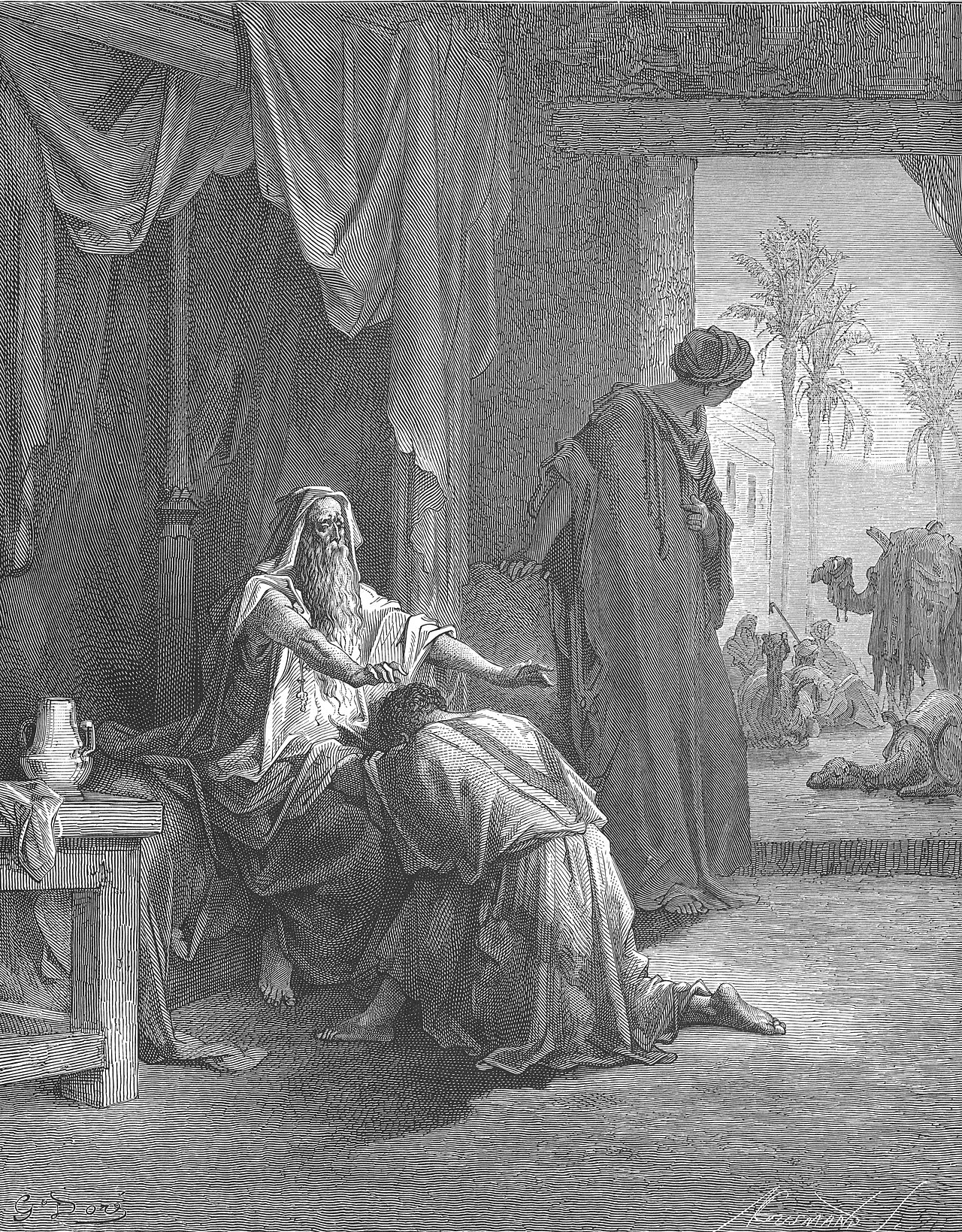
in Genesis 27His father Isaac answered him: “Behold, your dwelling place shall be away from the richness of the land, away from the dew of heaven above.
BSB
The same verse in ASV and KJV ▾
ASV
And Isaac his father answered and said unto him, Behold, of the fatness of the earth shall be thy dwelling, And of the dew of heaven from above;
KJV
And Isaac his father answered and said unto him, Behold, thy dwelling shall be the fatness of the earth, and of the dew of heaven from above;
⋯
This verse in Genesis 27
Commentary
7 notes on this verseAnd Isaac his father answered and said unto him,.... Being willing to bestow what he could upon him, without lessening or breaking in upon the grant made to Jacob: behold, thy dwelling shall be the fatness of the earth, and of the dew of heaven from above: this agrees with part of the blessing of Jacob, only the clauses are inverted, and no mention made of corn and wine; the land of Edom not being so fat and fruitful as the land of Canaan.
This site's exposition
Do you have only one blessing
on Genesis 27:38-40
Esau's portion lies away from the richness of the land and the dew of heaven. The Hebrew preposition at verse 39 can carry a share in a thing or a distance from it, and the Berean reads distance. Wesley notes that nothing in this word reaches toward Christ or the promise. Esau lives by the sword and later breaks his brother's yoke.
This site's exposition
your dwelling place shall be away
John Gill read the line as a lesser share of the same goods, the richness and the dew in reverse order, with the grain and new wine left out. He judged Edom less fruitful than Canaan. The Berean takes the other reading, a dwelling away from the richness of the land.
The record, by era
The Church Fathers2 voices
But why was it after being "roughly handled" that Isaac gave his blessing? For in the last resort what Isaac said to Esau was spoken under constraint and force: "Behold, your dwelling will be by the fruitfulness of the earth and by the dew of heaven." And in case you should imagine yourself for that reason to be good—"You shall live by your sword and be servant to your brother." But in order that you shouldn't despair of yourself, since you can after all correct yourself—"But the time will come when you will put off and undo the yoke from your neck." There you are, he will receive of the fruitfulness of the earth and of the dew of heaven. But when Isaac is roughly handled, he throws this blessing at him. He does not give it to him. Doesn't it happen now in the church with evil people who want to cause trouble in the church that they are tolerated for the sake of peace, that they are admitted to share in the common sacraments? And sometimes it is public knowledge that they are evil, but for some reason or other they cannot be convicted of it. No proof or conviction can be obtained so that they may be corrected and removed from office, excluded, excommunicated. If someone presses charges, it sometimes comes to the disruption of the church. The church leader is forced in effect to say, "Here you are with the fruitfulness of the earth and the dew of heaven; make use of the sacraments; you are eating judgment to yourself, you are drinking judgment to yourself. "Whoever eats and drinks unworthily eats and drinks judgment to himself." "You know that you are being admitted to the sacraments for the sake of the peace of the church; all you have at heart is stirring up trouble and causing divisions. That is why you will live by the sword. For as to what you receive from the dew of heaven and the fruitfulness of the earth, you won't live by that.
Are the words spoken there by the blessed Isaac meant either as a blessing or as a prophecy? It is necessary to understand the previous statement. This is what he says: "By the fatness of the earth shall your dwelling be, and by the dew of heaven above." In fact, it happens that the people settled down in the land of the Canaanites, which they shared with Joshua, son of Nun.
The Puritans and the Awakening2 voices
But the great difference is, that there is nothing in Esau's blessing that points at Christ, nothing that brings either him or his into the church, and without that the fatness of the earth, and the plunder of the field, will stand him in little stead. Thus Isaac by faith blessed them both, according as their lot should be.
(1.) It was a good thing, and better than he deserved. It was promised him, [1.] That he should have a competent livelihood-- the fatness of the earth, and the dew of heaven. Note, Those that come short of the blessings of the covenant may yet have a very good share of outward blessings.
The words behind it
13 Hebrew wordsEvery Hebrew word of this verse in the order it stands, with what it means and the door to its own study. The last column counts the times a word stands in the whole Bible: the rarer the word, the more the places it appears belong together.
| Hebrew | Sound | Meaning | Word study | In the Bible |
|---|---|---|---|---|
| וַיַּ֛עַן | vaiyaan | and he answered | H6030 → | 331 times |
| יִצְחָ֥ק | yitzchak | Isaac | H3327 → | 108 times |
| אָבִ֖יו | ʾaviv | father his | H1 → | 1212 times |
| וַיֹּ֣אמֶר | vaiyomer | and he said | H559 → | 5305 times |
| אֵלָ֑יו | ʾelav | to him | H413 → | 5510 times |
| הִנֵּ֞ה | hineh | there! | H2009 → | 843 times |
| מִשְׁמַנֵּ֤י | mishmanei | away from [the] fatness<es> of | H4924 → | |
| הָאָ֙רֶץ֙ | haaretz | the earth | H776 → | 2504 times |
| יִהְיֶ֣ה | yihyeh | it will be | H1961 → | 3559 times |
| מֽוֹשָׁבֶ֔ךָ | moshavekha | dwelling your | H4186 → | 44 times |
| וּמִטַּ֥ל | umital | and away from [the] dew of | H2919 → | |
| הַשָּׁמַ֖יִם | hashamayim | the heavens | H8064 → | 421 times |
| מֵעָֽל׃ | meal | <from> above | H5921 → | 5755 times |
וַיַּ֛עַןand he answered
vaiyaanH6030 →331 times
יִצְחָ֥קIsaac
yitzchakH3327 →108 times
אָבִ֖יוfather his
ʾavivH1 →1212 times
וַיֹּ֣אמֶרand he said
vaiyomerH559 →5305 times
אֵלָ֑יוto him
ʾelavH413 →5510 times
הִנֵּ֞הthere!
hinehH2009 →843 times
מִשְׁמַנֵּ֤יaway from [the] fatness<es> of
mishmaneiH4924 →
הָאָ֙רֶץ֙the earth
haaretzH776 →2504 times
יִהְיֶ֣הit will be
yihyehH1961 →3559 times
מֽוֹשָׁבֶ֔ךָdwelling your
moshavekhaH4186 →44 times
וּמִטַּ֥לand away from [the] dew of
umitalH2919 →
הַשָּׁמַ֖יִםthe heavens
hashamayimH8064 →421 times
מֵעָֽל׃<from> above
mealH5921 →5755 times
A shaded row is a word that stands 400 times or fewer in the Bible.
The walk
8 stopsEach card is a verse this one points to, and under it the verses that one points to in turn. Where several paths arrive at the same place, that place is listed first: the text keeps returning to it.
Through
Genesis 27:28May God give to you the dew of heaven and the richness of the earth—an abundance of grain and new wine.
it leads to
- Deuteronomy 33:28
So Israel dwells securely; the fountain of Jacob lives untroubled in a land of grain and new wine, where even the heavens drip with dew.
- Deuteronomy 33:13
Concerning Joseph he said: “May his land be blessed by the LORD with the precious dew from heaven above and the deep waters that lie beneath,
- Psalms 133:3
It is like the dew of Hermon falling on the mountains of Zion. For there the LORD has bestowed the blessing of life forevermore.
- Hosea 14:5–7
I will be like the dew to Israel; he will blossom like the lily and take root like the cedars of Lebanon.
- Deuteronomy 7:13
He will love you and bless you and multiply you. He will bless the fruit of your womb and the produce of your land—your grain, new wine, and oil, the young of your herds…
- Deuteronomy 33:28
Through
Hebrews 11:20By faith Isaac blessed Jacob and Esau concerning the future.
it leads to
- Genesis 27:27–40
So he came near and kissed him. When Isaac smelled his clothing, he blessed him and said: “Ah, the smell of my son is like the smell of a field that the LORD has…
- Genesis 27:27–40
Through
Joshua 24:4and to Isaac I gave Jacob and Esau. I gave Esau Mount Seir to possess, but Jacob and his sons went down to Egypt.
it leads to
- Genesis 36:8
So Esau (that is, Edom) settled in the area of Mount Seir.
- Deuteronomy 2:5
Do not provoke them, for I will not give you any of their land, not even a footprint, because I have given Mount Seir to Esau as his possession.
- Genesis 36:8
Where this verse is studied
About Genesis
Who and where
1 name in this verse with a page on the site.
This page draws on Augustine of Hippo, SERMON 4.35; Hippolytus of Rome, ON THE BLESSINGS OF ISAAC AND JACOB 10; Jerome, Hebrew Questions on Genesis; John Gill, Exposition of the Old Testament (1748-1763); John Gill, Exposition of the Old Testament; John Wesley, Explanatory Notes upon the Old Testament and Matthew Henry, Commentary on the Whole Bible.