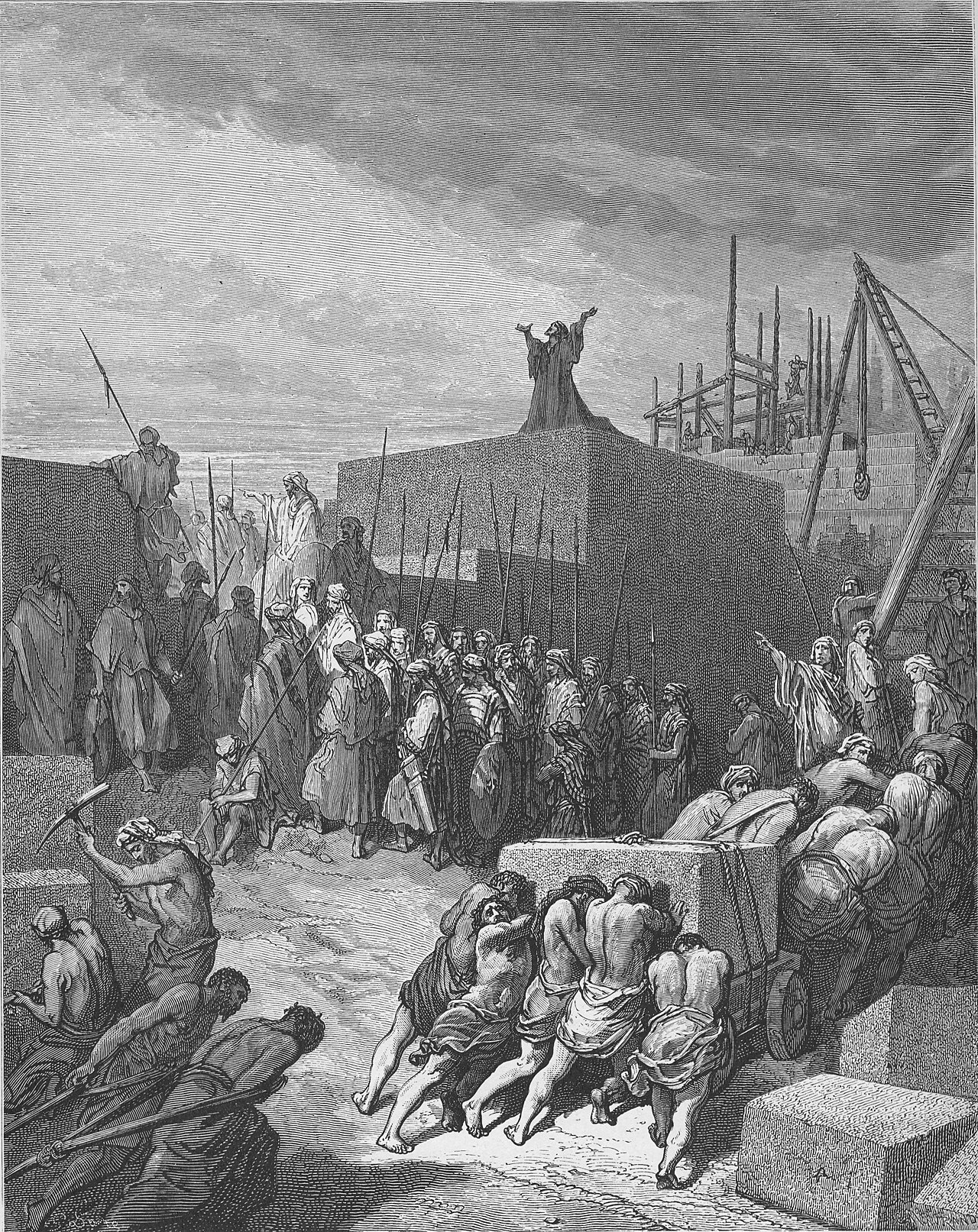
History · Ezra
The Rebuilt House and the Rebuilt Heart
Ezra tells one story in two waves: the physical temple restored by a pagan emperor's decree, and the covenant community restored by the Word, in the person of a scribe who “set his heart to seek the law of Jehovah, and to do it, and to teach” (7:10). A people who have the land without the Torah have gained nothing; a people who keep the Torah without the land still possess everything that matters.

The Two Waves
— one book, two returns — every chapter a doorEzra's own structure names itself: a first wave rebuilds the house (chs. 1–6), a second wave — arriving roughly fifty-eight years later — rebuilds the heart (chs. 7–10). Four chapters in the middle of the book shift out of Hebrew into imperial Aramaic, the chancery language of the Persian court, letting the reader hear the actual official correspondence in its own tongue.
- I. The Rebuilt HouseEzra 1:1–6:22Will the temple actually rise again?
Yahweh, who scattered his people for covenant unfaithfulness, stirs a pagan emperor's spirit to send them home. The altar is rebuilt before the foundation is even laid — sacrifice resumes before the structure exists — and local opposition stalls the work for years until two prophets and a fair-minded Persian governor get it moving again.
- 1–2 · Cyrus's decree (538 BC); the return under Sheshbazzar; the census
- 3 · the altar rebuilt; the foundation laid — the old weep, the young shout
- 4 · Rehum and Shimshai's accusing letter halts the work
- 5–6 · Haggai and Zechariah prophesy; Tattenai's inquiry; Darius confirms Cyrus; the temple finished and dedicated; Passover kept
- II. The Rebuilt HeartEzra 7:1–10:44Will the people who have the land keep the Torah?
Roughly fifty-eight years later, a priest-scribe — “a ready scribe in the law of Moses” — arrives with a royal commission to teach. He finds a community that has the land back but has begun repeating the very sin that cost it the land the first time, and answers it not with force but with grief, confession, and a covenant renewed.
- 7 · Ezra's priestly line to Aaron; Artaxerxes' commission and funding
- 8 · the company gathers; a fast chosen over a royal military escort
- 9 · the intermarriage crisis exposed; Ezra's identificational confession (9:6)
- 10 · the assembly weeps, confesses, and covenants to put away the foreign wives
Ezra opens by repeating, nearly verbatim, the closing verses of 2 Chronicles (36:22–23) — the Hebrew canon's own hinge from kingdom to return, exile ending where Chronicles stops, mid-decree.
The Argument
— the whole book in three sentences- Attribution
- Traditionally Ezra the priest-scribe (b. Bava Batra 15a)
- Span
- 538 BC (Cyrus's decree) → c. 458 BC (Ezra's own return)
- Genre
- Restoration memoir; roughly a third in imperial Aramaic
- Shape
- 10 chapters · 2 waves · 1 hinge verse (7:10)
- 1
Yahweh, who scattered his people for covenant unfaithfulness, is the same Yahweh who stirs a pagan emperor's spirit to send them home — and stirs a pagan emperor's spirit again to fund and authorize Torah-teaching in the land, sovereign over Gentile thrones for the sake of his covenant people and his house.
- 2
The return is not automatic restoration to Eden; the book's own prayers confess the community still lives under partial mercy (“a little reviving,” 9:8) and still faces the live danger of repeating the sin that caused the exile.
- 3
Intermarriage with the peoples of the land becomes the diagnostic test case — not ethnic exclusion but the same danger that always threatened Israel: worship compromised by what it married into.
Seek · Do · Teach
— Ezra 7:10 — the book's programmatic verse, and the hinge between its two waves“For Ezra had set his heart to seek the law of Jehovah, and to do it, and to teach in Israel statutes and ordinances.”
Ezra 7:10 →The sequence is deliberate: competence before obedience before instruction — no one teaches what they have not first sought and done. Planted at the seam between the book's two waves, it reframes everything after it: the real restoration this book narrates is not the house in chs. 1–6 but the Word taking root in a scribe, and through him, in a people.
“This use we must make of our knowledge of the scriptures; for happy are we if we do what we know of the will of God. (4.) He set himself to teach Israel the statutes and judgments of that law. What he knew he was willing to communicate for the good of others; for the ministration of the Spirit is given to every man to profit withal.”
Matthew Henry, Commentary on the Whole Bible(1710), on Ezra 7:10 — public domain.
Christ in Ezra
— not christologically explicit, but load-bearing for the messianic lineThe genealogies of ch. 2 (the returning families) and 7:1–5 (Ezra's own priestly line to Aaron) are Ezra's quiet Christ-connection: the covenant people, priestly and Davidic alike, survive the exile intact. Zerubbabel — grandson of the last reigning Davidic king — leads the first return and is later named a “signet” of restored Davidic hope, directly in Messiah's genealogical chain.
The genealogy of Jesus, worked in full →The Zerubbabel temple finished in ch. 6 is the same house Haggai promises will hold “the precious things of all nations” — and in which the child Jesus is later presented and teaches. Ezra's temple is one stop on the dwelling-chain that runs from Eden through the tabernacle to Christ's own body.
Ezra “set his heart… to do… and to teach” — prefiguring, by contrast and correspondence, the greater Scribe who “taught… as one having authority” and alone perfectly did what he taught. Where Ezra's reform could only enforce an external covenant boundary, the New Covenant he anticipates is fulfilled in Christ, who writes the law within rather than merely legislating it without.
The Artaxerxes decree of ch. 7 — and, in Nehemiah, a second decree — are the terminus-a-quo candidates for Daniel's Messiah-prophecy. Ezra 7's decree supplies the alternative candidate; the site's primary reading anchors to the later, city-building decree. The full count, five schemes at full strength, lives on its own page.
The Seventy Weeks, the full count →Themes
— five load-bearing lines through the bookGod's sovereignty over Gentile empires
Cyrus's heart is “stirred” by the LORD, and Ezra credits “the good hand of his God upon him” again and again — a phrase denser here than almost anywhere in Scripture. Providence, not mere permission, governs pagan decrees.
The Word as the true restoration
Ezra's threefold commitment — seek, do, teach — is the book's hinge: competence before obedience before instruction. A people who have the land without the Torah have gained nothing.
Corporate, identificational confession
Ezra, personally innocent of the intermarriage sin, tears his robe and prays standing with the guilty community, not above it — the same pattern Nehemiah 9 and Daniel 9 repeat.
Rebuilding as worship, not mere construction
The altar rises before the foundation — sacrifice resumes before the structure exists. The mixed weeping and shouting at the foundation-laying is an honest, unflattened moment; restoration does not erase loss.
Separation as the post-exilic covenant boundary
Pre-exilic prophets warned mainly against idolatry and injustice; the post-exilic community's diagnostic sin is dissolution through intermarriage with the peoples of the land — the remedy severe, and contested (see below).
Original Language
— four words that carry the book's argumentThe book's Aramaic sections (4:8–6:18; 7:12–26) use the chancery vocabulary of the Persian court — a linguistic datum some scholars read as supporting a Persian-period compositional setting, consistent with what the text itself claims for its own origin.
The Approved Voices on Ezra
— the roster applied — the specific work named, so you can go to itThe Book of Daniel commentary series
Marcus Brown's formative teacher; upholds and refines Anderson's Artaxerxes-decree arithmetic and reads the Persian-period chronology as evidence of providential precision — the through-line to the Seventy Weeks page.
The Coming Prince (1894)
The foundational 19th-century Artaxerxes-decree-to-Messiah computation. The load-bearing public-domain source for Ezra 7's role as the alternative, non-primary decree candidate.
Intercessory Prayer (Regal, 1996)
Reads Ezra 9's representative confession as the classic biblical type-scene for identificational, standing-in-the-gap intercession.
The Holiness of God (1985)
Frames Ezra's trembling posture in ch. 9 — fear before a holy God even after mercy has been shown — as the Reformed-register parallel to the fear-of-the-LORD anchor theme.
The Knowledge of the Holy (1961)
The fear-of-the-LORD and holiness-vs-grace balance applies directly to Ezra's insistence on covenant purity in chs. 9–10.
the pattern-and-cycle prophetic corpus
Reads decree-driven national turning points — Cyrus's stirred heart chief among them — as instances of a recurring prophetic pattern. Exact title pending verification.
Commentary on the Whole Bible · Commentary Critical and Explanatory · Commentary on the Old Testament
The standard 19th-century devotional and philological treatments of Ezra — K&D especially strong on the Aramaic sections and the chronology crux. Paraphrased pending a verbatim quote-pull pass.
Ezra does not carry a dedicated book-level topic key on the roster; its bearing on this book comes through adjacent load-bearing topics (the Seventy Weeks, identificational repentance, holy fear). No verbatim quotation is drawn from any of these works on this page — every note above is a paraphrase pending the quote-pull pass. Marcus Brown's own commentary leads above all; within a tier, all voices are equal.
Contested Points
— presented at full strength, then MannaFest's flagWhich Artaxerxes — did Ezra precede or follow Nehemiah?
Traditional (458 BC)
Ezra arrives in the 7th year of Artaxerxes I Longimanus (7:7–8), roughly thirteen years before Nehemiah's 445 BC arrival — the canonical books' own order, supported by their overlap of named contemporaries and Neh 8's picture of Ezra reading the Law at Nehemiah's wall dedication.
The minority revision (398 BC)
Some scholars place Ezra's arrival in the 7th year of Artaxerxes II — a full generation after Nehemiah — arguing Ezra 9–10's intermarriage crisis and Nehemiah 13's near-identical crisis read awkwardly as recurring within one reformer's continuous watch.
MannaFest flag — The traditional 458 BC order is presented as the site's working chronology — it is also the frame the platform's chronology anchors assume — with the minority 398 BC proposal stated fairly, not suppressed.
The ethics of Ezra's intermarriage reform (chs. 9–10)
The covenant-purity case at full strength
The concern named is that the people were “doing according to their abominations” (9:1) — religious assimilation, not bloodline. A tiny, fragile, post-exilic community faced genuine dissolution risk; Ruth and Rahab show the boundary was never ethnic but covenantal — the text nowhere forbids a convert's marriage, only marriage that imports idolatry.
The moral-difficulty critique
Ch. 10's remedy — sending away wives and, the text implies, their children — is difficult by any measure, and the text itself registers dissent (10:15). Some readers hold Ezra's zeal outran explicit Mosaic warrant, since Deut 7:1–4 forbids initiating such marriages but nowhere commands divorcing existing ones.
MannaFest flag — The covenant-purity reading is presented at full strength as primary, given the book's own framing — Ezra's grief, not triumphalism, and the community's voluntary confession — while the moral-difficulty critique is held visibly, not smoothed over. Ch. 10 is never a template for modern ethnic or religious exclusion; the text's own concern is idolatry, not ancestry.
Is Ezra–Nehemiah one book?
The manuscript reality
The Hebrew Masoretic tradition, the Talmud, and the earliest manuscript evidence treat Ezra–Nehemiah as a single scroll, only later divided in Christian and eventually Jewish tradition.
The practical reading
Several of the arguments above — the chronology crux, the recurring intermarriage crisis, the shared cast — read differently depending on whether the two are treated as one continuous narrative or two originally independent memoirs later joined.
MannaFest flag — MannaFest treats Ezra and Nehemiah as companion books while flagging the one-book manuscript tradition as the older reality, not a later theory imposed on the text.
The Cast
— two linked pages, and the fuller cast the story needsAlso in the story, awaiting their own pages: Cyrus the Great (the decree-giver, 1:1–4) · Sheshbazzar (“the prince of Judah,” 1:8, 11) · Jeshua/Joshua the high priest (3:2, 8; 5:2) · Haggai and Zechariah (5:1) · Darius I (6:1–12) · Artaxerxes (7:1, 7, 11–26) · Rehum and Shimshai (4:8–23) · Tattenai, governor beyond the river (5:3–6:13) · Shecaniah (10:2–4).
Places
Also in the story, awaiting their own pages: the river Ahava (Ezra's caravan gathers and fasts here, 8:15, 21) · Susa/Shushan (the Persian court, implied setting for Ezra's commissioning) · “Beyond the river” — the Persian satrapy Eber-Nahara, Tattenai's jurisdiction.