
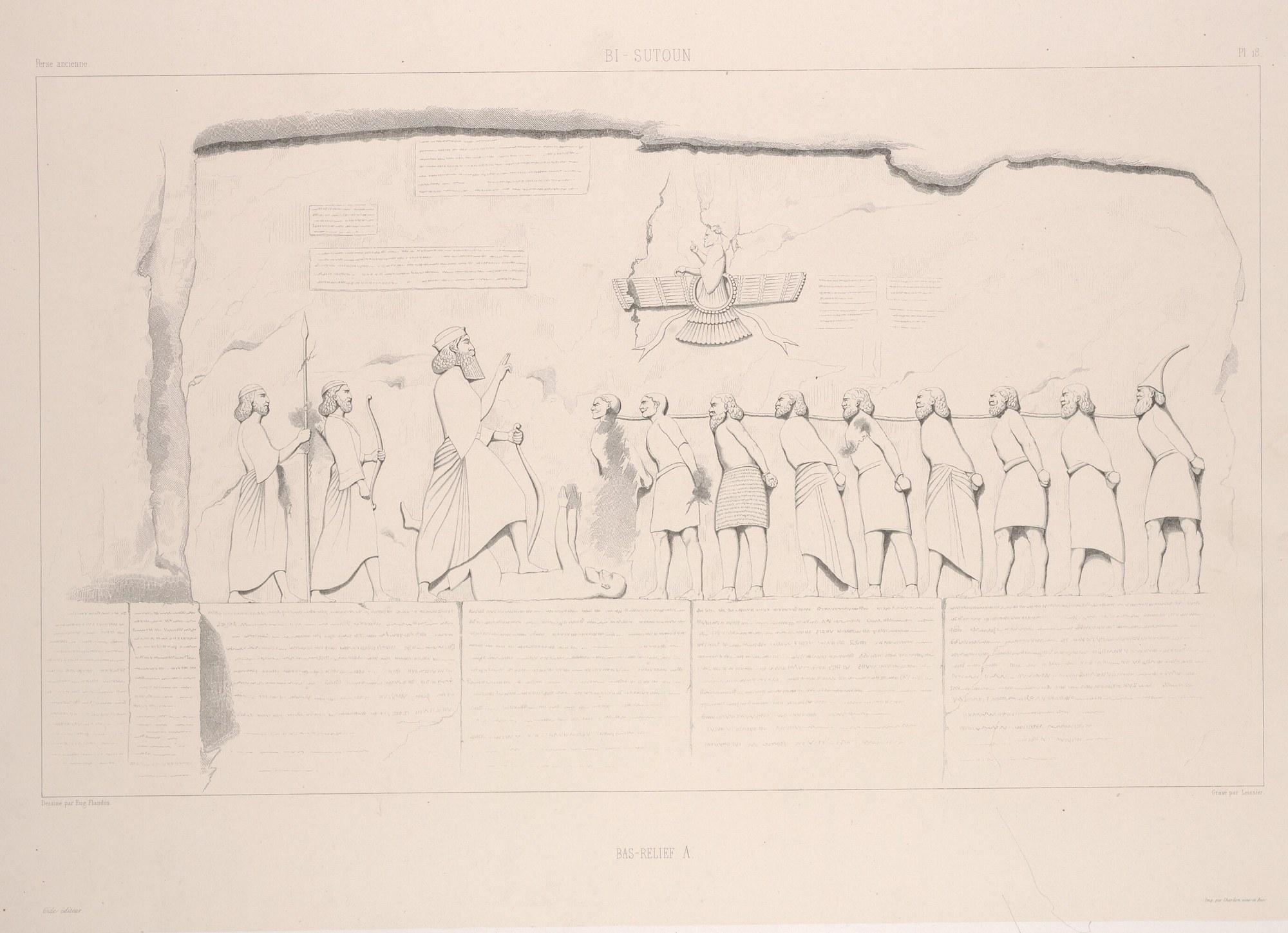
Eugène Flandin, Bi-Sutoun, 1851. Public domain.
Ezra, Esther, Daniel and Isaiah 45 · Subject · Featured Study
The Religion of Persia: Its Gods and Practices
Persian worship as Ezra, Esther, Daniel and Isaiah show it, and as the kings' inscriptions and Herodotus describe it.
“This is what Cyrus king of Persia says: ‘The LORD, the God of heaven, who has given me all the kingdoms of the earth, has appointed me to build a house for Him at Jerusalem in Judah.
- Books
- Isaiah, Ezra, Daniel, Esther
- Hold in memory
- Isaiah 45:7, Isaiah 45:22
Cyrus, Darius and Artaxerxes all wrote of the God of heaven in their decrees for Jerusalem.
Summary
Scripture shows Persian religion only where it touches God's people. It records royal decrees, fixed laws, a lot and the king's advisers.
- At Behistun, Darius I says that Ahuramazda gave him his kingdom.
- Herodotus writes that the Persians set up no images, temples or altars. They sacrificed only with a Magian present.
- In Daniel 6 the Darius of that chapter made a decree under the law of the Medes and Persians. It forbade petitions to any god or man but the king for thirty days.
- Two questions stay open: what Isaiah's light and darkness mean, and who Esther's wise men were.
The God of Heaven in the Kings' Decrees
Three Persian kings in Ezra speak of Israel's God, and Isaiah says the first of them did not know Him.
Albert Barnes thought the Persian original of the decree probably named Ormazd, and that the Hebrew copy set the LORD in his place.
Then they will be able to offer sacrifices of a sweet aroma to the God of heaven and to pray for the lives of the king and his sons.Darius wants the priests' prayers for his house.
Whatever is commanded by the God of heaven must be done diligently for His house. For why should wrath fall on the realm of the king and his sons?Artaxerxes fears divine anger on his kingdom.
Isaiah, speaking to Cyrus by name, says twice in two verses that Cyrus has not known the LORD.
I am the LORD, and there is no other; there is no God but Me. I will equip you for battle, though you have not known Me,The king served a purpose he did not see.
Persian Worship in the Persian and Greek Sources
The inscriptions of Darius I and Xerxes and the histories of Herodotus describe Persian worship, and the papyri of Elephantine record Jewish worship under the Persian kings.
The Persians worshipped Ahuramazda without temples or images, and a Persian king ordered the Jews of Elephantine to keep the Feast of Unleavened Bread.
| Practice | Source | What it records |
|---|---|---|
| Ahuramazda | Behistun inscription, section 5 | Darius I credits his throne to this god. |
| The Lie | Behistun inscription, section 10 | Falsehood spreads through Persia, Media and the other provinces. |
| The daiva | Xerxes, the daiva inscription, section 4 | A shrine of demons is destroyed and Ahuramazda worshipped in its place. |
| No images, temples or altars | Herodotus, Histories 1.131 | Sacrifice is made on the mountain tops to the whole circle of the heavens. |
| The Magian | Herodotus, Histories 1.132 | No sacrifice is lawful without a Magian present. |
| The dead | Herodotus, Histories 1.140 | The body is covered with wax and buried, and the Magians leave it first to bird or dog. |
| The Passover letter | Cowley's papyrus 21 | The order to keep the Feast of Unleavened Bread is dated to the fifth year of Darius II, 419 BC. |
| The spared temple | Cowley's papyrus 30 | When Cambyses overthrew the temples of Egypt, no one harmed the temple of the Jews. |
The Passover letter, The spared temple
Light and Darkness in Isaiah 45
Older commentators heard an answer to Persian dualism in this verse.
I form the light and create the darkness; I bring prosperity and create calamity. I, the LORD, do all these things.Every power in the world answers to one Maker here.
Keil and Delitzsch called a contrast to the dualistic system of Zarathustra a natural supposition in this verse.
The question of God and evil in the same verse is taken up in the study of the goodness of God.
Persian Law and Counsel in Esther and Daniel
Esther and Daniel show the king's counsellors at work and laws that could not be undone.
The king of Esther 1 took counsel before he acted against Vashti.
Then the king consulted the wise men who knew the times, for it was customary for him to confer with the experts in law and justice.The court decided by precedent and counsel.
So if it pleases the king, let him issue a royal decree, and let it be recorded in the laws of Persia and Media so that it cannot be repealed, that Vashti shall never again enter the presence of King Xerxes, and that her royal position shall be given to a woman better than she.The sentence on Vashti was put beyond recall.
Therefore, O king, establish the decree and sign the document so that it cannot be changed—in accordance with the law of the Medes and Persians, which cannot be repealed.”A law that bound even the king is the trap of the story.
In the twelfth year of King Xerxes, in the first month, the month of Nisan, the Pur (that is, the lot) was cast before Haman to determine a day and month. And the lot fell on the twelfth month, the month of Adar.Persian custom chose the day by chance.
Daniel 6:8, Esther 3:7
Persian Law and Worship in Hebrew, Aramaic and Greek
Five words of Esther, Ezra and Matthew, from the Tyndale House lexicon, each with a verse where it stands.
pur
8 uses in the canon
A lot; Esther 3:7 explains the word as the lot.
dath
22 uses in the canon
A royal edict or statute; it is the word for the laws of Persia and Media in Esther 1:19.
dath, Aramaic
14 uses in the canon
The Aramaic form; Ezra 7:26 sets the law of God beside the law of the king.
elah
95 uses in the canon
The Aramaic word for God in the title the God of heaven, in Ezra 6:10 and Ezra 7:23.
magos
6 uses in the canon
A Magian, as the lexicon glosses it; the Berean text writes Magi in Matthew 2:1.
What the Text Leaves Unsaid
Three things about Persian religion that Scripture does not record.
The Berean text never names Ahuramazda or Zarathustra.
The text does not say whether Cyrus, who called the LORD the God of heaven, came to know Him.
Matthew 2 says the Magi came from the east and does not name their land.
One LORD, the Maker of Light
Isaiah calls the nations to the one God, and the Darius of Daniel 6 decrees reverence for Him.
Turn to Me and be saved, all the ends of the earth; for I am God, and there is no other.Every nation is invited to the one Saviour.
I hereby decree that in every part of my kingdom, men are to tremble in fear before the God of Daniel: For He is the living God, and He endures forever; His kingdom will never be destroyed, and His dominion will never end.The king who signed the ban ends by honouring the God he had banned.
John speaks of God and light to the church.
And this is the message we have heard from Him and announce to you: God is light, and in Him there is no darkness at all.John applies the image to God Himself.
A Voice on the God of Heaven
Jamieson, Fausset and Brown wrote on the decree of Cyrus in 1871.
Jamieson, Fausset & Brown (1802 to 1910)
The three commentators explain why a Persian king named the LORD in his decree.
“The existence of predictions so remarkable led him to acknowledge that all his kingdoms were gifts bestowed on him by ‘the Lord God of heaven,’ and prompted him to fulfil the duty which had been laid upon him long before his birth. This was the source and origin of the great favor he showed to the Jews.”
Jamieson, Fausset & Brown · Commentary Critical and Explanatory on the Whole Bible · on Ezra 1:2Reformed
Where Readers Differ on Persian Religion
Readers differ on Isaiah's word of light and darkness and on Esther's wise men, and each reading has its holders and an objection.
Isaiah 45:7 answers the Persian belief in two powersAdam Clarke; Albert Barnes; John Gill; Keil and Delitzsch · Protestant commentary
Clarke read the verse against the two co-eternal causes of the Magian religion. Barnes saw a reference to the prevalent doctrine among the Persians, and Gill wrote that the Persian Magi held two first causes.
The objection is Theodoret of Cyrus's reading, which names no Persian doctrine and takes the light as the return of the exiles and the darkness as the siege and the captivity.
The wise men of Esther 1:13 were astrologersJamieson, Fausset and Brown · Protestant commentary
Jamieson, Fausset and Brown wrote, on Esther 3:7, that Persian kings and nobles never engaged in any enterprise without consulting the astrologers.
The objection is Barnes's, who held that the wise men of Esther 1:13 were men of practical wisdom and that astrologers were unknown in Persia.
Books to Read Next
Three works on the sources and the verses, each free to read.
Aramaic Papyri of the Fifth Century B.C.
A. E. Cowley · 1923
Cowley edits the Aramaic letters of a Jewish community in Persian Egypt.
Read it at the Internet ArchiveCommentaries on Isaiah 45:7
Albert Barnes, John Gill, Jamieson, Fausset and Brown and others · 1748 to 1871
It gathers what Barnes, Gill and Keil wrote on the verse.
Read them at Bible HubCommentaries on Esther 3:7
Matthew Henry, Albert Barnes, Jamieson, Fausset and Brown and others · 1710 to 1871
Keil traces the word pur, and Barnes the casting of lots for a lucky day.
Read them at Bible HubThe God Who Made the Light
Persian kings honoured their own god at home and the LORD in their letters to Judah.
Isaiah had already named the LORD as the one Maker of light and darkness.
Sources
Scripture is the Berean Standard Bible.
- The Berean text, for the names Ahura, Ormazd, Zoroaster and Zarathustra; the word index, for G3097.
- STEP Bible TBESH lexicon and TAHOT word index, Tyndale House, CC BY 4.0.
- The Behistun inscription of Darius I, sections 5 and 10, translated by L. W. King and R. C. Thompson, adapted.
- Xerxes, the daiva inscription (XPh), section 4.
- Herodotus, The History of Herodotus, volume 1, translated by G. C. Macaulay, 1.131, 1.132 and 1.140.
- A. E. Cowley, Aramaic Papyri of the Fifth Century B.C., Oxford, Clarendon Press, 1923, Nos. 21 and 30.
- On Isaiah 45:7: Albert Barnes, Notes, Explanatory and Practical (1832 to 1869); John Gill, Exposition of the Old Testament (1748 to 1763); Jamieson, Fausset and Brown, Commentary Critical and Explanatory on the Whole Bible, 1871; Keil and Delitzsch, as Bible Hub prints them.
- Adam Clarke, Commentary on the Bible, 1832, on Isaiah 45:7.
- Albert Barnes, Notes, Explanatory and Practical, on the Old and New Testaments, on Ezra 1:2 and Esther 1:13.
- Theodoret of Cyrus, Commentary on Isaiah, on Isaiah 45:7.
- On Esther 3:7: Matthew Henry, Commentary on the Whole Bible (1710); Albert Barnes, Notes, Explanatory and Practical (1832 to 1869); Jamieson, Fausset and Brown (1871); C. F. Keil, The Books of Ezra, Nehemiah, and Esther (1873)
- Jamieson, Fausset and Brown, Commentary Critical and Explanatory on the Whole Bible, 1871, on Ezra 1:2.
Keep Studying
Studies4
People and groups10
Places2
Doctrines5