
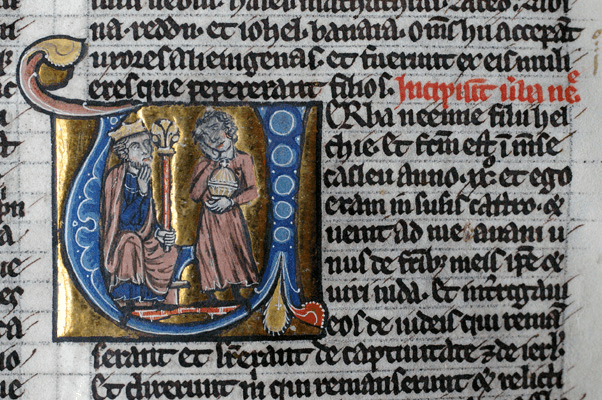
Nehemiah and Artaxerxes, Alcobaça Bible, 1220s. Public domain.
Ezra 1 to 7 and Nehemiah 1 to 13 · Subject · Featured Study
The Persian Kings of Ezra and Nehemiah
Four Persian kings appear in Ezra and Nehemiah, from the decree of Cyrus to Nehemiah's return to Artaxerxes.
In the first year of Cyrus king of Persia, to fulfill the word of the LORD spoken through Jeremiah, the LORD stirred the spirit of Cyrus king of Persia to send a proclamation throughout his kingdom and to put it in writing as follows:
- Books
- Ezra, Nehemiah
- Hold in memory
- Proverbs 21:1, Ezra 7:27
Nehemiah, the king's cupbearer, asked Artaxerxes for leave to rebuild Jerusalem.
Summary
The two books run from the first year of Cyrus to the thirty-second year of Artaxerxes. They date their events by the years of the kings who ruled Judah.
- Darius found the decree of Cyrus at Ecbatana and ordered the work on the house to go on.
- Artaxerxes sent Ezra in his seventh year and Nehemiah in his twentieth.
- Readers differ over the order of Ezra 4 and over the Darius of Nehemiah 12:22.
The Kings the Books Name
Each king enters the story through a decree, a letter or a request.
The opponents of the builders worked against them from one reign to another.
They hired counselors against them to frustrate their plans throughout the reign of Cyrus king of Persia and down to the reign of Darius king of Persia.The opposition outlasted more than one reign.
So the Jewish elders built and prospered through the prophesying of Haggai the prophet and Zechariah son of Iddo. They finished building according to the command of the God of Israel and the decrees of Cyrus, Darius, and Artaxerxes, kings of Persia.The verse names the source of the work before the kings who served it.
Nehemiah dates his own story by the years of Artaxerxes, whom he served at table.
Now in the month of Nisan, in the twentieth year of King Artaxerxes, when wine was set before him, I took the wine and gave it to the king. I had never been sad in his presence,Nehemiah dates his request by his master's reign.
The Kings in Order, From Cyrus to Darius II
Six reigns run from the fall of Babylon to the end of the fifth century BC.
Four of the six reigns appear in Ezra and Nehemiah, which date their events by the kings' years.
To scale: 6 of 6 stops dated; a bar is a span; a mark that would lie on another stands in a lane under the axis.
- Cyrus539 to 530 BCYear 1: the decree to rebuild the house of God.Ezra 1:1 to 4
- Cambyses530 to 522 BCThe son and successor of Cyrus; after him Bardiya held the throne for some months, until Darius killed him.
- Darius I522 to 486 BCYear 2: the work resumes. Year 6, the third of Adar: the house is completed.Ezra 6:1 to 15
- Xerxes486 to 465 BCAn accusation at the beginning of his reign, if Ezra 4:6 names this king.
- Artaxerxes I465 to 424 BCYear 7: Ezra goes up. Year 20: Nehemiah asks leave. Year 32: Nehemiah returns to the king.Ezra 7:7
- Darius II423 to 404 BCHe reigned when the papyri of Elephantine were written.
A timeline of the Persian kings from Cyrus to Darius II, each with what Ezra and Nehemiah record in his reign.
Ezra 4: The Letters Between Cyrus and Darius
Between Cyrus and Darius, Ezra 4 sets an accusation and letters, and readers differ on which kings received them.
Ezra 4:5 carries the opposition from Cyrus to Darius, and Ezra 4:24 returns to the second year of Darius. Between them the Berean text names Xerxes and Artaxerxes.
At the beginning of the reign of Xerxes, an accusation was lodged against the people of Judah and Jerusalem.A new king's accession brought a new complaint.
And in the days of Artaxerxes king of Persia, Bishlam, Mithredath, Tabeel, and the rest of his associates wrote a letter to Artaxerxes. It was written in Aramaic and then translated.The complaint reached the king in writing.
Now, therefore, issue an order for these men to stop, so that this city will not be rebuilt until I so order.The king left himself room to change his mind.
Thus the construction of the house of God in Jerusalem ceased, and it remained at a standstill until the second year of the reign of Darius king of Persia.The narrative returns to the building and its delay.
The letter of Ezra 4:12 complains of the city's walls and foundations, and the house of God is the subject of Ezra 4:24.
Ezra 4:21, Ezra 4:24
How the Reigns Are Dated
Two modern works set the Persian reigns and place Nehemiah's return.
Richard Parker and Waldo Dubberstein set out the reigns in their Babylonian Chronology of 1942 from tablets dated by the kings' years. By that evidence Artaxerxes I was still recognized as king at the end of December 424 BC.
A. E. Cowley published the Aramaic papyri of Elephantine in 1923. He reasoned from a petition of 408 BC, sent to a later governor of Judah, that the thirty-second year of Nehemiah 13:6 is that of Artaxerxes I, the year 433 BC.
The Kings' Names in Hebrew
Four royal names, from the Tyndale House lexicon, with the verses where they stand.
Koresh
Cyrus; the Hebrew form of his name opens the book in Ezra 1:1 and Ezra 1:2.
Daryavesh
10 uses in the canon
Darius; the lexicon reads the name as a title borne by more than one king, and the Hebrew form stands in Ezra 4.
Achashverosh
31 uses in the canon
The name the Berean text renders Xerxes; it stands in Ezra 4 and throughout Esther.
Artachshasta
15 uses in the canon
Artaxerxes, a royal name in the lexicon's reading; it stands in Ezra 4:7, Ezra 7:1 and Nehemiah 13:6.
What the Text Leaves Unsaid
Three questions about the kings that Ezra and Nehemiah leave open.
The King's Heart in the LORD's Hand
Both books trace the kings' favour to a higher hand.
Blessed be the LORD, the God of our fathers, who has put into the heart of the king to so honor the house of the LORD in Jerusalem,Ezra breaks off the king's letter to praise God.
For seven days they kept the Feast of Unleavened Bread with joy, because the LORD had made them joyful and turned the heart of the king of Assyria toward them to strengthen their hands in the work on the house of the God of Israel.Ezra gives Darius the title of the empire Persia inherited.
And may I have a letter to Asaph, keeper of the king’s forest, so that he will give me timber to make beams for the gates of the citadel to the temple, for the city wall, and for the house I will occupy.” And because the gracious hand of my God was upon me, the king granted my requests.The timber and the safe passage are laid to God's account.
The king’s heart is a waterway in the hand of the LORD; He directs it where He pleases.The proverb states the rule the two books show at work.
He changes the times and seasons; He removes kings and establishes them. He gives wisdom to the wise and knowledge to the discerning.Daniel gives the same rule in a prayer of praise.
Nehemiah 2:8, Proverbs 21:1, Daniel 2:21
Two Voices on the Kings and Their Courts
Matthew Henry in the eighteenth century and Jamieson, Fausset and Brown in the nineteenth, on the accusers and the kings' change of heart.
Matthew Henry (1662 to 1714)
Matthew Henry reads the accusation of Ezra 4:6 as one more work of the accuser of the brethren.
“The devil is the accuser of the brethren ( Rev. xii. 10 ), and he carries on his malicious designs against them, not only by accusing them himself before God, as he did Job, but by acting as a lying spirit in the mouths of his instruments, whom he employs to accuse them before magistrates and kings and to make them odious to the many and obnoxious to the mighty.”
Matthew Henry · Commentary on the Whole Bible · on Ezra 4:6Puritan
Jamieson, Fausset & Brown (1802 to 1910)
Jamieson, Fausset and Brown read the joy of Ezra 6:22 as thanks for a change in the hearts of pagan kings.
“The religious joy that so remarkably characterized the celebration of this feast, was testified by expressions of lively gratitude to God, whose overruling power and converting grace had produced so marvellous a change in the hearts of the mighty potentates, and disposed them, pagans though they were, to aid the cause and provide for the worship of the true God.”
Jamieson, Fausset & Brown · Commentary Critical and Explanatory on the Whole Bible · on Ezra 6:22Reformed
Where Readers Differ on the Kings
Three readings, two of the order of Ezra 4 and one of Darius the Persian, each with its holders and the objection to it.
Ezra 4:6 to 23 runs ahead to Xerxes and ArtaxerxesC. F. Keil; Jamieson, Fausset and Brown · Protestant commentary
Keil held in 1873 that Ezra 4:6 to 23 is an episode inserted by the historian to give a short view of all the hostile acts. Jamieson, Fausset and Brown take the king of Ezra 4:6 to be the successor of Darius, the famous Xerxes.
The objection is Adam Clarke's, who kept the chapter in order and named the kings Cambyses and Smerdis.
The kings of Ezra 4:6 and Ezra 4:7 are Cambyses and SmerdisAdam Clarke; Albert Barnes; John Gill · Protestant commentary
Adam Clarke took the king of Ezra 4:6 to be the one the Greeks call Cambyses, and the Artaxerxes of Ezra 4:7 to be the Magian who reigned as Smerdis. Barnes and Gill read Ezra 4:6 the same way.
The objection is Keil's, who reported that older expositors had read it so and held that the section runs ahead to later kings.
Darius the Persian is the last king of PersiaAlbert Barnes · Protestant commentary
Barnes took the Darius of Nehemiah 12:22 to be Darius Codomannus, the enemy of Alexander the Great, and the verses to be an addition to the book.
The objection is Cowley's: he ties the Johanan of Nehemiah 12:22 to the high priest of a papyrus written under Darius II.
Books to Read Next
Four works on the kings and the dates, each free to read.
Babylonian Chronology, 626 B.C. to A.D. 45
Richard A. Parker and Waldo H. Dubberstein · 1942
The Oriental Institute published it as Studies in Ancient Oriental Civilization 24.
Read it at the Internet ArchiveThe Books of Ezra, Nehemiah, and Esther
C. F. Keil · 1873
Keil sets out the order of Ezra 4 and the kings it names.
Read it at the Internet ArchiveAramaic Papyri of the Fifth Century B.C.
A. E. Cowley · 1923
Cowley edits and translates the Aramaic papyri of the Jews of Elephantine.
Read it at the Internet ArchiveAntiquities of the Jews, book 11
Flavius Josephus, translated by William Whiston · 1737
Josephus retells the return and the reigns after it, down to the coming of Alexander.
Read it at the University of ChicagoKings Under a Greater King
The kings of Persia decreed the work, stopped it and renewed it.
The books set the rulers of an empire beside a small house in Jerusalem and give the last word to the God of heaven.
Sources
Scripture is the Berean Standard Bible.
- The Berean text, for the names Cambyses, Smerdis, Bardiya and Darius the Persian.
- STEP Bible TBESH lexicon and TAHOT word index, Tyndale House, CC BY 4.0.
- Richard A. Parker and Waldo H. Dubberstein, Babylonian Chronology 626 B.C. to A.D. 45, Studies in Ancient Oriental Civilization 24, Oriental Institute, 1942.
- A. E. Cowley, Aramaic Papyri of the Fifth Century B.C., Oxford, Clarendon Press, 1923, No. 30.
- C. F. Keil, The Books of Ezra, Nehemiah, and Esther, translated by Sophia Taylor, Edinburgh, T. and T. Clark, 1873.
- Jamieson Fausset and Brown, John Gill, Albert Barnes, Ellicott and the Pulpit Commentary on Ezra 4:6.
- Adam Clarke, Commentary on the Bible, 1832, on Ezra 4:6 and 4:7.
- Albert Barnes, Notes, Explanatory and Practical, on the Old and New Testaments, on Ezra 4:6, Ezra 6:22 and Nehemiah 12:22.
- Matthew Henry, Commentary on the Whole Bible, 1710, on Ezra 4:6.
- Jamieson, Fausset and Brown, Commentary Critical and Explanatory on the Whole Bible, 1871, on Ezra 6:22.
- Flavius Josephus, Antiquities of the Jews, book 11, translated by William Whiston, 1737.
Keep Studying
Read it4
Studies5
People and groups11
Doctrines1
Subjects5
Church history1