
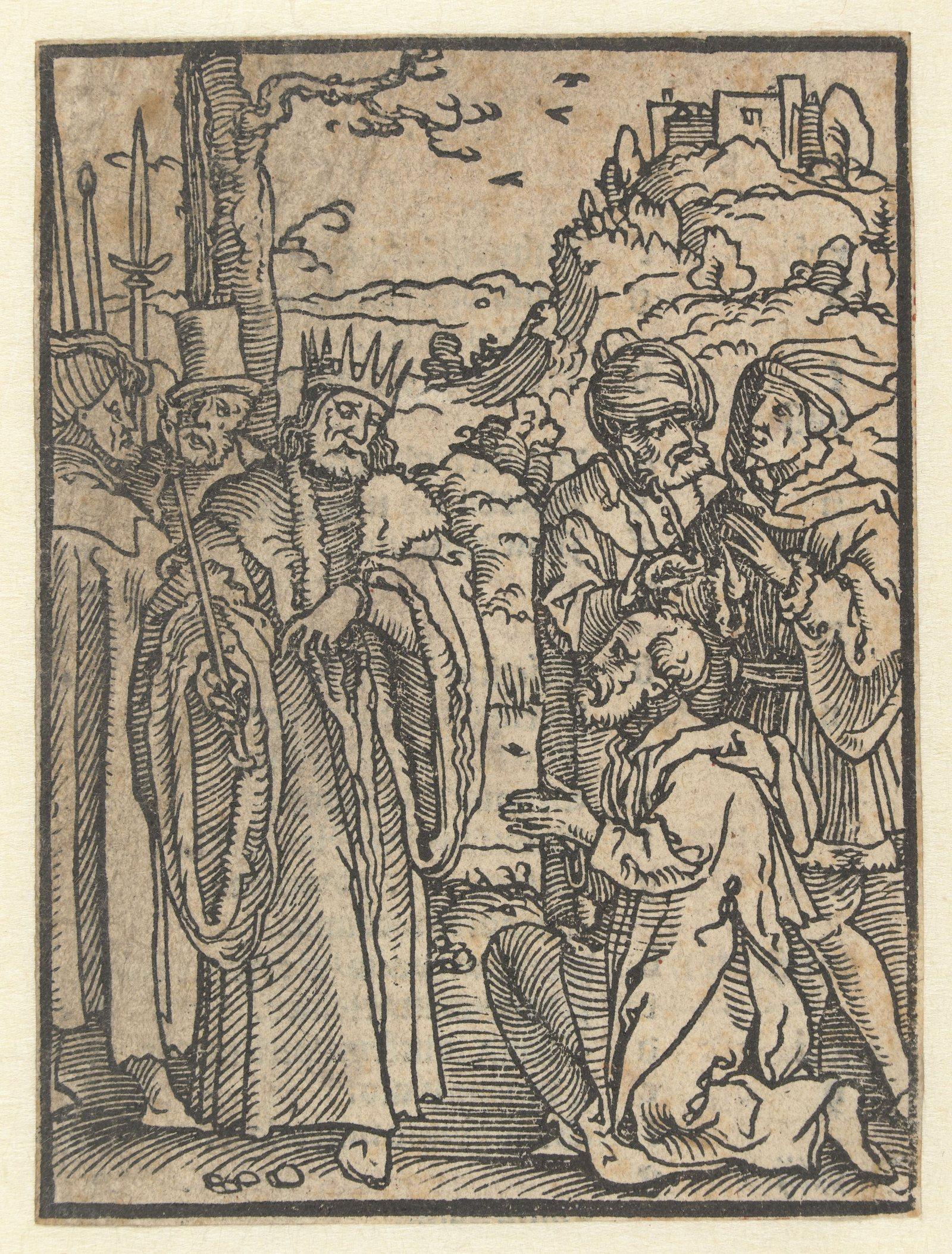
Jan Swart van Groningen, Cyrus Lets the Israelites Return to Jerusalem, 1528. Public domain.
2 Chronicles 36 and Ezra 1 · Subject · Featured Study
Chronicles Last in the Hebrew Order
Two ancient lists of the Hebrew books set Chronicles in two places, and readers differ over why it stands last.
The last word of Chronicles in Hebrew is vaya'al, and let him go up.
In the first year of Cyrus king of Persia, to fulfill the word of the LORD spoken through Jeremiah, the LORD stirred the spirit of Cyrus king of Persia to send a proclamation throughout his kingdom and to put it in writing as follows:
In the first year of Cyrus king of Persia, to fulfill the word of the LORD spoken through Jeremiah, the LORD stirred the spirit of Cyrus king of Persia to send a proclamation throughout his kingdom and to put it in writing as follows:
- Books
- 2 Chronicles, Ezra
- Hold in memory
- 2 Chronicles 36:23, Ezra 1:3
Summary
Chronicles retells the story from Adam to Cyrus in sixty-five chapters.
- Jerome and the Talmud list the last books of the Hebrew Bible in two orders.
- The end of Chronicles and the start of Ezra differ in small ways.
- Readers explain its place and its last verses in more than one way.
The Last Two Verses
The book closes on the decree of Cyrus in 2 Chronicles 36:22 to 23.
“This is what Cyrus king of Persia says: ‘The LORD, the God of heaven, who has given me all the kingdoms of the earth, has appointed me to build a house for Him at Jerusalem in Judah. Whoever among you belongs to His people, may the LORD his God be with him, and may he go up.’”The book's final verse closes on leave for the exiles to go home and build.
What Chronicles Retells, Part by Part
The chapters of 1 and 2 Chronicles fall into four parts of the story.
Chronicles gives nine chapters to the generations from Adam and twenty-seven to the kings of Judah after Solomon.
The four counts as a table
| Part of the story | Chapters | Verse |
|---|---|---|
| The generations from Adam, 1 Chronicles 1 to 9 | 9 | 1 Chronicles 1:1 |
| Saul's death and David's reign, 1 Chronicles 10 to 29 | 20 | 1 Chronicles 10:1 |
| Solomon's reign, 2 Chronicles 1 to 9 | 9 | 2 Chronicles 1:1 |
| The kings of Judah to the exile and the decree, 2 Chronicles 10 to 36 | 27 | 2 Chronicles 10:1 |
A bar chart of the chapters of 1 and 2 Chronicles by the part of the story they tell, from zero.
Where the parts divide1 Chronicles 10:1, 1 Chronicles 29:28 and 2 Chronicles 9:31
Now the Philistines fought against Israel, and the men of Israel fled before them, and many fell slain on Mount Gilboa.The second part begins here, after the genealogies.
He died at a ripe old age, full of years, riches, and honor, and his son Solomon reigned in his place.The second part ends here, at the turn from father to son.
And Solomon rested with his fathers and was buried in the city of his father David. And his son Rehoboam reigned in his place.The third part ends here, and the line of the divided kingdom begins.
The Same Decree Twice
Ezra 1:1 to 3 gives the decree again and carries it on to its purpose.
Whoever among you belongs to His people, may his God be with him, and may he go to Jerusalem in Judah and build the house of the LORD, the God of Israel; He is the God who is in Jerusalem.Ezra carries the decree on to the house in Jerusalem.
The first verse is the same in both books, word for word in the Berean text (2 Chronicles 36:22 and Ezra 1:1). In the decree that follows, Chronicles says may the LORD his God be with him where Ezra says may his God be with him.
Who Finished It and Where It Stands
The Talmud names who completed Chronicles, and Jerome gives the Writings in another order.
The Babylonian Talmud, at Bava Batra 15a, asks who completed Chronicles for the generations after Ezra, and it answers Nehemiah son of Hacaliah.
Jerome, in his preface to Samuel and Kings, lists the Writings as the Hebrews of his day counted them. In his list Chronicles stands seventh of nine, after Daniel and before Ezra and Esther.
He gives the Hebrew name as Dabre Aiamim, Words of Days. He says it may better be called a chronicle of the whole of the sacred history.
The Word of the Close
One Hebrew word of the last verse comes from the STEP Bible lexicon of Tyndale House.
alah (Hebrew, H5927)
To ascend or go up, used in many senses; it stands 53 times in 2 Chronicles.
What the Text Leaves Unsaid
The closing verses leave these matters open.
The decree in Chronicles names no road, no leader and no number of those who should go.
The book ends before the house is built and leaves unsaid whether it was.
An Ending That Looks Ahead
The decree on which the book ends points beyond the book.
Now these are the people of the province who came up from the captivity of the exiles carried away to Babylon by Nebuchadnezzar its king. They returned to Jerusalem and Judah, each to his own town,Ezra's list of those who went up answers the decree on which Chronicles ends.
Read last, Chronicles leaves the Hebrew Bible open, with the people called home and the house still to be built.
A Voice on the Close of Chronicles
An eighteenth-century commentator reads the last two verses.
Matthew Henry (1662 to 1714)
Matthew Henry wrote his Commentary on the Whole Bible in 1710. He says the last two verses look back to the prophecy of Jeremiah and show how it was fulfilled.
Why Chronicles Stands Last
Readers weigh why the book stands last and why it shares Ezra's opening, each reading with its holders and an objection.
Chronicles was received after Ezra and NehemiahH. E. Ryle · historical scholarship of the canon
The objection is Jerome's list in the preface to Samuel and Kings.
The last two verses were copied in from EzraAdam Clarke · Protestant commentary
Clarke, in his Commentary on the Bible of 1832, says these verses are thought to have been written by mistake from the book of Ezra. He holds that Chronicles properly closes with 2 Chronicles 36:21.
The objection is that 2 Chronicles 36:22 takes up the word of Jeremiah named in 2 Chronicles 36:21.
Chronicles and Ezra were once one workAlbert Barnes · Protestant commentary
Barnes, in his Notes on the Old Testament, holds that Ezra was probably a continuation of Chronicles, the two forming one work.
The objection is the Talmud's list in Bava Batra 14b, which counts Ezra and Chronicles as two books.
Books to Read Next
This study of where Chronicles stands is free to read.
The Canon of the Old Testament
H. E. Ryle · 1892
Ryle traces when each part of the Hebrew canon was received.
Read it at the Internet ArchiveThe Call to Go Up
The Hebrew Bible, read in the Talmud's order, ends with a people sent home to build.
The story stops before the work begins, and Ezra takes it up from there.
Sources
Scripture is the Berean Standard Bible.
- STEP Bible TBESH lexicon and TAHOT word index, Tyndale House, CC BY 4.0.
- The chapter counts of 1 and 2 Chronicles.
- Babylonian Talmud, Bava Batra 14b:11 and 15a:3, William Davidson Edition, CC BY-NC.
- Jerome, Preface to the Books of Samuel and Kings, Nicene and Post-Nicene Fathers, second series, volume 6.
- H. E. Ryle, The Canon of the Old Testament, Macmillan, 1892, chapter 6, page 141.
- Matthew Henry, Commentary on the Whole Bible, 1710, on 2 Chronicles 36:22 to 23.
- Adam Clarke, Commentary on the Bible, 1832, on 2 Chronicles 36:22.
- Albert Barnes, Notes on the Old Testament, 1832 to 1869, on 2 Chronicles 36:22.