
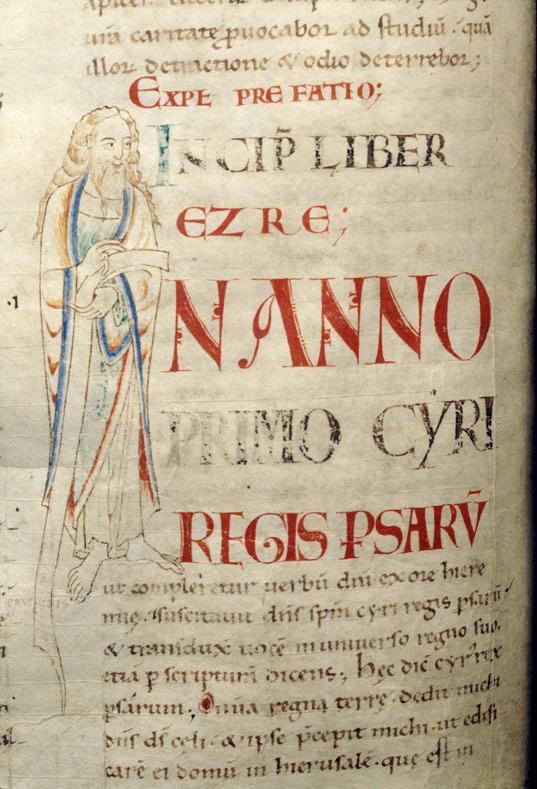
The Harding Bible, Ezra, twelfth century. Public domain.
Ezra 9 and 10 · Subject · Featured Study
The Mixed Marriages of Ezra 9 and 10
In Ezra 9 and 10 the leaders of Judah reported marriages with the peoples of the land, and an assembly in Jerusalem bound the men to send their foreign wives away.
Ezra sat in horror until the evening offering, and then he knelt and confessed the people's guilt as his own.
After these things had been accomplished, the leaders approached me and said, “The people of Israel, including the priests and Levites, have not kept themselves separate from the surrounding peoples whose abominations are like those of the Canaanites, Hittites, Perizzites, Jebusites, Ammonites, Moabites, Egyptians, and Amorites.
After these things had been accomplished, the leaders approached me and said, “The people of Israel, including the priests and Levites, have not kept themselves separate from the surrounding peoples whose abominations are like those of the Canaanites, Hittites, Perizzites, Jebusites, Ammonites, Moabites, Egyptians, and Amorites.
- Book
- Ezra
- Hold in memory
- Ezra 9:6, 2 Corinthians 6:14
Summary
The reform of Ezra 9 and 10 ran from a report and a prayer to a covenant and an inquiry, family by family. The list that closes the book names 111 men in the Berean text.
- The leaders' report names eight peoples, five of them from the list of Deuteronomy 7:1.
- Shecaniah son of Jehiel spoke first for a covenant before God.
- Family heads chosen by name heard the cases town by town over three months.
- Readers differ on whether the dismissal was right, and on what the four men of Ezra 10:15 did.
The Report, the Prayer and the Covenant
Ezra 9 and 10 run from the leaders' report to an oath sworn before the house of God.
The leaders came to Ezra with a list of eight peoples. Five of them stand in the list of Deuteronomy 7:1, and Ammon, Moab and Egypt are added.
Indeed, the Israelites have taken some of their daughters as wives for themselves and their sons, so that the holy seed has been mixed with the people of the land. And the leaders and officials have taken the lead in this unfaithfulness!”The charge falls hardest on those who led the people.
Ezra answered the report with a prayer.
and said: “O my God, I am ashamed and embarrassed to lift up my face to You, my God, because our iniquities are higher than our heads, and our guilt has reached the heavens.The prayer opens in shame before it asks for anything.
shall we again break Your commandments and intermarry with the peoples who commit these abominations? Would You not become so angry with us as to wipe us out, leaving no remnant or survivor?His fear is that a second breach would leave no remnant at all.
Shecaniah son of Jehiel, whom the Berean text calls an Elamite, then spoke to Ezra.
So now let us make a covenant before our God to send away all the foreign wives and their children, according to the counsel of my lord and of those who tremble at the command of our God. Let it be done according to the Law.His proposal reaches the children as well as the wives.
Ezra 9:14, Ezra 10:3
From the Report to the Last Case
Ezra dates the assembly and the inquiry by the day and the month.
The inquiry took three months, and Ezra dates its first and last days.
- Ezra reaches JerusalemThe first day of the fifth monthHe came from Babylon with the gracious hand of his God upon him.Ezra 7:9
- The leaders' reportNot datedThe leaders told Ezra of the marriages.Ezra 9:1 to 2
- The prayerThe evening offeringEzra rose from his fasting and knelt with his hands spread out.Ezra 9:5 to 6
- The oathNot datedThe leading priests, the Levites and all Israel swore to the covenant.Ezra 10:5
- The summonsThree days' noticeEvery exile was called to Jerusalem on pain of losing his property.Ezra 10:7 to 8
- The assembly in the rainThe twentieth day of the ninth monthThe men of Judah and Benjamin sat in the square and agreed to the plan.Ezra 10:9 to 12
- The inquiry beginsThe first day of the tenth monthFamily heads chosen by name began to examine each case.Ezra 10:16
- The inquiry endsThe first day of the first monthEvery case had been dealt with.Ezra 10:17
The steps in the order of the text, each with its date as Ezra gives it and what was done.
The inquiry begins, The inquiry ends
What the Law Forbade and What Ezra Quoted
Ezra's prayer gathers the commands of the Law into one sentence.
Now, therefore, do not give your daughters in marriage to their sons or take their daughters for your sons. Never seek their peace or prosperity, so that you may be strong and may eat the good things of the land, leaving it as an inheritance to your sons forever.’Ezra gives the command as the word of the prophets.
Do not intermarry with them. Do not give your daughters to their sons or take their daughters for your sons,The command Ezra echoes was given before Israel entered the land.
Albert Barnes notes that the words Ezra quotes in Ezra 9:11 stand in no single earlier book and give the sense of many passages.
because they will turn your sons away from following Me to serve other gods. Then the anger of the LORD will burn against you, and He will swiftly destroy you.Moses gives the reason: the marriages would lead Israel into idolatry.
The Israelites who had returned from exile ate it, together with all who had separated themselves from the uncleanness of the peoples of the land to seek the LORD, the God of Israel.Ezra's history counts these joiners among those who kept the feast.
Deuteronomy 7:4, Ezra 6:21
Two Later Tellings and the Last Verse
Josephus and 1 Esdras retell the dismissal, and the Hebrew of the book's last verse is read in two ways.
Josephus, in his Antiquities of the Jews, book 11, writes that the men immediately cast out their wives, and the children which were born of them.
1 Esdras closes the same list with the words, they put them away with their children.
All these men had married foreign women, and some of them had children by these wives.The verse is the last line of the book.
C. F. Keil, in his commentary of 1873, takes the Hebrew of Ezra 10:44 to say that some of the wives had borne sons. He calls the reading of 1 Esdras 9:36 a mere conjecture from the context.
Every Man Named in Ezra 10, Family by Family
The Berean text lists the men in eighteen groups, the priests first.
Seventeen of the 111 men were priests, and ten more were Levites, singers or gatekeepers.
JESHUA SON OF JOZADAK, PRIESTS
The list gives four names: Maaseiah, Eliezer, Jarib and Gedaliah.
IMMER, PRIESTS
The list gives two names: Hanani and Zebadiah.
HARIM, PRIESTS
The list gives five names: Maaseiah, Elijah, Shemaiah, Jehiel and Uzziah.
PASHHUR, PRIESTS
The list gives six names: Elioenai, Maaseiah, Ishmael, Nethanel, Jozabad and Elasah.
LEVITES
The list gives six names: Jozabad, Shimei, Kelaiah, Pethahiah, Judah and Eliezer.
SINGERS
The list gives one name: Eliashib.
GATEKEEPERS
The list gives three names: Shallum, Telem and Uri.
PAROSH
The list gives seven names: Ramiah, Izziah, Malchijah, Mijamin, Eleazar, Malchijah and Benaiah.
ELAM
The list gives six names: Mattaniah, Zechariah, Jehiel, Abdi, Jeremoth and Elijah.
ZATTU
The list gives six names: Elioenai, Eliashib, Mattaniah, Jeremoth, Zabad and Aziza.
BEBAI
The list gives four names: Jehohanan, Hananiah, Zabbai and Athlai.
BANI, THE FIRST LIST
The list gives six names: Meshullam, Malluch, Adaiah, Jashub, Sheal and Jeremoth.
PAHATH-MOAB
The list gives eight names: Adna, Chelal, Benaiah, Maaseiah, Mattaniah, Bezalel, Binnui and Manasseh.
HARIM
The list gives eight names: Eliezer, Isshijah, Malchijah, Shemaiah, Shimeon, Benjamin, Malluch and Shemariah.
HASHUM
The list gives seven names: Mattenai, Mattattah, Zabad, Eliphelet, Jeremai, Manasseh and Shimei.
BANI, THE SECOND LIST
The list gives twelve names: Maadai, Amram, Uel, Benaiah, Bedeiah, Cheluhi, Vaniah, Meremoth, Eliashib, Mattaniah, Mattenai and Jaasu.
BINNUI
The list gives thirteen names: Shimei, Shelemiah, Nathan, Adaiah, Machnadebai, Shashai, Sharai, Azarel, Shelemiah, Shemariah, Shallum, Amariah and Joseph.
NEBO
The list gives seven names: Jeiel, Mattithiah, Zabad, Zebina, Jaddai, Joel and Benaiah.
Harim, priests, Pashhur, priests, Levites, Singers, Gatekeepers, Parosh, Elam, Zattu and 8 more
The Hebrew Words of the Reform
Five Hebrew words of Ezra 9 and 10, from the Tyndale House lexicon, each with a verse where it stands.
nokri
45 uses in the canon
Foreign or strange; it describes the wives seven times in Ezra 10, from Ezra 10:2 to Ezra 10:44.
yashab
1079 uses in the canon
To sit or dwell; the Hebrew uses it five times in Ezra 10 for the men's marrying.
badal
42 uses in the canon
To divide or separate; it is the command of Ezra 10:11 and the joining of Ezra 6:21.
ma'al
28 uses in the canon
Treachery or unfaithfulness; the noun stands in Ezra 9:2, Ezra 9:4 and Ezra 10:6.
yatsa
1067 uses in the canon
To go out, and in its causative form to send out; it is the verb of sending the wives away in Ezra 10:3 and Ezra 10:19.
What the Text Leaves Unsaid
Three questions Ezra 9 and 10 leave open.
The chapters do not say whether any of the wives had turned to the LORD.
The text does not say whether the Jehiel of the family of Elam in Ezra 10:26 is Shecaniah's father.
The text does not say how the elders and judges of each town heard the cases.
The Holy Seed and the Line of Christ
Paul's letters to Corinth treat the partner still to be chosen and the marriage already made as two cases.
Do not be unequally yoked with unbelievers. For what partnership can righteousness have with wickedness? Or what fellowship does light have with darkness?For the believer still choosing, the line is drawn here.
To the rest I say this (I, not the Lord): If a brother has an unbelieving wife and she is willing to live with him, he must not divorce her.For the believer already married, the marriage stands.
For the unbelieving husband is sanctified through his believing wife, and the unbelieving wife is sanctified through her believing husband. Otherwise your children would be unclean, but now they are holy.Their offspring are counted within the covenant.
On the marriage already made, Shecaniah's counsel and Paul's point in opposite directions.
Salmon was the father of Boaz by Rahab, Boaz the father of Obed by Ruth, Obed the father of Jesse,Two women from outside Israel stand in the line of the Messiah.
But Ruth replied: “Do not urge me to leave you or to turn from following you. For wherever you go, I will go, and wherever you live, I will live; your people will be my people, and your God will be my God.Her confession made a Moabite a member of the people.
1 Corinthians 7:14, Matthew 1:5, Ruth 1:16
Two Voices on Marriage Outside the Faith
Tertullian wrote in the third century and Matthew Henry in the eighteenth.
Tertullian (died 220)
Tertullian, writing against Marcion, ties Paul's rule for Christian marriage to the Law of Moses.
“Assuredly also, when (the apostle) rules that marriage should be ‘only in the Lord,’ (1 Cor. 7:39) that no Christian should intermarry with a heathen, he maintains a law of the Creator, who everywhere prohibits marriage with strangers.”
Tertullian · Against Marcion Book V · on Ezra 10:10Patristic
Matthew Henry (1662 to 1714)
Matthew Henry weighs whether the returned men worshipped the gods of the nations.
“We are willing to hope that they did not worship their gods, but that their captivity had cured them of their idolatry: it is said indeed that they did according to their abominations; but that (says bishop Patrick) signifies here only the imitation of the heathen in promiscuous marriages with any nation whatsoever, which by degrees would lead them to idolatry.”
Matthew Henry · Commentary on the Whole Bible · on Ezra 9:2Puritan
Where Readers of Ezra 10 Differ
Four readings, three of the dismissal and one of Ezra 10:15, each with its holders and the objection to it.
The dismissal obeyed the LawC. F. Keil; Albert Barnes; Joseph Benson · Protestant commentary
Keil wrote that Shecaniah's covenant was made to put away this scandal from the congregation, and to act in conformity with the law. Barnes held that Ezra regarded it as necessary for the moral and religious welfare of the people. Joseph Benson wrote that the marriages were, properly speaking, no marriages at all.
The objection is Gerald West's and Lester Grabbe's, as the encyclopedia article on Ruth reports them. Ruth can be read as an answer from the same years, in which a foreign wife and her children need not be excluded.
A hard measure, taken for the sake of the faithJamieson, Fausset and Brown; John Gill; the Asbury Bible Commentary · Protestant commentary
Jamieson, Fausset and Brown granted that the proposal may seem harsh and cruel, and judged it just as well as necessary for the Jews of that day. John Gill held that a provision was made for the maintenance of both the wives and the children.
The Asbury Bible Commentary of 1992 rejects the charge that the ban reflects racial bigotry, and it weighs the separation against Malachi 2:16 as the lesser of two evils.
The objection is the Pulpit Commentary's: Shecaniah thought it best to make a clean sweep and dismiss the children as well as the mothers.
The dismissal went beyond what the civil power could doThe Pulpit Commentary · Protestant commentary
The Pulpit Commentary called the remedy scarcely one which the civil power could enforce.
The objection is Keil's: the covenant acted in conformity with the law.
The four men of Ezra 10:15 stood against the matterJohn Lightfoot, as Matthew Henry reports him; Albert Barnes; the American Standard Version
(Only Jonathan son of Asahel and Jahzeiah son of Tikvah, supported by Meshullam and Shabbethai the Levite, opposed this plan.)The Berean rendering makes the four men opponents.
John Lightfoot, as Henry reports him, read Ezra 10:15 to say that Jonathan and Jahaziah stood against the matter, either the thing itself or this method of proceeding. Barnes gave the same translation, and the American Standard Version reads that they stood up against this matter.
The objection is the King James Version, which reads that the two men were employed about this matter.
Books to Read Next
Three works on the reform and its later tellings, each free to read.
The Books of Ezra, Nehemiah, and Esther
C. F. Keil · 1873
Keil's commentary covers the whole of Ezra, Nehemiah and Esther.
Read it at the Internet ArchiveAntiquities of the Jews, book 11
Flavius Josephus, translated by William Whiston · 1737
Josephus covers Ezra's reform in book 11 and, later, Alexander's coming to Jerusalem.
Read it at the University of ChicagoCommentaries on Ezra 10:3
Albert Barnes, Joseph Benson, John Gill and others · 1748 to 1871
Bible Hub sets the older commentators side by side on the covenant to send the wives away.
Read them at Bible HubThe Remnant That Wept
Ezra rested his prayer on the grace that had left a remnant, and the assembly answered with tears and an oath.
Paul's letters to Corinth give the church its own counsel on the same questions.
Sources
Scripture is the Berean Standard Bible.
- King James Version and American Standard Version, Ezra 10:15 and 10:44.
- The names of Ezra 10:18 to 43 counted from the Berean text.
- Book of Ruth, Wikipedia, citing Gerald West, Eerdmans Commentary on the Bible (2003), page 209, and Lester Grabbe (2004), page 312.
- Tertullian, Against Marcion, book 5.
- STEP Bible TBESH lexicon and TAHOT word index, Tyndale House, CC BY 4.0.
- Albert Barnes, Notes on the Old Testament, on Ezra 9:11, 10:3 and 10:26.
- C. F. Keil, The Books of Ezra, Nehemiah, and Esther, translated by Sophia Taylor, Edinburgh, T. and T. Clark, 1873.
- Flavius Josephus, Antiquities of the Jews 11.5.4, translated by William Whiston.
- 1 Esdras 9:36, King James Version with the Apocrypha.
- Joseph Benson, Jamieson Fausset and Brown, John Gill and the Pulpit Commentary on Ezra 10:3.
- Asbury Bible Commentary, Zondervan, 1992, Ezra, B. Problem of Mixed Marriages (9:1 to 10:44)
- Matthew Henry, Commentary on the Whole Bible, 1710, on Ezra 9:2, 10:15 and 10:44.
- Bede, On Ezra and Nehemiah, on Ezra 10:19.
Keep Studying
Read it4
People and groups3
Church history1
Places1