
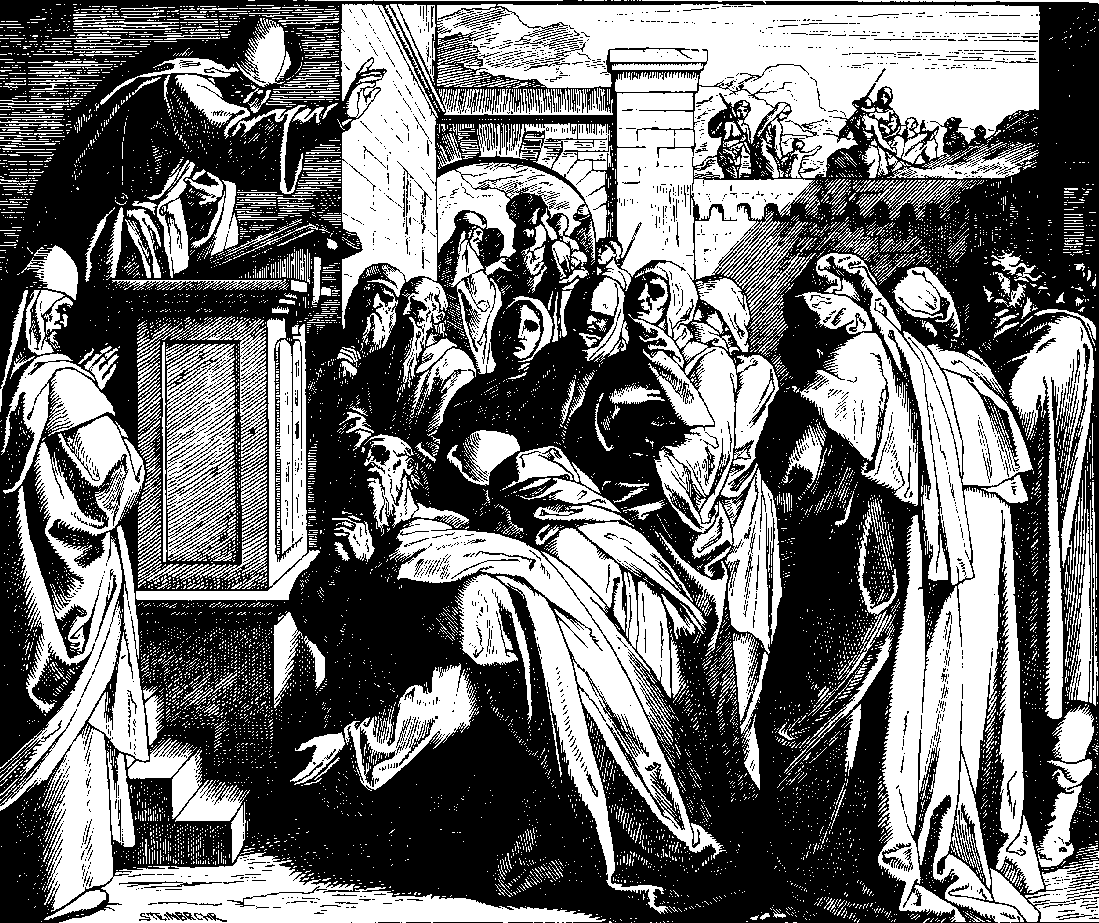
Julius Schnorr von Carolsfeld, Die Bibel in Bildern, 1860. Public domain.
Ezra 7 and Nehemiah 8 · Subject · Featured Study
Ezra the Scribe and the Shape of the Canon
In Ezra 7 Ezra is a scribe of the Law, and later writers credited him with restoring and gathering the sacred books.
In the Talmud Ezra is a man fit to have had the Torah given through him.
this Ezra came up from Babylon. He was a scribe skilled in the Law of Moses, which the LORD, the God of Israel, had given. The king had granted Ezra all his requests, for the hand of the LORD his God was upon him.
- Books
- Ezra, Nehemiah
- Hold in memory
- Ezra 7:10, 2 Timothy 3:16
Summary
Ezra 7 and Nehemiah 8 show a scribe who studied, practised and taught the Law of Moses and read it to the assembly. Readers ever since have asked how much of the Old Testament passed through his hands.
- Bava Batra 14b and 15a give a writer for each book of the Hebrew Bible.
- In the Talmud, Ezra is the writer of the book that bears his name.
- The church fathers made Ezra the restorer of Scriptures lost in the captivity.
- Humphrey Prideaux held that Ezra settled the canon, and Herbert Ryle in 1892 called that account a legend.
The Scribe in the Text
Ezra 7 and Nehemiah 8 describe Ezra's work in their own words.
For Ezra had set his heart to study the Law of the LORD, to practice it, and to teach its statutes and ordinances in Israel.The order of the verbs puts learning before doing and doing before teaching.
The king's letter turned the scribe into a royal officer.
And you, Ezra, according to the wisdom of your God which you possess, are to appoint magistrates and judges to judge all the people west of the Euphrates—all who know the laws of your God. And you are to teach these laws to anyone who does not know them.A Persian decree gave the Law of Moses the force of the king's law in the province.
At that time all the people gathered together in the square before the Water Gate, and they asked Ezra the scribe to bring out the Book of the Law of Moses, which the LORD had commanded for Israel.The request for the reading came from the assembly.
On the second day of the month, the heads of all the families, along with the priests and Levites, gathered around Ezra the scribe to study the words of the Law.The leaders of the clans took the place of learners.
Nehemiah 8:1, Nehemiah 8:13
How the Tradition Grew
Ezra and Nehemiah, 2 Esdras and three fathers of the church say what Ezra did for the Scriptures.
The early church made the scribe of Ezra 7 the restorer of the lost Scriptures.
- Ezra and NehemiahEzra 7; Nehemiah 8He read the Law to the assembly at the Water Gate.Nehemiah 8:2 to 3
- 2 EsdrasChapter 14Ezra dictates again the books of the Law that were burned, with others kept for the wise.
- IrenaeusAgainst Heresies 3.21.2God inspired Ezra to recast all the words of the former prophets.
- TertullianOn the Apparel of Women 1.3Every document of the Jewish literature was restored through Ezra.
- Clement of AlexandriaStromata 1.22Ezra, inspired, restored again the whole of the ancient Scriptures.
A table of the earliest writings on Ezra and the Scriptures, each with the work and what it says he did.
What the Text Says and What Is Often Said
Ezra and Nehemiah speak of one book, the Law Ezra carried, and later writers credit him with all the Scriptures.
The king's letter speaks of the Law as already in Ezra's hand when he set out from Babylon.
You are sent by the king and his seven counselors to evaluate Judah and Jerusalem according to the Law of your God, which is in your hand.The king assumes Ezra carried a written copy with him.
The early church went further and made Ezra the restorer of books that had been lost. Jerome, writing against Helvidius, left open whether Moses wrote the Pentateuch or Ezra re-edited it.
Matthew Henry, on Ezra 7:6, wrote that with prophecy about to cease it was time to promote the knowledge of Scripture. He added that gospel ministers are called scribes instructed to the kingdom of heaven.
Then He told them, “For this reason, every scribe who has been discipled in the kingdom of heaven is like a homeowner who brings out of his storeroom new treasures as well as old.”Jesus gives the trained scribe a place in His kingdom.
What the Talmud and Josephus Say of Ezra
The Babylonian Talmud, the Mishnah and Josephus each speak of Ezra and the books.
Bava Batra 14b and 15a name the writers of the books. Ezra wrote his own book and the genealogy of Chronicles until his period, and Nehemiah son of Hacaliah completed it.
The same passage says the men of the Great Assembly wrote Ezekiel, the Twelve, Daniel and the Scroll of Esther.
Sanhedrin 21b says the Torah was given again in the days of Ezra in the Ashurit script and the Aramaic tongue. Sukkah 20a says Ezra came up from Babylonia and reestablished laws that had been forgotten.
Avot 1:1 traces the Torah from Moses at Sinai through Joshua, the elders and the prophets to the men of the Great Assembly.
Josephus, in Against Apion 1.8, says the prophets after Moses wrote the history of their times down to the reign of Artaxerxes. Later history, he says, lacks the same authority because there has not been an exact succession of prophets since that time.
Ezra's Work in Hebrew and Aramaic
Five Hebrew and Aramaic words from the Tyndale House lexicon name Ezra's work, each with a verse where it stands.
darash
164 uses in the canon
Properly to tread or frequent; it is the seeking of the LORD in Ezra 6:21 and the first verb of Ezra's resolve.
asah
2628 uses in the canon
To do or make; it is the second verb of Ezra's resolve, and the doing Shecaniah urged in Ezra 10:3.
lamad
85 uses in the canon
Properly to goad, and by implication to teach; it is the third verb of Ezra's resolve.
safer
8 uses in the canon
The Aramaic word for a scribe, Ezra's title in the king's letter of Ezra 7:12 and Ezra 7:21, and the title of Shimshai in Ezra 4:8.
parash
5 uses in the canon
To separate or specify; the word stands in the account of the reading in Nehemiah 8:8.
What the Text Leaves Unsaid
Ezra and Nehemiah leave three things unrecorded about Ezra and the books.
The books record no word of Ezra about writing or gathering any book besides the Law.
Nehemiah 8 does not say which books the Book of the Law of Moses contained.
The text does not say where Ezra's copy of the Law came from.
The Word Read and Opened
The scribe who taught the Law points to the Lord who opened the Scriptures.
On the road to Emmaus the risen Jesus taught from the Scriptures.
And beginning with Moses and all the Prophets, He explained to them what was written in all the Scriptures about Himself.He began with the Law that Ezra carried.
Then He opened their minds to understand the Scriptures.Understanding came as a gift of the risen Lord.
Paul tells Timothy where the books came from.
All Scripture is God-breathed and is useful for instruction, for conviction, for correction, and for training in righteousness,Paul gives the whole collection one Author.
A Voice on the Opened Book
Matthew Henry wrote on the reading of Nehemiah 8 in 1710.
Matthew Henry (1662 to 1714)
Henry reads the opening of the scroll as a gift to the people who heard it.
“He brought it forth with a sense of the great mercy of God to them in giving them that book; he opened it with a sense of his mercy to them in giving them leave to read it, that it was not a spring shut up and a fountain sealed.”
Matthew Henry · Commentary on the Whole Bible · on Nehemiah 8:5Puritan
Where Readers Differ on Ezra and the Canon
Readers hold three positions on Ezra's part in the books, and each has its holders and an objection.
Ezra gathered the books and settled the canonElias Levita, as Herbert Ryle reports him; Humphrey Prideaux · the older account
Levita held in 1538 that Ezra and the men of the Great Synagogue collected the Holy Scriptures and formed the canon. Prideaux wrote that Ezra collected together all the books of which the holy scriptures did then consist and settled the canon.
The objection is Ryle's: only legend has transformed Ezra's care for the Scriptures into the work of officially promulgating the books.
The canon came long after EzraBaruch Spinoza · philosophical criticism
Spinoza held that before the time of the Maccabees there was no canon of sacred books, and that the books were chosen from a multitude of others when the Pharisees restored the Temple.
The objection is Levita's and Prideaux's account, which puts the gathering of the books in Ezra's own day.
The canon grew and was received over timeHerbert Edward Ryle · nineteenth-century scholarship
Ryle held in 1892 that the books were received over a long time, and that Ezra's countrymen rightly remembered him for keeping the Scriptures safe.
The objection is the rabbis' tradition, which gives every book a named author.
Books to Read Next
Three works carry the subject further, and each is free to read.
The Canon of the Old Testament
Herbert Edward Ryle · 1892
Ryle traces the tradition about Ezra from the fathers to the Reformation in his introduction.
Read it at the Internet ArchiveThe Old and New Testament Connected
Humphrey Prideaux · 1857 edition
Prideaux's history of the Jews between the Testaments includes his case for Ezra.
Read it at the Internet ArchiveAgainst Apion, book 1
Flavius Josephus, translated by William Whiston · 1737
Book 1 holds Josephus's account of the Jewish Scriptures.
Read it at the University of ChicagoThe Scribe and the Word
Scripture gives Ezra a book already written, a heart set to keep it and a people who wept to hear it.
The larger claims of later writers rest on that picture: a teacher who gave his life to the Law of Moses.
Sources
Scripture is the Berean Standard Bible.
- STEP Bible TBESH lexicon and TAHOT word index, Tyndale House, CC BY 4.0.
- Babylonian Talmud, Bava Batra 14b and 15a, Sanhedrin 21b, Sukkah 20a, William Davidson edition; Mishnah Avot 1:1, Mishnah Yomit by Joshua Kulp.
- Flavius Josephus, Against Apion 1.8, translated by William Whiston, 1737.
- 2 Esdras 14, King James Version with the Apocrypha.
- Irenaeus, Against Heresies 3.21.2.
- Tertullian, On the Apparel of Women 1.3.
- Clement of Alexandria, Stromata 1.22.
- Jerome, The Perpetual Virginity of Blessed Mary, against Helvidius, section 7.
- Matthew Henry, Commentary on the Whole Bible, 1710, on Nehemiah 8:5.
- Humphrey Prideaux, The Old and New Testament Connected, New York, Harper, 1857 edition.
- Herbert Edward Ryle, The Canon of the Old Testament, London and New York, Macmillan, 1892.
- Benedictus de Spinoza, Theologico-Political Treatise, Part 2, translated by R. H. M. Elwes, chapter 8 section 116 and chapter 10 section 95.
- Matthew Henry, Commentary on the Whole Bible, 1710, on Ezra 7:6.
Keep Studying
Studies7
People and groups3
Church history1
Go further1