
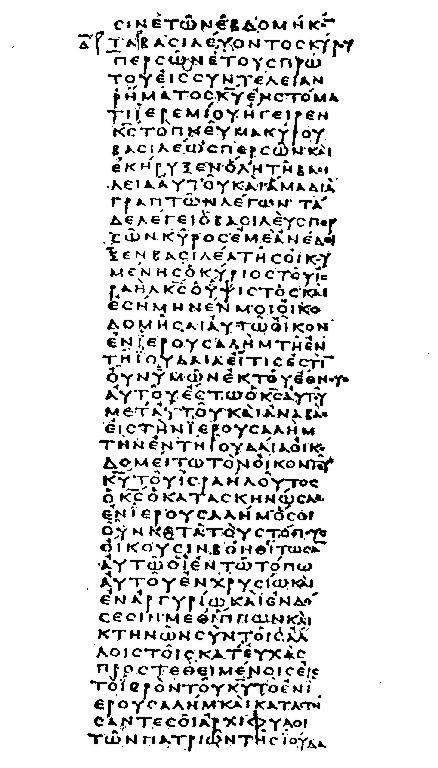
Codex Vaticanus, fourth century. Public domain.
1 Esdras 1 to 9 · Book · Apocrypha, a study resource beside the canon
1 Esdras
A book of the Apocrypha read beside Chronicles, Ezra and Nehemiah.
Cook found a convenient name for it in the Greek Ezra.
For Ezra had set his heart to study the Law of the LORD, to practice it, and to teach its statutes and ordinances in Israel.
For Ezra had set his heart to study the Law of the LORD, to practice it, and to teach its statutes and ordinances in Israel.
- Date
- about the first century BC, by Cook's reckoning (probable)
- Occasion
- A history written in Greek.
- Edition
- 1 Esdras in the King James Version Apocrypha, 1769 text (eBible.org); the Berean Standard Bible for the canon
Summary
The Greek Old Testament kept this book, and the churches of East and West have placed it in different ways. Commentators on Ezra have read it as a third witness to Ezra's text. The site reads it beside the Bible as a study resource and rests no doctrine on it.
- Josephus is its earliest known reader.
- Its first chapter opens with the Passover of King Josiah.
- A thousand horsemen of Darius escort the returning families in its fifth chapter.
The First Book of Esdras
Nine chapters and 448 verses carry the history from King Josiah to Ezra the scribe.
S. A. Cook called it a somewhat free Greek version of the biblical history from Josiah's Passover to the reading of the Law by Ezra.
The site holds the sixty-six books of the Bible as Scripture. The site's reader gives 1 Esdras in the King James Version Apocrypha, 1769 text.
The Book Beside the Canon
One part of the book has nothing beside it in the canon.
The book's eight parts, in order, each with the account it retells.
- 1 Esdras 1:1 to 58Josiah's Passover, the last kings and the seventy years of desolation2 Chronicles 35:1 to 36:212 Chronicles 35:1
- 1 Esdras 2:1 to 15The decree of Cyrus and the vessels brought back by SanabassarEzra 1Ezra 1:1
- 1 Esdras 2:16 to 30The letter to Artaxerxes and the building stoppedEzra 4:7 to 24Ezra 4:7
- 1 Esdras 3:1 to 5:6The contest of the three guards and the departure of the familiesNo parallel in the canon
- 1 Esdras 5:7 to 73The list of those who came up, the altar and the hindering of the workEzra 2:1 to 4:5Ezra 2:1
- 1 Esdras 6 and 7Haggai and Zechariah, the roll found at Ecbatana and the dedicationEzra 5 and 6Ezra 5:1
- 1 Esdras 8:1 to 9:36Ezra's journey and the putting away of the foreign wivesEzra 7 to 10Ezra 7:1
- 1 Esdras 9:37 to 55Ezra reads the Law to the peopleNehemiah 7:73 to 8:13Nehemiah 7:73
A sequence of the eight parts of 1 Esdras in order, each with what it tells and its parallel, after S. A. Cook's table of 1913.
1 Esdras 8:1 to 9:36, 1 Esdras 9:37 to 55
The book sets the letter to Artaxerxes before the list of those who came up, where Ezra sets the list first.
Where the Book Came From
Cook and the Catholic Encyclopedia gave the book different dates.
Cook dated the book, apparently, about the first century BC. He held that its original must be some time after 333 BC, and that its Greek belongs to the time of the old Greek translation of Daniel.
The Catholic Encyclopedia of 1909 placed its making probably in Lower Egypt, during the second century BC. It added that the early fathers quoted it freely.
Cook named Josephus the earliest witness to the book. Josephus used it for his account of King Josiah and followed its order of events, though for the other books he used the Greek Old Testament.
Cook also set out its names. The Greek Bible and English Bibles since the Geneva Bible of 1560 call it Esdras A or 1 Esdras, and Latin Bibles since Jerome call it 3 Esdras.
Who Receives the Book
East and West have given the book different places.
Five witnesses place 1 Esdras in four ways, from the Greek canon to an appendix in small type.
| Who | What they do with the book |
|---|---|
| The Greek Bible | keeps it as Esdras A, the first of its books of Ezra |
| The Council of Trent, session 4, 1546 | names the first book of Esdras and the second, entitled Nehemias, and no third |
| The Church of England, Article VI, 1571 | lists The Third Book of Esdras first among the other books |
| The Latin Vulgate after Trent | prints it in an appendix in small type |
| The Eastern Orthodox and the Ethiopian Orthodox Tewahedo Church | accept it as canonical |
Article VI gives the Church of England's rule for the other books: the church reads them for example of life and instruction of manners, and does not apply them to establish any doctrine.
The Voices
Adam Clarke and Albert Barnes set the book's lists and numbers beside Ezra's.
Adam Clarke (1762 to 1832)
Adam Clarke counted three copies of the list of those who returned, and 1 Esdras holds one of them.
Albert Barnes (1798 to 1870)
Albert Barnes, in his Notes on Ezra 1:11, found that the book's items agree with its total of 5,469 vessels. He judged those items improbable and held that Ezra's own total had probably suffered corruption.
In his Commentary on the Bible, on Ezra 2:2, he held that the copies in Ezra, Nehemiah and 1 Esdras, read with care, correct each other.
Books to Read Next
Three works on 1 Esdras are free to read.
1 Esdras, King James Version Apocrypha
The King James translators · 1611
It gives the whole book in nine chapters in the King James English.
Read it in the readerThe Apocrypha and Pseudepigrapha of the Old Testament, vol. I
R. H. Charles, ed.; I Esdras by S. A. Cook · 1913
Cook sets out the book's parallels, names, witnesses and date, and annotates the text.
Read it free at archive.orgEsdras, in The Catholic Encyclopedia, vol. 5
The Catholic Encyclopedia · 1909
The article treats the four books of Esdras and the place of the third in the Vulgate.
Read it free at New AdventA Book Read Beside Ezra
The last scene of 1 Esdras is a scene of the canon as well.
Ezra's reading of the Law closes 1 Esdras, and the Berean text gives the same day from Nehemiah.
So they read from the Book of the Law of God, explaining it and giving insight, so that the people could understand what was being read.Sources
Scripture is the Berean Standard Bible.
- 1 Esdras, King James Version Apocrypha, 1769 text (eBible.org USFX edition), public domain.
- S. A. Cook, I Esdras, in R. H. Charles (ed.), The Apocrypha and Pseudepigrapha of the Old Testament, vol. I, Oxford, 1913; public domain.
- The Catholic Encyclopedia, Esdras, vol. 5, 1909; public domain.
- The Council of Trent, session 4, 8 April 1546, tr. J. Waterworth, 1848.
- The Church of England, Articles of Religion, 1571, Article VI, in the Book of Common Prayer of 1863.
- Wikipedia, 1 Esdras.
- Adam Clarke, Commentary on the Bible (1832), on Ezra 2:2.
- Albert Barnes, Notes, Explanatory and Practical, on the Old Testament, on Ezra 1:11.
Keep Studying
People and groups4