
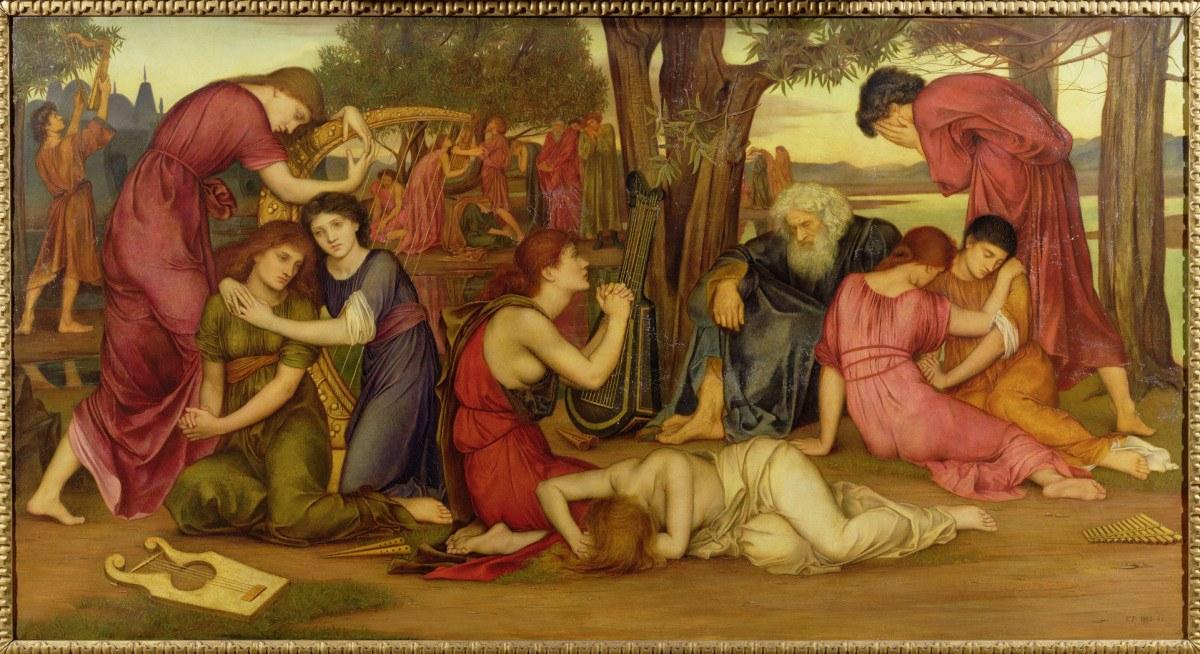
Evelyn De Morgan, By the Waters of Babylon, 1882 to 1883. Public domain.
Psalm 137 · Subject · Featured Study
Remembering Jerusalem Inside a Celebration
Psalm 137:6 vows to put Jerusalem first among the singer's joys.
May my tongue cling to the roof of my mouth if I do not remember you, if I do not exalt Jerusalem as my greatest joy!
- Books
- Psalms, Ezra, Zechariah, Galatians, Revelation
- Hold in memory
- Psalm 137:6
The Talmud keeps one small thing unfinished in the house, the meal and the dress.
Summary
The exiles of Psalm 137 swear never to forget Jerusalem. Rashi, the Talmud and the code of law each turned the oath into a rule for times of joy.
- Malbim likens Jerusalem to a right hand that cannot be forgotten
- Ezra 3:13 records shouts of joy and weeping that no one could tell apart
- Berakhot 31a and the Rema disagree on why a cup is broken at a wedding
The Vow of Psalm 137
Two verses bind the singer by an oath to remember Jerusalem.
If I forget you, O Jerusalem, may my right hand cease to function.The Talmud gives this oath as the source of the customs of remembrance.
The singer stakes his right hand and his tongue on the oath.
The Customs of Remembrance
Jewish law leaves the house, the table and the dress a little unfinished.
Each custom leaves a joy a little unfinished, or marks it with mourning.
| Custom | What is done |
|---|---|
| The house | A square cubit is left without whitewash opposite the entrance |
| The meal | One small item is left off the table |
| A woman's adornment | One small thing is left out, or one ornament left missing from a set |
| The groom | Ashes are set on his forehead, where the tefillin rest |
| The wedding | In some places a cup is broken, or a black cloth set on the groom |
How Rashi and Malbim Read the Vow
Each wrote a note on Psalm 137:5 and 6.
On Psalm 137:5 Rashi says the congregation of Israel speaks the vow. On Psalm 137:6 he writes, in A. J. Rosenberg's translation for the Judaica Press: “The remembrance of the mourning of its destruction I shall bring up to mention at the head of every joyous occasion of mine.”
Malbim, in Rabbi Mike Feuer's translation, compares Jerusalem to the right hand, which is ready for every movement and task. Forgetting her is as impossible as forgetting one's own hand.
He reads the vow beyond the exile. When a man rejoices in worldly success, Jerusalem is to stand above it, until the memory of her destruction turns the joy to sadness.
What the Talmud Ordains
The Talmud gives the customs a verse, and a later code sets them in law.
In Bava Batra 60b Rabbi Yehoshua reports a ruling of the Sages for the house, the meal and a woman's adornment, and the passage gives the vow of Psalm 137:5 and 6 as its source.
The passage takes the word head in the vow, rosh in Hebrew, as the bridegroom's head.
The Shulchan Arukh, Orach Chayim 560, opens by saying that the sages of the generation of the destruction made these decrees.
Joy and Weeping in One Sound
The return from exile mixed the two, and a prophet promised the fasts would end in feasts.
But many of the older priests, Levites, and family heads who had seen the first temple wept loudly when they saw the foundation of this temple. Still, many others shouted joyfully. The people could not distinguish the shouts of joy from the sound of weeping, because the people were making so much noise. And the sound was heard from afar.The foundation of the second temple is laid.
“This is what the LORD of Hosts says: The fasts of the fourth, the fifth, the seventh, and the tenth months will become times of joy and gladness, cheerful feasts for the house of Judah. Therefore you are to love both truth and peace.”The fasts kept for the city's fall are promised an end.
Adam Clarke, in his Commentary on the Bible, ties the fast of the fourth month to the taking of Jerusalem.
Voices on the Greatest Joy
Christian readers took the vow as a rule for the heart's love.
Jerome (died 420)
“Let my tongue cleave to my jaws, if I do not remember you. That is, let me have neither works nor speech, if the memory of you is not continually turned over in my heart.”
Jerome · Homily 48, on Psalm 136 · on Psalm 137:6Patristic
Matthew Henry (1662 to 1714)
“They preferred it above their chief joy, and therefore they remembered it and could not forget it. What we love we love to think of. Those that rejoice in God do, for his sake, make Jerusalem their joy, and prefer it before that, whatever it is, which is the head of their joy, which is dearest to them in this world.”
Matthew Henry · Commentary on the Whole Bible · on Psalm 137:5 to 6Puritan
Where the Broken Cup Comes From
The texts give the cup broken at a wedding different reasons.
To sober the feastThe Babylonian Talmud, Berakhot 30b to 31a
Mar son of Ravina saw the sages too merry at his son's wedding feast, and he broke a cup worth four hundred zuz before them. Rav Ashi did the same with a costly cup of white glass.
The stories follow the Talmud's teaching on Psalm 2:11, that joy should keep some fear in it.
Serve the LORD with fear, and rejoice with trembling.The Talmud tells the two stories after this verse.
The objection: the passage names neither the Temple nor Psalm 137.
To remember JerusalemThe Rema's gloss on Orach Chayim 560:2
The Rema sets the cup among the customs of mourning for the destruction and cites the vow's two verses.
The objection: in his gloss on Even HaEzer 65:3 the Rema gives the glass as the custom of his lands and ties it to no verse.
The City Prepared as a Bride
The New Testament sets Jerusalem itself at a wedding.
But the Jerusalem above is free, and she is our mother.Paul names the city the church belongs to.
I saw the holy city, the new Jerusalem, coming down out of heaven from God, prepared as a bride adorned for her husband.The canon ends the city's story at a wedding.
Sources
Scripture is the Berean Standard Bible.
- Rashi on Psalms 137:5 and 137:6, The Judaica Press complete Tanach with Rashi, translated by A. J. Rosenberg (CC-BY, via Sefaria)
- Malbim on Psalms 137:1 and 137:5, translated by Rabbi Mike Feuer, Jerusalem Anthology (CC-BY, via Sefaria)
- The Babylonian Talmud, Bava Batra 60b, William Davidson Edition (CC-BY-NC, cited and not quoted)
- The Babylonian Talmud, Berakhot 30b to 31a, William Davidson Edition (CC-BY-NC, cited and not quoted)
- Shulchan Arukh, Orach Chayim 560:1 and 560:2 with the Rema's gloss, and Even HaEzer 65:3, Sefaria Community Translation (CC0)
- Adam Clarke, Commentary on the Bible (1832), on Zechariah 8:19.
- Matthew Henry, Commentary on the Whole Bible (1710), on Psalm 137:5 and 6.
- Jerome, Homily 48, on Psalm 136 (137 in the Hebrew numbering)
Keep Studying
Studies5