
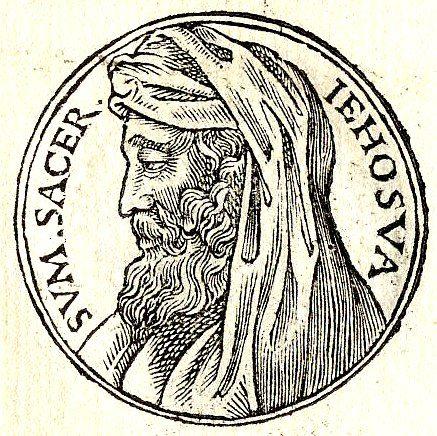
Woodcut portrait of Joshua the high priest, published by Guillaume Rouillé, 1553. Public domain.
Zechariah 3 and Zechariah 6:9 to 15 · Person · Featured Study
Joshua the High Priest and the Accuser
Joshua son of Jehozadak served as high priest when the exiles rebuilt the temple in Jerusalem.
The grandson of the chief priest put to death at Riblah became high priest after the exile.
And the LORD said to Satan: “The LORD rebukes you, Satan! Indeed, the LORD, who has chosen Jerusalem, rebukes you! Is not this man a firebrand snatched from the fire?”
- Family
- grandfather, in 1 Chronicles 6:14: Seraiah; father, in Haggai 1:1: Jehozadak; son, in Nehemiah 12:10: Joiakim
- Places
- Babylon, Jerusalem
- First named
- Ezra 2:2 “accompanied by Zerubbabel, Jeshua, Nehemiah, Seraiah, Reelaiah, Mordecai,…”
- Last named
- Zechariah 6:11 “…head of the high priest, Joshua son of…”
Summary
Joshua was the high priest who came home from Babylon with Zerubbabel. In a vision Zechariah saw him accused, cleansed and crowned.
- Ezra and Nehemiah spell his name Jeshua.
- Nehemiah traces his descendants for five generations.
- Readers name the Branch of his crowning as the Messiah or as Zerubbabel.
Where Joshua Stands in Scripture
Haggai, Ezra and Zechariah name him and set him beside the governor.
In the second year of the reign of Darius, on the first day of the sixth month, the word of the LORD came through Haggai the prophet to Zerubbabel son of Shealtiel, governor of Judah, and to Joshua son of Jehozadak, the high priest, statingThe word comes to both leaders at once, so the high priest shares the work with the governor.
Then Jeshua son of Jozadak and his fellow priests, along with Zerubbabel son of Shealtiel and his associates, began to build the altar of the God of Israel to sacrifice burnt offerings on it, as it is written in the Law of Moses the man of God.Ezra sets the high priest first at the altar, before the governor and his associates.
His Life from Exile to the Temple
Kings, Chronicles, Ezra, Haggai and Zechariah each add a turn to his story.
Joshua's house fell with Jerusalem and rose again with the temple.
- The king of Babylon strikes down Seraiah at RiblahWhen Judah was taken into exile2 Kings 25:18 to 21
- His father Jehozadak goes into captivityWhen Nebuchadnezzar took Judah and Jerusalem into exile1 Chronicles 6:15
- He comes up from Babylon with ZerubbabelNo year given in the listEzra 2:1 to 2
- He and his fellow priests build the altarBy the seventh month after the returnEzra 3:1 to 2
- The word of the LORD comes to him through HaggaiThe first day of the sixth month, second year of DariusHaggai 1:1
- Zechariah sees him before the angel of the LORDIn the visions of the twenty-fourth day of the eleventh monthZechariah 3:1
- A crown is set on his headNo time givenZechariah 6:11
- The temple is completedThe third day of Adar, sixth year of DariusEzra 6:15
Each turn with the time its text gives.
A crown is set on his head, The temple is completed
The Court Scene of Zechariah 3
Zechariah 3 sets the high priest on trial, with an accuser, a rebuke, a change of clothes and a charge.
The accuser at his right handZechariah 3:1 to 2
Then the angel showed me Joshua the high priest standing before the angel of the LORD, with Satan standing at his right hand to accuse him.The vision places the accuser where a prosecutor stood in a court of law.
Jamieson, Fausset and Brown explain that the Hebrew name Satan means an adversary in a law court, as the Greek word devil means an accuser.
Jude 9 gives the archangel Michael the words of the LORD's rebuke to Satan in Zechariah 3:2, spoken in his dispute with the devil over the body of Moses.
The filthy garments taken awayZechariah 3:3 to 4
Now Joshua was dressed in filthy garments as he stood before the angel.The priest who must stand clean before God stands here in soiled clothes.
So the angel said to those standing before him, “Take off his filthy clothes!” Then he said to Joshua, “See, I have removed your iniquity, and I will clothe you with splendid robes.”The angel names what the clothes stood for when he takes them away.
Adam Clarke noted that the Jews wore sackcloth in times of public calamity, and he took the filthy garments to point to it. John Wesley wrote that Christ took away what the angels could not, the guilt and the stain of sin. Justin Martyr, in his Dialogue with Trypho, wrote that believers have been stripped of the filthy garments of their sins through the name of God's first-begotten Son.
The clean turbanZechariah 3:5
Then I said, “Let them put a clean turban on his head.” So a clean turban was placed on his head, and they clothed him, as the angel of the LORD stood by.The prophet himself speaks inside his own vision, and his request is carried out.
E. B. Pusey held that the turban was left until last so that the prophet's intercession would complete the work. Jamieson, Fausset and Brown observe that Zechariah does not command here but prays.
The charge to the high priestZechariah 3:7
“This is what the LORD of Hosts says: ‘If you walk in My ways and keep My instructions, then you will govern My house and will also have charge of My courts; and I will give you a place among these who are standing here.The order of the scene puts the cleansing before any duty laid on the priest.
Men Who Are a Sign
Joshua and his companions are given a meaning beyond themselves.
Hear now, O high priest Joshua, you and your companions seated before you, who are indeed a sign. For behold, I am going to bring My servant, the Branch.This verse is the first place in Zechariah where the Branch is named.
Adam Clarke rendered the Hebrew phrase as typical men, whose office and service pointed forward to Christ.
His Line of Priests
Chronicles gives the line before Joshua, and Ezra and Nehemiah give his kin and his descendants.
Joshua's line runs from his grandfather Seraiah down to Jaddua.
Grandfather
- SeraiahChief priest, father of Jehozadak
Father
- JehozadakWent into captivity under Nebuchadnezzar
The high priest to Brothers
- JoshuaThe high priest, Son of Jehozadak, the high priest of the return
- His brothersBrothers, Named with his descendants among the priests who married foreign women
Son
- JoiakimNamed first among Jeshua's descendants
Grandson
- EliashibSon of Joiakim
Great-grandson
Descendant
- JonathanSon of Joiada
- A son of Jehoiada son of EliashibBecame son-in-law to Sanballat, and Nehemiah drove him away
Descendant
- JadduaSon of Jonathan, the last name in the list
Each priest with his generation and his tie to Joshua.
The Places of His Life
Five places mark the record of his house, from the land of Hamath to the temple.
Joshua's house was carried to Babylon and restored to Jerusalem.
| Place | What the text says of it | Who stands there |
|---|---|---|
| Riblah | In the land of Hamath, the king of Babylon put Seraiah to death. | Seraiah the chief priest, with the officials taken from Jerusalem |
| Babylon | The family was carried there, and Joshua came up from the captivity. | Jehozadak, then Joshua |
| The altar at Jerusalem | Jeshua and his fellow priests built it for the burnt offerings. | Jeshua, his fellow priests, Zerubbabel and his associates |
| Josiah's house | The prophet is told to go there on the day he takes the offering. | Heldai, Tobijah and Jedaiah, who arrived from Babylon |
| The temple of the LORD | The crown is to stay there as a memorial. | Helem, Tobijah and Jedaiah |
The Crown Set on Joshua
In Zechariah 6 the exiles' silver and gold become a crown for the high priest.
Take silver and gold, make an ornate crown, and set it on the head of the high priest, Joshua son of Jehozadak.The verse names the high priest and his father, so the crown is set on this Joshua.
E. B. Pusey noted that the Hebrew word is used of a royal crown and never of the high priest's mitre. C. F. Keil read the plural word as one splendid crown of gold and silver twists wound together, while John Wesley read it as two crowns, one of silver and one of gold.
Voices on the High Priest
Jerome read the vision of Jesus himself, and Matthew Henry of the believer before God.
Jerome (died 420)
Jerome, preaching on the Psalms, answers an objection with this vision and reads the high priest's name as the name of Jesus.
“But perhaps an inquisitive reader will object this too: how we can assert that God stands at the right of the just man, and the devil at the left of the sinner, when concerning our Lord it is read in Zechariah, ‘And the devil was standing at his right hand to oppose him.’ Let him, then, who objects this read also what follows: that when the devil was standing at his right hand, Jesus had filthy garments.”
Jerome · Homilies on the Psalms, Alternate Series 61 · on Zechariah 3:2Patristic
Matthew Henry (1662 to 1714)
Matthew Henry finds in the scene a word for believers whose lives fall short.
“Yet Joshua was permitted to stand before the angel of the Lord. Though his children did not as they should, yet the covenant of priesthood was not broken. Note, Christ bears with his people, whose hearts are upright with him, and admits them into communion with himself, notwithstanding their manifold infirmities.”
Matthew Henry · Commentary on the Whole Bible · on Zechariah 3:3Puritan
Whom Does the Branch Name?
Each reading of the Branch of Zechariah 3:8 and Zechariah 6:12 has its holders and an objection.
The Messiah, shown beforehand in JoshuaJohn Wesley, Explanatory Notes upon the Old Testament (1765), with Adam Clarke's Commentary on the Bible (1832) and C. F. Keil's Twelve Minor Prophets (1878)
Wesley wrote that the Branch of Zechariah 3:8 is the Messiah. Clarke held that the crowning of Joshua pointed to the Messiah, of whom Joshua was the type, and reported that the Chaldee paraphrase renders the name of Zechariah 6:12 as my Messiah. Keil wrote that the man Joshua typifies when the crown is placed on his head is the Messiah, named the Branch.
The objection: S. R. Driver pointed to the plural crowns of Zechariah 6:11 and judged it possible that the words upon the head of Zerubbabel had fallen out of the verse.
Zerubbabel, the heir of David's lineArchbishop William Newcome, as Adam Clarke reports him on Zechariah 3:8
Newcome held that the Branch is Zerubbabel, because Zerubbabel descended from Jeconiah, king of Judah, and was heir to his throne.
The objection: Clarke answers that Zerubbabel is not mentioned in Zechariah 3:8 at all.
Be Strong, O Joshua
But now be strong, O Zerubbabel, declares the LORD. Be strong, O Joshua son of Jehozadak, the high priest. And be strong, all you people of the land, declares the LORD. Work! For I am with you, declares the LORD of Hosts.The charge to the high priest stands beside the charge to the governor and to the people.
Ezra records that the two prophets spoke to Judah and Jerusalem, and that Zerubbabel and Jeshua then set to work on the house of God with the prophets beside them (Ezra 5:1 to 2).
Sources
Scripture is the Berean Standard Bible.
- Matthew Henry, Commentary on the Whole Bible (1710); John Wesley, Explanatory Notes upon the Old Testament (1765); Adam Clarke, Commentary on the Bible (1832); Jamieson, Fausset and Brown, Commentary Critical and Explanatory on the Whole Bible (1871); Jerome, Homilies on the Psalms, Alternate Series 61.
- E. B. Pusey, The Minor Prophets with a Commentary, vol. viii, Zechariah (Nisbet, 1907 reprint), on Zechariah 3:5 and 6:11; public domain.
- C. F. Keil, Biblical Commentary on the Old Testament: The Twelve Minor Prophets, vol. 2 (T. and T. Clark, 1878), on Zechariah 6:11 to 12, pp. 297 to 298; public domain.
- S. R. Driver, An Introduction to the Literature of the Old Testament (1891), p. 324; public domain.
- Justin Martyr, Dialogue with Trypho, ch. 116, translated by Marcus Dods and George Reith (Ante-Nicene Fathers, vol. 1, 1885); public domain.
Keep Studying
Read it5
Studies5
People and groups3
Doctrines5