
New Testament · Book 62 of 66
1 John
1 John is a letter written so that believers may know they have eternal life. It calls them to walk in the light, to love one another, and to confess that Jesus Christ has come in the flesh.
1 John is a letter written so that believers may know they have eternal life. It calls them to walk in the light, to love one another, and to confess that Jesus Christ has come in the flesh.
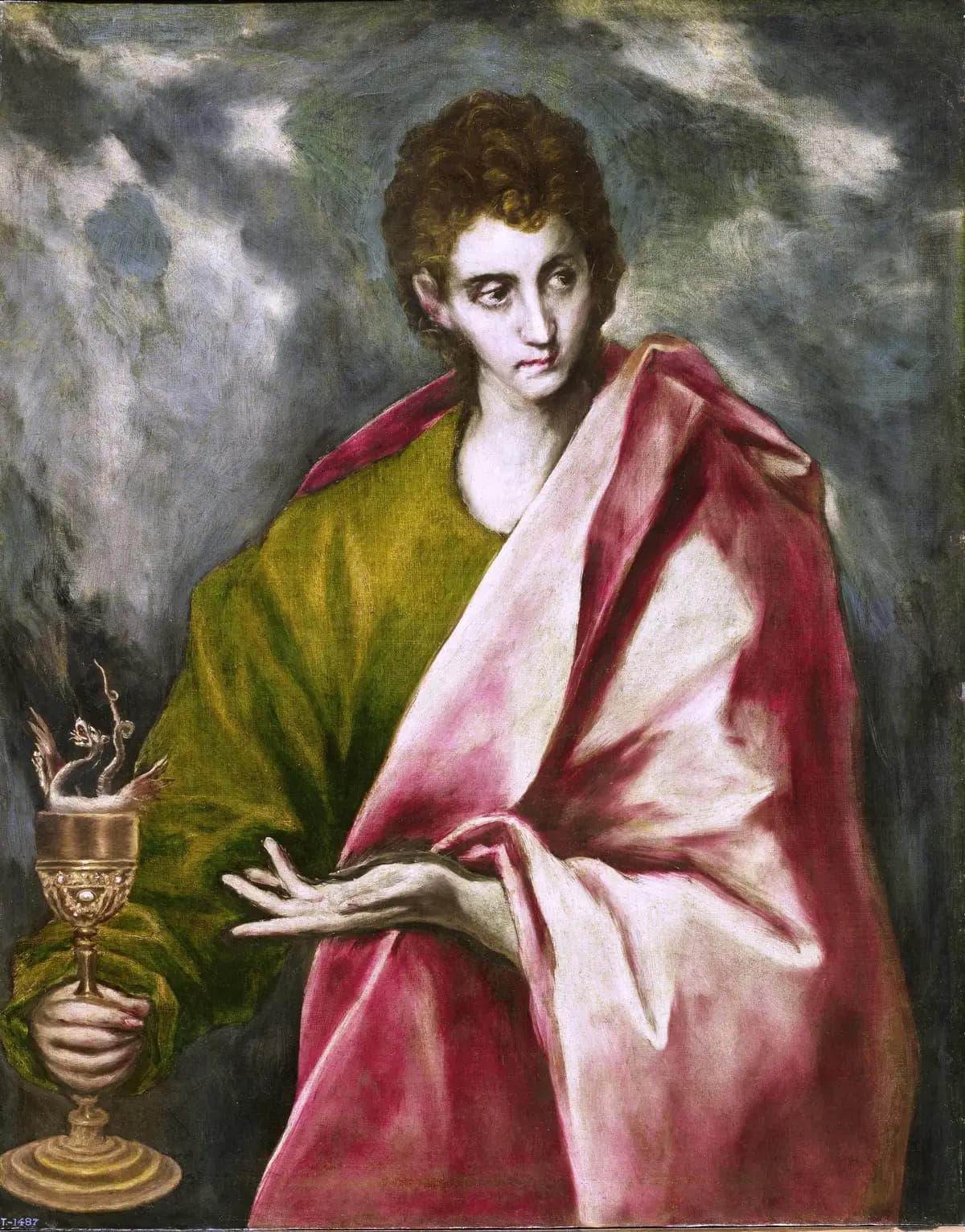
Saint John the Evangelist, El Greco and workshop, about 1605, Museo del Prado. Public domain.
What is 1 John about?
1 John is a letter from one who heard, saw and touched the Word of life, written to believers after a group had left their churches denying the Son. It teaches that God is light and that God is love, and it tests every claim to know Him by three marks: keeping His commandments, loving the brothers, and confessing Jesus as the Christ come in the flesh. It says why it was written: “so that you may know that you have eternal life” (5:13). Its last line warns its readers to keep away from idols.
All 5 chapters
Every chapter of the book, in one grid. Each cell opens that chapter.
- God is lightChapters 1 to 2
- Children of GodChapter 3
- God is loveChapter 4
- That you may knowChapter 5
The colour is the movement of the letter the chapter stands in, and every cell opens that chapter's Study level.
Who wrote it, where, when, for whom, and why?
The writer speaks for a group who heard, saw and touched the Word of life and testify to it (1:1 to 3). He calls the readers my little children and writes with the authority of one who was there from the beginning. The same vocabulary of light, life, truth and the new commandment runs through the Gospel of John. The two short letters that follow it are sent by the elder (2 John 1, 3 John 1).
That which was from the beginning, which we have heard, which we have seen with our own eyes, which we have gazed upon and touched with our own hands—this is the Word of life.
1 John 1:1, Berean Standard Bible.
The letter sets its readers in the world they are told not to love (2:15), beside those who went out from them (2:19) and the false prophets who have gone out into the world (4:1).
The letter says it is the last hour and that many antichrists have already appeared, and a group has already left the churches it writes to (2:18 to 19). It assumes the readers have known the commandment from the beginning (2:7).
It is written to believers: those who believe in the name of the Son of God (5:13), whose sins are forgiven for His name's sake, who know the Father and have overcome the evil one (2:12 to 14).
The writer gives his reasons himself: that the readers may share the apostles' fellowship and their joy may be complete (1:3 to 4), that they may not sin (2:1), that they may not be deceived by those trying to lead them astray (2:26), and that they may know they have eternal life (5:13).
The churches have been divided. Some have gone out denying that Jesus is the Christ and that He came in the flesh (2:22, 4:2 to 3), false prophets speak and the world listens (4:5), and the readers are warned against the desires of the flesh, the desires of the eyes and the pride of life (2:16) and against idols (5:21).
Sources. 1 John 1:1 to 4, 2:1, 2:7, 2:12 to 14, 2:16, 2:18 to 19, 2:22, 2:26, 4:1 to 5, 5:13 and 5:21; 2 John 1; 3 John 1. Every verse is read in the Berean Standard Bible.
How is 1 John arranged, and what is it for?
The four movements the letter falls into, then what it teaches and what it was written to do.
- God is lightChapters 1 to 2, 39 verses, the turn at 1:5
The Word of life seen and touched, walking in the light, and the warning of the last hour.
- Children of GodChapter 3, 24 verses, the turn at 3:1
The Father's love that names us his children, the two families, and love in action and truth.
- God is loveChapter 4, 21 verses, the turn at 4:10
The spirits tested by their confession of Christ, and the love that begins with God.
- That you may knowChapter 5, 21 verses, the turn at 5:13
The faith that overcomes the world, the testimony God has given, and what believers know.
The theme
The letter sets out what is true of God and what follows for those who know Him. God is light, so His people walk in the light and confess their sins. God is love, shown in the Son He sent, so His children love one another in action. Jesus is the Christ come in the flesh, and whoever has the Son has life. The same three marks return through the letter: obedience, love and a right confession of Christ.
The purpose
The letter was written to believers after a group had left their churches denying the Son. It warns them against those teachers, gives them the tests by which to know the truth, and assures them that they have eternal life. It closes by telling them to keep away from idols.
Three tests, taken up again and again
Obedience (3)
Keeping His commandments
Love (3)
Loving the brothers
God is light, 1 John 1 to 2
What the text says in these 39 verses, and the pages they open on.
The letter opens on what the writer and those with him heard, saw with their eyes and touched with their hands, the Word of life that was with the Father and was revealed (1:1 to 3). They write so that the readers may share their fellowship with the Father and the Son. The message is that God is light and there is no darkness in Him. Three claims are answered in turn: to have fellowship while walking in darkness, to have no sin, and never to have sinned. The one who sins has an advocate with the Father, the Righteous One, the atoning sacrifice for the sins of the whole world (2:1 to 2). The one who knows Him keeps His commandments and loves his brother. The writer addresses little children, fathers and young men, warns against loving the world, and says it is the last hour: many antichrists have gone out from the church, denying that Jesus is the Christ. The anointing the readers received teaches them, and they are to remain in Him.
And this is the message we have heard from Him and announce to you: God is light, and in Him there is no darkness at all.
- Study
1 John 1the Word of life, walking in the light, sin confessedShow the summary and 3 pagesShow summary, 3 pagesHide the summary
The letter begins without a name, in the cadence of John's Gospel prologue but with hands in it: 'That which was from the beginning, which we have heard, which we have seen with our own eyes, which we have gazed upon and touched with our own hands … this is the Word of life' (1:1): a deliberate blow against anyone teaching that the Christ only seemed to have flesh. Then the message: 'God is light, and in Him there is no darkness at all' (1:5). Three false claims are answered in turn, and the last answer is the one the church has memorized: 'If we confess our sins, He is faithful and just to forgive us our sins and to cleanse us from all unrighteousness' (1:9).
On this chapter (3)
- The incarnation
The Word who became flesh and was seen and touched.
- Who wrote the letter, the apostle John or an elder John?
Answered under Where do readers disagree, lower on this page, with each reading and who holds it.
- 1 John 1:9
The verse on its own page, with the commentators on it by era.
- The incarnation
- Study
1 John 2the advocate, the old and new commandment, the antichristsShow the summary and 5 pagesShow summary, 5 pagesHide the summary
'My little children, I am writing these things to you so that you will not sin. But if anyone does sin, we have an advocate before the Father … He Himself is the atoning sacrifice for our sins, and not only for ours but also for the sins of the whole world' (2:1-2). The tests follow, we know that we know him if we keep his commandments, and he that hateth his brother is in the darkness. John addresses the church in tiers, little children, fathers, young men, then warns: 'Do not love the world … The world is passing away, along with its desires; but whoever does the will of God remains forever' (2:15-17). Then the schism: 'it is the last hour,' many antichrists have arisen, and 'they went out from us, but they were not of us.'
On this chapter (5)
- Antichrist
The word and the figure, from John's letters on.
- Who went out in 2:19, and what did they deny about Jesus?
Answered under Where do readers disagree, lower on this page, with each reading and who holds it.
- How does 2:2 stand in the debate on the extent of the atonement?
Answered under Where do readers disagree, lower on this page, with each reading and who holds it.
- Who is the antichrist of 2:18?
Answered under Where do readers disagree, lower on this page, with each reading and who holds it.
- 1 John 2:1
The verse on its own page, with the commentators on it by era.
- Antichrist
Six claims, and the answer to each
- 1
The claim: “If we say we have fellowship with Him yet walk in the darkness” (1:6)
The answer: “if we walk in the light as He is in the light, we have fellowship with one another” (1:7)
- 2
The claim: “If we say we have no sin” (1:8)
The answer: “If we confess our sins, He is faithful and just to forgive us our sins” (1:9)
- 3
The claim: “If we say we have not sinned” (1:10)
The answer: “if anyone does sin, we have an advocate before the Father” (2:1)
- 4
The claim: “If anyone says, “I know Him,” but does not keep His commandments” (2:4)
The answer: “if anyone keeps His word, the love of God has been truly perfected in him” (2:5)
- 5
The claim: “Whoever claims to abide in Him” (2:6)
The answer: “must walk as Jesus walked” (2:6)
- 6
The claim: “If anyone claims to be in the light but hates his brother” (2:9)
The answer: “whoever hates his brother is in the darkness” (2:11)
Characters (4)
Who the text names. A name with a page carries its door.
- The writer
One of those who heard, saw and touched the Word of life (1:1). Who he was stands under Where do readers disagree.
- Little children, fathers and young men
The readers, addressed by name in turn (2:12 to 14).
- Those who went out
A group that left the churches and did not belong to them (2:19).
- The antichrists
Those who deny the Father and the Son (2:22).
Places (2)
The realms the letter sets its readers in.
- The light and the darkness
Where a person walks, shown by how he treats his brother (2:9 to 11).
- The world
What the readers are told not to love, which is passing away (2:15 to 17).
Themes (4)
What these chapters raise, each on its own page where one stands.
- Fellowship
With the Father, the Son and one another.
- The advocate
The Righteous One, before the Father for the one who sins.
- The commandment
Old from the beginning and new in Him (2:7 to 8).
- Abiding
Remaining in the Son and in the Father.
These chapters quote no Old Testament passage.
- Beside the Gospel of John: 1 John 1:1 to 4 with John 1:1 to 14. The Word who was from the beginning and was seen, as the Gospel's opening tells it.
- Beside the Gospel of John: 1 John 2:7 to 8 with John 13:34. The new commandment Jesus gave, love one another.
Children of God, 1 John 3
What the text says in these 24 verses, and the pages they open on.
The Father has given such love that the readers are called children of God, and they are (3:1). What they will be is not yet revealed, but when Christ appears they will be like Him and see Him as He is, and the one with this hope purifies himself. Sin is lawlessness, and Christ appeared to take away sins. The chapter then sets two families side by side: the one who practices righteousness and the one who practices sin, the one born of God and the one who belongs to the devil. The Son of God was revealed to destroy the devil's works. The message from the beginning is to love one another, and Cain is the example not to follow. Love is known by this, that Jesus laid down His life for us, so love is shown in action and truth and in help given to a brother in need. When the heart condemns, God is greater than the heart. His commandment is to believe in the name of the Son and to love one another (3:23).
Behold what manner of love the Father has given to us, that we should be called children of God. And that is what we are! The reason the world does not know us is that it did not know Him.
- Study
1 John 3called children of God, the two families, Cain, love in actionShow the summary and 3 pagesShow summary, 3 pagesHide the summary
'Behold what manner of love the Father has given to us, that we should be called children of God. And that is what we are!' (3:1). 'Beloved, we are now children of God, and what we will be has not yet been revealed. We know that when Christ appears, we will be like Him, for we will see Him as He is'. And everyone with this hope purifieth himself. Sin is lawlessness, and 'the Son of God was revealed, to destroy the works of the devil' (3:8). The children of God and of the devil are told apart by righteousness and love, not as Cain, who slew his brother. Then love is defined by the cross: 'By this we know what love is: Jesus laid down His life for us, and we ought to lay down our lives for our brothers' (3:16).
On this chapter (3)
- Cain and Abel
The brothers of Genesis 4, the story the letter names.
- How do 3:6 and 3:9 stand with 1:8?
Answered under Where do readers disagree, lower on this page, with each reading and who holds it.
- 1 John 3:16
The verse on its own page, with the commentators on it by era.
- Cain and Abel
The two families of chapter 3
- What each practices
Of God: “The one who practices righteousness is righteous” (3:7)
Of the devil: “The one who practices sin is of the devil” (3:8)
- Whose each is
Of God: “Anyone born of God refuses to practice sin” (3:9)
Of the devil: “Anyone who does not practice righteousness is not of God” (3:10)
- How each treats his brother
Of God: “we have passed from death to life, because we love our brothers” (3:14)
Of the devil: “Everyone who hates his brother is a murderer” (3:15)
The letter“Do not be like Cain, who belonged to the evil one and murdered his brother” (3:12)
The story it names“Cain rose up against his brother Abel and killed him” (Genesis 4:8)
Characters (3)
Who the text names. A name with a page carries its door.
- The children of God
Those born of God, who practice righteousness and love their brothers.
- The children of the devil
Those who practice sin and hate their brothers.
- Cain
The brother who belonged to the evil one and murdered Abel (3:12).
Places (1)
The realms the letter sets its readers in.
- The world
It did not know Him, and it may hate the readers (3:1, 3:13).
Themes (3)
What these chapters raise, each on its own page where one stands.
- Born of God
The new birth that shows in how a person lives.
- Love in action
Help given to a brother in need, after the pattern of the Cross.
- The tests of life
Righteousness, love and belief, the marks the chapter names.
Where these chapters take up the Old Testament (1)each marked for what it is
- Named story1 John 3:12 takes up Genesis 4:8. The one Old Testament story the letter names. Cain is the pattern of the one who hates his brother, and the letter asks why he killed Abel.Both verses are drawn in the figure above from the store's Berean text.
God is love, 1 John 4
What the text says in these 21 verses, and the pages they open on.
The readers are not to believe every spirit but to test the spirits, because many false prophets have gone out into the world. A spirit that confesses Christ come in the flesh is from God, and one that does not is the spirit of the antichrist. The one in the readers is greater than the one in the world (4:4). Then the chapter turns to love. Love comes from God, and whoever loves has been born of God, because God is love. God showed His love by sending the Son so that we might live through Him. No one has ever seen God, but when believers love one another God remains in them. Perfect love drives out fear of the day of judgment. We love because He first loved us, and whoever says he loves God while hating his brother is a liar (4:20).
And love consists in this: not that we loved God, but that He loved us and sent His Son as the atoning sacrifice for our sins.
- Study
1 John 4the spirits tested, God is love, fear driven outShow the summary and 2 pagesShow summary, 2 pagesHide the summary
'Beloved, do not believe every spirit, but test the spirits to see whether they are from God. For many false prophets have gone out into the world' (4:1), and the test is christological and blunt: every spirit that confesseth that Jesus Christ is come in the flesh is of God. You have overcome them, 'because greater is He who is in you than he who is in the world.' Then the summit: 'Beloved, let us love one another, because love comes from God … Whoever does not love does not know God, because God is love' (4:7-8), love defined not by sentiment but by an event, 'not that we loved God, but that He loved us and sent His Son as the atoning sacrifice for our sins' (4:10). 'There is no fear in love, but perfect love drives out fear' (4:18).
On this chapter (2)
- Discerning of spirits
Testing what is spoken by its confession of Christ.
- 1 John 4:8
The verse on its own page, with the commentators on it by era.
- Discerning of spirits
The chain of love in chapter 4
- Station 1
Love is from God
“love comes from God” (4:7)
- Station 2
The Son sent
“God sent His one and only Son into the world, so that we might live through Him” (4:9)
- Station 3
He loved us first
“We love because He first loved us” (4:19)
- Station 4
We ought to love one another
“we also ought to love one another” (4:11)
- Station 5
Perfect love drives out fear
“perfect love drives out fear” (4:18)
Characters (2)
Who the text names. A name with a page carries its door.
- The false prophets
Many have gone out into the world (4:1).
- The Son sent
The Savior of the world, sent by the Father (4:14).
Places (1)
The realms the letter sets its readers in.
- The world
Where the false prophets speak and are heard (4:5).
Themes (3)
What these chapters raise, each on its own page where one stands.
- Testing the spirits
By what each confesses about Christ.
- God is love
Love that comes from God and is perfected in His people.
- The incarnation
Christ come in the flesh, the confession that marks the Spirit of God.
These chapters quote no Old Testament passage.
That you may know, 1 John 5
What the text says in these 21 verses, and the pages they open on.
Everyone who believes that Jesus is the Christ has been born of God, and loving God means keeping His commandments, which are not burdensome. The faith of those born of God is the victory that overcomes the world. Jesus came by water and blood, and the Spirit testifies, so three agree: the Spirit, the water and the blood. God's testimony is greater than human testimony: He has given eternal life, and this life is in the Son. Whoever has the Son has life (5:12). The writer then gives his reason for writing, and the letter closes on what believers know: that God hears what they ask according to His will, that they may pray for a brother whose sin does not lead to death, that the one born of God is kept, and that the Son of God has come and is the true God and eternal life. Its last line is a warning to keep away from idols.
I have written these things to you who believe in the name of the Son of God, so that you may know that you have eternal life.
- Study
1 John 5faith overcomes, the three that testify, the we know sentencesShow the summary and 4 pagesShow summary, 4 pagesHide the summary
'Everyone who believes that Jesus is the Christ has been born of God': faith, love, and obedience braided into one. His commandments are not grievous, 'because everyone born of God overcomes the world. And this is the victory that has overcome the world: our faith' (5:4). The witness is threefold (the Spirit, the water, and the blood) and 'Whoever has the Son has life; whoever does not have the Son of God does not have life.' (5:12). Then the purpose statement, matching John 20:31: 'I have written these things to you who believe in the name of the Son of God, so that you may know that you have eternal life' (5:13). The letter ends in certainties, and one last command: 'keep yourselves from idols.'
On this chapter (4)
- Eternal security
Whether a believer can know he has eternal life, and keep it.
- What is the sin that leads to death in 5:16?
Answered under Where do readers disagree, lower on this page, with each reading and who holds it.
- Why does the King James Version carry three heavenly witnesses at 5:7 to 8?
Answered under Where do readers disagree, lower on this page, with each reading and who holds it.
- 1 John 5:4
The verse on its own page, with the commentators on it by era.
- Eternal security
What believers know, and the three that testify
- 1“By this we know that we love the children of God” (5:2)
- 2“we know that He hears us in whatever we ask” (5:15)
- 3“We know that anyone born of God does not keep on sinning” (5:18)
- 4“We know that we are of God” (5:19)
- 5“we know that the Son of God has come” (5:20)
This is the One who came by water and blood, Jesus Christ—not by water alone, but by water and blood. And it is the Spirit who testifies to this, because the Spirit is the truth. For there are three that testify: the Spirit, the water, and the blood—and these three are in agreement.
1 John 5:6–8, Berean Standard Bible
For there are three that bear record in heaven, the Father, the Word, and the Holy Ghost: and these three are one. And there are three that bear witness in earth, the spirit, and the water, and the blood: and these three agree in one.
1 John 5:7–8, King James Version
Characters (3)
Who the text names. A name with a page carries its door.
- Those born of God
Everyone who believes that Jesus is the Christ (5:1).
- The brother who sins
For whom the readers pray, where his sin does not lead to death.
- The evil one
Who cannot touch the one born of God (5:18).
Places (1)
The realms the letter sets its readers in.
- The whole world
Under the power of the evil one (5:19).
Themes (4)
What these chapters raise, each on its own page where one stands.
- The testimony
The Spirit, the water and the blood, and the testimony God has given about the Son.
- Eternal life
Given by God and found in the Son.
- Assurance
Knowing that one has eternal life.
- The true God
The Son who has come, the true God and eternal life.
These chapters quote no Old Testament passage.
- Beside the Gospel of John: 1 John 5:13 with John 20:31. The Gospel was written that readers may believe; the letter, that believers may know.
- Author
- The apostle John: same author as the Gospel of John and 2/3 John; early church unanimous
- Date
- Late 1st century, c. AD 85–95, likely written from Ephesus
- Audience
- Churches in Asia Minor under docetic / proto-Gnostic pressure
Where do readers disagree?
One list: the readings with their holders, and what the evidence does not settle.
Who wrote the letter, the apostle John or an elder John?
- John the apostle, the son of Zebedee. Held by Irenaeus in Against Heresies, book 3, who quotes the letter as the work of John the disciple of the Lord, and by John R. W. Stott in The Letters of John.
- John the elder, a second John of Asia. Held by Eusebius in Ecclesiastical History, book 3, chapter 39, who reads Papias's Expositions of the Sayings of the Lord as naming two men called John.
- A disciple in the circle of John. Held by Raymond E. Brown in The Epistles of John, Anchor Bible.
What the evidence does not settle: Whether Papias's sentence names one John twice or two men, since his book survives only in the lines Eusebius quotes.
The argument in full
John the apostle, the son of Zebedee. The writer claims to have heard, seen and touched the Word of life, and the letter shares the Gospel's language throughout.
John the elder, a second John of Asia. Papias lists John among the apostles and then names the elder John a second time, and the two short letters after this one come from the elder.
A disciple in the circle of John. The letter speaks for a we who carry the tradition, and it differs from the Gospel in emphasis while sharing its words.
Who went out in 2:19, and what did they deny about Jesus?
Antichrist, the word and the figure→- Followers of Cerinthus. Held by Irenaeus in Against Heresies, book 1, chapter 26, who says Cerinthus taught that the Christ came down on Jesus at His baptism and left Him before He suffered.
- Teachers who denied that Christ had a real body. Held by Robert Law in The Tests of Life.
- Members of the community who read the Gospel their own way. Held by Raymond E. Brown in The Community of the Beloved Disciple.
What the evidence does not settle: Each reading is built from what the letter says the teachers denied: that Jesus is the Christ (2:22) and that He has come in the flesh (4:2 to 3).
The argument in full
Followers of Cerinthus. The letter answers anyone who denies that Jesus is the Christ, and says He came by water and blood, the blood as well as the water.
Teachers who denied that Christ had a real body. The confession the letter asks for is that Christ has come in the flesh, and it opens on hands that touched Him.
Members of the community who read the Gospel their own way. They went out from us, so they had belonged to the same churches, and they drew on the Gospel of John for a Christ whose earthly life mattered little.
How do 3:6 and 3:9 stand with 1:8?
- Sin as a settled way of life. Held by John R. W. Stott in The Letters of John.
- The sin against love. Held by Augustine in Ten Homilies on the First Epistle of John, homily 5.
- Sin that reigns. Held by John Calvin in Commentaries on the Catholic Epistles, on 3:9.
- Freedom from sin given in this life. Held by John Wesley in A Plain Account of Christian Perfection.
What the evidence does not settle: Whether the tense alone carries the difference, since the letter also uses a present tense at 1:8 for having sin.
The argument in full
Sin as a settled way of life. The Greek verbs in chapter 3 are present tense and describe what a person keeps doing, and the letter provides an advocate for the believer who does sin.
The sin against love. The sin the one born of God cannot commit is hatred of his brother, since the chapter ties being of God to loving the brothers.
Sin that reigns. The seed of God in the regenerate keeps sin from ruling them, though sin remains in them.
Freedom from sin given in this life. The verses promise what God works in the believer: a heart wholly given to love, in which ignorance and mistakes remain and wilful sin ends.
Why does the King James Version carry three heavenly witnesses at 5:7 to 8?
The Trinity→- A Latin addition to the text. Held by Bruce M. Metzger in A Textual Commentary on the Greek New Testament.
- Part of the text the church received. Held by Edward F. Hills in The King James Version Defended.
- How the words reached the King James. Held by H. J. de Jonge in 'Erasmus and the Comma Johanneum', Ephemerides Theologicae Lovanienses.
What the evidence does not settle: When the words first entered the Latin text, and whether they began as a note in the margin.
The argument in full
A Latin addition to the text. The oldest Greek manuscripts, Codex Sinaiticus, Codex Vaticanus and Codex Alexandrinus, carry the shorter text, and the words first stand in Greek manuscripts of the fourteenth century. They are first quoted in Latin, in Priscillian's Book of Apology (about 380).
Part of the text the church received. The Latin witness is early, a sixth-century Latin preface complains that translators left the words out, and the Greek grammar of 5:8 is said to read more smoothly with them.
How the words reached the King James. Erasmus left the words out of his Greek New Testament in 1516 and 1519 and printed them in 1522, after a Greek manuscript with them, Codex Montfortianus, was brought to him; the Received Text behind the translation of 1611 followed that edition.
What is the sin that leads to death in 5:16?
- The denial of the Son by those who went out. Held by Raymond E. Brown in The Epistles of John.
- Grave sins such as murder, idolatry and adultery. Held by Tertullian in On Modesty, chapter 19.
- Sin against the grace one has known. Held by Augustine in Our Lord's Sermon on the Mount, book 1.
What the evidence does not settle: What the sin is, since the letter says only that there is a sin that leads to death and that the writer is not saying the reader should ask regarding it (5:16).
The argument in full
The denial of the Son by those who went out. The letter has just said that whoever does not have the Son does not have life, and it was written after a group left denying Him.
Grave sins such as murder, idolatry and adultery. The letter itself separates sins that lead to death from sins that do not.
Sin against the grace one has known. The sin is that of a brother who, after coming to know God, attacks the brotherhood out of envy of grace.
How does 2:2 stand in the debate on the extent of the atonement?
- Christ died for every person. Held by John Wesley in Explanatory Notes upon the New Testament, on 2:2.
- Christ died for His people in every nation. Held by John Owen in The Death of Death in the Death of Christ.
- Sufficient for all, effective for the elect. Held by Peter Lombard in The Four Books of Sentences, book 3, distinction 20.
What the evidence does not settle: What John means by the whole world here, since he uses the word both for all people and for the realm under the evil one.
The argument in full
Christ died for every person. The whole world is set against our sins, so the sacrifice reaches everyone.
Christ died for His people in every nation. The whole world means believers scattered among all nations, beyond the Jewish readers John writes to.
Sufficient for all, effective for the elect. The sacrifice is of worth enough for the whole world and takes effect in those who believe.
Who is the antichrist of 2:18?
Antichrist, the word and the figure→- One person at the end of the age. Held by Irenaeus in Against Heresies, book 5, chapters 25 to 30.
- Everyone who denies Christ. Held by Augustine in his Ten Homilies, homily 3.
- The many as forerunners of the one. Held by John R. W. Stott in The Letters of John.
What the evidence does not settle: Whether the letter expects a single figure at all, since it speaks of the one to come only as what the readers had heard.
The argument in full
One person at the end of the age. The readers had heard that the antichrist is coming, which points to one figure still to appear.
Everyone who denies Christ. The letter says many antichrists have already appeared and defines the antichrist as the one who denies the Father and the Son.
The many as forerunners of the one. The spirit of the antichrist is already in the world, and the one the readers heard of is still to come.
Does the letter follow an outline, or return to the same tests?
The Tests of Life→- Three tests that recur. Held by Robert Law in The Tests of Life.
- Two halves, on the Gospel's pattern. Held by Raymond E. Brown in The Epistles of John.
- No plan that divides cleanly. Held by A. E. Brooke in A Critical and Exegetical Commentary on the Johannine Epistles.
What the evidence does not settle: Where the divisions fall; the four movements on this page follow the chapter openings.
The argument in full
Three tests that recur. Righteousness, love and belief are each taken up more than once, and each time more deeply.
Two halves, on the Gospel's pattern. Two sentences open with this is the message, one on light and one on love, and the letter falls into two parts at them.
No plan that divides cleanly. The thought moves by association from one idea to the next, and every outline cuts across it somewhere.
The Text and the Spade
- The Basilica of Saint John at Ayasuluk hill, Selçukthe standing basilica built under Justinian in the 6th century, over a 4th-century church
The hill above ancient Ephesus carries the remains of a large cruciform basilica built by Justinian in the sixth century, standing over a smaller fourth-century church that in turn marked a tomb held to be John's. Excavation has traced the sequence of buildings. What the site establishes is the antiquity and the strength of the tradition that John spent his last years at Ephesus and was buried there, which is the tradition Irenaeus reports in the second century and Eusebius repeats. The grave itself is presented here as tradition with a long and traceable history.
- The temple of Artemis at Ephesusthe great temple built in the 4th century BC; excavated by J. T. Wood from 1869
The Artemision was one of the largest buildings of the ancient world and the economic center of Ephesus, whose silversmiths made shrines of the goddess. Acts 19 describes the riot that followed Paul's preaching there, and the temple platform, column bases and dedications recovered from the site show the scale of the cult. It bears on this letter through its last sentence, 'Little children, keep yourselves from idols' (5:21), which reads as an ordinary practical warning if the readers lived in that province.
- The papyri of Oxyrhynchusexcavated from 1896; the manuscripts 1st to 7th century
The rubbish mounds of a provincial Egyptian town produced hundreds of thousands of papyrus fragments, among them Papyrus 9 with its few verses of 1 John 4. The importance of the find for this letter is what it shows about ordinary circulation. A short private copy of part of a letter, written in an unpractised hand and thrown away, tells us the text was in the hands of ordinary Christians in a small town far from Ephesus within a century or two of its writing.
The pages 1 John opens on
Studies40
Show the next 6 titles
Show the next 6 titles
Show the next 6 titles
- Creation to New Creation
- Second Adam
- Christ / Messiah
- Forgiven, and Forgiving
- The Man Who Asked to Touch: John 20:24-29
- The Covenant Lawsuit: When God Sues His People
Show the next 6 titles
People1
Places1
Words5
Books beside it5
Sources for this page
The painting in the band is Saint John the Evangelist, El Greco and workshop, about 1605, Museo del Prado. Public domain. The movements, the chapter entries, the figures and the Context are read off the text of 1 John. The works behind the readings under Where do readers disagree are Irenaeus, Against Heresies (about 180); Tertullian, On Modesty (about 220); Eusebius, Ecclesiastical History (about 325), with Papias, Expositions of the Sayings of the Lord, as he quotes it; Augustine, Our Lord's Sermon on the Mount (about 394) and Ten Homilies on the First Epistle of John (about 407); Peter Lombard, Sentences (about 1150); John Calvin, Commentaries on the Catholic Epistles (1551); John Owen, The Death of Death in the Death of Christ (1647); John Wesley, Explanatory Notes upon the New Testament (1755) and A Plain Account of Christian Perfection (1766); Robert Law, The Tests of Life (1909); A. E. Brooke, A Critical and Exegetical Commentary on the Johannine Epistles (1912); Edward F. Hills, The King James Version Defended (1956); Bruce M. Metzger, A Textual Commentary on the Greek New Testament (1971); Raymond E. Brown, The Community of the Beloved Disciple (1979) and The Epistles of John (1982); H. J. de Jonge, Erasmus and the Comma Johanneum (1980); and John R. W. Stott, The Letters of John (1988). Every verse quoted on this page is the Berean Standard Bible, read from the store, except the wording of 1611 at 5:7 to 8 in the figure for chapter 5, which the page teaches.