
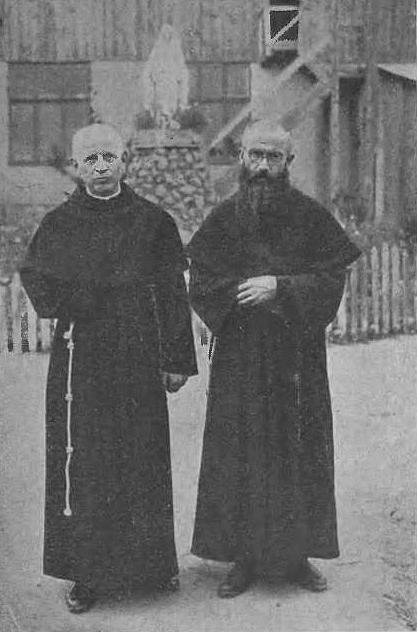
Korneli Czupryk and Maksymilian Kolbe, Misje Katolickie, 1933. Public domain.
Poland and Japan, to 1941 · Person · Featured Study
Maximilian Kolbe
He was a Polish Franciscan friar who died at Auschwitz in August 1941 in the bunker where the camp starved condemned men.
When one condemned prisoner cried out that he had a family, another stepped forward and asked to die in his place.
Greater love has no one than this, that he lay down his life for his friends.
Greater love has no one than this, that he lay down his life for his friends.
- Born
- 8 January 1894, at Zduńska Wola
- Died
- 14 August 1941, in the bunker of Block 11 at Auschwitz
- Family
- mother: Marianna Kolbe; elder brother: Franciszek Kolbe
- Places
- Zduńska Wola, Rome, Niepokalanów, Nagasaki, Auschwitz
Summary
Maximilian Kolbe was born in Poland in 1894. In Rome in 1917 he and six other students formed the Militia Immaculatae. He built up the friary of Niepokalanów near Warsaw. From 1930 he worked in Nagasaki. The Germans arrested him twice, and in May 1941 he came to Auschwitz.
- Franciszek Gajowniczek, whose place he took, survived the war.
- Westminster Abbey set his statue over its west door in 1998.
- His elder brother Franciszek died in the camp at Mittelbau in January 1945.
The Verse That Opened His Canonization
The homily at his canonization begins with John 15:13.
It quotes the verse in Italian, and later asks whether the death Kolbe chose was not a particular fulfilment of the words of Christ.
The question of this life is what survivors and the few camp papers left can tell of the roll call where he took another man's place.
By this we know what love is: Jesus laid down His life for us, and we ought to lay down our lives for our brothers.John's letter draws the same command from the death of Christ.
The Life in Order
The years before the war stand on the Abbey's life, and the camp on the Auschwitz Memorial.
The last six months of the life hold five of its dates.
- 8 January 1894He was born at Zduńska WolaWestminster Abbey
- October 1917He and six other students in Rome formed the Militia ImmaculataeWestminster Abbey, the life
- October 1927A gift of land near Warsaw began the friary of NiepokalanówThe Abbey, on Prince Drucki-Lubecki's gift
- 1930He went to Nagasaki with four of his brothersThe Abbey, on Japan
- 19 September 1939He was first arrested, with more than forty friarsThe Memorial's podcast
- 17 February 1941He was arrested a second time, with four friarsThe podcast, on the second arrest
- 28 May 1941A transport from Warsaw brought him to AuschwitzThe Memorial, on the transport from Warsaw
- End of July 1941He took Franciszek Gajowniczek's place at a roll callThe Memorial gives 29 July
- 14 August 1941He died at forty-seven, about two weeks after the roll callThe camp's death certificate
- 1971Paul VI beatified himThe Memorial's notice
- 10 October 1982John Paul II canonized himThe canonization homily
Each step of the life stands with its witness.
28 May 1941, End of July 1941, 14 August 1941, 1971, 10 October 1982
From Zduńska Wola to Block 11
The Abbey tells the friar's work, and the Memorial tells the eleven weeks in the camp.
At eighteen he went to Rome to study philosophy and theology, and he came back to Poland to lecture at the Franciscan seminary in Kraków.
His movement flourished at Niepokalanów and published widely across Poland, and by 1936 the friary produced nine journals with large print runs. In Nagasaki he and his brothers built a house on land that had been a burial ground and published a journal there too.
When war broke out he sent the brothers away and stayed at the friary. He resisted pressure to apply for release, and after a time of freedom he was taken again.
The Abbey writes that after he came back from Japan in 1936 he saw Niepokalanów as "a modern workshop of the improvement of man".
A few days after his transport an SS man called out at roll call, "Alle Pfaffen raus", which the Memorial renders "All the clergy forward". The priests were sent to a labour unit at Babitz. There the boxer Tadeusz Pietrzykowski was sparring with another prisoner for sport. Kolbe took his hand and said, as the Memorial tells it, "Son, do not fight, do not hit".
A Kapo named Hans Krot beat him badly. He spent several weeks in the camp hospital with the tuberculosis he had caught as a student in Rome. From the hospital he was moved to work in the kitchen, peeling vegetables and mending uniforms. The Abbey writes that he gave away his own food, heard confessions and said mass against the camp's orders.
When a prisoner was found missing from his block, the camp leader Karl Fritzsch chose ten men to die by starvation. One of them cried out that he had a family and children. Kolbe stepped out of the ranks and spoke to the SS directly, which broke the camp's rule. After a brief dispute Fritzsch allowed the exchange.
The ten were locked in the bunker of Block 11 without food or water, and fellow prisoners remembered Kolbe singing prayers there. On 14 August the guards found a few still alive, and Hans Bock, a prisoner of the camp hospital, killed them with injections of phenol. Kolbe's body was burned the next day.
What the Camp's Papers Keep
Almost all of the camp's papers were destroyed, so the account rests on the testimony of survivors.
The Auschwitz Memorial says that almost ninety-five percent of the camp's documents were destroyed. The book of the bunker in Block 11 does not hold the names of the nine men who died with Kolbe. The date of his death comes from his death certificate.
Ludwik Pius Bartosik, a friar in the camp, sent news of his death to Niepokalanów in a letter written in a kind of code. In the English of the Institute of National Remembrance, it reads, "I was very impressed by the death of father Maximillian". The camp sent no official word to his community until January 1942.
In Their Own Words
Two sayings are his, spoken and written in 1941, and two are those of the prisoner he saved, from 1946 and after the war.
Maximilian Kolbe (1894 to 1941)
David Binder, "Franciszek Gajowniczek Dead; Priest Died for Him at Auschwitz", The New York Times, 15 March 1995, section B, page 13, as Franciszek Gajowniczek told it on a visit to the United States in December 1994
I am alone
“I want to go instead of the man who was selected. He has a wife and family. I am alone. I am a Catholic priest.”
Roman Catholic
About this saying1 paragraph
Franciszek Gajowniczek gave these as Kolbe's words at the roll call of July 1941, telling the story in the United States in December 1994.
Maximilian Kolbe
Pedro Estaún, "St. Maximilian Kolbe", Omnes, 14 August 2023, his last letter to his mother, in the English Omnes prints, whose translator is not named
The good God is everywhere
“As for me, everything is going well, dear mother. You can rest assured for me and for my health, because the good God is everywhere and thinks with great love of everyone and everything.”
Roman Catholic
About this saying1 paragraph
He wrote this to his mother from Auschwitz in 1941, in the last letter he was able to send her.
Franciszek Gajowniczek (died 1995)
Krzysztof Kunert, "Saved in 50 Seconds: The Story of Franciszek Gajowniczek, the Man Spared by St. Maximilian Kolbe at Auschwitz", National Catholic Register, 23 March 2025, quoting his testimony "The Voice of the Survivor", Knight of the Immaculata, May 1946, an issue not opened
The voice of the survivor
“I was raised in a religious atmosphere; I kept my faith in the hardest moments; religion was my only sustenance and hope at the time. The sacrifice of Fr. Maximilian Kolbe further intensified my religiosity and devotion to the Catholic Church, which gives birth to such heroes.”
Roman Catholic
About this saying1 paragraph
Gajowniczek closed his own account, printed in May 1946, with these words.
Franciszek Gajowniczek
Krzysztof Kunert, "Saved in 50 Seconds: The Story of Franciszek Gajowniczek, the Man Spared by St. Maximilian Kolbe at Auschwitz", National Catholic Register, 23 March 2025, his words of the years after the war, for which the article names no work
So I could live
“How could I waste his life? He offered it so I could live with my wife and enjoy my sons.”
Roman Catholic
About this saying1 paragraph
Years after the war he said this of the typhus he survived in the camp in 1942.
The People Around Him
The camp's officers, his fellow prisoners and his family stand in the record.
The man he saved and the men who killed him are all named.
| Person | Tie to Kolbe | The record |
|---|---|---|
| Franciszek Gajowniczek | A soldier of the Polish army in 1939, prisoner 5659, father of two sons | The podcast's summary, and its answer on his army service |
| Karl Fritzsch | The camp leader who chose the ten and allowed the exchange | The podcast, on the selection at the roll call |
| Hans Bock | Prisoner number 5, block elder of the camp hospital | The Memorial's anniversary article |
| Ludwik Pius Bartosik | A friar of his house, arrested with him | The Institute of National Remembrance, and the podcast's five friars |
| Tadeusz Pietrzykowski | A boxer from Warsaw, prisoner 77, who described the beating | The podcast, on Babitz and the beating |
| Marianna Kolbe | His mother, living in Kraków, who had a letter from him at the end of June, weeks before his death | The podcast, on the news reaching his family |
| Franciszek Kolbe | His elder brother, a member of the resistance, later deported to Auschwitz | The podcast, on Franciszek's arrest and death |
| Korneli Czupryk | A fellow friar, photographed beside him in 1933 | Misje Katolickie, December 1933 |
Franciszek Kolbe, Korneli Czupryk
The Places of His Life
His life runs from central Poland to Rome, Nagasaki and Oświęcim.
Two houses, one in Poland and one in Japan, hold the years of his work.
| Place | What the records say | The record |
|---|---|---|
| Zduńska Wola | His birthplace, where his elder brother lived in the year Kolbe died | Westminster Abbey, and the Memorial's podcast |
| Rome | He studied there and founded the Militia Immaculatae | The Abbey, on Rome |
| Kraków | Where he taught before Niepokalanów, and where his mother lived in 1941 | Westminster Abbey, and the Memorial's podcast |
| Niepokalanów | The city of the Immaculata, on land near Warsaw | The Abbey, on Prince Drucki-Lubecki's gift |
| Nagasaki | His house and journal in Japan for six years | The Abbey, on Japan |
| Auschwitz, at Oświęcim | The German camp beside the town of Oświęcim | The Memorial's podcast, on the transport |
| Brzeg | The Silesian town where Gajowniczek lived after the war | The Memorial's podcast, on Gajowniczek |
Confessor and Martyr
The Catholic Church honoured him first as a confessor and then as a martyr.
John Paul II recalled in 1982 that Paul VI had called Kolbe the "martire dell'amore", the martyr of love, of Oświęcim. He said that after the beatification many voices asked for Kolbe to be proclaimed a saint as a martyr. Above all, the bishops of Poland and Germany asked for it.
In the canonization homily he decreed that Kolbe, venerated as a confessor since his beatification, should from then on be venerated "anche come Martire", also as a martyr.
Westminster Abbey writes that the destruction of six million Jewish lives "may give us reason to hesitate" before it remembers one Christian who died at Auschwitz.
What the Witnesses Leave Open
The records differ on his number, three dates and his movement's journal, and no one knows who escaped.
The day of the roll callThe Auschwitz Memorial; Westminster Abbey
The Memorial's news of 2005 gives 29 July 1941. The Memorial's podcast says the roll call came at the end of July and that the day is not clear from any surviving paper. The Abbey writes "late in July".
The same podcast says that no one knows for certain which prisoner escaped.
Whether he was conscious at the endWestminster Abbey; the Auschwitz Memorial
The Abbey writes that Kolbe was still fully conscious when he was killed. The Memorial's podcast says that the men still breathing at the end were unconscious, with only a pulse to show life.
His prisoner numberThe Auschwitz Memorial; the Institute of National Remembrance; Westminster Abbey
The Memorial and the Institute of National Remembrance give 16670. The Abbey's page gives 16770.
The day he reached the campThe Auschwitz Memorial
The transport left Warsaw on the evening of 27 May 1941 and reached the camp the next evening, and the registration began on 29 May, the date the surviving papers carry.
The year of the beatificationThe Auschwitz Memorial; Westminster Abbey
The Memorial gives 1971, and its podcast places Gajowniczek at the ceremony in the Vatican that year. The Abbey gives 1970.
His movement's journalWestminster Abbey
The Abbey writes that a number of issues of the movement's journal carried antisemitic articles, that Kolbe did not write them, and that he was known to censure the other editors for them.
What Kolbe Left
Kolbe left two houses and a movement in Poland and Japan, and Franciszek Gajowniczek lived to stand at his beatification.
Sources
Scripture is the Berean Standard Bible.
- The Holy Bible, Berean Standard Bible (read 2026)
- Westminster Abbey, "St Maximilian Kolbe", the Abbey's commemoration page.
- Auschwitz-Birkenau State Museum, "64th Anniversary of the Death of St. Maksymilian Kolbe in Auschwitz" (news, 2005)
- Auschwitz-Birkenau State Museum, "The sacrifice and death of father Maximilian Kolbe", podcast transcript, E-learning.
- Institute of National Remembrance, "Friar, editor, martyr".
- John Paul II, homily at the canonization of Maximilian Kolbe, 10 October 1982, the Italian text.
- David Binder, "Franciszek Gajowniczek Dead; Priest Died for Him at Auschwitz", The New York Times, 15 March 1995, section B, page 13.
- Pedro Estaún, "St. Maximilian Kolbe", Omnes, 14 August 2023, with the text of his last letter to his mother in an English whose translator is not named.
- Krzysztof Kunert, "Saved in 50 Seconds: The Story of Franciszek Gajowniczek, the Man Spared by St. Maximilian Kolbe at Auschwitz", National Catholic Register, 23 March 2025, which quotes Gajowniczek's testimony "The Voice of the Survivor" from the Knight of the Immaculata of May 1946; that issue was not opened.
Keep Studying
People and groups2
Places1
Trials of life1