
1861 to 1865 · Story · Featured Study
The Revival in the Armies, 1861 to 1865
Chaplains in Lee's army and the Union's Christian Commission wrote down revivals in the camps of both sides of the American Civil War.
Union pickets on the north bank of the Rapidan watched Confederate soldiers being baptized in the river, and did not fire.
- When
- 1861 to 1865
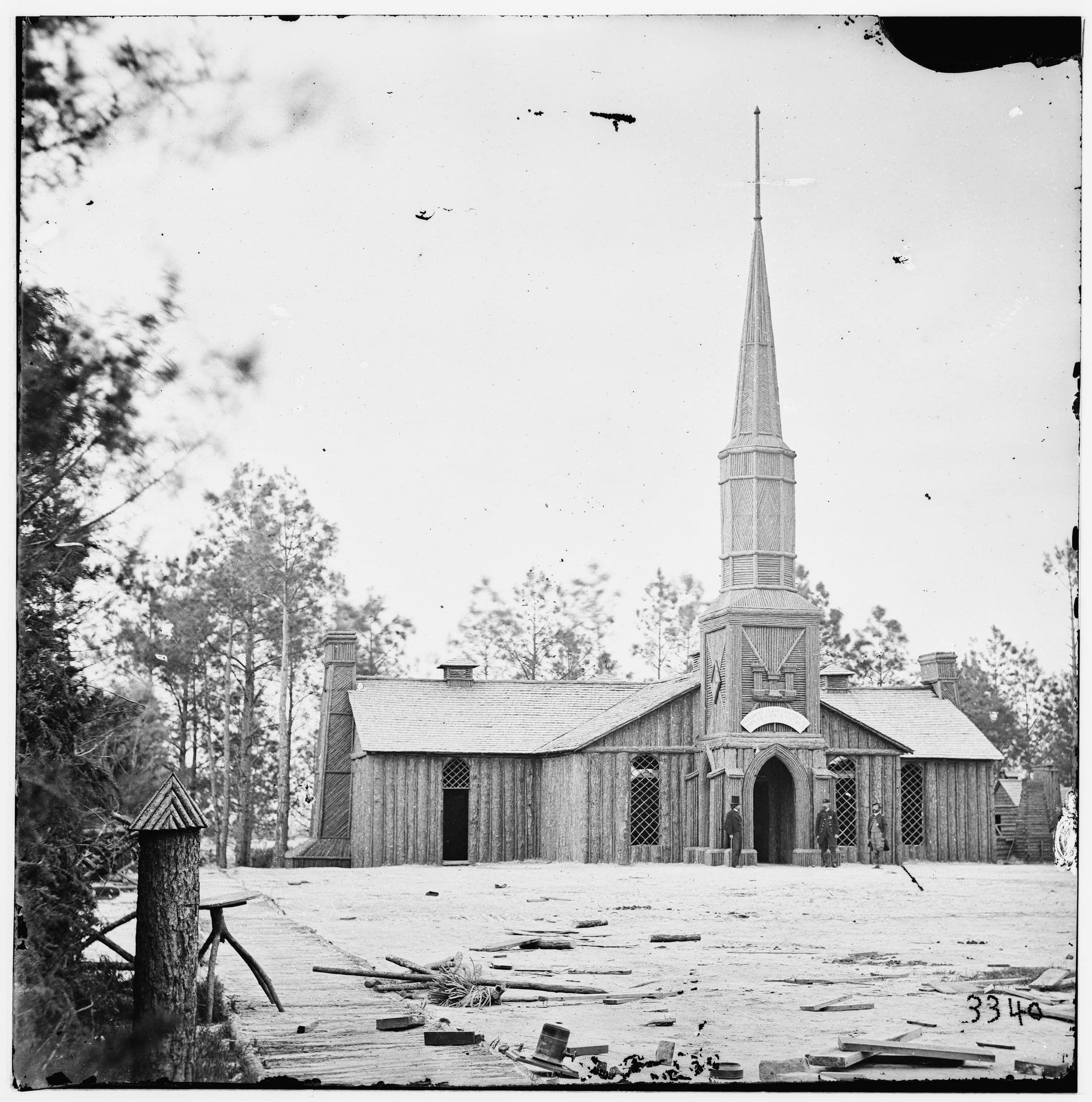
Timothy H. O'Sullivan, Church at Poplar Grove, 1864. Public domain.
Come to Me, all you who are weary and burdened, and I will give you rest.
Summary
From 1861 to 1865 revivals ran through the armies of both North and South.
- Chaplains, missionaries and pastors preached in the camps.
- Southern soldiers held revivals in Northern prisons.
- The Union's Christian Commission closed its work on 1 January 1866.
The Texts of the Camp Sermons
The letters Jones printed name the texts of many camp sermons.
A visitor to the hospital at Charlottesville heard the key verse preached to a large congregation of the sick and wounded.
And we know that God works all things together for the good of those who love Him, who are called according to His purpose.
B. T. Lacy preached on it to Lee's army on the first quiet Sabbath after Chancellorsville, and called it General Jackson's favourite text.
Romans 8:28BSB
Behold, I stand at the door and knock. If anyone hears My voice and opens the door, I will come in and dine with him, and he with Me.
General M. P. Lowry preached on it in the Baptist church at Dalton, in the revival of the western Confederate army.
The Counts of the Revival
Jones, Bennett, the Commission and Duryea made the counts.
The counts of converts come from Confederate writers, and the counts of delegates and chapels from the Union.
| What was counted | The count | Who counted, and on what |
|---|---|---|
| Professions of faith in Lee's army during the four years of the war | At least 15,000 | J. William Jones (1887), from the chaplains' minutes, newspapers and letters |
| Conversions in all the Confederate armies, up to January 1865 | Nearly 150,000 | William W. Bennett (1877), page 413 |
| Delegates the Christian Commission sent to the Union armies, 1862 to 1865 | 4,859 | The Commission's own table, in Moss (1868) |
| Commission chapels in the Army of the Potomac in March 1865 | 140 | J. T. Duryea, in an address in New York, in Moss |
The Story From Fredericksburg to Petersburg
It moves from a town under bombardment to the chapels of the last winter.
After the battle of Fredericksburg on 13 December 1862, a revival began in Barksdale's Mississippi Brigade, stationed in the battered town. W. B. Owen, a Methodist chaplain, led the meetings.
The Baptist church had been too damaged by the bombardment to use. The meetings filled the Presbyterian and the Methodist churches and moved to the Episcopal church, which its rector offered.
The work went on through Chancellorsville and stopped only when the brigade marched for Gettysburg.
Then Jesus told them a parable about their need to pray at all times and not lose heart:Owen preached on it at the Episcopal church to perhaps fifteen hundred, mostly soldiers, as one of them wrote.
On the Union side, the delegates of the Christian Commission worked among the soldiers without pay. At Stoneman's Station the Army of the Potomac held nightly meetings in a row of tents nearly sixty feet long, which the soldiers called Mount Zion.
In April 1864, as Sherman mustered his army for Georgia, a revival began at Ringgold and Cleveland among veterans of Chickamauga and Missionary Ridge.
Do you not say, ‘There are still four months until the harvest’? I tell you, lift up your eyes and look at the fields, for they are ripe for harvest.The Commission's first appeal to the churches, in November 1861, took the army for a harvest field from this saying of Jesus.
On 6 September 1863, near Orange Court House, two ministers baptized eighty-two soldiers of Mahone's and Wilcox's brigades in a creek, with about five thousand men on the banks.
That evening Jones preached by the light of fire-stands to at least five thousand men. More than six hundred came forward, and about two hundred professed conversion.
Lee's soldiers built forty chapels along the Rapidan that winter, and more than sixty the next winter on the lines before Richmond and Petersburg.
But if we walk in the light as He is in the light, we have fellowship with one another, and the blood of Jesus His Son cleanses us from all sin.Jones took it as his text on the evening of 6 September 1863 in Wilcox's Brigade.
A War Over Slavery
The men who led the secession named slavery as its cause in 1861.
Mississippi's convention declared its reasons in January 1861: "Our position is thoroughly identified with the institution of slavery."
Alexander Stephens, elected vice president of the Confederate States, spoke at Savannah on 21 March 1861. The newspaper reported him saying that its "corner-stone rests upon the great truth, that the negro is not equal to the white man".
The revival in Lee's army ran among soldiers who fought for that government. A member of Barksdale's brigade wrote of a fast day at Fredericksburg in Bennett's pages. He tells of young converts at Fredericksburg asking God to favour the land they had so often risked their lives to defend.
The Witnesses of the Revival
Each book was written by a man who served in the work it describes.
Three of the four witnesses wrote of a work they had served in.
| Witness | His place in the work | His interest |
|---|---|---|
| J. William Jones | He was a chaplain in the Army of Northern Virginia and later secretary of the Southern Historical Society. | His book's introducer, Bishop Granbery, wrote that Jones was no small part of the movement he narrates. |
| William W. Bennett | He was superintendent of the Soldiers' Tract Association and a chaplain in the Confederate army. | He left the Northern armies to those who had worked among them. |
| Lemuel Moss | He was Home Secretary of the United States Christian Commission. | His book is the Commission's own account of itself. |
| Thomas Wentworth Higginson | He was the colonel of a regiment raised from former slaves. | He wrote of the men he commanded. |
A Regiment of Freed Slaves at Prayer
The First South Carolina Volunteers fought for the Union, and its eight hundred men had been slaves.
Higginson describes the "shout" at the cook-fires, a ring of singing and clapping that went on night after night, while elsewhere in the camp prayer meetings went on soberly.
He heard his men speak in their prayer meetings of "a Gospel army".
He wrote down one spiritual that the war itself had made, "Many Thousand Go", which had been sung in secret to avoid detection.
How the Key Verse Was Taught
Four writers from the fourth century to the eighteenth taught the invitation.
Hilary of Poitiers (died 367)
Catena Aurea by Aquinas
Hilary's reading is the earliest of the four, kept in Aquinas's chain of the Fathers.
“He calls to Him those that were labouring under the hardships of the Law, and those who are burdened with the sins of this world.”
on Matthew 11:28Patristic
John Chrysostom (died 407)
Homily on the Gospel of Matthew 38
Chrysostom, a generation after Hilary, widens the call to every burdened sinner.
“Next, having brought them by His words to an earnest desire, and having signified His unspeakable power, He after that invites them, saying. ‘Come unto me, all ye that labor and are heavy laden, and I will give you rest.’ Not this or that person, but all that are in anxiety, in sorrows, in sins. Come, not that I may call you to account, but that I may do away your sins; come, not that I want your honor, but that I want your salvation. ‘For I,’ saith He, ‘will give you rest.’ He said not, ‘I will save you,’ only; but what was much more, ‘I will place you in all security.’”
on Matthew 11:28Patristic
Augustine of Hippo (died 430)
Catena Aurea by Aquinas
Augustine, writing a lifetime after Hilary, asks why the labouring are called.
“Whence do we all thus labour, but that we are mortal men, bearing vessels of clay which cause us much difficulty. But if the vessels of flesh are straitened, the regions of love will be enlarged. To what end then does He say, Come unto me, all ye that labour, but that ye should not labour?”
on Matthew 11:28Patristic
Matthew Henry (1662 to 1714)
An Exposition of the Old and New Testament
Henry's commentary of 1710 is the one Protestant reading of the four.
“It is the duty and interest of weary and heavy laden sinners to come to Jesus Christ.”
Puritan
Augustine of Hippo, Matthew Henry
In Their Own Words
Two chaplains of Lee's army, a soldier of a black regiment and a Union soldier left these words.
W. B. Owen
Letter to the Religious Herald, in J. William Jones, Christ in the Camp; or, Religion in Lee's Army, page 296
A letter from Fredericksburg
“This is the twenty-first day of the meeting, and the interest is still on the increase. About one hundred have professed faith in Jesus.”
Methodist
About this saying1 paragraph
Owen sent this news from Barksdale's brigade at Fredericksburg in March 1863, three weeks into its meetings.
J. William Jones
Christ in the Camp; or, Religion in Lee's Army, chapter 13, page 391
Jones on his own figures
“I have been very anxious in all of the statements I have made about this great work not to exaggerate in the least, and I have, therefore, preferred to underestimate rather than to risk overestimating these grand results.”
Christian
About this saying1 paragraph
Jones set down this rule for his own figures in 1887.
A soldier of the First South Carolina Volunteers
Thomas Wentworth Higginson, Army Life in a Black Regiment, the camp diary
A camp prayer
“Let me lib wid de musket in one hand an' de Bible in de oder,--dat if I die at de muzzle ob de musket, die in de water, die on de land, I may know I hab de bressed Jesus in my hand, an' hab no fear.”
Christian
About this saying1 paragraph
Higginson noted this prayer beside a camp-fire on 13 December 1862, as best he could.
A Union soldier at Nashville
Lemuel Moss, Annals of the United States Christian Commission, page 482
A furlough put off
“I promised my mother that I would be a Christian in the army. I have neglected it up to this time, and I could not go home until I could answer my mother's first question.”
Christian
About this saying1 paragraph
A young Union soldier at Nashville in 1864 gave this reason for asking to delay his leave, as Moss's Annals tell it.
A soldier of the First South Carolina Volunteers, A Union soldier at Nashville
Where Historians Disagree
Two questions divide the witnesses to the revival.
How many were converted?2 paragraphs
Bennett gave his total for the Confederate armies as an estimate made by January 1865. He names no one who made the estimate.
Jones built his count for Lee's army from the minutes of the chaplains' association and hundreds of letters. He noted that Bennett's figure would give Lee's army at least 50,000.
Was it a lasting work?2 paragraphs
Jones set down the objection, put to him by questioners he does not name, that the revival was a mere animal excitement produced by danger.
He answered it from the converts' later lives, and his book credits "The New South" to "the brains, the muscle, the pluck, the piety, of the men who wore the gray".
Books to Read Next
Four free books were printed between 1868 and 1887.
Christ in the Camp; or, Religion in Lee's Army
J. William Jones · 1887
It holds the chaplains' letters from Fredericksburg, the Rapidan and the Petersburg lines.
Read it free onlineA Narrative of the Great Revival Which Prevailed in the Southern Armies
William W. Bennett · 1877
It covers every Confederate army and gives the largest count.
Read it free onlineAnnals of the United States Christian Commission
Lemuel Moss · 1868
It holds the Commission's tables and its reports from the Union armies.
Read it free onlineArmy Life in a Black Regiment
Thomas Wentworth Higginson · 1870
It holds the camp diary of 1862 and a chapter on the spirituals.
Read it free onlineWhat the Revival Left
The revival left the Southern churches men Jones described as filling their pulpits and standing as pillars of their churches.
Sources
Scripture is the Berean Standard Bible.
- The Holy Bible, Berean Standard Bible (read 2026)
- J. William Jones, Christ in the Camp; or, Religion in Lee's Army (Richmond: B. F. Johnson and Co., 1887), the title page, the introduction, chapters 8, 10, 11 and 13 and the appendix.
- William W. Bennett, A Narrative of the Great Revival Which Prevailed in the Southern Armies (Philadelphia: Claxton, Remsen and Haffelfinger, 1877), the title page, the preface and pages 258 and 413.
- Lemuel Moss, Annals of the United States Christian Commission (Philadelphia: J. B. Lippincott and Co., 1868), chapter 2, Table VI and pages 181, 249, 377, 482 and 489.
- Thomas Wentworth Higginson, Army Life in a Black Regiment (Boston: Fields, Osgood, and Co., 1870), the camp diary and chapter 9.
- Journal of the State Convention of Mississippi, January 1861 (Jackson: E. Barksdale, 1861), the declaration of the causes, pages 86 to 87.
- Henry Cleveland, Alexander H. Stephens, in Public and Private (Philadelphia: National Publishing Company, 1866), the speech at Savannah of 21 March 1861, page 721.
Keep Studying
People and groups9
Church history4
Values1