
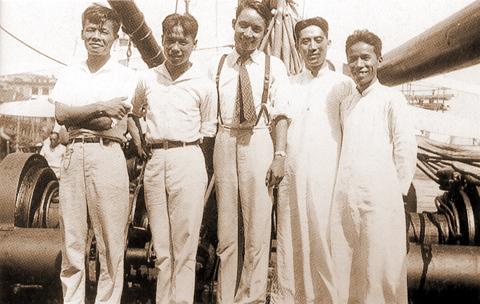
The Bethel Worldwide Evangelistic Band, 1931. Public domain.
China and South-East Asia, 1901 to 1944 · Person · Featured Study
John Sung
He trained as a chemist in Ohio and became a revival preacher known across China and South-East Asia.
- Born
- 1901, at Putian in Fujian (probable)
- Died
- 18 August 1944, outside Beijing (probable)
- Places
- Putian, Columbus, New York, Shanghai, Beijing
Sailing home from America, a new doctor of chemistry threw his academic awards into the sea.
If we confess our sins, He is faithful and just to forgive us our sins and to cleanse us from all unrighteousness.
Summary
John Sung was the son of a Methodist pastor at Putian in Fujian. He took a doctorate in chemistry at Ohio State University. He left Union Seminary for a hospital and then came home to preach. For twelve years he travelled as a preacher, and he died outside Beijing at 42.
- Writers have called him "the Wesley of China" and "the apostle of China".
- Lim writes that even those who did not share his theology knew his work, as reports in The Chinese Recorder show.
- Lim and Lyall read his months in the hospital in two ways.
The Call to Confess
The proverb on hidden sin and James on confession to one another stand behind his meetings.
Lim Ka-Tong writes that his "fearless attacks on sin were unmatched" and spared neither Chinese leaders nor Western missionaries. The question of this life is how a scientist trained in America came to lead the confession of sin across the churches of East Asia.
He who conceals his sins will not prosper, but whoever confesses and renounces them will find mercy.Sung called his hearers to the confession this proverb asks for.
Therefore confess your sins to each other and pray for each other so that you may be healed. The prayer of a righteous man has great power to prevail.James tells the church to confess sins to one another, as his meetings asked.
The Life in Order
The dates stand on Lim Ka-Tong's entry, and Leslie Lyall's life of him is named where it adds to them.
His public ministry ran twelve years, from 1928 to 1939.
- 1901BirthLim
- 1920To AmericaLim
- 1927Union Seminary and the hospitalLim; Lyall
- End of 1927HomeLim
- 1928 to 1930FujianLim
- 1931 to 1933The Bethel bandLim
- Late 1931HwanghsienThe Southern Baptist report of 1932
- 1934 to 1939Alone in China and South-East AsiaLim
- August 1944DeathLim
Each step of the life stands with its witness.
Late 1931, 1934 to 1939, August 1944
From Putian to the Churches of Asia
The chemist came home a preacher and spent twelve years on the road.
He grew up in a Methodist parsonage at Putian, then called Hinghwa, and wanted to preach from boyhood. He left for America in 1920 and earned three degrees in five and a half years, the last a doctorate in chemistry from Ohio State University. He then entered Union Theological Seminary in New York.
He came home at the end of 1927 resolved to preach, keeping only his doctoral diploma as a gift for his parents.
He taught science for a short time at his old school in Putian and then became the evangelist of the Hinghwa Methodist conference. Outside Putian few understood its dialect, so in other parts of Fujian he preached in English with an interpreter, until he learned Mandarin after 1933.
In 1931 he joined the Bethel Evangelistic Band of the Bethel Mission in Shanghai, led by Andrew Gih, whom Lim calls Andrew Jih. In three years with the band he preached from Inner Mongolia in the north to Guangxi in the south. Late in 1931 he led meetings at Hwanghsien in Shandong, where the Shandong revival was under way.
He left the band at the end of 1933 and worked alone from 1934. Until 1939 he preached across China and in the Philippines, Taiwan, Hong Kong, Singapore, Malaya, Sarawak, Thailand, Burma, Indonesia and Vietnam. He usually preached three times a day for two or three hours, and in 1936 he preached through the whole Bible in one month to 2,000 people.
He died outside Beijing on 18 August 1944, aged 42, and left his wife and three daughters.
Read The Shandong Revival, where he led meetings at Hwanghsien
The Seminary and the Hospital
The months he spent in a hospital are told two ways.
Lim Ka-Tong writes that he had a mental breakdown at the end of the semester at Union and was confined in a mental hospital for more than six months of 1927.
Leslie Lyall tells it as the seminary's answer to a change of heart. He writes that Sung found peace with God one night that February. His new joy, Lyall says, confirmed the fear of the seminary's authorities that study had upset his mind, so they had a psychiatrist examine him. Lyall says he read the Bible through forty times in the hospital.
Lyall writes that the Chinese consul and Rollin Walter, his old teacher, won his release, on the condition that he go home to China.
In Their Own Words
Four of his sayings, from his homecoming in 1927 to his last night in 1944, come through the life of him that Lyall published in 1954.
John Sung (1901 to 1944)
Leslie T. Lyall, John Sung (London: China Inland Mission, 1954; revised 1956), the reprint of November 1965, chapter 8, Beginning at Jerusalem
Dedicated to the gospel
“Father, I cannot do this, for I have dedicated my life to the preaching of the gospel!”
Methodist
About this saying1 paragraph
He gave this answer at the family's welcome feast at Hinghwa at the end of 1927, when his father asked him to take a post in a government university.
John Sung
Leslie T. Lyall, John Sung (London: China Inland Mission, 1954; revised 1956), the reprint of November 1965, page 120, from his journal
Strength to go on preaching
“I cried to the Lord for strength to go on preaching the Gospel with all my might without any anxieties for other things.”
Methodist
About this saying1 paragraph
His journal records this prayer from the end of 1933, when he left the Bethel band with no plans for the future.
John Sung
Leslie T. Lyall, John Sung (London: China Inland Mission, 1954; revised 1956), the reprint of November 1965, pages 154 to 155, the final session at Amoy
That day's duty
“I do not know when I shall die, but every day I have on earth I must fulfil that day's duty by distributing to you what the Lord has entrusted to me, and then when I do die I shall see the Lord in peace.”
Methodist
About this saying1 paragraph
He said this at the last session of a month of Bible teaching at Amoy in 1936, and the addresses were printed the same year.
John Sung
Leslie T. Lyall, John Sung (London: China Inland Mission, 1954; revised 1956), the reprint of November 1965, page 189, his last words to his wife
The Lord Jesus is at the door
“Don't be afraid! The Lord Jesus is at the door. What is there to fear?”
Methodist
About this saying1 paragraph
Lyall gives these as his last words to his wife, about midnight before his death in August 1944.
The People Around Him
The witnesses name his father, his band and the preachers who stood with him.
His fellow preachers were the conservative leaders of the Chinese churches.
| Person | Tie to Sung | The witness |
|---|---|---|
| His father | A Methodist pastor at Putian. | Lim |
| Rollin Walter | His teacher at Ohio Wesleyan, who helped win his release in 1927. | Lyall |
| Andrew Gih | Leader of the Bethel Evangelistic Band. | Lim; the photograph of 1931 |
| Wang Mingdao | A fellow champion of conservative belief, who preached at Hwanghsien in 1931. | Lim; the Shandong page |
| Watchman Nee | Another of the conservative leaders Lim names with him. | Lim |
The Places of His Life
His life ran from Fujian to Ohio and New York, and back across China and the South Seas.
His preaching reached from Inner Mongolia to Indonesia.
| Place | What the witnesses say | The witness |
|---|---|---|
| Putian | His home, once called Hinghwa, and his first field as an evangelist. | Lim |
| Columbus, Ohio | Where he took his doctorate. | Lim |
| New York | Union Theological Seminary, where he enrolled after his doctorate. | Lim |
| Shanghai | Home of the Bethel Mission and its band. | Lim |
| Hwanghsien | A station of the Shandong revival, where he preached in 1931. | The Shandong revival page |
| Beijing | Place of his death. | Lim |
What He Preached
He attacked sin without sparing leaders, and he called his hearers to confess it.
Leslie Lyall records hearers coming to the front in crowds to confess their sin and get right with God.
Lim writes that he stood against missionary paternalism and the liberal theology of the mainline leaders, and that he was loved by many and loathed by others. He became so well known that a paper for the missionary conference at Tambaram in 1938 named him simply "Dr. Sung".
How the Key Verse Was Taught
Augustine and Matthew Henry read the promise to those who confess.
Augustine of Hippo (died 430)
Ten Homilies on 1 John 1
Augustine warned his hearers against making light of small sins.
“‘If we confess our sins, He is faithful and just to forgive us our sins, and to purge us from all iniquity.’ Not only the past, but haply if we have contracted any from this life; because a man, so long as he bears the flesh, cannot but have some at any rate light sins. But these which we call light, do not thou make light of. If thou make light of them when thou weighest them, be afraid when thou countest them. Many light make one huge sin: many drops fill the river; many grains make the lump. And what hope is there? Before all, confession: lest any think himself righteous, and, before the eyes of God who seeth that which is, man, that was not and is, lift up the neck. Before all, then, confession; then, love: for of charity what is said? ‘Charity covereth a multitude of sins.’”
on 1 John 1:9Patristic
Matthew Henry (1662 to 1714)
Commentary on the Whole Bible
Matthew Henry called confession the believer's business.
“Penitent confession and acknowledgment of sin are the believer's business, and the means of his deliverance from his guilt. His encouragement thereto, and assurance of the happy issue. This is the veracity, righteousness, and clemency of God, to whom he makes such confession: He is faithful and just to forgive us our sins, and to cleanse us from all unrighteousness,”
on 1 John 1:9Puritan
What the Witnesses Leave Open
The hospital and the worth of his numbers are each read two ways.
Why he was in the hospitalLim Ka-Tong; Leslie Lyall
Lim calls it a mental breakdown. Lyall tells it as the seminary's answer to his new faith.
How far his numbers can be trustedLim Ka-Tong
Lim writes that the numbers in his diary and memoir are generally reliable and agree with reports of the time, and that Sung admitted he had exaggerated on a few occasions in his preaching.
Books to Read Next
Dictionary of Christian Biography in Asia, the entry on John Sung
Lim Ka-Tong · not recorded
The entry gives the course of his ministry and weighs his diary's numbers.
Read the entry free at DCB AsiaA Biography of John Sung
Leslie T. Lyall · 1956
The China Inland Mission published this life of him, and Lim cites its printing of 1956.
In print: find it wherever books are sold.
What John Sung Left
He left a diary kept night by night, which Lim reads as a reliable count of his meetings. Lim names him as a champion of conservative belief in the Chinese churches of his day.
Sources
Scripture is the Berean Standard Bible.
- The Holy Bible, Berean Standard Bible (read 2026)
- Lim Ka-Tong, "Sung, John", Dictionary of Christian Biography in Asia.
- Leslie T. Lyall, A Biography of John Sung (China Inland Mission), cited by Lim in its printing of 1956.
- Leslie T. Lyall, John Sung, the title page's title, whose half-title and running head read A Biography of John Sung (London: China Inland Mission, first published November 1954; revised and reprinted October 1956), the reprint of November 1965, pages 120, 154 to 155 and 189 and chapter 8.
- Annual of the Southern Baptist Convention, 1932, the report of the Foreign Mission Board on Hwanghsien.
- Augustine, Ten Homilies on the First Epistle of John, homily 1.
- Matthew Henry, Commentary on the Whole Bible (1710), on 1 John 1:9.