
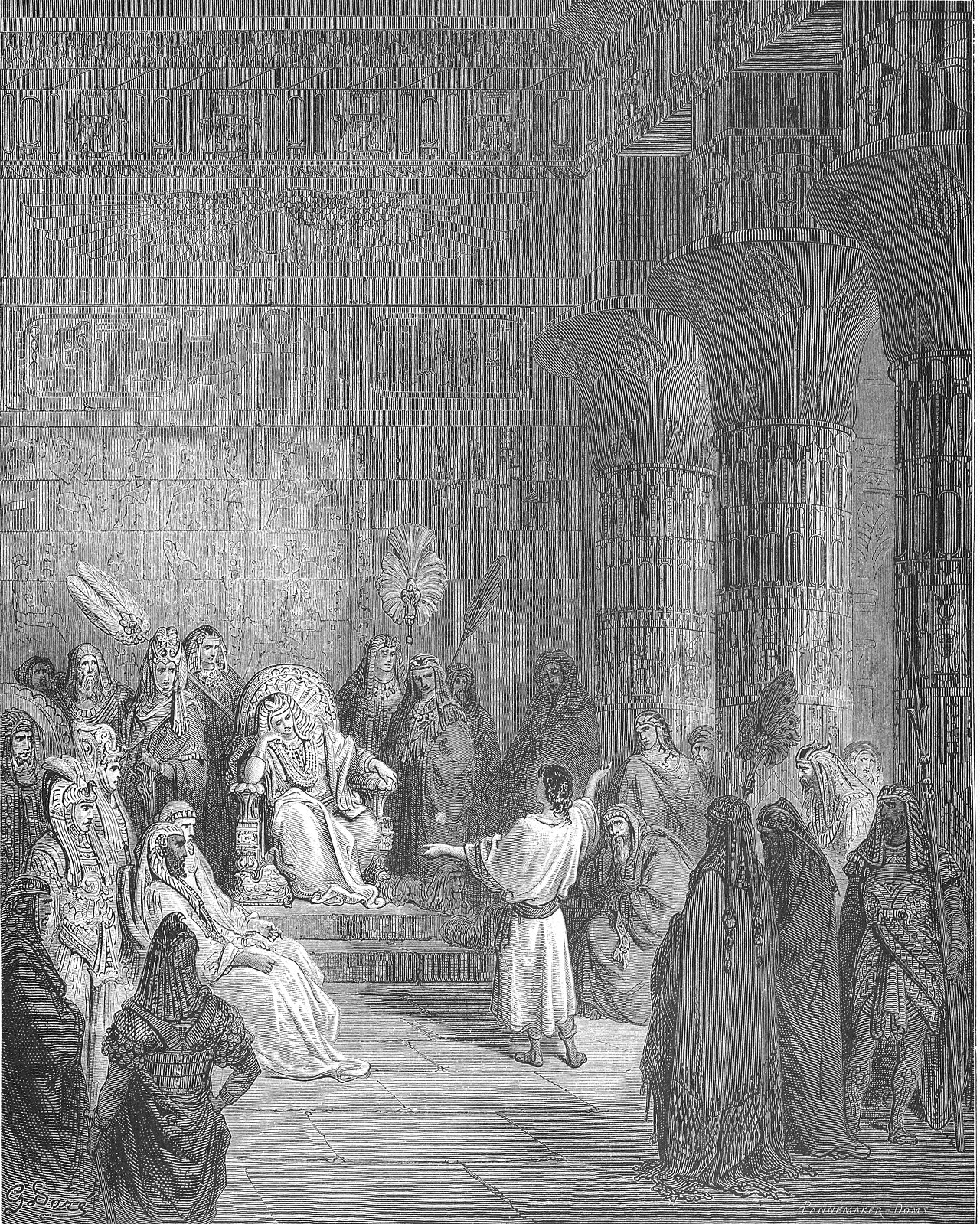
Genesischapter 41
57 verses · Moses, by tradition · 15th to 13th century BC · The Law
In Jewish life
The reading
Weekly portion 10 of 54
מִקֵּץ Miketz, Genesis 41:1 to 44:17
Read with it: 1 Kings 3:15 to 4:1.
The verse numbers here are the ones a Hebrew Bible carries, which differ from an English Bible by a verse or two in several places. The Sephardi reading is named only where this site records a difference; communities vary beyond what is listed. What these books are, and how a Christian reader meets them →
How it is read
Rashi reads Pharaoh's dream as a picture whose every detail carries its meaning. The well-favoured cattle stand for the years of plenty, and he gives the sign a social sense: "This was an indication of a period of plenty, when people show themselves well-disposed one to another, for no-one then envies another person's prosperity" (Rashi on Genesis 41:2:1, the Pentateuch with Rashi's commentary by M. Rosenbaum and A. M. Silbermann, 1929 to 1934, public domain). The eating of the fat cattle by the lean he reads the same way, "indicating that all the joy occasioned by the years of plenty would be forgotten in the days of famine" (Rashi on Genesis 41:4:1). He notices how the butler speaks of Joseph and judges him for it: "Cursed be the wicked for the favours they do are never really complete!", because he named him as a lad, a Hebrew and a slave (Rashi on Genesis 41:12:1). Joseph's disclaimer before Pharaoh he takes at its word, that the skill is not Joseph's own and that God will put an answer in his mouth for Pharaoh's welfare (Rashi on Genesis 41:16:1). On the doubled dream he rules plainly, "all together they are only seven years", and explains the repetition as a sign that the thing is ready to happen (Rashi on Genesis 41:26:1). Much of the rest of his commentary here is translation work, and several times he gives the old French word he used himself for a thing the Hebrew names. Sforno reads the failure of the Egyptian wise men as a failure of method: "He noted that all his professional wise men proceeded from the premise that they had to interpret two separate dreams", where Pharaoh himself held it to be one dream, "and this is why all your interpreters have failed to come up with the correct answer" (Sforno on Genesis 41:24:1 and 41:25:1, translated by Eliyahu Munk, HaChut Hameshulash, CC-BY). Radak notes the ordinary fact that a man repeating his own account adds and drops details, and reads Pharaoh's second telling by that rule (Radak on Genesis 41:17:1 and 41:20:1, Munk translation, CC-BY). Ibn Ezra comments here at 41:9:1, 41:10:1 and 41:21:1, and the corpus holds no English of him under a licence permitting quotation, so he stands as a citation.
What the rabbis say
The corpus records forty rabbinic locators on this chapter, thirty-nine of them Midrash and one Talmud. Bereshit Rabbati is the densest work here and follows the dream closely, at Parashat Miketz 3, 4, 5, 6, 7, 29, 30, 31, 32 and 33. Midrash Sekhel Tov is cited eleven times, at Bereshit 41:19:1, 41:20:1, 41:22:1, 41:23:1, 41:26:1, 41:28:1, 41:29:1, 41:31:1, 41:35:1 and 41:37:1, and Midrash Lekach Tov at Genesis 41:11:1, 41:15:1 and 41:17:1 and at Genesis 22:18:2 and Exodus 2:24:1. Bereshit Rabbah stands at 88:3, 89:5, 90:1 and 90:6, the last two at Pharaoh's search for a man in whom the spirit of God is and at the appointment over the land. Midrash Aggadah is cited at Genesis 41:8:1 and at Genesis 21:22:1 and 49:22:5, Bamidbar Rabbah at 10:10 and 14:6, Aggadat Bereshit at 67:1, 70:5 and 83:1, Eikhah Rabbah at 1:18, and Mekhilta DeRabbi Yishmael at Tractate Pischa 13:17. The single Talmud locator is Berakhot 55b:20, at the thirty-second verse, which is the verse about the doubling of the dream. Rashi hands on further sayings with their locators, among them Genesis Rabbah on the well-favoured cattle and Chullin 92a as he cited it in the chapter before.
The text, verse by verse
Each word shows the Hebrew, the English under it, how it sounds and its Strong’s number. A rule between verses marks where the Hebrew manuscripts end a paragraph.
Pharaoh's Cows and Ears of Grain
Ramban on Genesis 41:1
BY THE ‘YE’OR’ (RIVER). With the exception of the Nile, none of the other rivers is called ye’or, a word signifying “canal,” because the entire country consists of artificially constructed canals, and the waters of the Nile.
Read it in full at Sefaria · Commentary on the Torah by Ramban (Nachmanides). Translated and annotated by Charles B. Chavel. New York, Shilo Pub. House, 1971-1976
The Butler Finally Remembers
Ibn Ezra on Genesis 41:10
I believe that Pharaoh is an adjective. What I.E. means by “adjective” is an adjectival noun, a descriptive term like melekh (king). Cf.
Read it in full at Sefaria · Ibn Ezra's commentary on the Pentateuch, tran. and annot. by H. Norman Strickman and Arthur M. Silver. Menorah Pub., 1988-2004
Ibn Ezra on Genesis 41:11
I have previously explained this. 33 I.E. explains the meaning of each man according to the interpretation of his dreams in his comments on Gen.:5.
Read it in full at Sefaria · Ibn Ezra's commentary on the Pentateuch, tran. and annot. by H. Norman Strickman and Arthur M. Silver. Menorah Pub., 1988-2004
Ramban on Genesis 41:12
He interpreted it in accordance with the dream and consistent with its contents. Thus the words of Rashi.
Read it in full at Sefaria · Commentary on the Torah by Ramban (Nachmanides). Translated and annotated by Charles B. Chavel. New York, Shilo Pub. House, 1971-1976
Seven Years of Plenty, Seven of Famine
Joseph Raised Over All Egypt
Grain Stored Like Sand of the Sea
Hebrew words in this chapter
The 40 most used Hebrew words of the chapter, counted by lemma. The article, the object marker, the negatives and the common prepositions are left out.
| Word | Sense here | Uses | Strong’s |
|---|---|---|---|
| פַּרְעֹהParʻôh | Pharaoh | 34 | H6547 |
| שֶׁבַעshebaʻ | seven | 28 | H7651 |
| אֶרֶץʼerets | land | 27 | H776 |
| מִצְרַיִםMitsrayim | Egypt | 20 | H4714 |
| יוֹסֵףYôwçêph | Joseph | 20 | H3130 |
| שָׁנֶהshâneh | year | 16 | H8141 |
| חֲלוֹםchălôwm | dream | 13 | H2472 |
| אָמַרʼâmar | to say | 13 | H559 |
| רָעָבrâʻâb | famine | 12 | H7458 |
| הִנֵּהhinnêh | and there | 11 | H2009 |
| פָּרָהpârâh | cows | 11 | H6510 |
| שִׁבֹּלshibbôl | ears of grain | 10 | H7641 |
| אֱלֹהִיםʼĕlôhîym | God | 9 | H430 |
| בּוֹאbôwʼ | to come | 8 | H935 |
| עָלָהʻâlâh | coming up | 7 | H5927 |
| נָתַןnâthan | and he put | 7 | H5414 |
| יְאֹרyᵉʼôr | the river | 6 | H2975 |
| בָּרִיאbârîyʼ | fat | 6 | H1277 |
| רַעraʻ | displeasing of | 6 | H7451 |
| דַּקdaq | thin | 6 | H1851 |
| Word | Sense here | Uses | Strong’s |
|---|---|---|---|
| טוֹבṭôwb | and good | 6 | H2896 |
| קָרָאqârâʼ | to call | 6 | H7121 |
| פָּתַרpâthar | to interpret | 6 | H6622 |
| עָשָׂהʻâsâh | about to do | 6 | H6213 |
| שָׂבָעsâbâʻ | plenty | 6 | H7647 |
| אֹכֶלʼôkel | food | 6 | H400 |
| חָלַםchâlam | dreaming | 5 | H2492 |
| מַרְאֶהmarʼeh | appearance | 5 | H4758 |
| בָּשָׂרbâsâr | flesh | 5 | H1320 |
| אֶחָדʼechâd | one | 5 | H259 |
| אַיִןʼayin | and there not | 5 | H369 |
| אִישׁʼîysh | man | 5 | H376 |
| רָאָהrâʼâh | to see | 5 | H7200 |
| עָמַדʻâmad | to stand | 4 | H5975 |
| שַׂרsar | chief of | 4 | H8269 |
| עֶבֶדʻebed | servants his | 4 | H5650 |
| יָדyâd | hand | 4 | H3027 |
| פּוֹטִי פֶרַעPôwṭîy Pheraʻ | poti- | 4 | H6319 |
| יָפֶהyâpheh | good looking of | 3 | H3303 |
| יָקַץyâqats | and he awoke | 3 | H3364 |
Keep studying
Sources for this chapter
The Hebrew text
STEP Bible, the tagged Hebrew text and its English glosses and James Strong, Strong's Exhaustive Concordance.
In Jewish life
Rashi, Rashi on Genesis 41:1:1, 41:2:1, 41:3:1, 41:4:1, 41:5:1, 41:6:1, 41:7:1, 41:8:1, 41:11:1, 41:12:1, 41:13:1, 41:14:1, 41:15:1, 41:16:1, 41:19:1, 41:23:1 and 41:26:1, the Pentateuch with Rashi's commentary by M. Rosenbaum and A. M. Silbermann, 1929 to 1934, public domain; Sforno, Sforno on Genesis 41:24:1 and 41:25:1, translated by Eliyahu Munk, HaChut Hameshulash, CC-BY; Radak, Radak on Genesis 41:17:1 and 41:20:1, translated by Eliyahu Munk, HaChut Hameshulash, CC-BY; Ibn Ezra, Ibn Ezra on Genesis 41:9:1, 41:10:1 and 41:21:1, cited only, no English version in the corpus under a licence permitting quotation; Midrash, Bereshit Rabbati, Parashat Miketz 3, 4, 5, 6, 7, 29, 30, 31, 32 and 33; Midrash Sekhel Tov, Bereshit 41:19:1, 41:20:1, 41:22:1, 41:23:1, 41:26:1, 41:28:1, 41:29:1, 41:31:1, 41:35:1 and 41:37:1; Midrash Lekach Tov, Genesis 41:11:1, 41:15:1, 41:17:1 and 22:18:2 and Exodus 2:24:1; Bereshit Rabbah 88:3, 89:5, 90:1 and 90:6; Midrash Aggadah, Genesis 41:8:1, 21:22:1 and 49:22:5; Bamidbar Rabbah 10:10 and 14:6; Aggadat Bereshit 67:1, 70:5 and 83:1; Eikhah Rabbah 1:18; Mekhilta DeRabbi Yishmael, Tractate Pischa 13:17 and Babylonian Talmud, Berakhot 55b:20.
The rabbinic texts
Ramban, Commentary on the Torah by Ramban (Nachmanides). Translated and annotated by Charles B. Chavel. New York, Shilo Pub. House, 1971-1976; Ibn Ezra, Ibn Ezra's commentary on the Pentateuch, tran. and annot. by H. Norman Strickman and Arthur M. Silver. Menorah Pub., 1988-2004 and Sefaria, texts and citation data.