
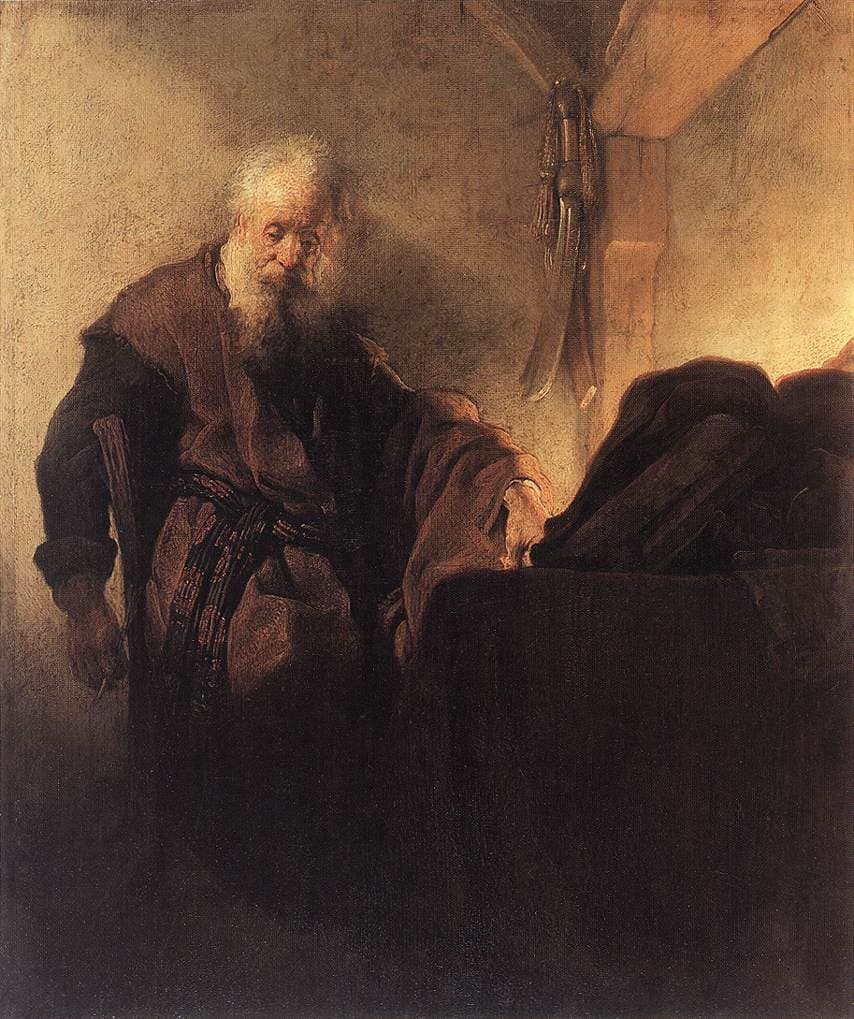
2 Corinthians 11 · Passage · Stress and Weariness
The Daily Pressure
2 Corinthians 11:23 to 30 stands in the part of the letter that Paul calls the boasting of a fool.
The Greek noun for Paul's concern for the churches, merimna, is the word Peter uses when he tells believers to cast all their anxiety on God (1 Peter 5:7).
Apart from these external trials, I face daily the pressure of my concern for all the churches.
- The passage
- 2 Corinthians 11:23 to 30, 2 Corinthians 11:16 to 22, Acts 14:19
- Books
- 2 Corinthians, Acts
- Hold in memory
- 2 Corinthians 11:30
Summary
Paul set out what he had suffered as a servant of Christ, from floggings and a stoning to shipwrecks, dangers and nights without sleep or food. Then he named a weight that came apart from all of these, his daily concern for all the churches. The passage shows that a servant of Christ can carry the care of others as a weight of its own.
- Paul's rivals at Corinth said that his presence was unimpressive and his speaking of no account (2 Corinthians 10:10).
- Acts tells only some of the trials in the list, so for the floggings and the shipwrecks Paul's own words are the one record.
- Readers from John Chrysostom to the commentators of the nineteenth century have disagreed on the purpose of the boast and on the Greek word behind the daily burden.
A Fool's Boast
Paul matches his rivals and then goes past them.
The Daily Pressure studies 2 Corinthians 11:23 to 30, Paul's account of his labours and dangers and of the care he carried for the churches. It is one of the texts of the trial of stress and weariness, the weight of work and care that wears a person down.
The question it answers is what weighed on Paul and why he set it out as a boast. It gives his trials beside the passages that bear on them and the Greek of 2 Corinthians 11:28. It also gives a bishop who took Paul's sympathy with the weak as the pattern of his own, and the disputes over the reason for his boasting and the nature of his daily burden.
Paul named his rivals "super-apostles" (2 Corinthians 11:5). He asked the Corinthians to "receive me as a fool, so that I too may boast a little" (2 Corinthians 11:16). He matched his rivals as a Hebrew, an Israelite and a descendant of Abraham (2 Corinthians 11:22).
In 2 Corinthians 11:23 Paul goes further and speaks paraphronon, glossed "as being beside myself", which the Berean text renders "like I am out of my mind".
If I must boast, I will boast of the things that show my weakness.Paul turns his whole list into a boast of weakness, the measure he keeps through 2 Corinthians 12.
The Trials Paul Counts
Some of Paul's trials can be read again in Acts or in the Law.
Paul counts some trials by number and others by kind, and the Law, Acts or his own letter stands beside each of them.
| Verse | Paul's words | How often | Another passage |
|---|---|---|---|
| 2 Corinthians 11:23 | in harder labor, in more imprisonments, in worse beatings, in frequent danger of death | More than his rivals | Acts 16:23: they threw them into prison and ordered the jailer to guard them securely |
| 2 Corinthians 11:24 | Five times I received from the Jews the forty lashes minus one. | Five times | Deuteronomy 25:3: He may receive no more than forty lashes |
| 2 Corinthians 11:25 | Three times I was beaten with rods | Three times | Acts 16:22: the magistrates ordered that they be stripped and beaten with rods |
| 2 Corinthians 11:25 | once I was stoned | Once | Acts 14:19: They stoned Paul and dragged him outside the city, presuming he was dead |
| 2 Corinthians 11:25 | three times I was shipwrecked. I spent a night and a day in the open sea. | Three times, and one night and day | Acts tells no shipwreck before Acts 27:41, where the vessel struck a sandbar and ran aground |
| 2 Corinthians 11:26 | in danger from rivers and from bandits, in danger from my countrymen and from the Gentiles, in danger in the city and in the country, in danger on the sea and among false brothers | Eight kinds of danger | Acts 9:23 to 24: the Jews conspired to kill him |
| 2 Corinthians 11:27 | in labor and toil and often without sleep, in hunger and thirst and often without food, in cold and exposure | Often | 2 Corinthians 6:5: in labor, sleepless nights, and hunger |
John Wesley, in his Explanatory Notes upon the New Testament (1755), called the forty lashes minus one "the utmost that the law allowed".
Paul's word for the sleepless nights of 2 Corinthians 11:27 is agrypnia, which Strong's dictionary glosses "sleeplessness, i.e. a keeping awake". It stands twice in the New Testament, both times in Paul's lists in this letter.
Earlier in the letter Paul wrote of a time in the province of Asia when he was "under a burden far beyond our ability to endure" (2 Corinthians 1:8).
Apart From These External Trials
Paul sets a burden of the mind beside the trials of the body.
Paul opens 2 Corinthians 11:28 with choris ton parektos, apart from the things outside, and names what remains with two nouns, epistasis, the pressure upon him, and merimna, care. Strong's dictionary glosses merimna "solicitude", and it stands six times in the New Testament.
Who is weak, and I am not weak? Who is led into sin, and I do not burn with grief?Paul's two questions show that the care of the churches reached each weak or stumbling believer.
How the Church Has Read Paul's Sympathy
A letter of Augustine to Jerome bears on Paul's sympathy with the weak.
died 430 · Augustine of Hippo
Letter 40, To Jerome
The quotation1 quotation
“You do not require me to teach you in what sense the apostle says, ‘To the Jews I became as a Jew, that I might gain the Jews,’ and other such things in the same passage, which are to be ascribed to the compassion of pitying love, not the artifices of intentional deceit. For he that ministers to the sick becomes as if he were sick himself; not, indeed, falsely pretending to be under the fever, but considering, with the mind of one truly sympathizing, what he would wish done for himself if he were in the sick man's place.”
Augustine of Hippo · Letter 40, To Jerome · on 2 Corinthians 11:29Patristic
Where Readers Differ
Each reading of the boast and of the burden stands with its holder and the strongest objection to it.
Compelled by circumstanceAlbert Barnes
Albert Barnes, in his Notes, Explanatory and Practical (1832 to 1869), gave Paul's sense as "It is unpleasant for me to boast, but circumstances have compelled me."
The objection: Paul goes on to say, "I will boast all the more gladly in my weaknesses" (2 Corinthians 12:9), so the boast of weakness is glad and chosen.
Weakness as the mark of an apostleJohn Chrysostom
John Chrysostom, in his Homily 25 on 2 Corinthians, observed that Paul "no where glorieth of miracles, but of his persecutions and his trials". He added, "This is the especial mark of an Apostle, by these things is the Gospel woven."
The objection: Paul still claims "I am so much more" (2 Corinthians 11:23), a comparison made on the terms his opponents set.
A rush of cases bearing downAdam Clarke
Adam Clarke read the word as episystasis in his Commentary on the Bible (1832). He explained it as "This continual press of business; this insurrection of cases to be heard, solved, and determined, relative to the doctrine, discipline, state, persecution, and supply of all the Churches."
The objection: the oldest manuscripts read epistasis, as Jamieson, Fausset and Brown report, and the Greek text Tyndale House tags at 2 Corinthians 11:28 reads epistasis.
The oversight of the churchesJamieson, Fausset and Brown
Jamieson, Fausset and Brown, in their Commentary Critical and Explanatory (1871), wrote that the oldest manuscripts read "the pressure", which they explained as "the pressing care-taking" or "inspection that is upon me daily."
The objection: the same noun stands in Acts 24:12, where Paul denies "riling up a crowd", so the word keeps the sense of a press of people around him.
Strength in Weakness
The boast of weakness carries on into the next chapter of the letter.
In 2 Corinthians 12 the Lord answers Paul's plea about his thorn, "My grace is sufficient for you, for My power is perfected in weakness" (2 Corinthians 12:9).
A reader who carries a daily weight of concern for others has Paul's words for that weight. A doctor's care for body and mind belongs beside prayer.
Sources
Scripture is the Berean Standard Bible.
- STEP Bible, Translators Amalgamated Greek New Testament (Tyndale House, Cambridge), CC BY 4.0.
- STEP Bible brief lexicon of Extended Strongs for Greek (Tyndale House, Cambridge), CC BY 4.0, with the Strong's glosses.
- Augustine of Hippo, Letter 40, To Jerome (Nicene and Post-Nicene Fathers, first series, volume 1)
- John Wesley, Explanatory Notes upon the New Testament (1755), on 2 Corinthians 11:24.
- Albert Barnes, Notes, Explanatory and Practical, on the Old and New Testaments (1832 to 1869), on 2 Corinthians 11:30.
- John Chrysostom, Homilies on the Second Epistle to the Corinthians, Homily 25 (NPNF series 1, volume 12)
- Adam Clarke, Commentary on the Bible (1832), on 2 Corinthians 11:28.
- Jamieson, Fausset and Brown, Commentary Critical and Explanatory on the Whole Bible (1871), on 2 Corinthians 11:28.
Keep Studying
People and groups7