
Genesis 33:4
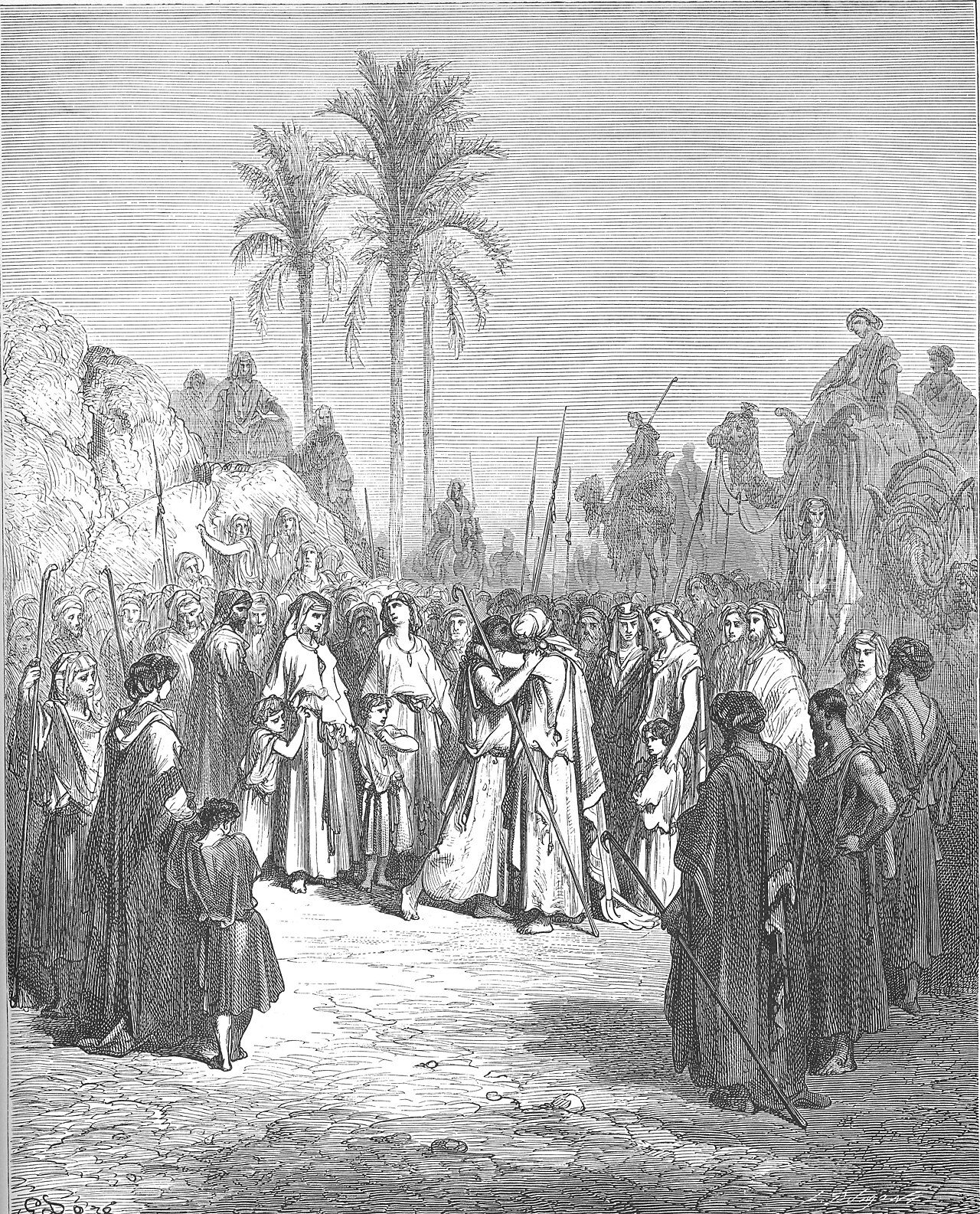
in Genesis 33Esau, however, ran to him and embraced him, threw his arms around his neck, and kissed him. And they both wept.
BSB
The same verse in ASV and KJV ▾
ASV
And Esau ran to meet him, and embraced him, and fell on his neck, and kissed him: and they wept.
KJV
And Esau ran to meet him, and embraced him, and fell on his neck, and kissed him: and they wept.
⋯
This verse in Genesis 33
Commentary
7 notes on this verseEsau ran to meet him - How sincere and genuine is this conduct of Esau, and at the same time how magnanimous! He had buried all his resentment, and forgotten all his injuries; and receives his brother with the strongest demonstrations, not only of forgiveness, but of fraternal affection. And kissed him - וישקהו vaiyishshakehu. In the Masoretic Bibles each letter of this word is noted with a point over it to make it emphatic.
This site's exposition
bowed to the ground seven times
on Genesis 33:3-4
Isaac's blessing had put Esau's family on the ground before Jacob. The man who took that blessing at Genesis 27 is the one bowing seven times, before the brother he took it from. Esau runs to him, embraces him, puts his arms around his neck and kisses him, and they both weep. Wesley notes that God holds the hearts of men and turned this one before a word was spoken.
This site's exposition
Esau, however, ran to him
In Luke 15:20 the father of the prodigal ran to his son, embraced him and kissed him, the same three things Esau does for his brother. In the Hebrew text the word for kissed carries a row of dots above its letters, one of ten places in the Torah so marked. Jewish readers argued over whether Esau kissed his brother sincerely.
The record, by era
The Church Fathers1 voice
At the end of time our Lord Jesus Christ will be reconciled with Israel, his ancient persecutor, just as Jacob kissed Esau after his return from Haran. No one who listens to the words of holy Scripture can actually doubt that with the passing of time Israel also will have to be received again into the love of Christ through faith.
The Puritans and the Awakening3 voices
And Esau ran to meet him - Not in passion but in love. Embraced him, fell on his neck and kissed him - God hath the hearts of all men in his hands, and can turn them when and how he pleases. He can of a sudden convert enemies into friends, as he did two Sauls, one by restraining grace, 1 Sam. xxvi, 21, 25, the other by renewing grace, Acts ix, 21.
And Esau ran to meet him,....
He can, of a sudden, convert enemies into friends, as he did two Sauls, one by restraining grace ( 1 Sam. xxvi. 21, 25 ), the other by renewing grace, Acts ix. (2.) It is not in vain to trust in God, and to call upon him in the day of trouble; those that do so often find the issue much better than they expected.
The words behind it
9 Hebrew wordsEvery Hebrew word of this verse in the order it stands, with what it means and the door to its own study. The last column counts the times a word stands in the whole Bible: the rarer the word, the more the places it appears belong together.
| Hebrew | Sound | Meaning | Word study | In the Bible |
|---|---|---|---|---|
| וַיָּ֨רָץ | vaiyarotz | and he ran | H7323 → | 103 times |
| עֵשָׂ֤ו | ʾesav | Esau | H6215 → | 97 times |
| לִקְרָאתוֹ֙ | likrato | to meet him | H7122 → | 139 times |
| וַֽיְחַבְּקֵ֔הוּ | vaychabekehu | and he embraced him | H2263 → | 13 times |
| וַיִּפֹּ֥ל | vaiyipol | and he fell | H5307 → | 435 times |
| עַל־ | ʾal- | on | H5921 → | 5755 times |
| צַוָּארָ֖יו | tzavarav | neck his | H6677 → | 42 times |
| וַׄיִּׄשָּׁׄקֵ֑ׄהׄוּׄ | vaiyishakehu | and he kissed him | H5401 → | 35 times |
| וַיִּבְכּֽוּ׃ | vaiyivku | and they wept | H1058 → | 114 times |
וַיָּ֨רָץand he ran
vaiyarotzH7323 →103 times
עֵשָׂ֤וEsau
ʾesavH6215 →97 times
לִקְרָאתוֹ֙to meet him
likratoH7122 →139 times
וַֽיְחַבְּקֵ֔הוּand he embraced him
vaychabekehuH2263 →13 times
וַיִּפֹּ֥לand he fell
vaiyipolH5307 →435 times
עַל־on
ʾal-H5921 →5755 times
צַוָּארָ֖יוneck his
tzavaravH6677 →42 times
וַׄיִּׄשָּׁׄקֵ֑ׄהׄוּׄand he kissed him
vaiyishakehuH5401 →35 times
וַיִּבְכּֽוּ׃and they wept
vaiyivkuH1058 →114 times
A shaded row is a word that stands 400 times or fewer in the Bible.
The walk
8 stopsEach card is a verse this one points to, and under it the verses that one points to in turn. Where several paths arrive at the same place, that place is listed first: the text keeps returning to it.
Through
Psalms 34:4I sought the LORD, and He answered me; He delivered me from all my fears.
it leads to
- Psalms 18:6
In my distress I called upon the LORD; I cried to my God for help. From His temple He heard my voice, and my cry for His help reached His ears.
- Matthew 7:7
Ask, and it will be given to you; seek, and you will find; knock, and the door will be opened to you.
- Psalms 116:1–6
I love the LORD, for He has heard my voice— my appeal for mercy.
- Psalms 56:3
When I am afraid, I put my trust in You.
- 2 Timothy 1:7
For God has not given us a spirit of fear, but of power, love, and self-control.
- Psalms 18:6
Through
Genesis 32:28Then the man said, “Your name will no longer be Jacob, but Israel, because you have struggled with God and with men, and you have prevailed.”
it leads to
- Revelation 2:17
He who has an ear, let him hear what the Spirit says to the churches. To the one who overcomes, I will give the hidden manna. I will also give him a white stone…
- Revelation 2:17
Through
Luke 15:20So he got up and went to his father. But while he was still in the distance, his father saw him and was filled with compassion. He ran to his son, embraced him, and…
it leads to
- Psalms 103:10–13
He has not dealt with us according to our sins or repaid us according to our iniquities.
- Psalms 86:5
For You, O Lord, are kind and forgiving, rich in loving devotion to all who call on You.
- Psalms 103:10–13
Where this verse is studied
On this page
Studies1
About Genesis
Who and where
1 name in this verse with a page on the site.
This page draws on Adam Clarke, Commentary on the Bible; Cyril of Alexandria, GLAPHYRA ON GENESIS, 5.3; John Gill, Exposition of the Old Testament; John Gill, Exposition of the Old Testament (1748-1763); John Wesley, Explanatory Notes upon the Old Testament and Matthew Henry, Commentary on the Whole Bible.