
Genesis 27:20
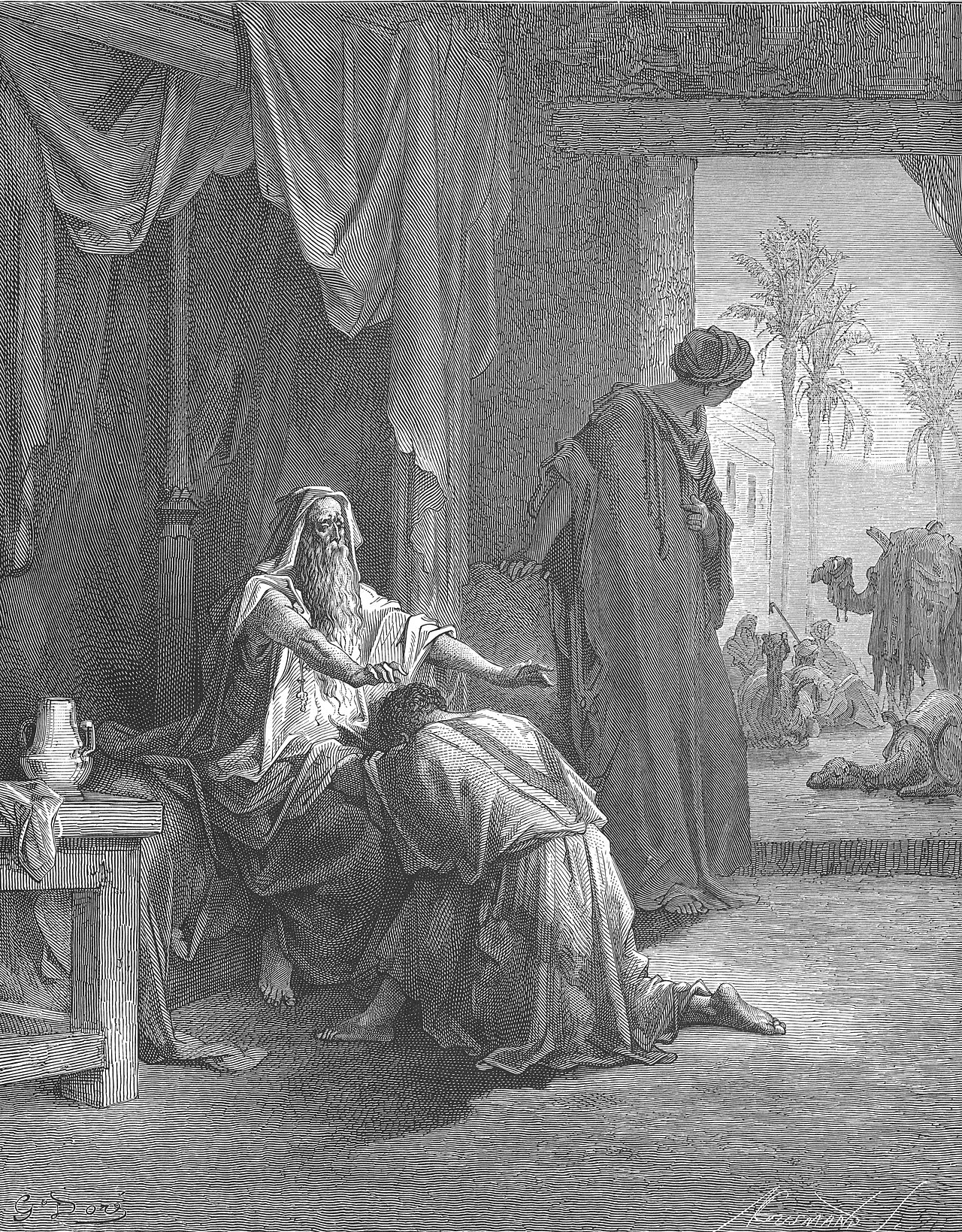
in Genesis 27But Isaac asked his son, “How did you ever find it so quickly, my son?” “Because the LORD your God brought it to me,” he replied.
BSB
The same verse in ASV and KJV ▾
ASV
And Isaac said unto his son, How is it that thou hast found it so quickly, my son? And he said, Because Jehovah thy God sent me good speed.
KJV
And Isaac said unto his son, How is it that thou hast found it so quickly, my son? And he said, Because the Lord thy God brought it to me.
⋯
This verse in Genesis 27
Commentary
6 notes on this verseThis site's exposition
Which one are you, my son
on Genesis 27:18-20
Jacob answers with three false statements: the name Esau, the place of the firstborn, and the claim that he hunted the meat. Pressed on the speed of the hunt, he puts the LORD behind it. Clarke marks that answer as the worst of them, a lie that borrows God's name.
This site's exposition
the LORD your God brought it to me
Jacob calls Him the LORD your God, his father's God. The first time he calls the LORD his own is his vow at Bethel, at 28:21, and even there it hangs on a condition. Adam Clarke counted this answer among the palpable falsehoods of the scene.
The record, by era
The Puritans and the Awakening3 voices
Now, certainly more is comprised in this blessing than appears at first; it must amount to an entail of the promise of the Messiah: that was in the patriarchal dialect the blessing; something spiritual doubtless is included in it. First, That from him should come the Messiah, that should have a sovereign dominion on earth.
And Isaac said unto his son,....
It is certainly written, not for our imitation, but for our admonition. Let him that thinks he stands take heed lest he fall. Good men have sometimes failed in the exercise of those graces for which they have been most eminent.
The Nineteenth Century1 voice
A commentator
Jamieson, Fausset & Brown1802–1910
Commentary Critical and Explanatory on the Whole Bible (1871)
proposed
he came unto his father--The scheme planned by the mother was to be executed by the son in the father's bedchamber; and it is painful to think of the deliberate falsehoods, as well as daring profanity, he resorted to.
quarantine:debris (2026-07-29) — starts-lowercase
The words behind it
15 Hebrew wordsEvery Hebrew word of this verse in the order it stands, with what it means and the door to its own study. The last column counts the times a word stands in the whole Bible: the rarer the word, the more the places it appears belong together.
| Hebrew | Sound | Meaning | Word study | In the Bible |
|---|---|---|---|---|
| וַיֹּ֤אמֶר | vaiyomer | and he said | H559 → | 5305 times |
| יִצְחָק֙ | yitzchak | Isaac | H3327 → | 108 times |
| אֶל־ | ʾel- | to | H413 → | 5510 times |
| בְּנ֔וֹ | beno | son his | H1121 → | 4930 times |
| מַה־ | mah- | what? | H4100 → | 752 times |
| זֶּ֛ה | zeh | this | H2088 → | 1180 times |
| מִהַ֥רְתָּ | miharta | have you hastened | H4116 → | 68 times |
| לִמְצֹ֖א | limtzo' | to find [it] | H4672 → | 455 times |
| בְּנִ֑י | beni | O son my | H1121 → | 4930 times |
| וַיֹּ֕אמֶר | vaiyomer | and he said | H559 → | 5305 times |
| כִּ֥י | ki | for | H3588 → | 4482 times |
| הִקְרָ֛ה | hikrah | he made happen | H7136 → | 27 times |
| יְהוָ֥ה | yahweh | Yahweh | H3068 → | 6520 times |
| אֱלֹהֶ֖יךָ | ʾeloheikha | God your | H430 → | 2601 times |
| לְפָנָֽי׃ | lefanai | <to> before me | H6440 → | 2123 times |
וַיֹּ֤אמֶרand he said
vaiyomerH559 →5305 times
יִצְחָק֙Isaac
yitzchakH3327 →108 times
אֶל־to
ʾel-H413 →5510 times
בְּנ֔וֹson his
benoH1121 →4930 times
מַה־what?
mah-H4100 →752 times
זֶּ֛הthis
zehH2088 →1180 times
מִהַ֥רְתָּhave you hastened
mihartaH4116 →68 times
לִמְצֹ֖אto find [it]
limtzo'H4672 →455 times
בְּנִ֑יO son my
beniH1121 →4930 times
וַיֹּ֕אמֶרand he said
vaiyomerH559 →5305 times
כִּ֥יfor
kiH3588 →4482 times
הִקְרָ֛הhe made happen
hikrahH7136 →27 times
יְהוָ֥הYahweh
yahwehH3068 →6520 times
אֱלֹהֶ֖יךָGod your
ʾeloheikhaH430 →2601 times
לְפָנָֽי׃<to> before me
lefanaiH6440 →2123 times
A shaded row is a word that stands 400 times or fewer in the Bible.
The walk
8 stopsEach card is a verse this one points to, and under it the verses that one points to in turn. Where several paths arrive at the same place, that place is listed first: the text keeps returning to it.
Through
Exodus 20:7You shall not take the name of the LORD your God in vain, for the LORD will not leave anyone unpunished who takes His name in vain.
it leads to
- Deuteronomy 5:11
You shall not take the name of the LORD your God in vain, for the LORD will not leave anyone unpunished who takes His name in vain.
- Leviticus 19:12
You must not swear falsely by My name and so profane the name of your God. I am the LORD.
- James 5:12
Above all, my brothers, do not swear, not by heaven or earth or by any other oath. Simply let your “Yes” be yes, and your “No,” no, so that you will not fall under…
- Matthew 5:33–37
Again, you have heard that it was said to the ancients, ‘Do not break your oath, but fulfill your vows to the Lord.’
- Psalms 50:14–16
Sacrifice a thank offering to God, and fulfill your vows to the Most High.
- Deuteronomy 5:11
Through
Genesis 24:12“O LORD, God of my master Abraham,” he prayed, “please grant me success today, and show kindness to my master Abraham.
it leads to
- Genesis 24:27
saying, “Blessed be the LORD, the God of my master Abraham, who has not withheld His kindness and faithfulness from my master. As for me, the LORD has led me on the journey to…
- Exodus 3:6
Then He said, “I am the God of your father, the God of Abraham, the God of Isaac, and the God of Jacob.” At this, Moses hid his face, for he was afraid to…
- Genesis 26:24
and that night the LORD appeared to him and said, “I am the God of your father Abraham. Do not be afraid, for I am with you. I will bless you and multiply your…
- Genesis 24:27
Where this verse is studied
About Genesis
Who and where
1 name in this verse with a page on the site.
This page draws on Adam Clarke, Commentary on the Bible; Jamieson, Fausset & Brown, Commentary Critical and Explanatory on the Whole Bible; John Gill, Exposition of the Old Testament; John Gill, Exposition of the Old Testament (1748-1763); John Wesley, Explanatory Notes upon the Old Testament and Matthew Henry, Commentary on the Whole Bible.