
John 19:5
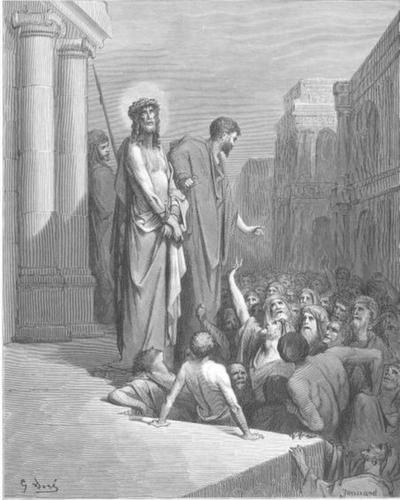
in John 19When Jesus came out wearing the crown of thorns and the purple robe, Pilate said to them, “Here is the man!”
BSB
The same verse in ASV and KJV ▾
ASV
Jesus therefore came out, wearing the crown of thorns and the purple garment. And Pilate saith unto them, Behold, the man!
KJV
Then came Jesus forth, wearing the crown of thorns, and the purple robe. And Pilate saith unto them, Behold the man!
⋯
This verse in John 19
Commentary
15 notes on this verseA commentator
Albert Barnes1798–1870
Notes, Explanatory and Practical, on the Old and New Testaments (1832-1869)
Behold the man! - It is probable that Pilate pointed to the Saviour, and his object evidently was to move them to compassion, and to convince them, by a sight of the Saviour himself, that he was innocent. Hence, he brought him forth with the crown of thorns, and the purple robe, and with the marks of scourging. Amid all this Jesus was meek, patient, and calm, giving evident proofs of innocence. The conduct of Pilate was as if he had said, “See! The man whom you accuse is arrayed in a gorgeous robe, as if a king.
This site's exposition
I find no basis for a charge against Him
on John 19:4-5
Pilate brings Jesus out beaten, the crown and the robe still on Him, and says again that he finds no basis for a charge. Here is the man, ecce homo in the Latin, is the line the church has carried ever since. Pilate's aim was political.
This site's exposition
Here is the man
Pilate shows the beaten prisoner to the crowd. Barnes takes Here is the man as an appeal for pity and a proof of innocence. Clarke hears scorn for the accusers who called Jesus an enemy of Caesar.
The record, by era
The Church Fathers4 voices
(Tr. cxvi) Hence it is apparent that these things were not done without Pilate's knowledge, whether he commanded, or only permitted them, for the reason we have mentioned, viz. that His enemies seeing the insults heaped upon Him, might not thirst any longer for His blood: Then came Jesus forth, wearing the crown of thorns, and the purple robe: not the insignia of empire, but the marks of ridicule. And Pilate saith unto them, Behold the man! as if to say, If ye envy the King, spare the outcast. Ignominy overflows, let envy subside.
"Pilate went forth again, and saith unto them, Behold, I bring him forth, that ye may know that I find no fault in him. Then came Jesus forth, wearing the crown of thorns and the purple robe. And he saith unto them, Behold the man!" Hence it is apparent that these things were done by the soldiers not without Pilate's knowledge, whether it was that he ordered them or only permitted them, namely, for the reason we have stated above, that His enemies might all the more willingly drink in the sight of such derisive treatment, and cease to thirst further for His blood. Jesus goes forth to them wearing the crown of thorns and the purple robe, not resplendent in kingly power, but laden with reproach; and the words are addressed to them, Behold the man! If you hate your king, spare him now when you see him sunk so low; he has been scourged, crowned with thorns, clothed with the garments of derision, jeered at with the bitterest insults, struck with the open hand; his ignominy is at the boiling point, let your ill-will sink to zero. But there is no such cooling on the part of the latter, but rather a further increase of heat and vehemence.
A commentator
Cyril of AlexandriaCommentary on the Gospel of John, Book 12 · Written before 444.
proposed
Just as in Adam Satan subdued the whole human race demonstrating its subjection to sin, so now Satan is vanquished by humanity. For the one who was truly God and without sin was still also human. And just as all of humanity was condemned under the sentence of sin through one man, the first Adam, in the same way, the blessing of justification by Christ is extended to all through one man, the second Adam.
A commentator
Cyril of AlexandriaCommentary on the Gospel of John, Book 12 · Written before 444.
proposed
He showed, then, the Lord of all impiously outraged, and mocked by the intolerable insults of the soldiers, trusting that the furious wrath of the Jews would be sated, and now, at last, abate, and rest content with that most pitiable and dishonourable spectacle.
The Medieval Church1 voice
Jesus therefore went out. Augustine: "Not illustrious in command, but full of reproach"; whence there follows: Bearing the crown of thorns and the purple garment, in which they had mocked him, according to that passage of Matthew 20: "They shall deliver him to the Gentiles …
7 more voices on this verse
The Medieval Church1 voice
2381 Secondly, we see Christ being presented before the crowd, Jesus came out, wearing the crown of thorns and the purple robe. He was exhibited in the same robe he wore when he was mocked by the officers in the hope that the crowd would …
The Puritans and the Awakening2 voices
Then came Jesus forth,....
The word however is very affecting: Behold the man. It is good for every one of us, with an eye of faith, to behold the man Christ Jesus in his sufferings.
The Nineteenth Century4 voices
A commentator
Jamieson, Fausset & Brown1802–1910
Commentary Critical and Explanatory on the Whole Bible (1871)
There was clearly a struggle in the breast of this wretched man. Not only was he reluctant to surrender to mere clamor an innocent man, but a feeling of anxiety about His mysterious claims, as is plain from what follows, was beginning to rack his breast, and the object of his exclamation seems to have been to move their pity.
A commentator
J.C. Ryle1816–1900
Expository Thoughts on the Gospels: John (lightly modernized text, Grace Gems edition) (1869)
proposed
Pilate said to the Jewish religious leaders, "Look, here is your king!" Then they shouted out, "Away with him! Away with him! Crucify him!" Pilate asked, "Shall I crucify your king?" The high priests replied, "We have no king except Caesar!" Then Pilate handed him over to them to be crucified. These verses exhibit to our eyes a wonderful picture, a picture which ought to be deeply interesting to all who profess and call themselves Christians. Like every great historical picture, it contains special points on which we should fix our special attention.
A commentator
J.C. Ryle1816–1900
Expository Thoughts on the Gospels: John (lightly modernized text, Grace Gems edition) (1869)
proposed
Pilate said to the Jewish religious leaders, "Look, here is your king!" Then they shouted out, "Away with him! Away with him! Crucify him!" Pilate asked, "Shall I crucify your king?" The high priests replied, "We have no king except Caesar!" Then Pilate handed him over to them to be crucified. These verses exhibit to our eyes a wonderful picture, a picture which ought to be deeply interesting to all who profess and call themselves Christians. Like every great historical picture, it contains special points on which we should fix our special attention. Above all, it contains three life-like portraits, which we shall find it useful to examine in order. The first portrait in the picture is that of our Lord JESUS CHRIST himself. We see the Savior of mankind scourged, crowned with thorns, mocked, smitten, rejected by His own people, unjustly condemned by a judge who saw no fault in Him, and finally delivered up to a most painful death. Yet this was He who was the eternal Son of God, whom the Father's countless angels delighted to honor. This was He who came into the world to save sinners, and after living a blameless life for thirty years, spent the last three years of His time on earth in going about doing good, and preaching the Gospel. Surely the sun never shone on a more wondrous sight since the day of its creation! Let us admire that love of Christ which Paul declares, "passes knowledge," and let us see an endless depth of meaning in the expression. There is no earthly love with which it can be compared, and no standard by which to measure it. It is a love that stands alone. Never let us forget when we ponder this tale of suffering, that Jesus suffered for our sins, the Just for the unjust, that He was wounded for our transgressions and bruised for our iniquities, and that with His stripes we are healed.
And Pilate saith - The word Pilate, which we supply in our version, is added by one MS., the later Syriac, later Arabic, and the Coptic. Behold the man! - The man who, according to you, affects the government, and threatens to take away the empire from the Romans. Behold the man whom ye have brought unto me as an enemy to Caesar, and as a sower of the seeds of sedition in the land! In him I find no guilt; and from him ye have no occasion to fear any evil.
The words behind it
19 Greek wordsEvery Greek word of this verse in the order it stands, with what it means and the door to its own study. The last column counts the times a word stands in the whole Bible: the rarer the word, the more the places it appears belong together.
| Greek | Sound | Meaning | Word study | In the Bible |
|---|---|---|---|---|
| Ἐξῆλθεν | exelthen | Went forth | G1831 → | 216 times |
| οὖν | oun | therefore | G3767 → | 497 times |
| ὁ | ho | <the> | G3588 → | 19766 times |
| Ἰησοῦς | iesous | Jesus | G2424 → | 908 times |
| ἔξω | exo | outside | G1854 → | 63 times |
| φορῶν | phoron | wearing | G5409 → | |
| τὸν | ton | the | G3588 → | 19766 times |
| ἀκάνθινον | akanthinon | thorny | G174 → | |
| στέφανον | stephanon | crown | G4735 → | |
| καὶ | kai | and | G2532 → | 9120 times |
| τὸ | to | the | G3588 → | 19766 times |
| πορφυροῦν | porphuroun | purple | G4210 → | |
| ἱμάτιον. | himation | robe. | G2440 → | 60 times |
| καὶ | kai | And | G2532 → | 9120 times |
| λέγει | legei | he says | G3004 → | 1325 times |
| αὐτοῖς· | autois | to them; | G846 → | 5565 times |
| ἰδοὺ | idou | behold | G2400 → | 200 times |
| ὁ | ho | the | G3588 → | 19766 times |
| ἄνθρωπος. | anthropos | man! | G444 → | 549 times |
ἘξῆλθενWent forth
exelthenG1831 →216 times
οὖνtherefore
ounG3767 →497 times
ὁ<the>
hoG3588 →19766 times
ἸησοῦςJesus
iesousG2424 →908 times
ἔξωoutside
exoG1854 →63 times
φορῶνwearing
phoronG5409 →
τὸνthe
tonG3588 →19766 times
ἀκάνθινονthorny
akanthinonG174 →
στέφανονcrown
stephanonG4735 →
καὶand
kaiG2532 →9120 times
τὸthe
toG3588 →19766 times
πορφυροῦνpurple
porphurounG4210 →
ἱμάτιον.robe.
himationG2440 →60 times
καὶAnd
kaiG2532 →9120 times
λέγειhe says
legeiG3004 →1325 times
αὐτοῖς·to them;
autoisG846 →5565 times
ἰδοὺbehold
idouG2400 →200 times
ὁthe
hoG3588 →19766 times
ἄνθρωπος.man!
anthroposG444 →549 times
A shaded row is a word that stands 400 times or fewer in the Bible.
The walk
8 stopsEach card is a verse this one points to, and under it the verses that one points to in turn. Where several paths arrive at the same place, that place is listed first: the text keeps returning to it.
Through
Isaiah 7:14Therefore the Lord Himself will give you a sign: Behold, the virgin will be with child and will give birth to a son, and will call Him Immanuel.
it leads to
- Matthew 1:23
“Behold, the virgin will be with child and will give birth to a son, and they will call Him Immanuel” (which means, “God with us”).
- Isaiah 9:6
For unto us a child is born, unto us a son is given, and the government will be upon His shoulders. And He will be called Wonderful Counselor, Mighty God, Everlasting Father, Prince of…
- Matthew 1:23
Through
Hebrews 12:2Let us fix our eyes on Jesus, the author and perfecter of our faith, who for the joy set before Him endured the cross, scorning its shame, and sat down at the right hand…
it leads to
- Micah 7:7
But as for me, I will look to the LORD; I will wait for the God of my salvation. My God will hear me.
- 1 Peter 3:18
For Christ also suffered for sins once for all, the righteous for the unrighteous, to bring you to God. He was put to death in the body but made alive in the Spirit,
- 1 Peter 2:23–24
When they heaped abuse on Him, He did not retaliate; when He suffered, He made no threats, but entrusted Himself to Him who judges justly.
- Hebrews 1:3
The Son is the radiance of God’s glory and the exact representation of His nature, upholding all things by His powerful word. After He had provided purification for sins, He sat down at the…
- Micah 7:7
Through
Isaiah 43:1Now this is what the LORD says— He who created you, O Jacob, and He who formed you, O Israel: “Do not fear, for I have redeemed you; I have called you by your…
it leads to
- Psalms 100:3
Know that the LORD is God. It is He who made us, and we are His; we are His people, and the sheep of His pasture.
- Isaiah 43:7
everyone called by My name and created for My glory, whom I have indeed formed and made.”
- Psalms 100:3
Where this verse is studied
On this page
Studies18
On this chapter
About John
This page draws on 14 works. Open the list of works
This page draws on Adam Clarke, Commentary on the Bible; Albert Barnes, Notes, Explanatory and Practical, on the Old and New Testaments (1832-1869); Albert Barnes, Notes, Explanatory and Practical, on the Gospels; Augustine, Tractates on the Gospel of John; Augustine of Hippo, Catena Aurea by Aquinas; Augustine of Hippo, Tractates on John 116; Bonaventure, Commentary on John, Chapter 19; Cyril of Alexandria, Commentary on the Gospel of John, Book 12; J. C. Ryle, Expository Thoughts on the Gospels, John; J.C. Ryle, Expository Thoughts on the Gospels: John (lightly modernized text, Grace Gems edition); Jamieson, Fausset & Brown, Commentary Critical and Explanatory on the Whole Bible; John Gill, Exposition of the New Testament (1746-1748); Matthew Henry, Commentary on the Whole Bible and Thomas Aquinas, Commentary on John.