
John 19:6
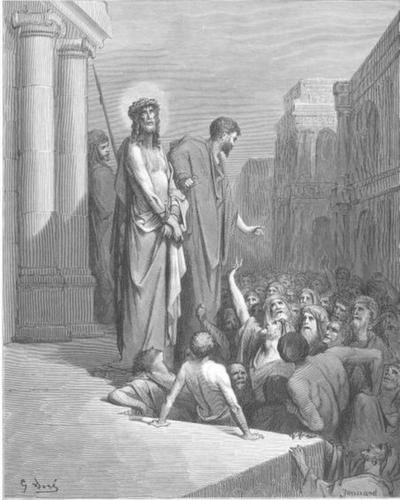
in John 19As soon as the chief priests and officers saw Him, they shouted, “Crucify Him! Crucify Him!” “You take Him and crucify Him,” Pilate replied, “for I find no basis for a charge against Him.”
BSB
The same verse in ASV and KJV ▾
ASV
When therefore the chief priests and the officers saw him, they cried out, saying, Crucify him, crucify him! Pilate saith unto them, Take him yourselves, and crucify him: for I find no crime in him.
KJV
When the chief priests therefore and officers saw him, they cried out, saying, Crucify him, crucify him. Pilate saith unto them, Take ye him, and crucify him: for I find no fault in him.
⋯
This verse in John 19
Commentary
17 notes on this versePilate is in consternation, that the people of the Jews and the inhuman crowd of the chief priests should attain to such a pitch of presumption, as not even to shrink from subjecting Christ to so frightful a death, though no fault was found in Him to bring Him to such a doom. And, therefore, he says, almost like one annoyed at an insult offered to himself: "Make you me a judge of this unjust shedding of blood?
This site's exposition
Crucify Him! Crucify Him!
on John 19:6-7
The chief priests drop the charge of kingship and name the real one. By their law He must die for declaring that He is the Son of God. Their account of His claim is accurate, and He had made it at 5:18 and 10:33.
The record, by era
The Church Fathers5 voices
"When the chief priests, therefore, and attendants saw Him, they cried out, saying, Crucify, crucify him. Pilate saith unto them, Take ye him and crucify him; for I find no fault in him. The Jews answered him, We have a law, and by the law he ought to die because he made himself the Son of God." Behold another and still greater ground of hatred. The former, indeed, seemed but a small matter, as that shown towards the usurpation, by an unlawful act of daring, of the royal power; and yet of neither did Jesus falsely claim possession, but each of them is truly His as both the only-begotten Son of God, and by Him appointed King upon His holy hill of Zion; and both might He now have shown to be His, were it not that in proportion to the greatness of His power, He preferred to manifest the corresponding greatness of His patience.
(Tr. cxvi) The envy of the Jews does not subside at Christ's disgraces; yea, rather rises: When the chief priests therefore and officers saw Him, they cried out, saying, Crucify Him. crucify Him.
A commentator
Romanos the MelodistKONTAKION ON THE PASSION OF CHRIST 36.5-6 · Written before 555.
proposed
The martyr Abel was envied by Cain and later murdered. This is what Christ also endured: Though he desired this envious people, He incited them to anger, while showing affection; He healed those who were sick, and instead of gratitude, he suffers and is crucified, …
See in how many ways the judge makes His defense, continually acquitting Him of the charges; but none of these things shamed the dogs from their purpose. For the, "Take ye him and crucify him," is the expression of one clearing himself of the guilt, and thrusting them forward to an action not permitted to them. They therefore had brought Him, in order that the thing might be done by the decision of the governor; but the contrary fell out, that He was rather acquitted than condemned by the governor's decision. Then, because they were ashamed, "We have," they said, "a law, and by our law he ought to die, because he made himself the Son of God." "How then when the judge said, 'Take ye him, and judge him according to your law,' did ye reply, 'It is not lawful for us to put any man to death,' while here ye fly to the law? And consider the charge, 'He made himself the Son of God.' Tell me, is this a ground of accusation, that He who performed the deeds of the Son of God should call Himself the Son of God?" What then doth Christ? While they held this dialogue one with the other, He held His peace, fulfilling that saying of the Prophet, that "He openeth not his mouth: in His humiliation His judgment was taken away."
But not even so was their rage quenched, but they cried out, "Crucify him, crucify him." Then Pilate, seeing that all was done in vain, said, "Take ye him, and crucify him." Whence it is clear that he had permitted what had been done before, because of their madness. "For I," he saith, "find no fault in him."
10 more voices on this verse
The Church Fathers1 voice
Never yet was the devil in so shameful a plight. For whilst expecting to have Him, he lost even those he had; and when That Body was nailed to the Cross, the dead arose. There death received his wound, having met his death-stroke from a dead body. And as an athlete, when he thinks he has hit his adversary, himself is caught in a fatal grasp; so truly doth Christ also show, that to die with confidence is the devil's shame. For he would have done everything to persuade men that He did not die, had he had the power. For seeing that of His Resurrection indeed all succeeding time was proof demonstrative; whilst of His death, no other time save that whereat it happened could ever furnish proof; therefore it was, that He died publicly in the sight of all men, but He arose not publicly, knowing that the aftertime would bear witness to the truth. For, that whilst the world was looking on, the serpent should be slain on high upon the Cross, herein is the marvel. For what did not the devil do, that He might die in secret? Hear Pilate saying, "Take ye Him away, and crucify Him, for I find no fault in Him," and withstanding them in a thousand ways. And again the Jews said unto Him, "If Thou art the Son of God, come down from the Cross." Then further, when He had received a mortal wound, and He came not down, for this reason He was also committed to burial; for it was in His power to have risen immediately: but He did not, that the fact might be believed. And yet in cases of private death indeed, it is possible to impute them to a swoon, but here, it is not possible to do this either. For even the soldiers brake not His legs, like those of the others, that it might be made manifest that He was dead. And those who buried The Body are known; and therefore too the Jews themselves seal the stone along with the soldiers. […]
The Medieval Church3 voices
When therefore they had seen him. Here upon the showing of Christ there follows thirdly the hardening of the obstinacy of the Jews, especially of the chief priests: whence he says: When therefore the chief priests and ministers had seen him, they cried out saying: …
2383 Now we see the effect of this exhibition on the Jews. No matter how disgraced and wretched and beaten he appeared, their hatred did not lessen, but was still burning and growing. When the chief priests and the officers saw him, when Jesus was …
But they were not tamed even by this, and cry out: "Crucify, crucify Him!" Pilate, seeing that everything he was doing remained in vain, says: "Take Him yourselves and crucify Him, for I find no fault in Him." He says this, urging them toward an …
The Puritans and the Awakening2 voices
Now by this it appears that their malice against Christ was, (1.) Unreasonable and most absurd, in that they offer not to make good their charges against him, nor to object against the judgment of Pilate concerning him; but, though he be innocent, he must be crucified. (2.) It was insatiable and very cruel.
When the chief priests therefore, and officers, saw him,....
The Nineteenth Century4 voices
Crucify Him - Αυτον, which is necessary to the text, and which is wanting in the common editions, and is supplied by our version in Italics, is added here on the authority of almost every MS. and version of importance. As it is omitted in the common editions, it affords another proof, that they were not taken from the best MSS.
A commentator
J.C. Ryle1816–1900
Expository Thoughts on the Gospels: John (lightly modernized text, Grace Gems edition) (1869)
proposed
Pilate said to the Jewish religious leaders, "Look, here is your king!" Then they shouted out, "Away with him! Away with him! Crucify him!" Pilate asked, "Shall I crucify your king?" The high priests replied, "We have no king except Caesar!" Then Pilate handed him over to them to be crucified. These verses exhibit to our eyes a wonderful picture, a picture which ought to be deeply interesting to all who profess and call themselves Christians. Like every great historical picture, it contains special points on which we should fix our special attention.
A commentator
J.C. Ryle1816–1900
Expository Thoughts on the Gospels: John (lightly modernized text, Grace Gems edition) (1869)
proposed
Pilate said to the Jewish religious leaders, "Look, here is your king!" Then they shouted out, "Away with him! Away with him! Crucify him!" Pilate asked, "Shall I crucify your king?" The high priests replied, "We have no king except Caesar!" Then Pilate handed him over to them to be crucified. These verses exhibit to our eyes a wonderful picture, a picture which ought to be deeply interesting to all who profess and call themselves Christians. Like every great historical picture, it contains special points on which we should fix our special attention. Above all, it contains three life-like portraits, which we shall find it useful to examine in order. The first portrait in the picture is that of our Lord JESUS CHRIST himself. We see the Savior of mankind scourged, crowned with thorns, mocked, smitten, rejected by His own people, unjustly condemned by a judge who saw no fault in Him, and finally delivered up to a most painful death. Yet this was He who was the eternal Son of God, whom the Father's countless angels delighted to honor. This was He who came into the world to save sinners, and after living a blameless life for thirty years, spent the last three years of His time on earth in going about doing good, and preaching the Gospel. Surely the sun never shone on a more wondrous sight since the day of its creation! Let us admire that love of Christ which Paul declares, "passes knowledge," and let us see an endless depth of meaning in the expression. There is no earthly love with which it can be compared, and no standard by which to measure it. It is a love that stands alone. Never let us forget when we ponder this tale of suffering, that Jesus suffered for our sins, the Just for the unjust, that He was wounded for our transgressions and bruised for our iniquities, and that with His stripes we are healed.
A commentator
Albert Barnes1798–1870
Notes, Explanatory and Practical, on the Old and New Testaments (1832-1869)
proposed
They cried out, saying, Crucify him ... - The view of the Saviour’s meekness only exasperated them the more. They had resolved on his death; and as they saw Pilate disposed to acquit him, they redoubled their cries, and endeavored to gain by tumult, and clamor, and terror, what they saw they could not obtain by justice. When men are determined on evil, they cannot be reasoned with. Every argument tends to defeat their plans, and they press on in iniquity with the more earnestness in proportion as sound reasons are urged to stay their course. Thus sinners go in the way of wickedness down to death. They make up in firmness of purpose what they lack in reason. They are more fixed in their plans in proportion as God faithfully warns them and their friends admonish them. Take ye him ... - These are evidently the words of a man weary with their importunity and with the subject, and yet resolved not to sanction their conduct. It was not the act of a judge delivering him up according to the forms of the law, for they did not understand it so. It was equivalent to this: “I am satisfied of his innocence, and shall not pronounce the sentence of death. If you are bent on his ruin - if you are determined to put to death an innocent man - if my judgment does not satisfy you - take him and put him to death on your own responsibility, and take the consequences. It cannot be done with my consent, nor in the due form of law; and if done, it must be by you, without authority, and in the face of justice.” See Mat 27:24.
The words behind it
29 Greek wordsEvery Greek word of this verse in the order it stands, with what it means and the door to its own study. The last column counts the times a word stands in the whole Bible: the rarer the word, the more the places it appears belong together.
| Greek | Sound | Meaning | Word study | In the Bible |
|---|---|---|---|---|
| ὅτε | hote | When | G3753 → | 103 times |
| οὖν | oun | therefore | G3767 → | 497 times |
| εἶδον | eidon | saw | G1492 → | 374 times |
| αὐτὸν | auton | Him | G846 → | 5565 times |
| οἱ | hoi | the | G3588 → | 19766 times |
| ἀρχιερεῖς | archiereis | chief priests | G749 → | 122 times |
| καὶ | kai | and | G2532 → | 9120 times |
| οἱ | hoi | the | G3588 → | 19766 times |
| ὑπηρέται, | huperetai | officers, | G5257 → | 20 times |
| ἐκραύγασαν | ekraugasan | they cried out | G2905 → | 9 times |
| λέγοντες· | legontes | saying; | G3004 → | 1325 times |
| σταύρωσον | stauroson | do crucify | G4717 → | 46 times |
| σταύρωσον | stauroson | do crucify | G4717 → | 46 times |
| Λέγει | legei | Says | G3004 → | 1325 times |
| αὐτοῖς | autois | to them | G846 → | 5565 times |
| ὁ | ho | <the> | G3588 → | 19766 times |
| Πιλᾶτος· | pilatos | Pilate; | G4091 → | 55 times |
| λάβετε | labete | do take | G2983 → | 257 times |
| αὐτὸν | auton | Him | G846 → | 5565 times |
| ὑμεῖς | humeis | yourselves | G4771 → | 2973 times |
| καὶ | kai | and | G2532 → | 9120 times |
| σταυρώσατε· | staurosate | do crucify [him]; | G4717 → | 46 times |
| ἐγὼ | ego | I myself | G1473 → | 839 times |
| γὰρ | gar | for | G1063 → | 1039 times |
| οὐχ | ouch | no | G3756 → | 1664 times |
| εὑρίσκω | heurisko | find | G2147 → | 175 times |
| ἐν | en | in | G1722 → | 2738 times |
| αὐτῷ | auto | Him | G846 → | 5565 times |
| αἰτίαν. | aitian | guilt. | G156 → | 20 times |
ὅτεWhen
hoteG3753 →103 times
οὖνtherefore
ounG3767 →497 times
εἶδονsaw
eidonG1492 →374 times
αὐτὸνHim
autonG846 →5565 times
οἱthe
hoiG3588 →19766 times
ἀρχιερεῖςchief priests
archiereisG749 →122 times
καὶand
kaiG2532 →9120 times
οἱthe
hoiG3588 →19766 times
ὑπηρέται,officers,
huperetaiG5257 →20 times
ἐκραύγασανthey cried out
ekraugasanG2905 →9 times
λέγοντες·saying;
legontesG3004 →1325 times
σταύρωσονdo crucify
staurosonG4717 →46 times
σταύρωσονdo crucify
staurosonG4717 →46 times
ΛέγειSays
legeiG3004 →1325 times
αὐτοῖςto them
autoisG846 →5565 times
ὁ<the>
hoG3588 →19766 times
Πιλᾶτος·Pilate;
pilatosG4091 →55 times
λάβετεdo take
labeteG2983 →257 times
αὐτὸνHim
autonG846 →5565 times
ὑμεῖςyourselves
humeisG4771 →2973 times
καὶand
kaiG2532 →9120 times
σταυρώσατε·do crucify [him];
staurosateG4717 →46 times
ἐγὼI myself
egoG1473 →839 times
γὰρfor
garG1063 →1039 times
οὐχno
ouchG3756 →1664 times
εὑρίσκωfind
heuriskoG2147 →175 times
ἐνin
enG1722 →2738 times
αὐτῷHim
autoG846 →5565 times
αἰτίαν.guilt.
aitianG156 →20 times
A shaded row is a word that stands 400 times or fewer in the Bible.
The walk
8 stopsEach card is a verse this one points to, and under it the verses that one points to in turn. Where several paths arrive at the same place, that place is listed first: the text keeps returning to it.
Through
John 19:4Once again Pilate came out and said to the Jews, “Look, I am bringing Him out to you to let you know that I find no basis for a charge against Him.”
it leads to
- John 18:38
“What is truth?” Pilate asked. And having said this, he went out again to the Jews and told them, “I find no basis for a charge against Him.
Reached by 2 separate paths from here.
- 1 Peter 2:22
“He committed no sin, and no deceit was found in His mouth.”
Reached by 2 separate paths from here.
- Luke 23:4
Then Pilate said to the chief priests and the crowds, “I find no basis for a charge against this man.”
- John 18:38
Through
Acts 7:52Which of the prophets did your fathers fail to persecute? They even killed those who foretold the coming of the Righteous One. And now you are His betrayers and murderers—
it leads to
- Matthew 5:12
Rejoice and be glad, because great is your reward in heaven; for in the same way they persecuted the prophets before you.
- 1 Kings 19:10
“I have been very zealous for the LORD, the God of Hosts,” he replied, “but the Israelites have forsaken Your covenant, torn down Your altars, and killed Your prophets with the sword. I am…
- 2 Chronicles 36:16
But they mocked the messengers of God, despising His words and scoffing at His prophets, until the wrath of the LORD against His people was stirred up beyond remedy.
- 1 Thessalonians 2:15
who killed both the Lord Jesus and their own prophets, and drove us out as well. They are displeasing to God and hostile to all men,
- Acts 3:14–15
You rejected the Holy and Righteous One and asked that a murderer be released to you.
- Matthew 5:12
Where this verse is studied
On this page
Studies25
- Blue, Purple and Scarlet
- Hanged on a tree
- How Greek Works
- Irony in Scripture: More Than the Speaker Knows
- Mary Magdalene: the Witness at the Tomb
- Mary of Nazareth
Show the next 6 titles
- Messianic Prophecy
- The Messianic Psalms
- Nicodemus at Night. John 3
- Passover
- The Scarlet Thread
- Scribes and the Sanhedrin
Show the next 6 titles
About John
This page draws on 16 works. Open the list of works
This page draws on Adam Clarke, Commentary on the Bible; Albert Barnes, Notes, Explanatory and Practical, on the Gospels; Albert Barnes, Notes, Explanatory and Practical, on the Old and New Testaments (1832-1869); Augustine of Hippo, Tractates on John 116; Augustine of Hippo, Catena Aurea by Aquinas; Bonaventure, Commentary on John, Chapter 19; Cyril of Alexandria, Commentary on the Gospel of John, Book 12; J.C. Ryle, Expository Thoughts on the Gospels: John (lightly modernized text, Grace Gems edition); John Chrysostom, Homily on the Gospel of John 84; John Chrysostom, Homily on Colossians 6; John Gill, Exposition of the New Testament; John Gill, Exposition of the New Testament (1746-1748); Matthew Henry, Commentary on the Whole Bible; Romanos the Melodist, KONTAKION ON THE PASSION OF CHRIST 36.5-6; Theophylact of Ohrid, Commentary on John and Thomas Aquinas, Commentary on John.