
John 19:10
in John 19So Pilate said to Him, “Do You refuse to speak to me? Do You not know that I have authority to release You and authority to crucify You?”
BSB
The same verse in ASV and KJV ▾
ASV
Pilate therefore saith unto him, Speakest thou not unto me? knowest thou not that I have power to release thee, and have power to crucify thee?
KJV
Then saith Pilate unto him, Speakest thou not unto me? knowest thou not that I have power to crucify thee, and have power to release thee?
⋯
This verse in John 19
Commentary
13 notes on this versePilate thought this silence the silence of a madman. Therefore, he stretches over Him, as it were, the wand of his official power, and thought that he could induce Him by fear, against His Will, to return a fruitless answer. For he says that nothing could hinder his inclining whichever way he chose, either to punish Him, or to take compassion upon Him; and that there was nothing to turn him aside, to give a verdict against his will, with whom alone rested the fate of the accused.
This site's exposition
authority to release You and authority to crucify You
on John 19:10-11
Pilate claims two powers, to release and to crucify, and Jesus traces the whole of it to what was given from above. Rome's authority stands under God even here. The greater sin lies on the one who handed Him over, read as Caiaphas or as Judas.
The record, by era
The Church Fathers1 voice
When He was silent, Pilate saith, "Knowest thou not that I have power to crucify thee?" Seest thou how he condemned himself beforehand; for, "if the whole rests with thee, why dost not thou let Him go, when thou hast found no fault in Him?" When then Pilate had uttered the sentence against himself, then He saith, "He that delivered Me unto thee hath the greater sin." Showing that he also was guilty of sin. Then, to pull down his pride and arrogance, He saith, "Thou wouldst have no power except it were given thee." Showing that this did not come to pass merely in the common order of events, but that it was accomplished mystically. Then lest, when thou hearest, "Except it were given thee," thou shouldest deem that Pilate was exempt from all blame, on this account therefore He said, "Therefore he that delivered Me unto thee hath the greater sin." "And yet if it was given, neither he nor they were liable to any charge." "Thou objectest idly; for the 'given' in this place means what is 'allowed'; as though He had said, 'He hath permitted these things to be, yet not for that are ye clear of the wickedness.'" He awed Pilate by the words, and proffered a clear defense. On which account that person sought to release Him.
The Medieval Church3 voices
Pilate said to him: Speakest thou not to me? As if to say: you err in despising my question, when you ought rather to seek my goodwill, as one placed in my hands: and this he adds: Knowest thou not that I have power to …
2392 Then the Evangelist shows how Pilate reproached him for his silence (v 10): first, we see Pilate boasting of his power; secondly, we have what Christ said about this power. 2393 Pilate was displeased that Jesus did not answer him, and said, You will …
It turns out that Pilate has no firmness whatsoever, but any chance danger can shake him. He feared the Jews; he also trembled before Jesus, as the Son of God. Let us see, then, how he condemns himself by his own words: "I have power …
The Puritans and the Awakening1 voice
Men in power are apt to be puffed up with their power, and the more absolute and arbitrary it is the more it gratifies and humours their pride. But he magnifies his power to an exorbitant degree when he boasts that he has power to crucify one whom he had declared innocent, for no prince or potentate has authority to do wrong.
6 more voices on this verse
The Puritans and the Awakening1 voice
Then saith Pilate unto him,.... Being angry with him, resenting his silence, and looking upon it as a contempt of him; speakest thou not unto me? he wondered that he stood in no fear of him, who was the Roman governor, his judge; who had the power of life and death; and that he should make no answer to him, who was in so much dignity, and in so high and exalted a station.
The Nineteenth Century5 voices
A commentator
Albert Barnes1798–1870
Notes, Explanatory and Practical, on the Old and New Testaments (1832-1869)
Speakest thou not ... - This is the expression of a man of pride. He was not accustomed to be met with silence like this. He endeavored, therefore, to address the fears of Jesus, and to appall him with the declaration that his life was at his disposal, and that his safety depended on his favor. This arrogance called forth the reply of the Savior, and he told him that he had no power except what was given him from above. Jesus was not, therefore, to be intimidated by any claim of power in Pilate.
A commentator
Jamieson, Fausset & Brown1802–1910
Commentary Critical and Explanatory on the Whole Bible (1871)
Then saith Pilate unto him, Speakest thou not to me?--The "me" is the emphatic word in the question. He falls back upon the pride of office, which doubtless tended to blunt the workings of his conscience. knowest thou not that I have power to crucify thee, and have power to release thee?--said to work upon Him at once by fear and by hope.
A commentator
Jamieson, Fausset & Brown1802–1910
Commentary Critical and Explanatory on the Whole Bible (1871)
When Pilate . . . heard this saying, he was the more afraid--the name "SON OF GOD," the lofty sense evidently attached to it by His Jewish accusers, the dialogue he had already held with Him, and the dream of his wife (Mt 27:19), all working together in the breast of the wretched man.
A commentator
J.C. Ryle1816–1900
Expository Thoughts on the Gospels: John (lightly modernized text, Grace Gems edition) (1869)
proposed
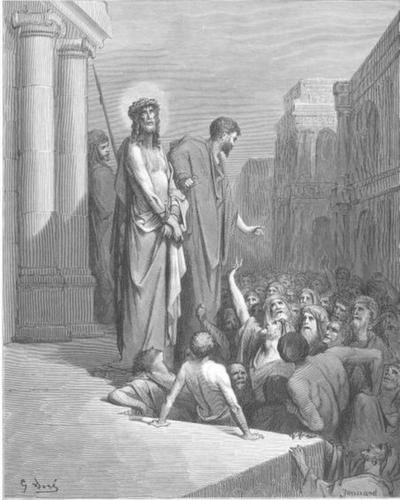
Pilate said to the Jewish religious leaders, "Look, here is your king!" Then they shouted out, "Away with him! Away with him! Crucify him!" Pilate asked, "Shall I crucify your king?" The high priests replied, "We have no king except Caesar!" Then Pilate handed him over to them to be crucified. These verses exhibit to our eyes a wonderful picture, a picture which ought to be deeply interesting to all who profess and call themselves Christians. Like every great historical picture, it contains special points on which we should fix our special attention.
A commentator
J.C. Ryle1816–1900
Expository Thoughts on the Gospels: John (lightly modernized text, Grace Gems edition) (1869)
proposed
Pilate said to the Jewish religious leaders, "Look, here is your king!" Then they shouted out, "Away with him! Away with him! Crucify him!" Pilate asked, "Shall I crucify your king?" The high priests replied, "We have no king except Caesar!" Then Pilate handed him over to them to be crucified. These verses exhibit to our eyes a wonderful picture, a picture which ought to be deeply interesting to all who profess and call themselves Christians. Like every great historical picture, it contains special points on which we should fix our special attention. Above all, it contains three life-like portraits, which we shall find it useful to examine in order. The first portrait in the picture is that of our Lord JESUS CHRIST himself. We see the Savior of mankind scourged, crowned with thorns, mocked, smitten, rejected by His own people, unjustly condemned by a judge who saw no fault in Him, and finally delivered up to a most painful death. Yet this was He who was the eternal Son of God, whom the Father's countless angels delighted to honor. This was He who came into the world to save sinners, and after living a blameless life for thirty years, spent the last three years of His time on earth in going about doing good, and preaching the Gospel. Surely the sun never shone on a more wondrous sight since the day of its creation! Let us admire that love of Christ which Paul declares, "passes knowledge," and let us see an endless depth of meaning in the expression. There is no earthly love with which it can be compared, and no standard by which to measure it. It is a love that stands alone. Never let us forget when we ponder this tale of suffering, that Jesus suffered for our sins, the Just for the unjust, that He was wounded for our transgressions and bruised for our iniquities, and that with His stripes we are healed.
The words behind it
20 Greek wordsEvery Greek word of this verse in the order it stands, with what it means and the door to its own study. The last column counts the times a word stands in the whole Bible: the rarer the word, the more the places it appears belong together.
| Greek | Sound | Meaning | Word study | In the Bible |
|---|---|---|---|---|
| λέγει | legei | Says | G3004 → | 1325 times |
| οὖν | oun | therefore | G3767 → | 497 times |
| αὐτῷ | auto | to Him | G846 → | 5565 times |
| ὁ | ho | <the> | G3588 → | 19766 times |
| Πιλᾶτος· | pilatos | Pilate; | G4091 → | 55 times |
| ἐμοὶ | emoi | To me myself | G1473 → | 839 times |
| οὐ | ou | not | G3756 → | 1664 times |
| λαλεῖς; | laleis | speak You? | G2980 → | 294 times |
| οὐκ | ouk | Surely | G3756 → | 1664 times |
| οἶδας | oidas | You know | ||
| ὅτι | hoti | that | G3754 → | 1292 times |
| ἐξουσίαν | exousian | authority | G1849 → | 102 times |
| ἔχω | echo | I have | G2192 → | 707 times |
| ἀπολῦσαί | apolusai | to release | G630 → | 63 times |
| σε | se | You | G4771 → | 2973 times |
| καὶ | kai | and | G2532 → | 9120 times |
| ἐξουσίαν | exousian | authority | G1849 → | 102 times |
| ἔχω | echo | I have | G2192 → | 707 times |
| σταυρῶσαί | staurosai | to crucify | G4717 → | 46 times |
| σε; | se | You? | G4771 → | 2973 times |
λέγειSays
legeiG3004 →1325 times
οὖνtherefore
ounG3767 →497 times
αὐτῷto Him
autoG846 →5565 times
ὁ<the>
hoG3588 →19766 times
Πιλᾶτος·Pilate;
pilatosG4091 →55 times
ἐμοὶTo me myself
emoiG1473 →839 times
οὐnot
ouG3756 →1664 times
λαλεῖς;speak You?
laleisG2980 →294 times
οὐκSurely
oukG3756 →1664 times
οἶδαςYou know
oidas
ὅτιthat
hotiG3754 →1292 times
ἐξουσίανauthority
exousianG1849 →102 times
ἔχωI have
echoG2192 →707 times
ἀπολῦσαίto release
apolusaiG630 →63 times
σεYou
seG4771 →2973 times
καὶand
kaiG2532 →9120 times
ἐξουσίανauthority
exousianG1849 →102 times
ἔχωI have
echoG2192 →707 times
σταυρῶσαίto crucify
staurosaiG4717 →46 times
σε;You?
seG4771 →2973 times
A shaded row is a word that stands 400 times or fewer in the Bible.
The walk
8 stopsEach card is a verse this one points to, and under it the verses that one points to in turn. Where several paths arrive at the same place, that place is listed first: the text keeps returning to it.
Through
John 18:39But it is your custom that I release to you one prisoner at the Passover. So then, do you want me to release to you the King of the Jews?”
it leads to
- Matthew 27:15–18
Now it was the governor’s custom at the feast to release to the crowd a prisoner of their choosing.
- Luke 23:16–23
Therefore I will punish Him and release Him.”
- Mark 15:6–14
Now it was Pilate’s custom at the feast to release to the people a prisoner of their choosing.
- Matthew 27:15–18
Through
Daniel 5:19Because of the greatness that He bestowed on him, the people of every nation and language trembled in fear before him. He killed whom he wished and kept alive whom he wished; he exalted…
it leads to
- Daniel 2:12–13
This response made the king so furious with anger that he gave orders to destroy all the wise men of Babylon.
- Daniel 3:6
And whoever does not fall down and worship will immediately be thrown into the blazing fiery furnace.”
- Daniel 3:4
Then the herald loudly proclaimed, “O people of every nation and language, this is what you are commanded:
- Jeremiah 27:5–7
By My great power and outstretched arm, I made the earth and the men and beasts on the face of it, and I give it to whom I please.
- Romans 13:1
Everyone must submit himself to the governing authorities, for there is no authority except that which is from God. The authorities that exist have been appointed by God.
- Daniel 2:12–13
Where this verse is studied
On this page
Studies25
- Blue, Purple and Scarlet
- Hanged on a tree
- How Greek Works
- Irony in Scripture: More Than the Speaker Knows
- Mary Magdalene: the Witness at the Tomb
- Mary of Nazareth
Show the next 6 titles
- Messianic Prophecy
- The Messianic Psalms
- Nicodemus at Night. John 3
- Passover
- The Scarlet Thread
- Scribes and the Sanhedrin
Show the next 6 titles
About John
This page draws on 11 works. Open the list of works
This page draws on Albert Barnes, Notes, Explanatory and Practical, on the Old and New Testaments (1832-1869); Bonaventure, Commentary on John, Chapter 19; Cyril of Alexandria, COMMENTARY ON THE GOSPEL OF JOHN 12; J.C. Ryle, Expository Thoughts on the Gospels: John (lightly modernized text, Grace Gems edition); Jamieson, Fausset & Brown, Commentary Critical and Explanatory on the Whole Bible; John Chrysostom, Homily on the Gospel of John 84; John Gill, Exposition of the New Testament (1746-1748); John Wesley, Explanatory Notes upon the New Testament; Matthew Henry, Commentary on the Whole Bible; Theophylact of Ohrid, Commentary on John and Thomas Aquinas, Commentary on John.