
John 19:1
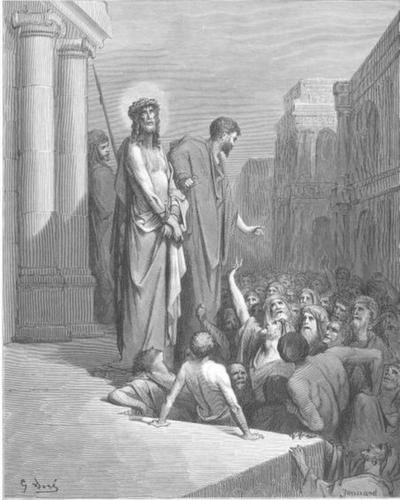
in John 19Then Pilate took Jesus and had Him flogged.
BSB
The same verse in ASV and KJV ▾
ASV
Then Pilate therefore took Jesus, and scourged him.
KJV
Then Pilate therefore took Jesus, and scourged him.
⋯
This verse in John 19
Commentary
15 notes on this versePilate took Jesus, and scourged him - That is, caused him to be scourged: for we cannot with Bede suppose that he scourged him with his own hand. As our Lord was scourged by order of Pilate, it is probable he was scourged in the Roman manner, which was much more severe than that of the Jews. The latter never gave more than thirty-nine blows; for the law had absolutely forbidden a man to be abused, or his flesh cut in this chastisement, Deu 25:
This site's exposition
Pilate took Jesus and had Him flogged
Pilate has Jesus flogged, and a flogging under Rome could kill a man before any cross was raised. The soldiers used leather thongs weighted with bone, and the governor meant the beating to satisfy a crowd shouting Crucify Him. Isaiah 53:5 names the stripes that heal.
The record, by era
The Church Fathers5 voices
(Tr. cxvi) When the Jews had cried out that they did not wish Jesus to be released on account of the passover, but Barabbas, Then Pilate therefore took Jesus, and scourged Him. Pilate seems to have done this for no reason but to satisfy the malice of the Jews with some punishment short of death. On which account he allowed his band to do what follows, or perhaps even commanded them. The Evangelist only says however that the soldiers did so, not that Pilate commanded them: And the soldiers platted a crown of thorns, and put it on His head, and they put on Him a purple robe, and said, Hail, King of the Jews! and they smote Him with their hands. (Tr. cxvi) Thus were fulfilled what Christ had prophesied of Himself; thus were martyrs taught to suffer all that the malice of persecutors could inflict; thus that kingdom which was not of this world conquered the proud world, not by fierce fighting, but by patient suffering.
On the Jews crying out that they did not wish Jesus to be released unto them at the passover, but Barabbas the robber; not the Saviour, but the murderer; not the Giver of life, but the destroyer, - "then Pilate took Jesus and scourged Him." We must believe that Pilate acted thus for no other reason than that the Jews, glutted with the injuries done to Him, might consider themselves satisfied, and desist from madly pursuing Him even unto death. With a similar intention was it that, as governor, he also permitted his cohort to do what follows, or even perhaps ordered them, although the evangelist is silent on the subject. For he tells us what the soldiers did thereafter, but not that Pilate ordered it. "And the soldiers," he says, "platted a crown of thorns, and put it on His head, and they clothed Him with a purple robe. And they came to Him and said, Hail, King of the Jews! And they smote Him with their hands." Thus were fulfilled the very things which Christ had foretold of Himself; thus were the martyrs moulded for the endurance of all that their persecutors should be pleased to inflict; thus, by concealing for a time the terror of His power, He commended to us the prior imitation of His patience; thus the kingdom which was not of this world overcame that proud world, not by the ferocity of fighting, but by the humility of suffering; and thus the grain of corn that was yet to be multiplied was sown amid the horrors of shame, that it might come to fruition amid the wonders of glory.
A commentator
Romanos the MelodistKONTAKION ON THE PASSION OF CHRIST 36.13-14 · Written before 555.
proposed
Like a lion they roared to seize The life of the lamb, Christ. Pilate, fulfilling their plan, Flogged you, the meek One. So he set to work on your back.… The Redeemer endured the whip. The Deliverer was in chains, Stripped and stretched out on …
But do thou all through observe the lovingkindness of the Lord in these circumstances. Pilate scourged Him perhaps desiring to exhaust and to soothe the fury of the Jews. For when he had not been able to deliver Him by his former measures, being anxious to stay the evil at this point, he scourged Him, and permitted to be done what was done, the robe and crown to be put on Him, so as to relax their anger. Wherefore also he led Him forth to them crowned, that, seeing the insult which had been done to Him, they might recover a little from their passion, and vomit their venom.
A commentator
Cyril of AlexandriaCommentary on the Gospel of John, Book 12 · Written before 444.
proposed
He scourges Him unjustly, and suffers the crowd of soldiers to insult Him, and put a crown of thorns about His Head, and throw a purple robe upon Him, and buffet Him with the palms of their hands, and otherwise dishonour Him. For he thought he could easily put to shame the people of the Jews, if they saw the Man Who was altogether free from guilt suffering this punishment, only without a cause.
8 more voices on this verse
The Medieval Church3 voices
Pilate scourges Him, wishing at least by this to calm and subdue their fury. Since he could not free Him from their hands by words, he scourges Him, hoping by this to restrain their madness.
Then he apprehended him, etc. Here Pilate intends to free him by a judgment of severity, scourging an innocent man, so that he might mitigate the zeal of the Jews: and there are here three parts. In the first is described the ignominious scourging of …
2371 Above, the Evangelist gave us an account of what Christ suffered from the Jews; here he describes what in particular he endured from the Gentiles. He suffered three things, as he had predicted: "They will deliver him to the Gentiles, to be mocked and …
The Reformation1 voice
There are many who, for the purpose of saving the life of those who are persecuted for the sake of the Gospel, constrain them wickedly to deny Christ. What is this, but to expose Christ to ridicule, that he may lead a dishonorable life? Others select and approve of certain parts of the Gospel, and yet tear the whole Gospel to pieces.
The Puritans and the Awakening2 voices
Pilate, seeing the people so outrageous, and being disappointed in his project of releasing him upon the people's choice, took Jesus, and scourged him, that is, appointed the lictors that attended him to do it. Bede is of opinion that Pilate scourged Jesus himself with his own hands, because it is said, He took him and scourged him, that it might be done favourably.
Then Pilate therefore took Jesus,....
The Nineteenth Century2 voices
A commentator
J.C. Ryle1816–1900
Expository Thoughts on the Gospels: John (lightly modernized text, Grace Gems edition) (1869)
proposed
Pilate said to the Jewish religious leaders, "Look, here is your king!" Then they shouted out, "Away with him! Away with him! Crucify him!" Pilate asked, "Shall I crucify your king?" The high priests replied, "We have no king except Caesar!" Then Pilate handed him over to them to be crucified. These verses exhibit to our eyes a wonderful picture, a picture which ought to be deeply interesting to all who profess and call themselves Christians. Like every great historical picture, it contains special points on which we should fix our special attention.
A commentator
J.C. Ryle1816–1900
Expository Thoughts on the Gospels: John (lightly modernized text, Grace Gems edition) (1869)
proposed
Pilate said to the Jewish religious leaders, "Look, here is your king!" Then they shouted out, "Away with him! Away with him! Crucify him!" Pilate asked, "Shall I crucify your king?" The high priests replied, "We have no king except Caesar!" Then Pilate handed him over to them to be crucified. These verses exhibit to our eyes a wonderful picture, a picture which ought to be deeply interesting to all who profess and call themselves Christians. Like every great historical picture, it contains special points on which we should fix our special attention. Above all, it contains three life-like portraits, which we shall find it useful to examine in order. The first portrait in the picture is that of our Lord JESUS CHRIST himself. We see the Savior of mankind scourged, crowned with thorns, mocked, smitten, rejected by His own people, unjustly condemned by a judge who saw no fault in Him, and finally delivered up to a most painful death. Yet this was He who was the eternal Son of God, whom the Father's countless angels delighted to honor. This was He who came into the world to save sinners, and after living a blameless life for thirty years, spent the last three years of His time on earth in going about doing good, and preaching the Gospel. Surely the sun never shone on a more wondrous sight since the day of its creation! Let us admire that love of Christ which Paul declares, "passes knowledge," and let us see an endless depth of meaning in the expression. There is no earthly love with which it can be compared, and no standard by which to measure it. It is a love that stands alone. Never let us forget when we ponder this tale of suffering, that Jesus suffered for our sins, the Just for the unjust, that He was wounded for our transgressions and bruised for our iniquities, and that with His stripes we are healed.
The words behind it
9 Greek wordsEvery Greek word of this verse in the order it stands, with what it means and the door to its own study. The last column counts the times a word stands in the whole Bible: the rarer the word, the more the places it appears belong together.
| Greek | Sound | Meaning | Word study | In the Bible |
|---|---|---|---|---|
| Τότε | tote | At that time | G5119 → | 160 times |
| οὖν | oun | therefore | G3767 → | 497 times |
| ἔλαβεν | elaben | took | G2983 → | 257 times |
| ὁ | ho | <the> | G3588 → | 19766 times |
| Πιλᾶτος | pilatos | Pilate | G4091 → | 55 times |
| τὸν | ton | <the> | G3588 → | 19766 times |
| Ἰησοῦν | iesoun | Jesus | G2424 → | 908 times |
| καὶ | kai | and | G2532 → | 9120 times |
| ἐμαστίγωσεν. | emastigosen | flogged [Him]. | G3146 → |
ΤότεAt that time
toteG5119 →160 times
οὖνtherefore
ounG3767 →497 times
ἔλαβενtook
elabenG2983 →257 times
ὁ<the>
hoG3588 →19766 times
ΠιλᾶτοςPilate
pilatosG4091 →55 times
τὸν<the>
tonG3588 →19766 times
ἸησοῦνJesus
iesounG2424 →908 times
καὶand
kaiG2532 →9120 times
ἐμαστίγωσεν.flogged [Him].
emastigosenG3146 →
A shaded row is a word that stands 400 times or fewer in the Bible.
The walk
8 stopsEach card is a verse this one points to, and under it the verses that one points to in turn. Where several paths arrive at the same place, that place is listed first: the text keeps returning to it.
Through
Isaiah 53:5But He was pierced for our transgressions, He was crushed for our iniquities; the punishment that brought us peace was upon Him, and by His stripes we are healed.
it leads to
- 1 Peter 2:24–25
He Himself bore our sins in His body on the tree, so that we might die to sin and live to righteousness. “By His stripes you are healed.”
- 1 Peter 3:18
For Christ also suffered for sins once for all, the righteous for the unrighteous, to bring you to God. He was put to death in the body but made alive in the Spirit,
- Matthew 20:28
just as the Son of Man did not come to be served, but to serve, and to give His life as a ransom for many.”
- 2 Corinthians 5:21
God made Him who knew no sin to be sin on our behalf, so that in Him we might become the righteousness of God.
- Romans 5:6–10
For at just the right time, while we were still powerless, Christ died for the ungodly.
- 1 Peter 2:24–25
Through
Isaiah 50:6I offered My back to those who struck Me, and My cheeks to those who tore out My beard. I did not hide My face from scorn and spittle.
it leads to
- Matthew 26:67
Then they spit in His face and struck Him. Others slapped Him
- Mark 14:65
Then some of them began to spit on Him. They blindfolded Him, struck Him with their fists, and said to Him, “Prophesy!” And the officers received Him with slaps in His face.
- Matthew 26:67
Through
Matthew 20:19and will deliver Him over to the Gentiles to be mocked and flogged and crucified. And on the third day He will be raised to life.”
it leads to
- Matthew 16:21
From that time on Jesus began to show His disciples that He must go to Jerusalem and suffer many things at the hands of the elders, chief priests, and scribes, and that He must…
Reached by 2 separate paths from here.
- Matthew 16:21
Where this verse is studied
On this page
Studies25
- Blue, Purple and Scarlet
- Hanged on a tree
- How Greek Works
- Irony in Scripture: More Than the Speaker Knows
- Mary Magdalene: the Witness at the Tomb
- Mary of Nazareth
Show the next 6 titles
- Messianic Prophecy
- The Messianic Psalms
- Nicodemus at Night. John 3
- Passover
- The Scarlet Thread
- Scribes and the Sanhedrin
Show the next 6 titles
About John
This page draws on 14 works. Open the list of works
This page draws on Adam Clarke, Commentary on the Bible; Albert Barnes, Notes, Explanatory and Practical, on the Gospels; Augustine of Hippo, Catena Aurea by Aquinas; Augustine of Hippo, Tractates on John 116; Bonaventure, Commentary on John, Chapter 19; Cyril of Alexandria, Commentary on the Gospel of John, Book 12; J.C. Ryle, Expository Thoughts on the Gospels: John (lightly modernized text, Grace Gems edition); John Calvin, Commentaries; John Chrysostom, Homily on the Gospel of John 84; John Gill, Exposition of the New Testament (1746-1748); Matthew Henry, Commentary on the Whole Bible; Romanos the Melodist, KONTAKION ON THE PASSION OF CHRIST 36.13-14; Theophylact of Ohrid, Commentary on John and Thomas Aquinas, Commentary on John.