
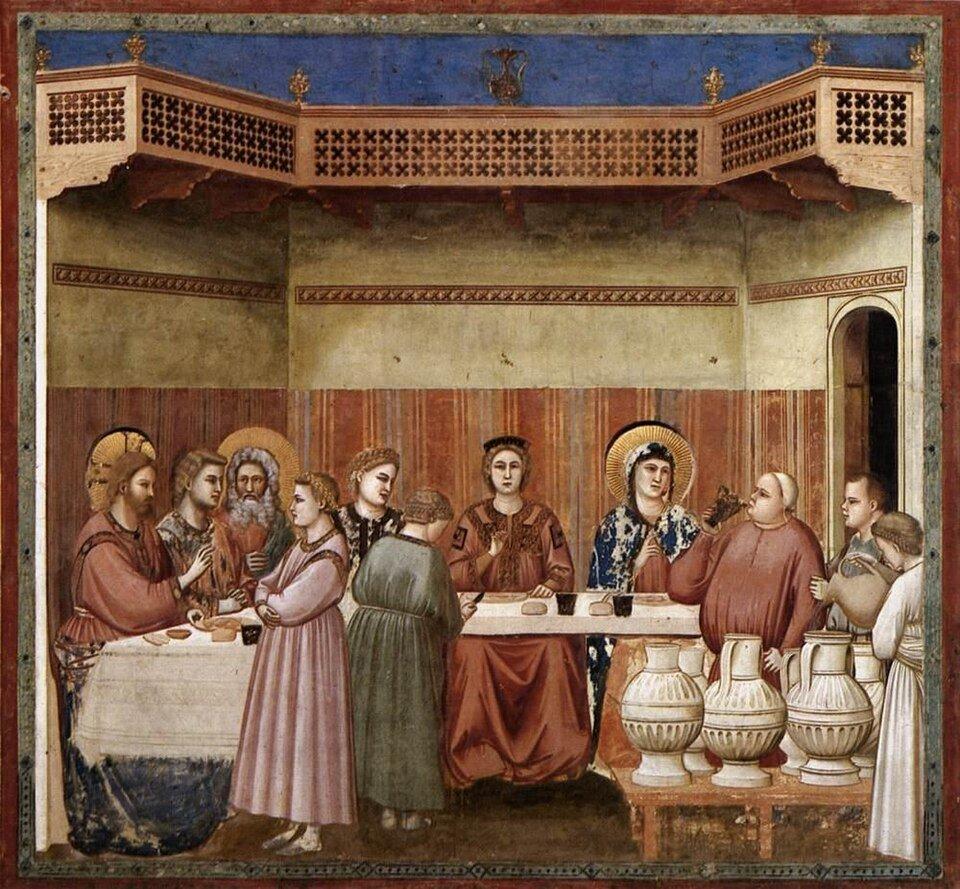
Giotto, Marriage at Cana, 1304 to 1306. Public domain.
John 2:1 to 11 · Story · Featured Study
Water into Wine: the Wedding at Cana
Mary, the servants, the disciples and the master of the banquet each have a part in the story.
Jesus made the wine the guests praised from water drawn for washing.
Jesus performed this, the first of His signs, at Cana in Galilee. He thus revealed His glory, and His disciples believed in Him.
- Where
- Cana of Galilee
- Who
- Jesus of Nazareth, Mary, Mother of Jesus
Summary
The wedding at Cana is the story of the first miracle of Jesus, told in John 2:1 to 11. At a wedding in the village of Cana in Galilee the wine ran out. Jesus had six stone jars filled with water. When the servants drew from them, the water had become wine, finer than the wine served first. John counts it as the first sign Jesus gave. Through it Jesus showed His glory, and His disciples trusted Him.
- Jesus's mother told Him the wine had run out, and He answered that His hour had not yet come.
- The stone jars were set out for the washings of Jewish purification.
- Readers differ over what Jesus meant by His answer to His mother.
The First Sign
John's word for the deed tells the reader what to look for in it.
A sign in John's Gospel is a deed that points past itself to who Jesus is. The seven signs of the Gospel have their own study, which begins at Cana.
The Sign in Eight Steps
The story moves from a shortage at a feast to the master's praise of the wine.
The wine runs out at the second step, and the master praises it at the eighth.
- A wedding at Cana"a wedding took place at Cana in Galilee"John 2:1
- The wine runs out"They have no more wine."John 2:3
- The first reply"My hour has not yet come."John 2:4
- His mother speaks to the servants"Do whatever He tells you."John 2:5
- The servants fill the jars"So they filled them to the brim."John 2:7
- They draw it out and carry it"take it to the master of the banquet"John 2:8
- Only the servants know"the servants who had drawn the water knew"John 2:9
- The master praises the wine"you have saved the fine wine until now!"John 2:10
Mary speaks twice, and after His answer to her Jesus speaks only to give the servants their orders.
Only the servants know, The master praises the wine
The Story Told in Order
John tells the story in three scenes: the shortage, the jars and the tasting.
The wine ran outJohn 2:1 to 5
Jesus and His disciples had been invited to the wedding, and His mother was there (John 2:1 to 2). She brought the need to Jesus in one short sentence (John 2:3).
After His answer she turned to the servants, and her word to them set up everything that followed (John 2:5).
The six stone jarsJohn 2:6 to 8
Now six stone water jars had been set there for the Jewish rites of purification. Each could hold from twenty to thirty gallons.John gives their purpose and their size, and both matter to the sign.
Mark describes the washings those rites required, of hands before eating and of cups, pitchers and kettles (Mark 7:3 to 4). Filled to the brim, the six jars held between 120 and 180 gallons.
The master of the banquet tasted itJohn 2:9 to 10
Albert Barnes, in his Notes on John 2:9, read the master's ignorance as the sign of an impartial judge, so that his praise is testimony that this was real wine.
What the Sign Revealed
Teachers from the second century on read the first sign as a picture of what Jesus came to do.
Irenaeus set the wine that grew in the vineyard beside the wine the Word made from water at Cana. The first was good, and the second better.
Cyril of Alexandria counted what the one sign did at once in Book 2 of his Commentary on the Gospel of John. It made marriage holy, put away the curse of bearing children in sorrow, showed the glory of Christ and confirmed the disciples in faith.
Matthew Henry set the first sign of Moses beside the first sign of Christ. Moses turned water into blood, and Christ turned water into wine, which Henry read as the difference between the law of Moses and the gospel of Christ.
Moses and Aaron did just as the LORD had commanded; in the presence of Pharaoh and his officials, Aaron raised the staff and struck the water of the Nile, and all the water was turned to blood.Exodus gives the plague Henry sets beside Cana.
Jamieson, Fausset and Brown observed that the miracle made good wine better. They read in it Christ's whole work, turning the water of earth into the wine of heaven.
Around the Story
The place, the wedding and the wine each have a study of their own.
Cana itself, where it stood and the second sign Jesus gave there, has its own page.
The customs of a wedding feast in Scripture are set out in their own study.
The study of wine and drunkenness weighs the wine of Cana beside the rest of Scripture.
Woman, Why Does This Concern Us?
Commentators from the second century to the eighteenth read Jesus's answer to His mother in three ways.
A mild reproof of her concernJohn Wesley, Explanatory Notes upon the New Testament, on John 2:4
John Wesley called the answer "a mild reproof of her inordinate concern and untimely interposal". He read the hour as the time for working this miracle or the time of His going away.
The objection: His mother's next words, to the servants, show that she did not take the answer as a refusal (John 2:5).
A word of respectJohn Gill, Exposition of the New Testament, on John 2:4
John Gill held that calling her woman was a mark of respect, since the Jews used the word when they showed the greatest respect. He pointed to the cross, where Jesus spoke to His mother with the same word in great tenderness.
When Jesus saw His mother and the disciple whom He loved standing nearby, He said to His mother, “Woman, here is your son.”Jesus uses the same address from the cross as He gives His mother into the care of the disciple He loved.
The objection: the question that follows the word sets a distance between His concern and hers.
A word about timingIrenaeus, Against Heresies, Book 3; Matthew Henry, on John 2:3
Irenaeus read the answer as a word about the Father's timing.
“With Him is nothing incomplete or out of due season, just as with the Father there is nothing incongruous. For all these things were foreknown by the Father; but the Son works them out at the proper time in perfect order and sequence.”
Irenaeus · Against Heresies Book III, Chapter XVI · on John 2:4Patristic
Matthew Henry read the hour the same way.
“Then his hour is come when we are reduced to the utmost strait, and know not what to do. This encouraged those that waited for him to believe that though his hour was not yet come it would come. Note, The delays of mercy are not to be construed the denials of prayer.”
Matthew Henry · Commentary on the Whole Bible · on John 2:3Puritan
The objection: the answer opens with a question to His mother, which a word about timing alone leaves unexplained.
So That You May Believe
The Gospel ends with its own reason for being written.
John wrote the signs down so that his readers would come to faith as well.
But these are written so that you may believe that Jesus is the Christ, the Son of God, and that by believing you may have life in His name.John's own statement of purpose closes the Gospel the first sign opened.
Sources
Scripture is the Berean Standard Bible.
- Irenaeus, Against Heresies, Book 3, chapters 11 and 16 (second century)
- Cyril of Alexandria, Commentary on the Gospel of John, Book 2 (fifth century)
- Matthew Henry, Commentary on the Whole Bible (1710), on John 2:3 and John 2:5.
- John Wesley, Explanatory Notes upon the New Testament (1755), on John 2:4.
- John Gill, Exposition of the New Testament (1746 to 1748), on John 2:4.
- Albert Barnes, Notes, Explanatory and Practical, on the New Testament (1832 to 1869), on John 2:9.
- Jamieson, Fausset and Brown, Commentary Critical and Explanatory on the Whole Bible (1871), on John 2:11.
Keep Studying
People and groups3
Subjects1
Places1
Doctrines1