
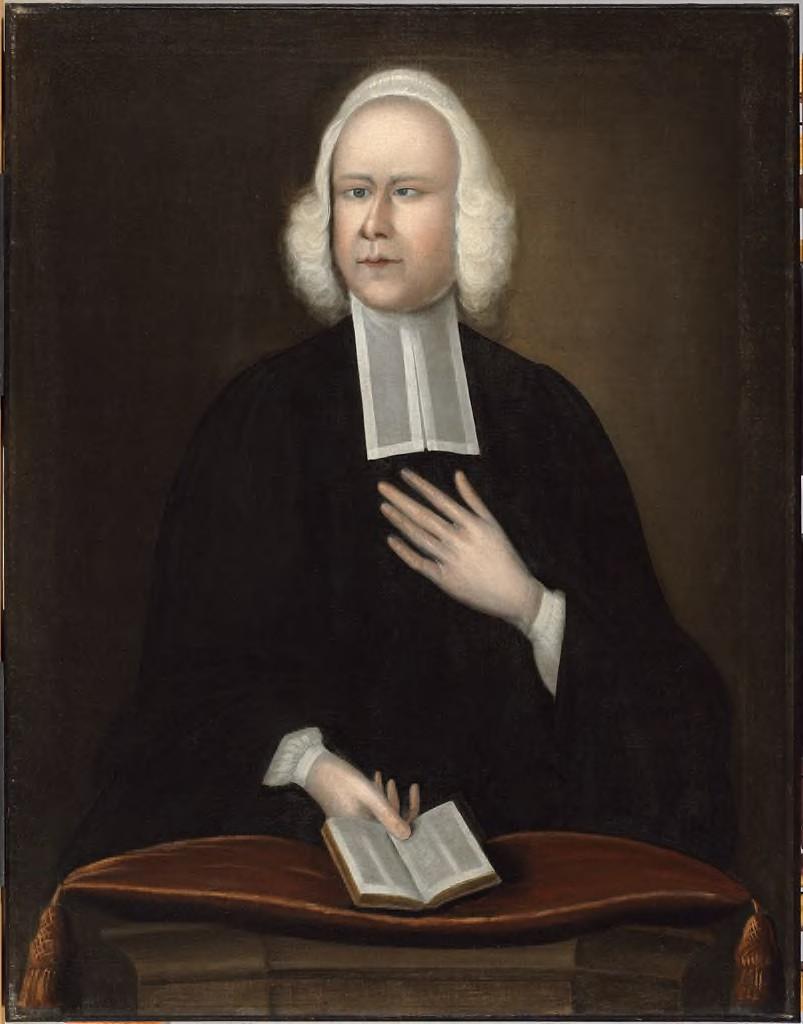
Joseph Badger, George Whitefield, about 1745. Public domain.
England, Scotland and the American colonies, 1714 to 1770 · Person · Featured Study
George Whitefield
A priest of the Church of England who preached in the open air to crowds in Britain and the American colonies.
A servant student at Oxford found the churches shut to him and preached to colliers in a field outside Bristol.
Therefore if anyone is in Christ, he is a new creation. The old has passed away. Behold, the new has come!
Therefore if anyone is in Christ, he is a new creation. The old has passed away. Behold, the new has come!
- Born
- 16 December 1714 (Old Style) at the Bell Inn, Gloucester
- Died
- 30 September 1770 at Newburyport, Massachusetts
- Family
- wife: Elizabeth James
- Places
- Gloucester, Oxford, Bristol, Savannah, Philadelphia, Newburyport
Summary
George Whitefield was the son of an innkeeper in Gloucester. He went to Oxford as a poor student and was converted there. He was ordained in 1736. Then he began to preach in the open air, first to the coal miners near Bristol. He crossed to America many times. He founded an orphan house in Georgia and died in New England.
- His first printed sermon, of 1737, was on 2 Corinthians 5:17 and the new birth.
- Benjamin Franklin printed his journals and measured how far his voice carried.
- He pressed for slavery in Georgia and owned enslaved people.
The Text of the New Birth
His first printed sermon took 2 Corinthians 5:17, and a cry from the cross marked his own conversion.
Whitefield's first printed sermon, of August 1737, was The Nature and Necessity of our New Birth in Christ Jesus. Its text in the King James wording was "If any man be in Christ, he is a new creature."
He told his own conversion through another verse. In his illness at Oxford he remembered that Christ's sufferings were near their end when He cried out that He thirsted, and he cried the same words himself. The question of this life is how a servant student who learned the new birth in his room carried it to the fields.
After this, knowing that everything had now been accomplished, and to fulfill the Scripture, Jesus said, “I am thirsty.”Christ's cry from the cross stands behind his account of his conversion.
The Life in Order
Most dates come from Tyerman, and the last ones from Gillies.
Three years ran from his ordination to his first sermon in the open air.
- December 1714He was born at the Bell Inn, GloucesterTyerman, volume 1
- 1732He entered Pembroke College, Oxford, as a servitorTyerman, volume 1
- 1735His conversion came about seven weeks after EasterTyerman, volume 1
- 20 June 1736Bishop Benson ordained him deaconTyerman, volume 1
- 5 August 1737The Nature and Necessity of our New Birth printedTyerman, volume 1
- 7 May 1738He reached Savannah in GeorgiaTyerman, volume 1
- February 1739He preached to the colliers at KingswoodTyerman, volume 1
- 1739He came to Philadelphia and met Benjamin FranklinFranklin, Autobiography
- 25 March 1740Work begun at BethesdaTyerman, volume 1
- 14 November 1741He married Elizabeth James in WalesTyerman, volume 1
- 6 December 1748He told the Georgia Trustees the colony needed slavesWhitefield, Works, volume 2
- 30 September 1770He died at Newburyport of asthmaGillies, 1772
Each step of the life stands with its witness.
February 1739, 1739, 25 March 1740, 14 November 1741, 6 December 1748, 30 September 1770
From the Bell Inn to Newburyport
His own Short Account tells the youth, his journals the fields, and Gillies the end.
George Whitefield was born at the Bell Inn in Gloucester on 16 December 1714. He went up to Pembroke College, Oxford, in 1732 as a servitor, a poor student who paid his way by serving richer ones. Charles Wesley brought him into the society at Oxford that others called the Methodists.
George Whitefield, an innkeeper's son converted at Oxford in 1735, three years before the Wesleys, took to preaching in the open fields when church pulpits closed to him. He went first to the coal miners of Kingswood, near Bristol, in February 1739. Gillies quotes him on the white gutters their tears made down their black cheeks as they came out of the pits.
For more than thirty years he preached on both sides of the Atlantic. Contemporary estimates put his largest crowds in the tens of thousands. The skeptical Benjamin Franklin walked backward down Market Street at Philadelphia until the noise drowned the voice, and he reckoned from it how many people could hear him.
On the tour he began in 1739 he went preaching through the colonies from Philadelphia to Georgia and back to New England. In Georgia he laid the first brick of an orphan house at Bethesda, and he raised its money in his sermons.
He was a Calvinist, and when Wesley printed his sermon Free Grace against predestination, Whitefield answered him in a letter from Bethesda. The two men stayed friends, and Wesley preached his funeral sermon in London in November 1770.
He preached his last sermon in the fields at Exeter, New Hampshire, and died the next morning at Newburyport, where he is buried beneath the pulpit.
Bethesda and the Enslaved
His letters and his will show where he stood on slavery.
At Savannah on 23 January 1740 Whitefield wrote an open letter to the inhabitants of Maryland, Virginia and the Carolinas. He told them that God had a quarrel with them for their cruelty to the enslaved. He would not say whether it was lawful for Christians to buy slaves.
On 6 December 1748 he wrote to the Trustees of Georgia, who then banned slavery in the colony, that Georgia never could flourish unless negroes were allowed. About two years earlier he had bought a plantation in South Carolina, where slavery was legal, and worked it with eight hands.
The Georgia ban fell in 1751, largely on his lobbying. His will left Bethesda, with its lands and its negroes, to the Countess of Huntingdon. His own letter from Savannah shows he knew the cruelty of slaveholding, and he owned enslaved people after he wrote it.
In Their Own Words
Five sayings from his Short Account, his journals and his letters, from 1735 to 1769.
George Whitefield (1714 to 1770)
A Short Account of God's Dealings with the Reverend Mr. George Whitefield (1740), as Luke Tyerman prints it in The Life of the Rev. George Whitefield, vol. 1, page 25
I thirst
“Upon which I cast myself down on the bed, crying out, ‘I thirst! I thirst!’ Soon after this, I found and felt in myself that I was delivered from the burden that had so heavily oppressed me.”
Calvinistic Methodist
About this saying1 paragraph
He wrote this of his conversion at Oxford in 1735, in his Short Account of God's Dealings of 1740.
George Whitefield
A Continuation of the Reverend Mr Whitefield's Journal, page 31, the fourth edition (London, 1739)
In the open fields
“I believe I never was more acceptable to my Master than when I was standing to teach those Hearers in the open Fields.”
Calvinistic Methodist
About this saying1 paragraph
He wrote this in his journal of 1739, on the day he first preached to the colliers.
George Whitefield
A Continuation of the Reverend Mr. Whitefield's Journal, pages 56 to 57
Ministers who do not know Christ
“Many, nay most that preach, I fear do not experimentally know Christ; yet I cannot see much worldly Advantage to tempt them to take upon them the sacred Function.”
Calvinistic Methodist
About this saying1 paragraph
He wrote this in a later entry of the same journal of 1739.
George Whitefield
Letter from Cambuslang, 27 August 1742, in L. Tyerman, The Life of the Rev. George Whitefield, volume 2
Such a passover
“Such a passover has not been heard of.”
Calvinistic Methodist
About this saying1 paragraph
He wrote this from Scotland on 27 August 1742, after the second communion at Cambuslang.
George Whitefield
Note on Franklin's letter of 1769, as printed by Belcher, chapter on Whitefield's last labours in Great Britain
The Lord reigneth
“Uncomfortable indeed! and, blessed be God, unscriptural; for we are fully assured that 'the Lord reigneth,' and are directed to cast all our own care on him, because he careth for us.”
Calvinistic Methodist
About this saying1 paragraph
He wrote this at the foot of a letter Benjamin Franklin sent him in London in 1769, the year before he died.
The People Around Him
The witnesses name the Oxford friends, the printer, the wife and the patron of his life.
A printer who never shared his faith kept his friendship for thirty years.
| Person | Tie to Whitefield | The witness |
|---|---|---|
| Charles Wesley | A tutor at Christ Church who brought him into the Oxford society. | Tyerman, volume 1 |
| John Wesley | He came to Bristol at Whitefield's call in 1739 and later printed Free Grace against him. | Wesley, Journal; Wesley, Sermon 53 |
| Benjamin Franklin | He printed Whitefield's sermons and journals and called theirs a civil friendship. | Franklin, Autobiography |
| Jonathan Edwards | He wept through Whitefield's sermon at Northampton in October 1740. | Whitefield's journal, in Tyerman |
| Elizabeth James | A widow of Abergavenny whom he married in 1741. | Tyerman, volume 1, page 530; Gillies, 1772 |
| William MacCulloch | The minister of Cambuslang, whose parish he served at the communions. | Gillies, 1772 |
| The Countess of Huntingdon | His patron, to whom his will left Bethesda. | Gillies, 1772 |
The Places of His Life
He was born in an English inn and buried in a New England meeting-house.
He preached from Scotland to Georgia and died far from his birthplace.
| Place | What the witnesses say | The witness |
|---|---|---|
| Gloucester | He preached his first sermon in St. Mary de Crypt there on 27 June 1736. | Tyerman, volume 1 |
| Oxford | He studied there at Pembroke College from 1732. | Tyerman, volume 1 |
| Kingswood | The colliers there heard him in the open air from February 1739. | Tyerman, volume 1, page 179; Gillies, 1772 |
| Savannah | He landed in Georgia in May 1738 and built the orphan house nearby. | Tyerman, volume 1 |
| Philadelphia | A hall a hundred feet long was built there for any preacher who came. | Franklin, Autobiography |
| Cambuslang | A hill near the manse there held the crowds at the communions of 1742. | Gillies, 1772 |
| Exeter | He preached there in the open air for near two hours on 29 September 1770. | Gillies, 1772 |
| Newburyport | He died in the manse there and was laid in a vault in the meeting-house. | Gillies, 1772; Wesley, Sermon 53, the editor's note |
Exeter, Newburyport
What He Preached
Wesley named Whitefield's doctrines at the funeral.
In his funeral sermon Wesley said that Whitefield's fundamental doctrines could be summed up in two words, the new birth and justification by faith. Wesley also gave his chief point: give God all the glory of whatever is good in man.
Franklin watched the effect in his own town. He wrote that the people of Philadelphia seemed to be growing religious, so that one could hardly walk through the town in an evening without hearing psalms sung in the houses.
Franklin also wrote that Whitefield prayed for his conversion and never had the satisfaction of seeing it.
The Voices
Two teachers on 2 Corinthians 5:17.
Basil of Caesarea (died 379)
Letter 8
Humanity is created a second time through baptism
“But, if we must go on with our discussion and make a deeper study, let us from this point contemplate especially the divine power of the Holy Spirit. We find three creations mentioned in the Scripture; the first, the education from nonexistence into existence; the second, the change from worse to better; and the third, the resurrection of the dead. In these you will find the Holy Spirit co-operating with the Father and the Son.… Now, humanity is created a second time through baptism, ‘for if any man is in Christ, he is a new creature.’”
on 2 Corinthians 5:17Patristic
Matthew Henry (1662 to 1714)
Commentary on the Whole Bible
Regenerating grace creates a new world in the soul
“And so great is the change the grace of God makes in the soul, that, as it follows, old things are passed away --old thoughts, old principles, and old practices, are passed away; and all these things must become new. Note, Regenerating grace creates a new world in the soul; all things are new.”
on 2 Corinthians 5:17Puritan
What the Witnesses Leave Open
Readers differ on his first field sermon, on the size of his crowds and on what he did for the Revolution.
His first sermon in the fieldsGeorge Whitefield; John Gillies; John Wesley
Whitefield's journal dates the first sermon at Kingswood to 17 February 1739 and counts upwards of two hundred hearers. Gillies puts the first crowd at about a hundred colliers. Wesley's funeral sermon gives Wednesday 21 February and near two thousand.
How many heard himBenjamin Franklin; John Gillies; George Whitefield
Franklin computed more than thirty thousand from one evening on Market Street, and he said it reconciled him to newspaper reports of twenty-five thousand. Gillies put the later crowds at Kingswood near twenty thousand, by a moderate computation.
No one counted these crowds, and each figure is an estimate by the man who gives it. The church history plan's verifier found no source for the share of colonists who heard him, often given as eighty percent.
Whitefield and the Revolutionthe church history plan, row 184; the great awakenings era brief
Some historians argue that the revival's preaching prepared the colonies for the Revolution, while others deny that the revival was one movement at all. The same verifier found no document that ties Whitefield's friendship with Franklin to the founding documents. Whitefield died in 1770, six years before the Declaration.
Books to Read Next
Memoirs of the Life of the Reverend George Whitefield
John Gillies · 1772
Gillies wrote two years after his death and printed his will and the account of his last days.
Read Gillies free at the Internet ArchiveThe Life of the Rev. George Whitefield
Luke Tyerman · 1876
Tyerman sets his journals and letters in order by the day.
Read Tyerman free at the Internet ArchiveThe Autobiography of Benjamin Franklin
Benjamin Franklin · 1916 edition
Franklin tells of the collection for Bethesda, the measured crowd and their friendship.
Read Franklin free at Project GutenbergWhat Whitefield Left
He left printed sermons and journals, an orphan house worked by enslaved people, and the practice of preaching in the open air.
Sources
Scripture is the Berean Standard Bible.
- The Holy Bible, Berean Standard Bible (read 2026)
- Luke Tyerman, The Life of the Rev. George Whitefield, volume 1 (London: Hodder and Stoughton, 1876)
- John Gillies, Memoirs of the Life of the Reverend George Whitefield (London, 1772)
- Benjamin Franklin, Autobiography, edited by Frank Woodworth Pine (New York: Henry Holt, 1916)
- The Works of the Reverend George Whitefield, volumes 2 and 4 (London, 1771)
- George Whitefield, A Letter to the Reverend Mr. John Wesley: In Answer to his Sermon, Entituled, Free-Grace (London, 1741), dated Bethesda in Georgia, 24 December 1740.
- John Wesley, Sermon 53, On the Death of the Rev. Mr. George Whitefield (1770), with the editor's note.
- Joseph Belcher, George Whitefield: A Biography (New York: American Tract Society, 1857)
- Basil of Caesarea, Letter 8, on 2 Corinthians 5:17.
- Matthew Henry, Commentary on the Whole Bible, on 2 Corinthians 5:17.
Keep Studying
People and groups6
Go further1