
John 19:7
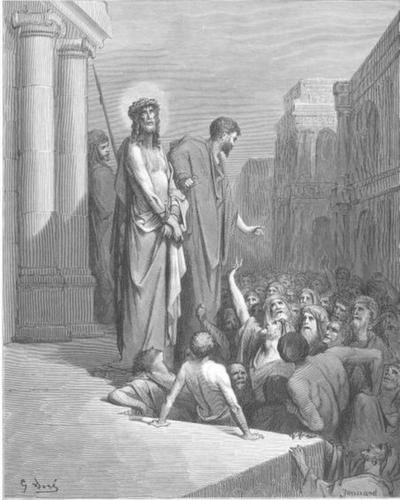
in John 19“We have a law,” answered the Jews, “and according to that law He must die, because He declared Himself to be the Son of God.”
BSB
The same verse in ASV and KJV ▾
ASV
The Jews answered him, We have a law, and by that law he ought to die, because he made himself the Son of God.
KJV
The Jews answered him, We have a law, and by our law he ought to die, because he made himself the Son of God.
⋯
This verse in John 19
Commentary
19 notes on this verseWhen their false accusation that they had at first contrived proved fruitless, and they established against Him no attempt at revolution or revolt against Caesar's rule (for the Lord parried these charges, saying: My Kingdom is not of this world; if my Kingdom were of this world, then would My servants fight, that I should not be delivered to the Jews), and when Pilate thereupon gave a just and impartial verdict, and did not as yet comply with their will, but said openly that He found no fault in Him, the audacious Jews completely changed their tactics, and asserted that they had a law, which condemned the Saviour to death.
This site's exposition
Crucify Him! Crucify Him!
on John 19:6-7
The chief priests drop the charge of kingship and name the real one. By their law He must die for declaring that He is the Son of God. Their account of His claim is accurate, and He had made it at 5:18 and 10:33.
This site's exposition
We have a law
The Jews change the charge. The law they mean is the law of blasphemy at Leviticus 24:16, as Barnes notes. On it the council had condemned Jesus at Matthew 26:63 to 65.
The record, by era
The Church Fathers5 voices
(Tr. cxvi) Lo, another greater outbreak of envy. The former was lighter, being only to punish Him for aspiring to a usurpation of the royal power. Yet did Jesus make neither claim falsely; both were true: He was both the Only-begotten Son of God, and the King appointed by God upon the holy hill of Sion. And He would have demonstrated His right to both now, had He not been as patient as He was powerful. (de Con. Evang. iii. 8) This agrees with Luke's account, We found this fellow perverting the nation, (Luke 23:2) only with the addition of, because He made Himself the Son of God.
"When the chief priests, therefore, and attendants saw Him, they cried out, saying, Crucify, crucify him. Pilate saith unto them, Take ye him and crucify him; for I find no fault in him. The Jews answered him, We have a law, and by the law he ought to die because he made himself the Son of God." Behold another and still greater ground of hatred. The former, indeed, seemed but a small matter, as that shown towards the usurpation, by an unlawful act of daring, of the royal power; and yet of neither did Jesus falsely claim possession, but each of them is truly His as both the only-begotten Son of God, and by Him appointed King upon His holy hill of Zion; and both might He now have shown to be His, were it not that in proportion to the greatness of His power, He preferred to manifest the corresponding greatness of His patience.
If you will not learn Who Christ is from those that know Him, learn it at least from those that know Him not. So shall the confession, which their ignorance is forced to make, rebuke your blasphemy.… Mark the fellowship with Jewish wickedness in which your denial of the Divine Sonship has involved you! For they have put on record the reason of their condemnation:—And by our Law He ought to die, because He made Himself the Son of God. Is not this the same charge which you are blasphemously bringing against Him, that, while you pronounce Him a creature, He calls Himself the Son? He confesses Himself the Son, and they declare Him guilty of death: you too deny that He is the Son of God. What sentence do you pass upon Him? You have the same repugnance to His claim as had the Jews. You agree with their verdict; I want to know whether you will quarrel about the sentence. Your offence, in denying that He is the Son of God, is exactly the same as theirs, though their guilt is less, for they sinned in ignorance.
See in how many ways the judge makes His defense, continually acquitting Him of the charges; but none of these things shamed the dogs from their purpose. For the, "Take ye him and crucify him," is the expression of one clearing himself of the guilt, and thrusting them forward to an action not permitted to them. They therefore had brought Him, in order that the thing might be done by the decision of the governor; but the contrary fell out, that He was rather acquitted than condemned by the governor's decision. Then, because they were ashamed, "We have," they said, "a law, and by our law he ought to die, because he made himself the Son of God." "How then when the judge said, 'Take ye him, and judge him according to your law,' did ye reply, 'It is not lawful for us to put any man to death,' while here ye fly to the law? And consider the charge, 'He made himself the Son of God.' Tell me, is this a ground of accusation, that He who performed the deeds of the Son of God should call Himself the Son of God?" What then doth Christ? While they held this dialogue one with the other, He held His peace, fulfilling that saying of the Prophet, that "He openeth not his mouth: in His humiliation His judgment was taken away."
"How then when the judge said, 'Take ye him, and judge him according to your law,' did ye reply, 'It is not lawful for us to put any man to death,' while here ye fly to the law? And consider the charge, 'He made himself the Son of God.' Tell me, is this a ground of accusation, that He who performed the deeds of the Son of God should call Himself the Son of God?" What then doth Christ? While they held this dialogue one with the other, He held His peace, fulfilling that saying of the Prophet, that "He openeth not his mouth: in His humiliation His judgment was taken away." (Isa. liii. 7, 8 LXX.)
11 more voices on this verse
The Medieval Church3 voices
The Jews answered him. Here is set forth the accusation of the Jews: whence they said: We have a Law, which namely we observe by the will of the Roman rulers. They allege the Law in their favor, when it is against them: above in …
And they, having been put to shame by this, say: "By our law He ought to die, because He made Himself the Son of God." See how wickedness is inconsistent with itself. Previously Pilate said to them: "Take Him yourselves and judge Him according to …
2386 But the Jews repeat Christ's offense: We have a law.... They seemed to understand from Pilate's response that he would not go against Christ because of a charge of claiming a kingdom, although they had thought he would be especially inclined by this to …
The Puritans and the Awakening3 voices
Now by this it appears that their malice against Christ was, (1.) Unreasonable and most absurd, in that they offer not to make good their charges against him, nor to object against the judgment of Pilate concerning him; but, though he be innocent, he must be crucified. (2.) It was insatiable and very cruel.
Whoever falsely pretended to be the Son of God was guilty of blasphemy, Lev. xxiv. But then, [2.] It was false that Christ pretended to be the Son of God, for he really was so; and they ought to have enquired into the proofs he produced of his being so.
The Jews answered him,....
The Nineteenth Century5 voices
A commentator
Albert Barnes1798–1870
Notes, Explanatory and Practical, on the Old and New Testaments (1832-1869)
We have a law - The law respecting blasphemy, Lev 24:16; Deu 13:1-5. They had arraigned Jesus on that charge before the Sanhedrin, and condemned him for it, Mat 26:63-65. But this was not the charge on which they had arraigned him before Pilate. They had accused him of sedition, Luk 23:2. On this charge they were now convinced that they could not get Pilate to condemn him. He declared him innocent.
A commentator
Jamieson, Fausset & Brown1802–1910
Commentary Critical and Explanatory on the Whole Bible (1871)
proposed
The Jews answered him, We have a law, and by our law he ought to die, because he made himself the Son of God--Their criminal charges having come to nothing, they give up that point, and as Pilate was throwing the whole responsibility upon them, they retreat into their own Jewish law, by which, as claiming equality with God (see ch. 5.
quarantine:debris (2026-07-29) — unbalanced-parens
A commentator
J.C. Ryle1816–1900
Expository Thoughts on the Gospels: John (lightly modernized text, Grace Gems edition) (1869)
proposed
Pilate said to the Jewish religious leaders, "Look, here is your king!" Then they shouted out, "Away with him! Away with him! Crucify him!" Pilate asked, "Shall I crucify your king?" The high priests replied, "We have no king except Caesar!" Then Pilate handed him over to them to be crucified. These verses exhibit to our eyes a wonderful picture, a picture which ought to be deeply interesting to all who profess and call themselves Christians. Like every great historical picture, it contains special points on which we should fix our special attention.
A commentator
J.C. Ryle1816–1900
Expository Thoughts on the Gospels: John (lightly modernized text, Grace Gems edition) (1869)
proposed
Pilate said to the Jewish religious leaders, "Look, here is your king!" Then they shouted out, "Away with him! Away with him! Crucify him!" Pilate asked, "Shall I crucify your king?" The high priests replied, "We have no king except Caesar!" Then Pilate handed him over to them to be crucified. These verses exhibit to our eyes a wonderful picture, a picture which ought to be deeply interesting to all who profess and call themselves Christians. Like every great historical picture, it contains special points on which we should fix our special attention. Above all, it contains three life-like portraits, which we shall find it useful to examine in order. The first portrait in the picture is that of our Lord JESUS CHRIST himself. We see the Savior of mankind scourged, crowned with thorns, mocked, smitten, rejected by His own people, unjustly condemned by a judge who saw no fault in Him, and finally delivered up to a most painful death. Yet this was He who was the eternal Son of God, whom the Father's countless angels delighted to honor. This was He who came into the world to save sinners, and after living a blameless life for thirty years, spent the last three years of His time on earth in going about doing good, and preaching the Gospel. Surely the sun never shone on a more wondrous sight since the day of its creation! Let us admire that love of Christ which Paul declares, "passes knowledge," and let us see an endless depth of meaning in the expression. There is no earthly love with which it can be compared, and no standard by which to measure it. It is a love that stands alone. Never let us forget when we ponder this tale of suffering, that Jesus suffered for our sins, the Just for the unjust, that He was wounded for our transgressions and bruised for our iniquities, and that with His stripes we are healed.
We have a law - In Lev 24:14-16, we find that blasphemers of God were to be put to death; and the chief priests having charged Jesus with blasphemy, they therefore voted that he deserved to die. See Mat 26:65, Mat 26:66. They might refer also to the law against false prophets, Deu 18:20. The Son of God - It is certain that the Jews understood this in a very peculiar sense. When Christ called himself the Son of God, they understood it to imply positive equality to the Supreme Being: and, if they were wrong, our Lord never attempted to correct them.
The words behind it
18 Greek wordsEvery Greek word of this verse in the order it stands, with what it means and the door to its own study. The last column counts the times a word stands in the whole Bible: the rarer the word, the more the places it appears belong together.
| Greek | Sound | Meaning | Word study | In the Bible |
|---|---|---|---|---|
| ἀπεκρίθησαν | apekrithesan | Answered | G611 → | 231 times |
| αὐτῷ | auto | to him | G846 → | 5565 times |
| οἱ | hoi | the | G3588 → | 19766 times |
| Ἰουδαῖοι· | ioudaioi | Jews; | G2453 → | 192 times |
| ἡμεῖς | hemeis | We ourselves | G3165 → | 1936 times |
| νόμον | nomon | a law | G3551 → | 192 times |
| ἔχομεν, | echomen | have, | G2192 → | 707 times |
| καὶ | kai | and | G2532 → | 9120 times |
| κατὰ | kata | according to | G2596 → | 468 times |
| τὸν | ton | the | G3588 → | 19766 times |
| νόμον | nomon | law | G3551 → | 192 times |
| ὀφείλει | opheilei | He ought | G3784 → | |
| ἀποθανεῖν, | apothanein | to die, | G599 → | 110 times |
| ὅτι | hoti | because | G3754 → | 1292 times |
| υἱὸν | huion | [the] Son | G5207 → | 377 times |
| θεοῦ | theou | of God | G2316 → | 1312 times |
| ἑαυτὸν | he'auton | Himself | G1438 → | 322 times |
| ἐποίησεν.¶ | epoiesen | He made. | G4160 → | 569 times |
ἀπεκρίθησανAnswered
apekrithesanG611 →231 times
αὐτῷto him
autoG846 →5565 times
οἱthe
hoiG3588 →19766 times
Ἰουδαῖοι·Jews;
ioudaioiG2453 →192 times
ἡμεῖςWe ourselves
hemeisG3165 →1936 times
νόμονa law
nomonG3551 →192 times
ἔχομεν,have,
echomenG2192 →707 times
καὶand
kaiG2532 →9120 times
κατὰaccording to
kataG2596 →468 times
τὸνthe
tonG3588 →19766 times
νόμονlaw
nomonG3551 →192 times
ὀφείλειHe ought
opheileiG3784 →
ἀποθανεῖν,to die,
apothaneinG599 →110 times
ὅτιbecause
hotiG3754 →1292 times
υἱὸν[the] Son
huionG5207 →377 times
θεοῦof God
theouG2316 →1312 times
ἑαυτὸνHimself
he'autonG1438 →322 times
ἐποίησεν.¶He made.
epoiesenG4160 →569 times
A shaded row is a word that stands 400 times or fewer in the Bible.
The walk
8 stopsEach card is a verse this one points to, and under it the verses that one points to in turn. Where several paths arrive at the same place, that place is listed first: the text keeps returning to it.
Through
John 5:18Because of this, the Jews tried all the harder to kill Him. Not only was He breaking the Sabbath, but He was even calling God His own Father, making Himself equal with God.
it leads to
- John 10:30
I and the Father are one.”
- John 10:33
“We are not stoning You for any good work,” said the Jews, “but for blasphemy, because You, who are a man, declare Yourself to be God.”
- John 8:58
“Truly, truly, I tell you,” Jesus declared, “before Abraham was born, I am!”
- John 10:30
Through
Romans 1:4and who through the Spirit of holiness was declared with power to be the Son of God by His resurrection from the dead: Jesus Christ our Lord.
it leads to
- Ephesians 1:19–23
and the surpassing greatness of His power to us who believe. These are in accordance with the working of His mighty strength,
- Hebrews 5:5–6
So also Christ did not take upon Himself the glory of becoming a high priest, but He was called by the One who said to Him: “You are My Son; today I have become…
- Hebrews 9:14
how much more will the blood of Christ, who through the eternal Spirit offered Himself unblemished to God, purify our consciences from works of death, so that we may serve the living God!
- Acts 13:33–35
He has fulfilled for us, their children, by raising up Jesus. As it is written in the second Psalm: ‘You are My Son; today I have become Your Father.’
- 2 Corinthians 13:4
For He was indeed crucified in weakness, yet He lives by God’s power. And though we are weak in Him, yet by God’s power we will live with Him to serve you.
- Ephesians 1:19–23
Where this verse is studied
On this page
Studies25
On this verse
On this chapter
- Blue, Purple and Scarlet
- Hanged on a tree
- How Greek Works
- Irony in Scripture: More Than the Speaker Knows
- Mary Magdalene: the Witness at the Tomb
- Mary of Nazareth
Show the next 6 titles
About John
This page draws on 16 works. Open the list of works
This page draws on Adam Clarke, Commentary on the Bible; Albert Barnes, Notes, Explanatory and Practical, on the Gospels; Albert Barnes, Notes, Explanatory and Practical, on the Old and New Testaments (1832-1869); Augustine of Hippo, Catena Aurea by Aquinas; Augustine of Hippo, Tractates on John 116; Bonaventure, Commentary on John, Chapter 19; Cyril of Alexandria, Commentary on the Gospel of John, Book 12; Hilary of Poitiers, ON THE TRINITY 6.50; J.C. Ryle, Expository Thoughts on the Gospels: John (lightly modernized text, Grace Gems edition); Jamieson, Fausset & Brown, Commentary Critical and Explanatory on the Whole Bible; John Chrysostom, Homily on the Gospel of John 84; John Gill, Exposition of the New Testament; John Gill, Exposition of the New Testament (1746-1748); Matthew Henry, Commentary on the Whole Bible; Theophylact of Ohrid, Commentary on John and Thomas Aquinas, Commentary on John.