
AD 863 to 886 · Story · Featured Study
Cyril and Methodius
Two brothers from Thessalonica wrote the Slavs an alphabet and translated Scripture for them, and Rome first allowed their worship and then forbade it.
Their opponents held that no nation but the Hebrews, the Greeks and the Latins could have letters of its own, because Pilate wrote the title over the cross in those three.
- Where
- Thessalonica, Rome
- When
- 863 to 886
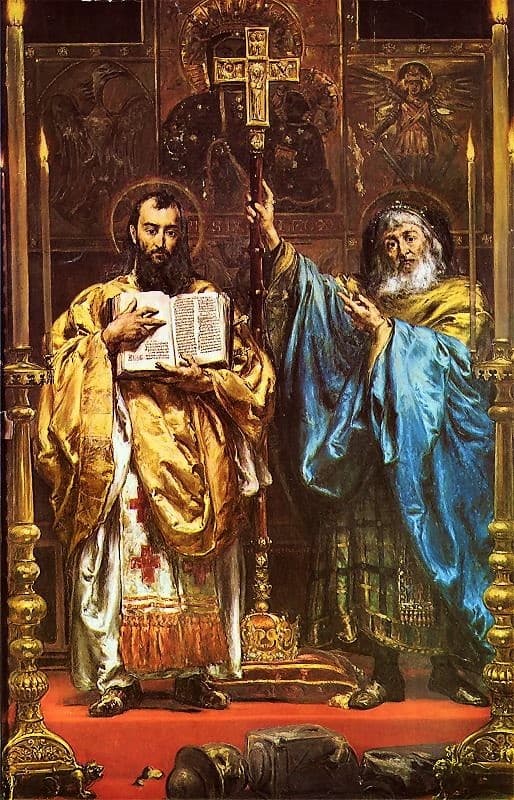
Jan Matejko, Cyril and Methodius, 1885. Public domain.
Praise the LORD, all you nations! Extol Him, all you peoples!
Summary
In 863 the brothers Constantine and Methodius went to Moravia to teach its people in their own tongue. Their church there broke up after Methodius died, but its worship lived on among other Slavs.
- Constantine was born at Thessalonica.
- German clergy called the Slavonic Mass an innovation.
- Schaff and Cross differ on which alphabet he made.
The Verses Both Sides Read
The Gospels and the Psalter were read on both sides of the quarrel.
The Primary Chronicle of Kiev gives the objectors' verse and a pope's answer, and the Life of Constantine gives his own answer at Venice.
Maclear tells that the Psalter's call to all nations, in Psalm 117, moved John VIII when Methodius came to Rome a second time.
The objectors' text
Many of the Jews read this sign, because the place where Jesus was crucified was near the city, and it was written in Hebrew, Latin, and Greek.
The Chronicle says the objectors took their stand on this verse.
John 19:20BSB
The answer
that you may be sons of your Father in heaven. He causes His sun to rise on the evil and the good, and sends rain on the righteous and the unrighteous.
As Leger gives the Life of Constantine in French, Constantine answered at Venice that the Lord's rain falls on all alike.
Matthew 5:45BSB
By their fruit you will recognize them. Are grapes gathered from thornbushes, or figs from thistles?
The pope in the Chronicle tells the Slavs to know the objectors by their fruits.
Matthew 7:16BSB
Matthew 5:45, Matthew 7:16
Who Recorded the Brothers
The record reaches English through a Kievan chronicle, the popes' letters and the historians who gave them in English.
The popes' letters of 868 to 1080 are the nearest witnesses, and the historians who give them in English wrote from 1885 to 1930.
| Witness | Written | Its side |
|---|---|---|
| The letters of Adrian II, John VIII and Stephen V, from Mann's English of 1925 | 868 to 885 | The popes, allowing in 868 and 880 and forbidding in 885 |
| Gregory VII's bull to Wratislaw of Bohemia, from de Schweinitz's English of 1885 | 1080 | Rome, forbidding |
| The Primary Chronicle of Kiev, from Cross's English of 1930, following the Pannonian Life of Methodius | To the second decade of the twelfth century | The Slavic church, with errors its editor names |
| The Lives of Constantine and of Methodius, from Leger's French of 1868 | Before the twelfth century, since the Chronicle follows the Life of Methodius | The Slavonic church's own record |
| Schaff, History of the Christian Church, volume 4 | 1885 | A historian of the whole church |
| De Schweinitz, history of the Unity of the Brethren | 1885 | A historian of the Moravian church |
| Mann, Lives of the Popes, volume 3 | 1925 | A Catholic historian who calls Wiching the lying German |
Moravia and Rome, From 863 to 886
Twenty-three years ran from the invitation to the expulsion of the disciples.
Rastislav of Moravia asked the emperor Michael III for teachers, and in 863 the brothers went to Moravia at his invitation, as Schaff gives it.
In the Primary Chronicle of Kiev the princes say, “we have no teacher to direct and instruct us and interpret the sacred scriptures.” Its editor, Samuel Cross, notes that only Rastislav applied.
The Chronicle says the brothers made a Slavic alphabet and translated the Acts and the Gospel. The Slavs, it says, rejoiced to hear the greatness of God in their own tongue.
On the road to Rome in 867 they met Kotzel, the prince of Pannonia. Adrian II approved the Slavonic liturgy, as Mann gives his letter, and wished the epistle and the gospel read first in Latin.
Constantine died at Rome on 14 February 869. As Leger gives the Life of Constantine in French, he prayed as he died that God would destroy the heresy of the three languages.
Methodius went back to the Slavs as archbishop of Pannonia, the see Adrian II formed for him.
The prison and the forged letters2 paragraphs
Two historians writing a thousand years later differ. The Catholic Encyclopedia puts his trial at a synod at Ratisbon in 870 and his prison at three years. Mann puts him in a tower from the end of 871 for two and a half years, “exposed to cold and rain.”
Wiching, one of his own bishops, claimed letters from the pope against him. On 23 March 881 John VIII wrote that he had sent no other letters to Svatopluk than the one Methodius knew.
Methodius died on 6 April 885 and named his disciple Gorazd to follow him. In 886 the disciples were driven out of Moravia and took refuge in Bulgaria.
Rome's Permission and Rome's Ban
The popes who allowed the Slavonic worship set limits on it, and later popes forbade it.
When John VIII had Methodius freed, the same pope told his legate to forbid the Slavonic liturgy.
His letter of June 880 allowed the Slavonic Mass and kept the Gospel in Latin first. Svatopluk and his judges might still hear Mass in Latin if they wished.
Stephen V condemned the Slavonic liturgy in 885, believing, as Mann tells it, that John VIII had condemned it before him.
In 1080 Gregory VII refused it to Bohemia. He wrote that “a frequent study of the Holy Scriptures” had shown him that God allowed parts of them to remain hidden.
In Their Own Words
John VIII (died 882)
Instruction to his legate Paul (873), in Horace K. Mann, The Lives of the Popes in the Early Middle Ages, vol. 3, 2nd ed. (London, 1925), page 240
John VIII sent his legate on in peace.
“Those who are in the service of St. Peter are men of peace, and wherever they go are not to be hindered by wars from working for the public weal.”
Roman Catholic
About this saying1 paragraph
In 873 John VIII would let no rumour of war delay the restoring of Methodius to his see.
John VIII
Letter to Svatopluk of Moravia (June 880), in Horace K. Mann, The Lives of the Popes in the Early Middle Ages, vol. 3, 2nd ed. (London, 1925), pages 242 to 243
John VIII allowed the Slavonic Mass.
“who made the three principal languages, Hebrew, Greek, and Latin, made the others also for His honour and glory.”
Roman Catholic
About this saying1 paragraph
In the same letter of 880 John VIII answered the objection of the three languages.
Gregory VII (died 1085)
Bull to Wratislaw of Bohemia (2 January 1080), in Edmund de Schweinitz, The History of the Church known as the Unitas Fratrum (Bethlehem, 1885), chapter on the Bohemian church
Gregory VII forbade it to Bohemia.
“Hence that which your people imprudently ask for may not be done. We forbid it, by the authority of the blessed Saint Peter”
Roman Catholic
About this saying1 paragraph
In 1080 the pope gave Duke Wratislaw his command, a year after the duke had asked.
A saying the Chronicle gives the pope
The saying1 paragraph
Attributed to the pope by the Chronicle of Kiev (Cross, 1930): “Whosoever condemns the Slavic writing shall be excluded from the Church until he mend his ways.”
Gregory VII, A saying the Chronicle gives the pope
Which Alphabet Constantine Made, and What Came After
Schaff gave Cyril the Cyrillic and Cross gave him the Glagolitic, and a later tradition links the brothers to the Unity of the Brethren.
The Glagolitic or the Cyrillic3 paragraphs
Schaff, in 1885, held that Cyril's alphabet was the one still used in Russia, Bulgaria and Servia. Edmund de Schweinitz wrote the same year that Cyril invented the Cyrillic in 855.
Samuel Cross held in 1930 that Constantine made the Glagolitic, devised from the Greek cursive. Morfill reports that Schafarik gave the Glagolitic to Cyril and the Cyrillic to Methodius.
Against the Cyrillic reading, Kopitar argued, as Morfill gives it, that older forms of the language stand in the Glagolitic manuscripts than in the Cyrillic.
The whole Bible in six months2 paragraphs
The Chronicle says Methodius translated the whole Scriptures from Greek into Slavic in six months. The Catholic Encyclopedia says he finished them except the Books of Maccabees.
Cross called the six months “generally regarded as apocryphal.” The Chronicle in his book gives March to 26 October, and his introduction gives 20 March to 6 October.
A line to the Unity of the Brethren2 paragraphs
Edmund de Schweinitz, a Moravian writing of his own church's past, says that after Rome's bans some Bohemian families and churches kept the national worship. Religious liberty, he writes, “slumbered but was not dead.”
Stransky and Plitt held that the old Slavonian church joined with the Waldenses. De Schweinitz, after Palacky, calls that union “wholly without foundation.” Whether any line runs from the brothers to the Unity of the Brethren of 1457 is not known.
What the Brothers Left
The brothers gave a people letters of its own and the Gospel in them. After the expulsion of 886 their liturgy, as Mann writes, was carried to the Slavs of the East and North.
Sources
Scripture is the Berean Standard Bible.
- The Holy Bible, Berean Standard Bible (read 2026)
- Samuel H. Cross, The Russian Primary Chronicle, Harvard Studies and Notes in Philology and Literature 12 (Cambridge, Mass., 1930), the introduction and the years 6396 to 6406.
- Horace K. Mann, The Lives of the Popes in the Early Middle Ages, vol. 3, 2nd ed. (London, 1925), the lives of Hadrian II, John VIII and Stephen V.
- Philip Schaff, History of the Christian Church, vol. 4 (New York, 1885), section 34, Cyrillus and Methodius, the Apostles of the Slavs.
- G. F. Maclear, The Slavs (London, 1879), the chapters on Moravia.
- W. R. Morfill, Slavonic Literature (London, 1883), the chapter on early Slavonic literature.
- Edmund de Schweinitz, The History of the Church known as the Unitas Fratrum (Bethlehem, 1885), the chapters on the Bohemian church before Hus.
- L. Abraham, "Sts. Cyril and Methodius", The Catholic Encyclopedia, vol. 4 (New York, 1908)
- Louis Leger, Cyrille et Méthode (Paris, 1868), from the Life of Constantine and the Pannonian Life of Methodius.