
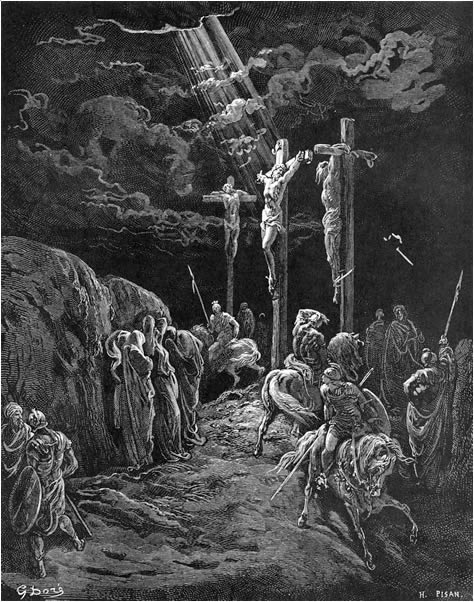
Matthewchapter 27
66 verses · Matthew, by tradition · AD 50 to 65 · The Gospels
About the ninth hour Jesus cried out in a loud voice, “Eli, Eli, lema sabachthani?” which means, “My God, My God, why have You forsaken Me?”
Introduction
Matthew, by tradition, The Gospels, Matthew Overview.
Matthew wrote for Jewish believers who had to explain a crucified Messiah to their own families, knowing the Law's word on a man hung on a tree. This chapter covers the single day of the crucifixion, from the council at dawn to the sealing of the tomb at evening. It moves between the Jewish leaders, the Roman governor, the soldiers and the crowd, and it records what each says of Jesus. Listen for the Scriptures the scene recalls, for the charge written over the cross, and for the signs in the earth and the temple. Notice who first names Him rightly.
Context
- Who
- Jewish readers who had to explain a crucified Messiah to their own families
- What
- The death of Judas, the trial before Pilate, the release of Barabbas, the crucifixion and death of Jesus, and His burial in a sealed tomb.
- Where
- The governor's headquarters in Jerusalem, the place of execution outside the city wall called Golgotha, and a rock-cut tomb nearby.
- When
- The Friday of Passover week, in AD 30 or AD 33, since the exact year is contested.
- Why
- To show that the crucified Jesus was the innocent King and Son of God, and that His death fulfilled the Scriptures.
Historical context
The Jewish council could try a case but not carry out an execution. Rome reserved capital punishment to the governor, which is why the morning ends with the prisoner sent to Pilate on a political charge, claiming to be a king, rather than a religious one.
Show the rest of the historical context, 4 more paragraphs
Pilate is a documented figure with a documented temperament. Josephus and the Jewish writer Philo both record his provocations: bringing military standards bearing the emperor's image into Jerusalem at night, and spending temple funds on an aqueduct and beating the protesters. A limestone block found at Caesarea in 1961 carries his name and title.
Scourging came before crucifixion as a matter of course. The Roman flagrum was a short whip of several thongs weighted with bone or metal that tore the skin open; prisoners sometimes died under it. Then the condemned man carried the crossbeam through the streets to the site, wearing a board that stated his crime, which is what the sign over Jesus' head was.
The nails went through the wrists or forearms, which will bear a body's weight; the feet were fixed to the upright. In 1968 a burial box was found near Jerusalem containing the heel bone of a crucified man from this period with an iron nail still driven through it, the first physical evidence of the practice ever recovered. Death came slowly, often over days, by exhaustion and suffocation, and Roman law let the execution squad divide the victim's clothing among themselves.
The burial detail fits the archaeology closely. Wealthy Jerusalem families owned rock-cut tombs outside the walls, with a low entrance closed by a heavy stone, and bodies were laid on a shelf inside. Several such tombs survive around the city. Joseph of Arimathea was a council member with the standing to ask a governor for a body, and the standing to lose everything for asking.
Significance
Every Jewish reader knew the verse that a man hung on a tree is under God's curse. That is the sentence Matthew's community had thrown at them, and this chapter answers it not by denying the horror but by surrounding it with signs: the darkness, the torn curtain, the shaken earth.
Show the rest of the significance, 1 more paragraph
And the first person in the chapter to say who he is happens to be the officer commanding the execution detail. Truly this was the Son of God, spoken by a Gentile soldier, at the foot of the cross, over the body of a man his own men had just killed.
The heads below are this chapter's scenes. The numbered points under each are its verses.
Judas' Remorse and the Potter's Field
Matthew 27:1-2
conspired against Jesus: The chief priests and elders "conspired against Jesus to put Him to death," a daylight session to settle the sentence of the night. They hand him over bound to Pilate the governor because the Sanhedrin lacked the power to execute, as John 18:31 states.
Matthew 27:1
The opening of this chapter describes the delivery of our Lord Jesus Christ into the hands of the Gentiles. The chief priests and elders of the Jews led him away to Pontius Pilate, the Roman governor. We may see in this incident the finger of God: it was ordered by his providence that Gentiles as well as Jews should be concerned in the murder of Christ; it was ordered by his providence that the priests should publicly confess that the “scepter had departed from Judah.”
J.C. Ryle · Expository Thoughts on the Gospels: Matthew (1856)Reformed Evangelical
2 more voices on this verseWhat preachers and commentators have said about this verse, in their own words.
Matthew 27:1
“In the morning - As the sanhedrim used to meet in one of the courts of the temple, which was never opened in the night, they were forced to stay till the morning before they could proceed regularly, in the resolution they had taken to put him to death.”
John Wesley · Explanatory Notes upon the New Testament (1755)evangelical
Matthew 27:1
“Jesus is brought before Pilate - See also Mar 16:1; Luk 23:1; Joh 18:28. When the morning was come - This was not long after Jesus had been condemned by the Sanhedrin. Peter’s last denial was probably not far from three o’clock a. m., or near the break of day. As soon as it was light, the Jews consulted together for the purpose of taking his life. The sun rose at that season of the year in Judea not far from five o’clock a. m., and the time when they assembled, therefore, was not long after Peter’s denial.”
handed Him over to Pilate: Adam Clarke reads the handover as a change of charge. The council had no proof of false doctrine, so it brought Jesus to the Roman governor as a man who claimed to be a king. J. C. Ryle sees Gentiles joined with Jews in His death.
Matthew 27:2
“They - delivered him to Pontius Pilate - The Sanhedrin had the power of life and death in their own hands in every thing that concerned religion; but as they had not evidence to put Christ to death because of false doctrine, they wished to give countenance to their conduct by bringing in the civil power, and therefore they delivered him up to Pilate as one who aspired to regal dignities, and whom he must put to death, if he professed to be Caesar’s friend.”
Adam Clarke · Commentary on the Bible (1810-1826)evangelical
Matthew 27:3-5
returned the thirty pieces of silver: Judas "was filled with remorse," the Greek metamelomai, sorrow over an outcome, where repentance is metanoia, a turning. He throws the silver into the temple and hangs himself, and the blood he names returns when Pilate washes his hands at verse 24.
Matthew 27:3
“Then seeing Judas, who had betrayed Him, that He was condemned, being moved by repentance, he returned the thirty pieces of silver to the chief priests and elders, saying: I have sinned in betraying innocent blood. He cast away the weight of impiety from the greatness of his greed. Seeing that the Lord was condemned to death, Judas returned the price to the priests, as if he had the power to change the sentence of those who persecuted. Therefore, although he changed his will, he did not change the outcome of his first intention.”
Jerome · written before 420 · Commentary on Matthewpatristic
3 more voices on this verse
Matthew 27:3
“Then Judas, when he saw that he was condemned, repented himself - This shows that Judas did not suppose that the affair would have resulted in this calamitous manner. He probably expected that Jesus would work a miracle to deliver himself, and not suffer this condemnation to come upon him. When he saw him taken, bound, tried, and condemned - when he saw that all probability that he would deliver himself was taken away - he was overwhelmed with disappointment, sorrow, and remorse.”
Matthew 27:3
“Then Judas, which had betrayed him,.... Before, he is described as he that shall, or should, or doth betray him; but now having perpetrated the horrid sin, as he that had done it.”
Matthew 27:3
“A short time before, the promise of this sordid pelf was temptation enough to his covetous heart to outweigh the most overwhelming obligations of duty and love; now, the possession of it so lashes him that he cannot use it, cannot even keep it!”
Jamieson, Fausset & Brown · Commentary Critical and Explanatory on the Whole Bible (1871)reformed
Judas has sinned and says so to the chief priests and elders, and Matthew Henry calls their reply the only absolution he receives. John Gill likens the confession to Pharaoh's at Exodus 9:27, followed by more sin. Jerome finds greater guilt in the priests who paid.
Matthew 27:4
“He made them his confessors, and that was the absolution they gave him; more like the priests of devils than like the priests of the holy living God. [1.] See here how carelessly they speak of the betraying of Christ. Judas had told them that the blood of Christ was innocent blood; and they said, What is that to us?”
Matthew Henry · Commentary on the Whole Bible (1707-1721)puritan
2 more voices on this verse
Matthew 27:4
“But if he who handed over the innocent blood sinned, how much more did the Jews sin, who bought the innocent blood, and by offering a price, provoked the betrayal of the disciple? Let those who attempt to introduce different natures and say that Judas, the traitor, had an evil nature, and could not be saved by election, answer how an evil nature could have repented.”
Jerome · written before 420 · Commentary on Matthewpatristic
Matthew 27:4
“Innocent blood - Αιμα αθωον, a Hebraism, for an innocent man. But instead of αθωον, innocent, two ancient MSS., Syriac, Vulgate, Sahidic, Armenian, and all the Itala; Origen, Cyprian, Lucifer, Ambrose, Leo, read δικαιον, righteous, or just. What is that to us? - What is it? - A great deal. You should immediately go and reverse the sentence you have pronounced, and liberate the innocent person. But this would have been justice, and that would have been a stranger at their tribunal.”
Adam Clarke · Commentary on the Bible (1810-1826)evangelical
threw the silver into the temple: Jamieson, Fausset and Brown hear Zechariah 11:13 in the thrown silver, where the prophet casts his wages to the potter. Acts 1:18 gives a second account of the death. Matthew Henry finds in Judas a sharp sense of sin with no grasp of the mercy of God in Christ.
Matthew 27:5
“Secondly, He became his own executioner; He hanged himself; he was suffocated with grief, so Dr. Hammond: but Dr. Whitby is clear that our translation is right. Judas had a sight and sense of sin, but no apprehension of the mercy of God in Christ, and so he pined away in his iniquity.”
Matthew Henry · Commentary on the Whole Bible (1707-1721)puritan
2 more voices on this verse
Matthew 27:5
“How is this to be explained? Perhaps he flung the money in after them. But thus were fulfilled the words of the prophet--"I cast them to the potter in the house of the Lord" (Zec 11:13). and departed, and went and hanged himself--For the details, see on Ac 1:18.”
Jamieson, Fausset & Brown · Commentary Critical and Explanatory on the Whole Bible (1871)reformed
Matthew 27:5
“And he cast down ... - This was an evidence of his remorse of conscience for his crime. His ill-gotten gain now did him no good. It would not produce relief to his agonized mind. He “attempted,” therefore, to obtain relief by throwing back the price of treason; but he attempted it in vain. The consciousness of guilt was fastened to his soul; and Judas found, as all will find, that to cast away or abandon ill-gotten wealth will not alleviate a guilty conscience.”
Matthew 27:6-8
The chief priests will not put the silver into the treasury "since it is blood money," though they paid it for the betrayal. They buy "the potter’s field as a burial place for foreigners," and it takes the name "the Field of Blood," called Akeldama at Acts 1:19.
Matthew 27:6
“And the chief priests took the silver pieces, and said, It is not lawful for to put them into the treasury--"the Corban," or chest containing the money dedicated to sacred purposes (see on Mt 15:5). because it is the price of blood--How scrupulous now! But those punctilious scruples made them unconsciously fulfil the Scripture.”
Jamieson, Fausset & Brown · Commentary Critical and Explanatory on the Whole Bible (1871)reformed
1 more voice on this verse
Matthew 27:6
“The treasury - Κορβαναν - the place whither the people brought their free-will offerings for the service of the temple, so called from the Hebrew קרבן korban, An Offering, from קרב karab, he drew nigh, because the person who brought the gift came nigh to that place where God manifested his glory between the cherubim, over the mercy-seat in the most holy place. It is from this idea that the phrase to draw nigh to God is taken, which is so frequently used in the sacred writings.”
Adam Clarke · Commentary on the Bible (1810-1826)evangelical
burial place for foreigners: Acts 1:18 says Judas acquired a field. Albert Barnes reconciles the two accounts: the priests made the purchase, and Judas furnished the money. Jerome reads the place for foreigners as a sign for the Gentiles, strangers to the Law who find rest in the price of Christ's blood.
Matthew 27:7
“And they took counsel ... - They consulted among themselves about the proper way to dispose of this money. And bought with them - In Act 1:18, it is said of Judas that “he purchased a field with the reward of his iniquity.” By the passage in the Acts is meant no more than that he “furnished the means” or “was the occasion” of purchasing the field.”
called the Field of Blood: John Gill holds that the common people gave the field its name, knowing what money had bought it. Adam Clarke sees Judas and the priests raising a lasting monument together. The name kept the innocence of Jesus before the city.
Matthew 27:8
“Wherefore that field was called,.... Not by the priests and elders, but by the common people, who knew by what money it was purchased, the field of blood; or "Aceldama", which so signifies, as in Act 1:19, not called the field of the priests, the purchasers; nor the field of the strangers, for whom it was bought; but the field of blood, being purchased with that money, for which innocent blood was betrayed; and this name it bore unto this day; in which Matthew wrote his Gospel, about eight years after, as is thought.”
1 more voice on this verse
Matthew 27:8
“The field of blood - In vain do the wicked attempt to conceal themselves; God makes them instrumental in discovering their own wickedness. Judas, by returning the money, and the priests, by laying it out, raise to themselves an eternal monument - the one of his treachery, the others of their perfidiousness, and both of the innocence of Jesus Christ.”
Adam Clarke · Commentary on the Bible (1810-1826)evangelical
Matthew 27:9-10
spoken through Jeremiah the prophet: The words credited to "Jeremiah the prophet" follow Zechariah 11:12-13, where thirty pieces of silver are thrown to the potter. One answer holds that the scroll of the Prophets opened with Jeremiah, so his name covered the collection. Jerome counted it an old copying difficulty.
Matthew 27:9
“Then was fulfilled that which was spoken by Jeremy the prophet, saying-- (Zec 11:12, 13). Never was a complicated prophecy, otherwise hopelessly dark, more marvellously fulfilled. Various conjectures have been formed to account for Matthew's ascribing to Jeremiah a prophecy found in the book of Zechariah.”
Jamieson, Fausset & Brown · Commentary Critical and Explanatory on the Whole Bible (1871)reformed
1 more voice on this verse
Matthew 27:9
“Spoken by Jeremy the prophet - The words quoted here are not to be found in the prophecy of Jeremiah. Words similar to these are recorded in Zec 11:12-13, and from that place this quotation has been doubtless made. Much difficulty has been experienced in explaining this quotation. In ancient times, according to the Jewish writers; “Jeremiah” was reckoned the first of the prophets, and was placed first in the “Book of the Prophets,” thus: Jeremiah, Ezekiel, Isaiah, and the twelve minor prophets.”
Cross references
Matthew 27:9
- QuotingZechariah 11:12“Then I told them, “If it seems right to you, give me my wages; but if not, keep them.” So they weighed out my wages, thirty pieces of silver.”
'thirty pieces of silver', potter's-field fulfillment (attributed to Jeremiah; contested, each view at full strength)
gave them for the potter’s field: In Zechariah 11:13 the prophet himself throws the silver, and Matthew has the priests pay it. Albert Barnes finds one sense in both texts, a price given for the potter's field. In Zechariah the silver was a shepherd's wages, paid in contempt.
Matthew 27:10
“And gave them - In Zechariah it is, I gave them. Here it is represented as being given by the priests. The meaning is not, however, different. It is, that this price “was given” for the potter’s field. As the Lord appointed me - That is, “commanded” me. The meaning of the place in Zechariah is this: He was directed to go to the Jews as a prophet - a pastor of the people. They treated him, as they had done others, with great contempt.”
Before Pilate; Barabbas Set Free
Matthew 27:11-14
Pilate asks whether Jesus is "the King of the Jews," the political charge that mattered to Rome, where blasphemy did not. Jesus answers, "You have said so," a Jewish idiom of qualified agreement. Then he gives "no answer, not even to a single charge, much to the governor’s amazement".
Matthew 27:11
“And Jesus stood before the governor - Many things are omitted by Matthew, in the account of this trial, which are recorded by the other evangelists. A much more full account is found in Joh 18:28-40. And the governor asked him ... - This question was asked On account of the “charge” which the Jews brought against Jesus, “of perverting the nation, and forbidding to give tribute to Caesar,” Luk 23:2. It was on this charge that, after consultation, they had agreed to arraign him before Pilate.”
2 more voices on this verse
Matthew 27:11
“And Jesus stood before the governor,.... Pilate who sat; for so was the custom for the judge to sit, and those that were judged, to stand, especially whilst witness was bore against them (f). "Says R. Bo, in the name of Rab Hona, the witnesses ought to stand whilst they bear witness. Says R. Jeremiah, in the name of R.”
Matthew 27:11
“These verses describe our Lord’s appearance before Pontius Pilate, the Roman governor. That sight must have been wonderful to the angels of God. He who will one day judge the world allowed himself to be judged and condemned, though “he had done no violence, neither was any deceit in his mouth” ( Isaiah 53:9 ). He, from whose lips Pilate and Caiaphas will one day receive their eternal sentence suffered silently, an unjust sentence to be passed upon him.”
J.C. Ryle · Expository Thoughts on the Gospels: Matthew (1856)Reformed Evangelical
He gave no answer: Albert Barnes names the charges from Luke 23:2: perverting the nation and forbidding tribute to Caesar. The accusers offered no proof, and He knew it. Matthew Henry adds that Christ, as Lord of His own life, knew His hour had come and entrusted Himself to the Father.
Matthew 27:12
“When he was accused ... - To wit, of perverting the nation, and of forbidding to give tribute to Caesar, Luk 23:2, Luk 23:5. Probably this was done in a tumultuous manner and in every variety of form. He answered nothing - He was conscious of his innocence. He knew that they could not prove these charges. They offered no testimony to prove them, and, in conscious innocence, he was silent.”
2 more voices on this verse
Matthew 27:12
“Neither then nor now did Jesus make any reply to their accusations, for the word of God was not sent to them, as it was formerly to the Prophets. Neither was Pilate worthy of an answer, as he had no fixed or abiding opinion of Christ, but veered about to contradictory suppositions. Hearest thou not how many things they witness against thee?”
Origen of Alexandria · written before 253 · Catena Aurea by Aquinaspatristic
Matthew 27:12
“Not as I will, but as thou wilt. He knew what his Father's will was, and therefore silently committed himself to him that judgeth righteously. We must not thus by our silence throw away our lives, because we are not lords of our lives, as Christ was of his; nor can we know, as he did, when our hour is come.”
Matthew Henry · Commentary on the Whole Bible (1707-1721)puritan
ConnectionsIsaiah 53:7
how many charges they are bringing: Albert Barnes calls the priests accusers here, men pressing charges without testimony, among them that Jesus stirred up the people from Galilee to Jerusalem. Pilate wants the prisoner to defend Himself, John Gill observes. Origen held that Pilate, veering between contrary opinions of Christ, was unworthy of an answer.
Matthew 27:13
“Then saith Pilate unto him,.... Observing he made no reply to the accusations of the chief priests and elders, and in order to draw something out of him, hearest thou not how many things they witness against thee? art thou deaf? or dost thou not take in what is alleged against thee? dost thou not consider the nature of these charges? how many, and of what kind the depositions are now made by persons of such rank and figure? art thou under no concern to make answer to them?”
1 more voice on this verse
Matthew 27:13
“They witness against thee - This means, rather, that they accused him. They were not “witnesses,” but accusers. These accusations were repeated and pressed. They charged him with exciting the people, teaching throughout, all Judea from Galilee to Jerusalem, and exciting the nation to sedition, Luk 23:5.”
much to the governor’s amazement: Origen explains the governor's wonder: a prisoner before a criminal court stood unafraid of the death all men dread. Adam Clarke contrasts the two audiences. The silence confounded the priests, while Pilate, who had nothing to gain, was deeply moved.
Matthew 27:14
“The governor marvelled at His endurance, as knowing that he had power to condemn Him, He yet continued in a peaceful, placid, and immovable prudence and gravity. He marvelled greatly, for it seemed to him a great miracle that Christ, produced before a criminal tribunal, stood thus fearless of death, which all men think so terrible.”
Origen of Alexandria · written before 253 · Catena Aurea by Aquinaspatristic
1 more voice on this verse
Matthew 27:14
“Marveled greatly - Silence under calumny manifests the utmost magnanimity. The chief priests did not admire this because it confounded them; but Pilate, who had no interest to serve by it, was deeply affected. This very silence was predicted. Isa 53:7.”
Adam Clarke · Commentary on the Bible (1810-1826)evangelical
Matthew 27:15-18
release to the crowd a prisoner: The release of a prisoner at the feast is known only from the Gospels, though Rome granted clemency at festivals elsewhere. Barabbas means son of the father, and some manuscripts name him Jesus Barabbas, so Pilate offers "Barabbas, or Jesus who is called Christ".
Matthew 27:15
“See also the parallel places in Mar 15:6-14; Luk 23:17-23; Joh 18:39-40. Mat 27:15 At that feast - The feast of the Passover. The governor was wont to release ... - that is, was “accustomed” to release. From what this custom arose, or by whom it was introduced, is not known. It was probably adopted to secure popularity among the Jews, and to render the government of the Romans less odious. Any little indulgence granted to the Jews during the heavy oppression of the Romans would serve to conciliate their favor, and to keep the nation from sedition.”
1 more voice on this verse
Matthew 27:15
“You should not be surprised that shortly after Roman rule had begun [in Palestine], the Jews who came under their yoke were granted the priviledge of asking for [the release of] "one [prisoner] whom they wanted," even though he appeared to be guilty of a thousand murders; the pagan nations granted a certain amount of leniency to their subjects until the yoke had been firmly secured around them.”
Origen of Alexandria · written before 253 · Commentary on Matthew 120patristic
a notorious prisoner named Barabbas: Adam Clarke, from Mark 15:7, takes the notorious prisoner Barabbas to be the leader of a recent riot in which men were put to death. Jerome reports that the Gospel of the Hebrews gives his name as son of their master. Pilate was holding him, John Gill notes.
Matthew 27:16
“A notable prisoner - Barabbas - This person had, a short time before, raised an insurrection in Jerusalem, in which it appears, from Mar 15:7, some lives were lost. In some MSS., and in the Armenian and Syriac Hieros., this man has the surname of Jesus.”
Adam Clarke · Commentary on the Bible (1810-1826)evangelical
2 more voices on this verse
Matthew 27:16
“In the Gospel entitled 'according to the Hebrews,' Barabbas is interpreted, 'The son of their master,' who had been condemned for sedition and murder.”
Jerome · written before 420 · Catena Aurea by Aquinaspatristic
Matthew 27:16
“And they had then a notable prisoner,.... The Vulgate Latin reads, "he had"; that is, Pilate, who had committed him to prison, and under whose power he was: for the Jews had lost all authority of this kind, at least in capital cases.”
John Gill takes the gathered crowd to be the common people, with whom the choice of the prisoner lay by custom. Pilate adds the title Christ, and Matthew Henry hears a reminder that many had taken Jesus for the Messiah. Jerome thinks Pilate expected them to choose Jesus.
Matthew 27:17
“So when they had gathered, Pilate said to them: Whom do you want me to release to you, Barabbas or Jesus who is called Christ? For he knew that they had handed Him over out of envy. Pilate offers them the option of releasing whoever they want, either the robber or Jesus, not doubting that they would choose Jesus, knowing that He had been handed over out of envy. Therefore, the evident cause of the cross is envy.”
Jerome · written before 420 · Commentary on Matthewpatristic
1 more voice on this verse
Matthew 27:17
“Therefore when they were gathered together,.... Meaning not the chief priests and elders; for these were together before, but the common people; and so the Persic version renders the words, when the people increased into a multitude: for it was to them the release of a prisoner was to be made, and so the proposal of one; and it was at their option, who should be the person; for it was "whom they would", as in Mat 27:15, and where the Ethiopic version adds, "and should choose". Pilate said unto them, whom will ye that I should release unto you?”
out of envy: Matthew Henry compares the priests to Saul, who envied David while the people loved him. A few days earlier the crowd had hailed Jesus, so Pilate counted on the people to choose Him. Adam Clarke says an upright governor would have released Him.
Matthew 27:18
“For envy - Δια φθονον, through malice. Then it was his business, as an upright judge, to have dispersed this mob, and immediately released Jesus. Seeing malice is capable of putting even Christ himself to death, how careful should we be not to let the least spark of it harbor in our breast. Let it be remembered that malice as often originates from envy as it does from anger.”
Adam Clarke · Commentary on the Bible (1810-1826)evangelical
1 more voice on this verse
Matthew 27:18
“When David was envied by Saul, he was the darling of the people; and any one that heard the hosannas with which Christ was but a few days ago brought into Jerusalem, would have thought that he had been so, and that Pilate might safely have referred this matter to the commonalty, especially when so notorious a rogue was set up as a rival with him for their favours.”
Matthew Henry · Commentary on the Whole Bible (1707-1721)puritan
that innocent man: Pilate's wife sends a message from a dream, the sixth and last dream in the book after the five that guarded Jesus. She calls him "that innocent man," the Greek dikaios, righteous. Early tradition, old but unverified, named her Procula, and the Eastern church counts her among its saints.
Matthew 27:19
“I have suffered many things - in a dream - There is no doubt that God had appeared unto this woman, testifying the innocence of Christ, and showing the evils which should pursue Pilate if this innocent blood should be shed by his authority. See Mat 27:2.”
Adam Clarke · Commentary on the Bible (1810-1826)evangelical
1 more voice on this verse
Matthew 27:19
“Secondly, It was a fair warning to Pilate; Have nothing to do with him. Note, God has many ways of giving checks to sinners in their sinful pursuits, and it is a great mercy to have such checks from Providence, from faithful friends, and from our own consciences; it is also our great duty to hearken to them.”
Matthew Henry · Commentary on the Whole Bible (1707-1721)puritan
Matthew 27:20-23
persuaded the crowds: The chief priests and elders "persuaded the crowds to ask for Barabbas and to have Jesus put to death". Pilate asks what evil he has done, and they shout "Crucify Him" all the louder, with no charge named. At 21:9 the crowds had cried Hosanna to the Son of David.
Matthew 27:20
“Ask Barabbas - Who had raised an insurrection and committed murder - and to destroy Jesus, whose voice was never heard in their streets, and who had, during the space of three years and a half, gone about unweariedly, from village to village, instructing the ignorant, healing the diseased, and raising the dead.”
Adam Clarke · Commentary on the Bible (1810-1826)evangelical
1 more voice on this verse
Matthew 27:20
“Here, [1.] We cannot but look upon these wicked priests with indignation; by the law, in matters of controversy between blood and blood, the people were to be guided by the priests, and to do as they informed them, Deut. xvii.”
Matthew Henry · Commentary on the Whole Bible (1707-1721)puritan
Pilate repeats the choice, hoping the crowd will ask him to release Jesus, and Matthew Henry notes his surprise at the answer. The cry for Barabbas needed no count. Adam Clarke says the chief priests had moved the crowd, and corrupt shepherds still lead a flock to prefer Barabbas.
Matthew 27:21
“They said, Barabbas - What a fickle crowd! A little before they all hailed him as the Son of David, and acknowledged him as a gift from God; now they prefer a murderer to him! But this it appears they did at the instigation of the chief priests. We see here how dangerous wicked priests are in the Church of Christ; when pastors are corrupt, they are capable of inducing their flock to prefer Barabbas to Jesus, the world to God, and the pleasures of sense to the salvation of their souls.”
Adam Clarke · Commentary on the Bible (1810-1826)evangelical
1 more voice on this verse
Matthew 27:21
“He hoped that he had gained his point, to have Jesus released. But, to his great surprise, they said Barabbas; as if his crimes were less, and therefore he less deserved to die; or as if his merits were greater, and therefore he better deserved to live. The cry for Barabbas was so universal, one and all, that there was no colour to demand a poll between the candidates.”
Matthew Henry · Commentary on the Whole Bible (1707-1721)puritan
Matthew Henry reads the crowd's answer through Isaiah 59:14 and 5:7, where truth falls in the street and an outcry answers the search for justice. Charles Spurgeon calls the voice of the people as changeable as the wind. They all answered with Rome's own penalty, the cross.
Matthew 27:22
“THIS morning we heard the shouts of "Hosanna!" It was very delightful to us to behold the multitude marching with the King of Zion through the streets of Jerusalem, welcoming Him with glad acclaim. But the shouts of "Hosanna" had hardly died away before they were followed by the cruel note, "Crucify Him! Crucify Him!" Or, as the text puts it, "Let Him be crucified!" Clearly in this case the Vox populi was not the Vox Dei. The one is fickle and shifting, the other is fixed and steadfast. The voice of the people is changeable as the wind.”
Charles Spurgeon · written before 1892 · The Metropolitan Tabernacle Pulpit, Sermon No. 3457: “All Are Guilty” (lightly modernized text, CCEL edition)Particular Baptist
1 more voice on this verse
Matthew 27:22
“Now was truth fallen in the street, and equity could not enter; where one looked for judgment, behold, oppression, the worst kind of oppression; for righteousness, behold, a cry, the worse cry that ever was, Crucify, crucify the Lord of glory.”
Matthew Henry · Commentary on the Whole Bible (1707-1721)puritan
Thomas Aquinas hears Pilate appealing to the prisoner's innocence. The words are close to the LORD's own challenge at Jeremiah 2:5 and to the question Jesus asked at John 8:46. Adam Clarke says Pilate saw no charge that Roman law could punish; the accusers knew it as well.
Matthew 27:23
“What evil hath he done? - Pilate plainly saw that there was nothing laid to his charge for which, consistently with the Roman laws, he could condemn him. But they cried out the more - What strange fury and injustice! They could not answer Pilate’s question, What evil hath he done? He had done none, and they knew he had done none; but they are determined on his death.”
Adam Clarke · Commentary on the Bible (1810-1826)evangelical
Matthew 27:24-25
took water and washed his hands before the crowd: Pilate washes his hands "before the crowd," a rite Deuteronomy 21:6-7 prescribes over an unsolved killing, and says, "I am innocent of this man’s blood". The people answer with the words "His blood be on us and on our children," spoken by those present, the generation Jesus addressed at 23:36.
Matthew 27:24
“Pilate - took water, and washed his hands - Thus signifying his innocence. It was a custom among the Hebrews, Greeks, and Latins, to wash the hands in token of innocence, and to show that they were pure from any imputed guilt. In case of an undiscovered murder, the elders of that city which was nearest to the place where the dead body was found, were required by the law, Deu 21:1-10, to wash their hands over the victim which was offered to expiate the crime, and thus make public protestation of their own innocence.”
Adam Clarke · Commentary on the Bible (1810-1826)evangelical
1 more voice on this verse
Matthew 27:24
“THE Crucifixion of Christ was the crowning sin of our race. In His death we shall find all the sins of mankind uniting in foul conspiracy. Envy and pride and hate are there, with covetousness, falsehood and blasphemy eager to rush on to cruelty, revenge, and murder! The devil awakened around the Seed of the woman the iniquities of us all—they compassed the Lord about, yes, they compassed Him about like bees.”
All the people answered: Albert Barnes reads the cry as an oath of legal responsibility. He compares an Athenian custom in which an accuser pledged himself and his children to the penalty if the accused was later found innocent. Charles Spurgeon's sermon lays the guilt of the cross on the whole human race.
Matthew 27:25
“His blood be on us ... - That is, let the guilt of putting him to death, if there be any, be on us and our children. We will be answerable for it, and will consent to bear the punishment for it. It is remarked by writers that, among the Athenians, if anyone accused another of a capital crime, he devoted himself and children to the same punishment if the accused was afterward found innocent. So in all countries the conduct of the parent involves the children in the consequences of his conduct.”
But he had Jesus flogged: Pilate "released Barabbas to them" and had Jesus flogged, the Roman scourging that could kill a man before the cross. A guilty man goes free while an innocent one goes to die, and 1:21 has said that Jesus will save his people from their sins.
Matthew 27:26
“It should be known that Pilate administered the Roman law, which enacted that every one who was crucified should first be scourged. Jesus then is given up to the soldiers to be beaten, and they tore with whips that most holy body and capacious bosom of God. This was done that we might be delivered from those stripes of which it is said, Many stripes shall be to the wicked. (Ps. 32:10.)”
Jerome · written before 420 · Catena Aurea by Aquinaspatristic
1 more voice on this verse
Matthew 27:26
“Scourged Jesus - This is allowed to have been a very severe punishment of itself among the Romans, the flesh being generally cut by the whips used for this purpose: so the poet: - - Horribili Sectere flagello. “To be cut by the horrible whip.” Hor. Sat. I. 3. 119. And sometimes it seems, they were whipped to death. See the same poet, Sat. I. 2. 41. - Ille Flagellis Ad Mortem caesus See also Horat. Epod. od. iv. v.”
Adam Clarke · Commentary on the Bible (1810-1826)evangelical
Mocked and Crowned With Thorns
Matthew 27:27-31
gathered the whole company around Him: The soldiers gather "the whole company," a cohort of up to six hundred men. They mock his kingship with "a scarlet robe" for purple, "a crown of thorns," and a staff for a scepter. They kneel to say "Hail, King of the Jews," spit on him and strike his head.
Matthew 27:27
“I HAVE not observed that anyone has turned to account the fact that "the whole band of soldiers" gathered in the Praetorium, or Common Hall, for the purpose of mocking our Lord. That they did mock Him has often been noticed and preached upon, but that they should have gathered unto Him the whole garrison—that all should have been there—is mentioned both by Matthew and by Mark. And this being twice recorded cannot have been without some meaning and some lesson for us.”
Charles Spurgeon · written before 1892 · The Metropolitan Tabernacle Pulpit, Sermon No. 2333: “The Whole Band Against Christ” (lightly modernized text, CCEL edition)Particular Baptist
2 more voices on this verse
Matthew 27:27
“He had been styled King of the Jews, and the Scribes and Priests had brought this charge against Him, that He claimed sovereignty over the Jewish nation; hence this mockery of the soldiers, taking away His own garments, they put on Him a scarlet cloak to represent that purple fringe which kings of old used to wear, for the diadem they put on Him a crown of thorns, and for the regal sceptre give Him a reed, and perform adoration to Him as to a king. All these things we may understand mystically.”
Jerome · written before 420 · Catena Aurea by Aquinaspatristic
Matthew 27:27
“See also Mar 15:15-20; Joh 19:1-3. Mat 27:27 Into the common hall - The original word here means, rather, the governor’s palace or dwelling. The trial of Jesus had taken place outside of the palace. The Jews would not enter in Joh 18:28, and it is probable that courts were held often in a larger and more public place than would be a room in his dwelling. Jesus, being condemned, was led by the soldiers away from the Jews “within” the palace, and subjected there to their profane mockery and sport.”
put a scarlet robe on Him: John Gill notes Jewish law fined a man four hundred pence for stripping another, and these soldiers faced no such penalty. Origen links the scarlet to Rahab's cord in Joshua 2 and the thread of Tamar's son in Genesis 38. In it he saw the world's blood laid on Christ.
Matthew 27:28
That scarlet robe was prefigured by the scarlet sign mentioned in Joshua the son of Nun, which Rahab used for her safety, and mentioned in Genesis, which was placed on the hand of one of Tamar's newborn sons in token of the future Passion of Christ. So now, in taking up the "scarlet robe," he took upon himself the blood of the world, and in that thorny "crown" plaited on his head he took upon himself the thorns of our sins. As to the robe, it is written that "they stripped him of the scarlet robe."
Origen of Alexandria · written before 253 · Commentary on Matthew 125.9patristic
2 more voices on this verse
Matthew 27:28
“Stripped him - Took off his mantle, or upper garment. A scarlet robe - Or, according to Mark and John, a purple robe, such as emperors and kings wore.”
Adam Clarke · Commentary on the Bible (1810-1826)evangelical
Matthew 27:28
“And they stripped him,.... Of his clothes; at least of his upper garment: for one man to spit upon another, as these soldiers afterwards did on Christ, or to strip him of his garment, according to the Jewish canons, were punishable with a fine of four hundred pence (z), which amounted to twelve pounds and ten shillings of our money; but the soldiers were in no danger of being prosecuted, for stripping Christ.”
twisted together a crown of thorns: Adam Clarke reads the crown of thorns as mockery first, a prop for a comic king. He reports that Bishop Pearce and Michaelis took the plant to be acanthus. Origen sees in the staff the fragile scepter of worldly kingdoms; Christ took it from human hands to break it.
Matthew 27:29
“A crown of thorns - Στεφανον εξ ακανθων. It does not appear that this crown was intended to be an instrument of punishment or torture to his head, but rather to render him ridiculous; for which cause also they put a reed in his hand, by way of scepter, and bowed their knees, pretending to do him homage. The crown was not probably of thorns, in our sense of the word: there are eminently learned men who think that the crown was formed of the herb acanthus; and Bishop Pearce and Michaelis are of this opinion.”
Adam Clarke · Commentary on the Bible (1810-1826)evangelical
1 more voice on this verse
Matthew 27:29
“What can be said about the reed they placed "in his right hand"? Here is my explanation: The reed embodied the hollow and fragile scepter that we all were leaning on before we saw it was a bad scepter, for we were trusting in the reed-shaped rod of Egypt or Babylon or some other kingdom opposed to God's kingdom. Then he took that reed and rod of the fragile kingdom from our hands, to subdue it and break it to pieces on the cross.”
Origen of Alexandria · written before 253 · Commentary on Matthew 125patristic
struck Him on the head: The Syriac adds that they spit on His face, John Gill reports, and he joins the scene to Isaiah 52:14. Jerome sets the blows of the staff on His head beside Isaiah 42:3. The Servant who spares a bruised reed is struck with one.
put His own clothes back: Jerome reads the change of clothes as a sign. Christ bore the mocking robe while He was scourged and spat upon, and He went to the cross in His own garments. John Gill notes that executions took place outside the city, as Leviticus 24:14 required for the blasphemer.
Matthew 27:31
“It is to be noted, that when Jesus is scourged and spit upon, He has not on His own garments, but those which He took for our sins; but when He is crucified, and the show of His mockery is completed, then He takes again His former garments, and His own dress, and immediately the elements are shaken, and the creature gives testimony to the Creator.”
Jerome · written before 420 · Catena Aurea by Aquinaspatristic
Crucified Between Two Robbers
man from Cyrene, named Simon: Roman law let a soldier compel a bystander to carry a load for a mile, the power behind 5:41. Here the soldiers force Simon of Cyrene to carry the cross. Mark 15:21 names him the father of Alexander and Rufus, names Mark's first readers seem to have known.
Matthew 27:32
“A man of Cyrene - him they compelled to bear his cross - In John, Joh 19:16, Joh 19:17, we are told Christ himself bore the cross, and this, it is likely, he did for a part of the way; but, being exhausted with the scourging and other cruel usage which he had received, he was found incapable of bearing it alone; therefore they obliged Simon, not, I think, to bear it entirely, but to assist Christ, by bearing a part of it.”
Adam Clarke · Commentary on the Bible (1810-1826)evangelical
1 more voice on this verse
Matthew 27:32
“And as they came out,.... Of the city; for no execution was made, neither in the court of judicature, nor in the city, but at some distance; as it was at stoning, so at crucifixion (h): "when judgment was finished, they brought him out to be stoned; the place of stoning was without the sanhedrim, as it is said, Lev 24:14, "bring forth him that hath cursed without the camp".”
Matthew 27:33-34
a place called Golgotha: Golgotha means "The Place of the Skull," named from the hill's shape or its executions. The wine "mixed with gall" was a drink Jerusalem women gave the condemned to dull pain, and Mark 15:23 calls it myrrh. Psalm 69:21 speaks of gall given for food.
Matthew 27:33
“Golgotha - This is a Hebrew word, signifying the place of a skull. This is the word which in Luke is called “Calvary.” The original Greek, there, also means a skull. The word “calvary” is a Latin word meaning “skull,” or place of “skulls.” It is not known certainly why this name was given to this place. Some have supposed that it was because the mount resembled in shape a human skull.”
1 more voice on this verse
Matthew 27:33
“And when they were come to a place called Golgotha,.... The true pronunciation is "Golgoltha", and so it is read in Munster's Hebrew Gospel. It is a Syriac word, in which language letters are often left out: in the Syriac version of this place, the first "l" is left out, and the latter retained, and it is read "Gogoltha": and so, in the Persic, "Gagulta"; and in the Arabic, "Gagalut".”
wine to drink, mixed with gall: John Gill traces the custom to Proverbs 31:6, which gives strong drink to one who is perishing. Adam Clarke reads the word gall as any bitter mixture. Jerome hears Jeremiah 2:21 in the cup, a choice vine turned bitter, offering its bitter wine to its Lord.
Matthew 27:34
“The bitter vine makes bitter wine; this they gave the Lord Jesus to drink, that that might be fulfilled which was written, They gave me also gall for my meat. (Ps. 69:21.) And God addresses Jerusalem, I had planted there a true vine, how art thou turned into the bitterness of a strange vine? (Jer. 2:21.)”
Jerome · written before 420 · Catena Aurea by Aquinaspatristic
2 more voices on this verse
Matthew 27:34
“They gave him vinegar to drink,.... It was a custom with the Jews (o) when "a man went out to be executed, to give him to drink a grain of frankincense in a cup of wine, that his understanding might be disturbed, as it is said, Pro 31:6. "Give strong drink to him that is ready to perish, and wine to those that be of heavy hearts"; and the tradition is, that the honourable women in Jerusalem gave this freely; but if they did not, it was provided at the charge of the congregation.”
Matthew 27:34
“They gave him vinegar - mingled with gall - Perhaps χολη, commonly translated gall, signifies no more than bitters of any kind. It was a common custom to administer a stupefying potion compounded of sour wine, which is the same as vinegar, from the French vinaigre, frankincense, and myrrh, to condemned persons, to help to alleviate their sufferings, or so disturb their intellect that they might not be sensible of them.”
Adam Clarke · Commentary on the Bible (1810-1826)evangelical
His garments by casting lots: Matthew states the crucifixion in one clause. The weight falls on the soldiers who "divided up His garments by casting lots," the act Psalm 22:18 describes. John 19:23-24 gives the detail: four soldiers split the outer garments and cast lots for the tunic woven without a seam.
Matthew 27:35
“And they crucified him,.... That is, the soldiers: they laid the cross upon the ground, and stretched Christ upon it; they extended his two arms as far as they could, to the transverse part of it, and nailed his hands unto it: his two feet they fixed by each other on a basis, in the body of the cross, through which they also drove nails; and then raising it up, fixed it in the earth, and left him hanging on it till he expired.”
1 more voice on this verse
Matthew 27:35
“And they crucified him - To “crucify” means to put to death on a cross. The “cross” has been described at Mat 27:32. The usual manner of the crucifixion was as follows: After the criminal had carried the cross, attended with every possible gibe and insult, to the place of execution, a hole was dug in the earth to receive the foot of it. The cross was laid on the ground; the person condemned to suffer was stripped and was extended on it, and the soldiers fastened the hands and feet either by nails or thongs.”
Matthew 27:36-37
they kept watch over Him there: The soldiers sit and keep watch against rescue, and above his head they post the written charge, naming Jesus "THE KING OF THE JEWS". John 19:20 records it in Hebrew, Latin and Greek. At John 19:21-22 the chief priests ask Pilate to make it a claim, and he refuses.
Matthew 27:36
“They watched him - To prevent his disciples or relatives from taking away the body or affording any relief to the sufferer.”
Adam Clarke · Commentary on the Bible (1810-1826)evangelical
the written charge against Him: Each Gospel names the written charge differently, John Gill notes, and the Syriac calls it the cause of His death. Jerome marvels that after purchased witnesses and a riot, the only charge left against Jesus was that He was King of the Jews. He thinks it was posted in mockery.
Matthew 27:37
“And they set up over his head his accusation written, This is Jesus, the King of the Jews. I cannot sufficiently wonder at the enormity of the thing, that having purchased false witnesses, and having stirred up the unhappy people to riot and uproar, they found no other plea for putting Him to death, than that He was King of the Jews; and this perhaps they set up in mockery.”
Jerome · written before 420 · Catena Aurea by Aquinaspatristic
2 more voices on this verse
Matthew 27:37
“And set up over his head - John says Joh 19:19 that Pilate wrote the title and put it upon the cross. Probably Pilate wrote it or caused it to be written, and directed the soldiers to set it up. A man is often said to do what he directs others to do. It was customary to set up over the heads of persons crucified the crime for which they suffered, and the name of the sufferer The accusation on which Jesus had been condemned by Pilate was his claiming to be the King of the Jews.”
Matthew 27:37
“And set up over his head his accusation written,.... The Evangelist John calls it a "title", Joh 19:19, and Luke, a "superscription", Luk 23:38, and Mark, the "superscription of his accusation", Mar 15:26, it was what contained the sum and substance of what he was accused, and for which he was condemned, and suffered. The Syriac and Persic versions here render it, "the cause of his death".”
Two robbers were crucified with Him: Two "robbers" are crucified with him, the Greek lestai, the word Josephus uses of the insurgents Rome crucified. Luke 22:37 has Jesus apply Isaiah 53:12, numbered with the transgressors, to himself. Luke records one of the two turning to him, while Matthew has both join the abuse at verse 44.
Matthew 27:38
“Two thieves - ΛῃϚαι, robbers, or cutthroats: men who had committed robbery and murder; for it does not appear that persons were crucified for robbery only. Thus was our Lord numbered (his name enrolled, placed as it were in the death warrant) with transgressors, according to the prophetic declaration, Isa 53:12; and the Jews placed him between these two, perhaps to intimate that he was the worst felon of the three.”
Adam Clarke · Commentary on the Bible (1810-1826)evangelical
Matthew 27:39-44
shaking their heads: Passersby turn his words from 26:61 into a taunt, though John 2:19-21 says he meant his body. The chief priests promise that "we will believe in Him" if he comes down, the sign Jesus refused them at 12:38-39. Even "the robbers who were crucified with Him" join the abuse.
Matthew 27:39
“No one standing still or directly approaching him blasphemes Jesus. "Those who passed by blasphemed him," and those who stayed behind plucked food from the vineyard wall demolished by God. Concerning this it is written, "Why then have you broken down its walls, so that those who pass along the way pluck its fruit?" Therefore, as long as one does not pass along the way or avoid it and can say to God while standing, "You have set 'my feet upon a rock,' " one does not blaspheme Jesus.”
Origen of Alexandria · written before 253 · Commentary on Matthew 132patristic
save Yourself!: The words If You are the Son of God repeat the tempter's at Matthew 4:3 and 4:6, a call to prove Sonship by power. Here the call is to come down from the cross and save Himself. Adam Clarke says cruelty must take refuge in lies.
Matthew 27:40
“And saying, thou that destroyest the temple,.... The Vulgate Latin, and Munster's Hebrew Gospel, read, "the temple of God"; and add "ah!" here, as in Mar 15:29, and so Beza says it is read in a certain copy. They refer to the charge of the false witnesses against him, who misrepresenting his words in Joh 2:19, declared that he gave out that he was able to destroy the temple of Jerusalem, and rebuild it in three days time; wherefore it is added, and buildest it in three days, save thyself.”
1 more voice on this verse
Matthew 27:40
“Thou that destroyest - Who didst pretend that thou couldst have destroyed the temple, and built it up again in three days. This malicious torturing of our Lord’s words has been noticed before. Cruelty is obliged to take refuge in lies, in order to vindicate its infamous proceedings.”
Adam Clarke · Commentary on the Bible (1810-1826)evangelical
the chief priests, scribes, and elders: The three groups named here made up the council, and Jesus had foretold at 16:21 that He would suffer at the hands of these men. Several ancient copies add the Pharisees to the list, Adam Clarke reports. He doubts that the Pharisees took part.
Matthew 27:41
“Chief priests - scribes and elders - To these, several ancient MSS. and versions add, και Φαρισαιων, and Pharisees. But though the authority for this reading is respectable, yet it does not appear that the Pharisees joined in with the others in the condemnation of our Lord. Probably his discourses and parables, related in some of the preceding chapters, which were spoken directly to them, had so far convinced them that they would at least have no hand in putting him to death. All the infamy of this seems to fall upon the Priests, scribes, and elders.”
Adam Clarke · Commentary on the Bible (1810-1826)evangelical
Several manuscripts read the taunt as a question, Adam Clarke reports. Clarke names the contradictions that gave offense: a Savior who saved others and died, and the Son of God crucified. The priests say King of Israel, where the board above Him reads King of the Jews.
Matthew 27:42
“He saved others; himself he cannot save - Or, Cannot he save himself? Several MSS. read this with the mark of interrogation as above; and this makes the sarcasm still more keen. A high priest who designs to destroy the temple of God: a Savior who saves not himself; and the Son of God crucified: these are the contradictions which give offense to Jews and libertines.”
Adam Clarke · Commentary on the Bible (1810-1826)evangelical
He trusts in God: Charles Spurgeon hears Psalm 22:7-8 fulfilled to the letter, where the mockers shake their heads and bid the LORD deliver the one who trusts Him. Adam Clarke notes that the Greek verb for wants renders the Hebrew for delight in the Septuagint. Jerome calls the promise false.
Matthew 27:43
“THESE WORDS ARE a fulfilment of the prophecy contained in the twenty-second Psalm. Read from the seventh verse’"All they that see me laugh me to scorn: they shoot out the lip, they shake the head, saying, He trusted on the Lord that he would deliver him: let him deliver him, seeing he delighted in him." Thus to the letter doth our Lord answer to the ancient prophecy.”
1 more voice on this verse
Matthew 27:43
“If he will have him - Or, if he delight in him - ει θελει αυτον. The verbs θελω and εθελω, are used by the Septuagint in more than forty places for the Hebrew חפץ chaphets, which signifies, earnestly to desire, or delight in.”
Adam Clarke · Commentary on the Bible (1810-1826)evangelical
the robbers who were crucified: Luke 23:39-43 has one robber repent, a detail harmonized two ways. Jerome holds both robbers who were crucified berated Him at first, and one came to believe when the darkness came and the earth quaked. Adam Clarke reads the plural as an idiom for one of the two.
Matthew 27:44
“The thieves also - cast the same in his teeth - That is, one of the robbers; for one, we find, was a penitent, Luk 23:39, Luk 23:40. See this form of expression accounted for, on Mat 26:8 (note).”
Adam Clarke · Commentary on the Bible (1810-1826)evangelical
1 more voice on this verse
Matthew 27:44
“Or it may be said that at first both reviled Him; but when the sun had withdrawn, the earth was shaken, the rocks were rent, and the darkness increased, one believed on Jesus, and repaired his former denial by a subsequent confession. Or, in the two thieves both nations, Jews and Gentiles, at first blasphemed the Lord; afterwards the latter terrified by the multitude of signs did penitence, and thus rebukes the Jews, who blaspheme to this day.”
Jerome · written before 420 · Catena Aurea by Aquinaspatristic
Darkness, the Loud Cry, and the Torn Veil
darkness came over all the land: d" from the sixth hour until the ninth, noon to three in the afternoon. Passover fell at full moon, when an eclipse of the sun cannot occur. The darkness recalls Amos 8:9, where God makes the sun go down at noon.
Matthew 27:45
“Now from the sixth hour - That is, from our twelve o’clock. The Jews divided their day into twelve hours, beginning to count at sunrise. There was darkness - This could not have been an eclipse of the sun, for the Passover was celebrated at the time of the full moon, when the moon is opposite to the sun. Luke says Luk 23:45 that “the sun was darkened,” but it was not by an eclipse.”
Matthew 27:46-49
The cry is Psalm 22:1, which Matthew gives in the sounds Jesus spoke and then in translation. The bystanders hear Eli as a call to Elijah, whose return Malachi 4:5 promised. At 17:12 Jesus had said Elijah had already come, and the disciples understood him to mean John the Baptist.
Matthew 27:46
“He employed the beginning of the twenty-first Psalm. (Ps. 22:1. Vulg.) That clause in the middle of the verse, Look upon me, is superfluous; for the Hebrew has only 'Eli, Eli, lama sabachthani,' that is, My God, my God, why hast thou forsaken me? It is impiety therefore to think that this Psalm was spoken in the character of David or Esther or Mardocheus, when passages taken out of it by the Evangelist are understood of the Saviour; as, They parted my garments among them, and, They pierced my hands.”
Jerome · written before 420 · Catena Aurea by Aquinaspatristic
2 more voices on this verse
Matthew 27:46
And about the ninth hour,.... Or three o'clock in the afternoon, which was about the time of the slaying and offering of the daily sacrifice, which was an eminent type of Christ. The Jews say (i), that "every day the daily sacrifice was slain at eight and a half, and was offered up at nine and a half: about which time also the passover was killed, which was another type of Christ; and as they say (k), "was offered first, and then the daily sacrifice."
Matthew 27:46
“My God, my God, why hast thou forsaken me? - Our Lord hereby at once expresses his trust in God, and a most distressing sense of his letting loose the powers of darkness upon him, withdrawing the comfortable discoveries of his presence, and filling his soul with a terrible sense of the wrath due to the sins which he was bearing.”
John Wesley · Explanatory Notes upon the New Testament (1755)evangelical
Cross references
Matthew 27:46
- QuotingPsalms 22:1“My God, my God, why have You forsaken me? Why are You so far from saving me, so far from my words of groaning?”
'My God, my God, why hast thou forsaken me?', cry of dereliction (invokes whole Psalm 22)
ConnectionsPsalms 22:1
Jerome offers two readings of the speakers. Roman soldiers who knew no Hebrew could have mistaken Eli for Elijah, or Jews could have twisted the cry to charge Him with weakness. Albert Barnes takes it as deliberate mockery of His claim to be the Messiah.
Matthew 27:47
“It follows, Some of them that stood by, &c.; some, not all; whom I suppose to have been Roman soldiers, ignorant of Hebrew, but from the words Eli, Eli, thought that He called upon Elias. But if we prefer to suppose them Jews, they do it after their usual manner, that they may accuse the Lord of weakness in thus invoking Elias.”
Jerome · written before 420 · Catena Aurea by Aquinaspatristic
1 more voice on this verse
Matthew 27:47
“This man calleth for Elias - This was done purposely to deride him and his pretensions to be the Messiah. The words “Eli, Eli,” they might easily pretend that they understood to mean Elias, or so pervert them. The taunt would be more cutting, because it was the universal belief of the Jews, as well as the doctrine of Christ, that “Elias” would come before the Messiah.”
filled it with sour wine: Sour wine mixed with water was the common drink of Roman soldiers, John Wesley notes. Wesley reads the act as a kindness to keep Jesus alive until Elijah came, and Adam Clarke as mercy to ease His pain. John 19:29 names the reed a stalk of hyssop.
Matthew 27:48
“One taking a sponge, filled it with vinegar - Vinegar and water was the usual drink of the Roman soldiers. It does not appear, that this was given him in derision, but rather with a friendly design, that he might not die before Elijah came.”
John Wesley · Explanatory Notes upon the New Testament (1755)evangelical
1 more voice on this verse
Matthew 27:48
“Took a sponge - This being the most convenient way to reach a liquid to his mouth; tied it on a reed, that they might be able to reach his lips with it. This reed, as we learn from St. John, was a stalk of hyssop, which, in that country, must have grown to a considerable magnitude. This appears also to have been done in mercy, to alleviate his sufferings. See Mat 27:34.”
Adam Clarke · Commentary on the Bible (1810-1826)evangelical
Thomas Aquinas reads the man with the sponge as moved by compassion. The others tell him to stop. The verb save runs through the mockery at verses 40, 42 and 49, and each time the onlookers demand a rescue as proof.
Matthew 27:49
And it may be that this man was moved by compassion; hence he wished to bring him aid, but the others did not wish it, and therefore they said: "let be; let us see whether Elias will come to deliver him."
Thomas Aquinas · written before 1274 · Commentary on Matthewpatristic
He yielded up His spirit: Jesus cries out "again in a loud voice" before he dies, where death by crucifixion usually came in exhaustion. The Greek behind "yielded up His spirit" has an active sense, the spirit sent away. At John 10:18 Jesus says no one takes his life but he lays it down.
Matthew 27:50
“Yielded up the ghost - Αφηκε το πνευμα, He dismissed the spirit. He himself willingly gave up that life which it was impossible for man to take away. It is not said that he hung on the cross till he died through pain and agony; nor is it said that his bones were broken, the sooner to put him out of pain, and to hasten his death; but that himself dismissed the soul, that he might thus become, not a forced sacrifice, but a free-will offering for sin.”
Adam Clarke · Commentary on the Bible (1810-1826)evangelical
Matthew 27:51-53
veil of the temple was torn: The veil of the temple is torn "from top to bottom," a direction that rules out a human hand. Matthew alone records "the bodies of many saints who had fallen asleep were raised," appearing in the holy city after his resurrection. Paul names Christ the firstfruits at 1 Corinthians 15:20.
Matthew 27:51
“The vail of the temple - This was doubtless the veil, curiously performed, which separated the holy from the most holy place, dividing the temple into two apartments, Exo 26:31-33. In twain - In two pieces or parts. This was the time of day when the priest was burning incense in the holy place, and it is probable that he witnessed it.”
1 more voice on this verse
Matthew 27:51
“Into this holiest of all none might enter, not even the high priest, save once a year, on the great day of atonement, and then only with the blood of atonement in his hands, which he sprinkled "upon and before the mercy seat seven times" (Le 16:14) --to signify that access for sinners to a holy God is only through atoning blood.”
Jamieson, Fausset & Brown · Commentary Critical and Explanatory on the Whole Bible (1871)reformed
The tombs broke open: Adam Clarke takes the tombs as opened by the earthquake of verse 51, and sleep as the common Scripture word for death. Jerome holds that the bodies rose only after the Lord rose, keeping Him the firstborn from the dead. Albert Barnes finds the moment of their raising left open.
Matthew 27:52
“But the lower parts of the earth, hell, are understood to be where our Lord and Savior descended, so that He might lead with Him to the heavens the souls of the saints who were being held captive there. Hence, after His resurrection, many bodies of the righteous were seen in the holy city (Matthew 27:52-53). And that hell is in the lower part of the earth is attested by the Psalmist who says: "The earth opened and swallowed up Dathan and covered the congregation of Abiron" (Psalm 106:17).”
Jerome · written before 420 · Commentariorum In Epistolam Beati Pauli Ad Ephesios, Book 2, on Ephesians 4:9patristic
2 more voices on this verse
Matthew 27:52
“And the graves were opened - By the earthquake; and many bodies of saints which slept, i.e. were dead, sleep being a common expression for death in the Scriptures.”
Adam Clarke · Commentary on the Bible (1810-1826)evangelical
Matthew 27:52
“Thus, while it was not deemed fitting that He Himself should appear again in Jerusalem, save to the disciples, provision was made that the fact of His resurrection should be left in no doubt.”
Jamieson, Fausset & Brown · Commentary Critical and Explanatory on the Whole Bible (1871)reformed
appeared to many people: The appearances are read three ways: Gill holds these saints rose to immortal life after Christ, the firstfruits. Jerome ties them to the saints Christ led up from the lower parts of the earth at Ephesians 4:9. Jamieson, Fausset and Brown read them as witnesses to His resurrection in Jerusalem.
Matthew 27:53
“And came out of the graves after his resurrection - The narrative of Matthew does not determine whether they came to life before Jesus rose, and remained in the tombs, or came to life after he died. The latter is probably the correct opinion. There is nothing said of the reason why they were raised. It is not improbable to suppose that it was, amid the other wonders attending the death of Jesus, to convince the Jews that he was the Messiah.”
1 more voice on this verse
Matthew 27:53
“And came out of the graves after his resurrection,.... The resurrection of Christ; for he rose as the first fruits, as the first begotten of the dead, and the firstborn from the dead; for he was the first that was raised to an immortal life; for though others were raised before him, by himself, and in the times of the prophets, yet to a mortal life; but these saints came forth to the resurrection of life, and therefore it was necessary that Christ the first fruits, should rise first.”
The centurion and the guard see "the earthquake and all that had happened" and say, "Truly this was the Son of God". Their words take up the taunt of verse 43, and a Gentile soldier says it in earnest. Luke 23:47 gives his words as a righteous man, dikaios.
Matthew 27:54
“The centurion - The officer who commanded the guard; and they that were with him feared, saying, Truly this was the Son of God - Referring to the words of the chief priests and scribes, chap. xxvii, xliii, He said, I am the Son of God.”
John Wesley · Explanatory Notes upon the New Testament (1755)evangelical
2 more voices on this verse
Matthew 27:54
“The centurion - The Roman officer who superintended the execution, called centurio, from centum, a hundred, because he had the command of one hundred men. Truly this was the Son of God - An innocent, holy, and Divine person; and God thus shows his disapprobation of this bloody tragedy. It is not likely that this centurion had any knowledge of the expectation of the Jews relative to the Messiah, and did not use the words in this sense.”
Adam Clarke · Commentary on the Bible (1810-1826)evangelical
Matthew 27:54
“The meaning, then, clearly is that He must have been what He professed to be; in other words, that He was no impostor. There was no medium between those two. See, on the similar testimony of the penitent thief--"This man hath done nothing amiss"--Luke 23.”
Jamieson, Fausset & Brown · Commentary Critical and Explanatory on the Whole Bible (1871)reformed
Matthew 27:55-56
had followed Jesus from Galilee: Many women watch "from a distance," women who "had followed Jesus from Galilee to minister to Him," as Luke 8:2-3 also records. Matthew names Mary Magdalene, Mary the mother of James and Joseph, and the mother of Zebedee's sons, whom a comparison with Mark 15:40 names Salome.
Matthew 27:55
“And many women were there,.... At the cross of Christ, at some little distance from it; but where was Peter, who had declared he would never be offended, though all men were; and would die with Christ, rather than deny him? and where were the rest of the disciples, who said the same things?”
1 more voice on this verse
Matthew 27:55
“Beholding afar off - These women were probably not suffered to come near the cross because it was surrounded by soldiers. They witnessed with intense feelings his sufferings from some convenient place as near as they could approach. Ministering unto him - Attending him and providing for his wants. While multitudes of people joined in the cry, “Crucify him!” and forsook him in his trying moments, it does not appear that any of his female followers were thus unfaithful. In the midst of all his trials, and all the Contempt poured upon him, they adhered to their Redeemer.”
Mary the mother of James: Magdalene names her town, Magdala in Galilee, John Gill notes. Helvidius took the James and Joseph for the brothers of Jesus, which made this Mary the Lord's own mother, and Jerome rejected that reading outright. Jamieson, Fausset and Brown identify her as the wife of Clopas at John 19:25.
Matthew 27:56
“Mary Magdalene - She probably had her name from Magdala, a village or district in Lower Galilee. See Mat 15:39. Some think she was called Magdalene from מגדלא magdala, which signifies a plaiter of hair. See Lightfoot. Mary the mother of James - She was mother of him called James the lesser, or junior, who was son of Alpheus or Cleopas - see Mat 10:3; Mar 15:40; Joh 19:25; and she was sister to the holy virgin. Thus it appears that there were four remarkable Marys mentioned in the Gospels. 1. Mary the Virgin, wife of Joseph.”
Adam Clarke · Commentary on the Bible (1810-1826)evangelical
2 more voices on this verse
Matthew 27:56
“Among which was Mary Magdalene,.... Out of whom Christ had cast out seven devils; and who having received much from him, loved much, which she showed by her zealous and constant attachment to him. She was called Magdalene, either because she was an inhabitant of Magdala, Mat 15:39, so we read (e) of R.”
Matthew 27:56
“Among which was Mary Magdalene--(See on Lu 8:2). and Mary the mother of James and Joses--the wife of Cleophas, or rather Clopas, and sister of the Virgin (Joh 19:25). See on Mt 13:55,56. and the mother of Zebedee's children--that is, Salome: compare Mr 15:40.”
Jamieson, Fausset & Brown · Commentary Critical and Explanatory on the Whole Bible (1871)reformed
Buried in Joseph's Tomb, Sealed and Guarded
Matthew 27:57-60
rich man from Arimathea named Joseph: Joseph of Arimathea, "a rich man" who was "a disciple of Jesus," asks Pilate for the body. Isaiah 53:9 sets the servant's grave with the rich in his death. Joseph lays him in "his own new tomb," where an executed man would usually go to a common grave.
Matthew 27:57
“He is described as rich, not out of any ambition on the part of the writer to represent so noble and rich a man as Jesus' disciple, but to show how he was able to obtain the body of Jesus from Pilate. For poor and unknown individuals would not have dared to approach Pilate, the representative of Roman power, and ask the body of a crucified malefactor.”
Jerome · written before 420 · Catena Aurea by Aquinaspatristic
ConnectionsIsaiah 53:9
ask for the body of Jesus: Mark 15:44-45 adds that Pilate first confirmed with the centurion that Jesus was dead. Albert Barnes points to the spear thrust of John 19:34, the fullest proof that He had died before the body came down. Pilate's order placed the burial in a disciple's hands.
Matthew 27:58
“Begged the body - That he might bury it honorably otherwise, by the Jewish customs, he would have either been burned, or buried in the common place appointed for executed criminals.”
Adam Clarke · Commentary on the Bible (1810-1826)evangelical
a clean linen cloth: Jewish burial wound the linen round and round the body, John Gill notes. John 19:40 adds the spices that Albert Barnes describes laid within its folds. Jerome sees the plain cloth as a rebuke to lavish tombs; he reads the clean linen as a pure heart that receives Christ.
Matthew 27:59
“He wrapped it in a clean linen cloth.” John adds that this was done “with spices” Joh 19:40. The Jews were accustomed to use myrrh, aloes, and other aromatics in large quantities when they buried their dead. When they were not regularly embalmed, which was a long and tedious process, they enclosed the spices in the folds of the linen, or wrapped the body in it. Spices were sometimes used in such quantities as to form a “heap or bed,” on which the dead body was laid.
1 more voice on this verse
Matthew 27:59
“By this simple burial of the Lord is condemned the ostentation of the rich, who cannot dispense with lavish expense even in their tombs. But we may also consider in a spiritual sense, that the Lord's body was wrapped not in gold, jewels, or silk, but in clean linen; and that he who wrapped it, is he who embraces Jesus with a pure heart.”
Jerome · written before 420 · Catena Aurea by Aquinaspatristic
his own new tomb: Jerome finds a purpose in the new tomb: with no other body inside, the risen Lord could be mistaken for no one else. The great stone, he adds, needed many hands to move. Adam Clarke reads the honorable grave as a sign that the sacrifice was complete.
Matthew 27:60
“Laid it in his own new tomb - To all human appearance the body of Christ must have had the same burial-place with those of the two robbers, as he was numbered with the transgressors, and suffered with them; for then he was a sacrifice, bearing the sin of the world in his own body on the tree; but now the sacrifice is offered, the atonement made and accepted, he is no longer to be enrolled with the transgressors, and, according to a prophecy delivered nearly seven hundred years before that time, he is to have the burying-place of a…”
Adam Clarke · Commentary on the Bible (1810-1826)evangelical
sitting there opposite the tomb: Mary Magdalene and the other Mary sit opposite the tomb as Joseph leaves, and so see where the body lies. With the guard set in verses 62 to 66 they fix which tomb held the body. Their watch is why they come first to the tomb at 28:1.
Matthew 27:61
“Mary Magdalene, and the other Mary - The mother of James and Joses, Mat 27:56. The mother of our Lord had probably, by this time, been taken home to the house of John. See Joh 19:26, Joh 19:27. Sitting over against the sepulchre - These holy women, filled with that love to their Lord which death cannot destroy, cleaved to him in life, and in death were not divided. They came to the grave to see the end, and overwhelmed with sorrow and anguish, sat down to mourn.”
Adam Clarke · Commentary on the Bible (1810-1826)evangelical
Matthew 27:62-64
and Pharisees assembled before Pilate: The next day, "the one after Preparation Day," is the Sabbath, yet the chief priests and Pharisees go to Pilate, setting aside their Sabbath scruple. They recall his words, "After three days I will rise again," and ask that the tomb "be secured until the third day".
Matthew 27:62
“The next day - This was the seventh, or Saturday, and might be what we should term the evening of the sixth, or Friday, because the Jews always ended their day when the sun set, and then began the next. That followed the day of the preparation - That is, of the Sabbath. The victuals, etc., which were to be used on the Sabbath by the Jews, were always prepared the preceding evening before the sun set.”
Adam Clarke · Commentary on the Bible (1810-1826)evangelical
2 more voices on this verse
Matthew 27:62
“On the morrow, the day that followed the day of the preparation - The day of preparation was the day before the Sabbath, whereon they were to prepare for the celebration of it. The next day then was the Sabbath according to the Jews. But the evangelist seems to express it by this circumlocution, to show the Jewish Sabbath was then abolished.”
John Wesley · Explanatory Notes upon the New Testament (1755)evangelical
Matthew 27:62
“Now the next day, that followed the day of the preparation--that is, after six o'clock of our Saturday evening. The crucifixion took place on the Friday and all was not over till shortly before sunset, when the Jewish sabbath commenced; and "that sabbath day was an high day" (Joh 19:31), being the first day of the feast of unleavened bread.”
Jamieson, Fausset & Brown · Commentary Critical and Explanatory on the Whole Bible (1871)reformed
that deceiver said: The word deceiver revives the charge of John 7:12, Barnes notes. Gill connects it with the Jewish legal term for one who leads others astray to false gods. Origen presses the priests on their memory; at the trial they had turned the same saying into a threat against the temple.
Matthew 27:63
“That impostor said, while he was yet alive, After three days I will rise again - We do not find that he had ever said this to them, unless when he spoke of the temple of his body, John ii, 19, 21. And if they here refer to what he then said, how perverse and iniquitous was their construction on these words, when he was on his trial before the council?”
John Wesley · Explanatory Notes upon the New Testament (1755)evangelical
3 more voices on this verse
Matthew 27:63
“It is reasonable to ask the chief priests who approached Pilate the following line of questions. Tell us, for what purpose do you think Jesus said, "Destroy this temple and in three days I will raise it up"? Was he speaking about the death and resurrection "of his body" or about the destruction and reconstruction of the temple? If you thought that he was speaking of his resurrection, why did you testify against him because he had said, "I am able to destroy this temple and in three days to rebuild it"?”
Origen of Alexandria · written before 253 · Commentary on Matthew 145patristic
Matthew 27:63
“We remember - They had either heard him say this, or, more probably, had understood that this was one of his doctrines. That deceiver - One of the charges against him was that he deceived the people, Joh 7:12. By this title they still chose to designate him, thinking that his death had fully confirmed the truth of the charges against him.”
Matthew 27:63
“Saying, Sir, we remember that that deceiver said,.... Meaning Jesus; for no better name could they give him alive or dead, and they chose to continue it; and the rather to use it before Pilate, who had a good opinion of his innocence; and to let him see, that they still retained the same sentiments of him: מסית, "a deceiver", is with the Jews (x), "a private person, that deceives a private person; saying to him there is a God in such a place, so it eats, and so it drinks; so it does well, and so it does ill.”
steal Him away: The chief priests fear that the disciples will steal the body and tell the people He has risen. At 28:13 they pay the soldiers to tell that very story. Adam Clarke reports that ten uncial manuscripts lack the words by night.
Matthew 27:64
“Lest his disciples come by night - Νυκτος, by night, is wanting in ten of the uncial MSS., and in several others, and in most of the versions. Erasmus, Aldus, Bengel, and Boghard, with Griesbach, leave it out of the text.”
Adam Clarke · Commentary on the Bible (1810-1826)evangelical
Matthew 27:65-66
Pilate's answer, "You have a guard," may point the priests to their own temple guard or grant them Roman soldiers, and the Greek allows either. They secure the tomb "by sealing the stone and posting the guard," a seal of cord and wax that showed any tampering.
Matthew 27:65
“Ye have a watch - The Jews had a guard of Roman soldiers, who kept watch in the tower of Antonia, on the northwest of the temple. Pilate either referred to these, or to the “watch” that attended the crucifixion - the whole “band” that had been appointed for that. As the torments of crucifixion sometimes lasted many days, the band had been probably granted to them during that time, and they were therefore still at the direction of the chief priests.”
1 more voice on this verse
Matthew 27:65
“Pilate's answer to their request is as much as to say, Be it enough for you that ye have conspired the death of an innocent man, henceforth let your error remain with you.”
Rabanus Maurus · written before 856 · Catena Aurea by Aquinaspatristic
sealing the stone: Adam Clarke reads the seal, likely the governor's, as a check on the guards themselves, so that no bribe could open the tomb. John Gill asks whether the walk to Joseph's garden passed the two thousand cubits allowed on a Sabbath. Mark 16:4 calls the stone very large.
Matthew 27:66
“Made the sepulchre sure, sealing the stone, and setting a watch - Or rather, made the tomb secure by the guard, and by sealing the stone. I follow Kypke, in construing μετα της κουστωδιας, with ησφαλισαντο. The guard was to take care that the disciples should not steal him away; and the seal, which was probably the seal of the governor, was to prevent the guards from being corrupted so as to permit the theft.”
Adam Clarke · Commentary on the Bible (1810-1826)evangelical
1 more voice on this verse
Matthew 27:66
“So they went, and made the sepulchre sure, sealing the stone--which Mark (Mr 16:4) says was "very great." and setting a watch--to guard it. But while they are trying to prevent the resurrection of the Prince of Life, God makes use of their precautions for His own ends.”
Jamieson, Fausset & Brown · Commentary Critical and Explanatory on the Whole Bible (1871)reformed
Keep studying
Sources for this chapter
The summary
Jamieson, Fausset & Brown, Commentary Critical and Explanatory; John Calvin, Commentaries; John Wesley, Explanatory Notes Upon the New Testament and Matthew Henry, Complete Commentary.
The exposition
Adam Clarke, Commentary on the Bible; Albert Barnes; Charles Spurgeon; J.C. Ryle, Expository Thoughts on the Gospels: Matthew; Jamieson, Fausset & Brown, Commentary Critical and Explanatory on the Whole Bible; Jerome; John Calvin, Commentary on a Harmony of the Evangelists; John Chrysostom, Homilies on the Gospel of Matthew; John Gill; John Lightfoot, Horae Hebraicae et Talmudicae on Matthew; John Wesley, Explanatory Notes upon the New Testament; Matthew Henry, Commentary on the Whole Bible; Origen of Alexandria and Thomas Aquinas, Commentary on Matthew.
The painting
The Crucifixion, Gustave Doré (engraving), public domain