
Matthew 27:33
in Matthew 27And when they came to a place called Golgotha, which means The Place of the Skull,
BSB
The same verse in ASV and KJV ▾
ASV
And when they were come unto a place called Golgotha, that is to say, The place of a skull,
KJV
And when they were come unto a place called Golgotha, that is to say, a place of a skull,
⋯
This verse in Matthew 27
Commentary
14 notes on this verse(Verse 33.) And they came to a place called Golgotha, which is the place of Calvary. I have heard someone explain the place of Calvary, where Adam was buried, and therefore it is called that because there the head of the ancient man is buried, and this is what the Apostle says: Awake, you who sleep, and arise from the dead, and Christ will give you light. A favorable interpretation that pleases the ears of the people, but not true.
This site's exposition
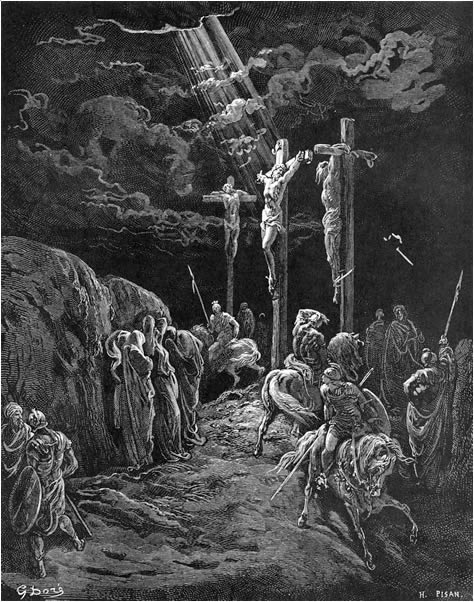
a place called Golgotha
on Matthew 27:33-34
Golgotha, place of a skull, likely takes its name from the hill's shape or from the executions it regularly hosted rather than from any relic tradition, and the two chief candidates, the Church of the Holy Sepulchre and the Garden Tomb, both sit outside the first century city wall as the law required. The vinegar mingled with gall was a customary narcotic mercy some Jerusalem women funded for the condemned, Mark calling it myrrh instead of gall, likely two names for one bitter mixture, and Jesus tastes it and refuses it, choosing to meet the cross with an unclouded mind rather than the numbing the custom offered. The refusal answers Psalm 69:21 by inversion, they gave me gall for my meat, and stands as the Gospel's quiet witness that nothing about what follows will be endured half aware.
The record, by era
The Church Fathers4 voices
When they had come to Golgotha, the Gospel says, "They gave him vinegar mixed with gall, but when he tasted it, he refused to drink." This event was foretold by David when he wrote, "They gave me gall for food, and they gave me vinegar …
I have heard Calvary expounded as the spot in which Adam was buried, as though it had been so called from the head of the old man being buried there. A plausible interpretation, and agreeable to the ears of the people, yet not a true one. Without the city outside the gate are the places where criminals are executed, and these have got the name of Calvary, that is, of the beheaded. And Jesus was crucified there, that where the plot of criminals had been, there might be set up the flag of martyrdom. But Adam was buried near Ebron and Arbee, as we read in the volume of Jesus the son of Navec.
(Hom. de Cruc. et Lat. ii.) The Lord would not suffer under a roof, or in the Jewish Temple, that you should not suppose that He was offered for that people alone; but without the city, without the walls, that you might know that the sacrifice was common, that it was the offering of the whole earth, that the purification was general.
Such is the place of the cross, set up in the centre of the earth, that it might be equally free to all nations to attain the knowledge of God.
The Medieval Church1 voice
Golgotha is a Syriac word, and is interpreted Calvary.
7 more voices on this verse
The Medieval Church2 voices
Then the place is set forth: "and they came to the place that is called Golgotha, which is the place of Calvary." Calvary means among men a bare place, as is evident in cemeteries. Hence in Greek it is called "cranios." And some say that …
And when they were come unto a place called Golgotha, which means, a place of a skull. It was called "a place of a skull," because those who have learned from the tradition of the fathers say that Adam was buried there; it was necessary …
The Puritans and the Awakening1 voice
And when they were come to a place called Golgotha,.... The true pronunciation is "Golgoltha", and so it is read in Munster's Hebrew Gospel. It is a Syriac word, in which language letters are often left out: in the Syriac version of this place, the first "l" is left out, and the latter retained, and it is read "Gogoltha": and so, in the Persic, "Gagulta"; and in the Arabic, "Gagalut".
The Nineteenth Century4 voices
A commentator
Albert Barnes1798–1870
Notes, Explanatory and Practical, on the Old and New Testaments (1832-1869)
Golgotha - This is a Hebrew word, signifying the place of a skull. This is the word which in Luke is called “Calvary.” The original Greek, there, also means a skull. The word “calvary” is a Latin word meaning “skull,” or place of “skulls.” It is not known certainly why this name was given to this place. Some have supposed that it was because the mount resembled in shape a human skull.
These verses describe the sufferings of our Lord Jesus Christ after his condemnation by Pilate, his sufferings in the hands of the brutal Roman soldiers, and his final sufferings on the cross. They form a marvelous record. They are marvelous when we remember the sufferer—the eternal Son of God. They are marvelous when we remember the persons for whom these sufferings were endured. We and our sins were the cause of all this sorrow! He “died for our sins” ( 1 Corinthians 15:3 ). Let us observe in the first place the extent and reality of our Lord’s sufferings.
These verses describe the sufferings of our Lord Jesus Christ after his condemnation by Pilate, his sufferings in the hands of the brutal Roman soldiers, and his final sufferings on the cross. They form a marvelous record. They are marvelous when we remember the sufferer—the eternal Son of God. They are marvelous when we remember the persons for whom these sufferings were endured. We and our sins were the cause of all this sorrow! He “died for our sins” ( 1 Corinthians 15:3 ). Let us observe in the first place the extent and reality of our Lord’s sufferings. The catalogue of all the pains endured by our Lord’s body is indeed a fearful one: seldom has such suffering been inflicted on one body in the last few hours of a life. The most savage tribes, in their refinement of cruelty, could hardly have heaped more agonizing tortures on an enemy than were accumulated on the flesh and bones of our beloved Master. Never let it be forgotten that he had a real human body, a body exactly like our own, just as sensitive, just as vulnerable, just as capable of feeling intense pain. And then let us see what that body endured. Our Lord, we must remember, had already passed a night without sleep, and endured excessive fatigue. He had been taken from Gethsemane to the Jewish council, and from the Council to Pilate’s judgment hall. He had been twice placed on his trial, and twice unjustly condemned. He had been already scourged and beaten cruelly with rods. And now, after all this suffering, he was delivered up to the Roman soldiers, a body of men no doubt expert in cruelty, and, of all people, least likely to behave with delicacy or compassion. These hard men at once proceeded to work their will.
A place called Golgotha - From the Hebrew גלגתה or גלגלת, golgoleth, a skull, probably so called from the many skulls of these who had suffered crucifixion and other capital punishments scattered up and down in the place. It is the same as Calvary, Calvaria, i.e. calvi capitis area, the place of bare skulls. Some think the place was thus called, because it was in the form of a human skull. It is likely that it was the place of public execution, similar to the Gemoniae Scalae at Rome.
The words behind it
11 Greek wordsEvery Greek word of this verse in the order it stands, with what it means and the door to its own study. The last column counts the times a word stands in the whole Bible: the rarer the word, the more the places it appears belong together.
| Greek | Sound | Meaning | Word study | In the Bible |
|---|---|---|---|---|
| Καὶ | kai | And | G2532 → | 9120 times |
| ἐλθόντες | elthontes | having come | G2064 → | 628 times |
| εἰς | eis | to | G1519 → | 1755 times |
| τόπον | topon | a place | G5117 → | 94 times |
| λεγόμενον | legomenon | being named | G3004 → | 1325 times |
| Γολγοθᾶ, | golgotha | Golgotha, | G1115 → | |
| ὅ | ho | which | G3739 → | 1405 times |
| ἐστιν | estin | is | G1510 → | 2333 times |
| κρανίου | kraniou | of a Skull | G2898 → | |
| τόπος | topos | Place | G5117 → | 94 times |
| λεγόμενος, | legomenos | being named, | G3004 → | 1325 times |
ΚαὶAnd
kaiG2532 →9120 times
ἐλθόντεςhaving come
elthontesG2064 →628 times
εἰςto
eisG1519 →1755 times
τόπονa place
toponG5117 →94 times
λεγόμενονbeing named
legomenonG3004 →1325 times
Γολγοθᾶ,Golgotha,
golgothaG1115 →
ὅwhich
hoG3739 →1405 times
ἐστινis
estinG1510 →2333 times
κρανίουof a Skull
kraniouG2898 →
τόποςPlace
toposG5117 →94 times
λεγόμενος,being named,
legomenosG3004 →1325 times
A shaded row is a word that stands 400 times or fewer in the Bible.
The walk
8 stopsEach card is a verse this one points to, and under it the verses that one points to in turn. Where several paths arrive at the same place, that place is listed first: the text keeps returning to it.
Through
Mark 15:34At the ninth hour, Jesus cried out in a loud voice, “Eloi, Eloi, lema sabachthani?” which means, “My God, My God, why have You forsaken Me?”
it leads to
- Psalms 22:1
My God, my God, why have You forsaken me? Why are You so far from saving me, so far from my words of groaning?
- Matthew 27:46
About the ninth hour Jesus cried out in a loud voice, “Eli, Eli, lema sabachthani?” which means, “My God, My God, why have You forsaken Me?”
- Hebrews 5:7
During the days of Jesus’ earthly life, He offered up prayers and petitions with loud cries and tears to the One who could save Him from death, and He was heard because of His…
- Psalms 27:9
Hide not Your face from me, nor turn away Your servant in anger. You have been my helper; do not leave me or forsake me, O God of my salvation.
- Isaiah 41:17
The poor and needy seek water, but there is none; their tongues are parched with thirst. I, the LORD, will answer them; I, the God of Israel, will not forsake them.
- Psalms 22:1
Through
Luke 23:44It was now about the sixth hour, and darkness came over all the land until the ninth hour.
it leads to
- Matthew 27:45
From the sixth hour until the ninth hour darkness came over all the land.
- Mark 15:33–34
From the sixth hour until the ninth hour darkness came over all the land.
- Amos 8:9
And in that day, declares the Lord GOD, I will make the sun go down at noon, and I will darken the earth in the daytime.
- Matthew 27:45
Where this verse is studied
About Matthew
Who and where
1 name in this verse with a page on the site.
This page draws on 14 works. Open the list of works
This page draws on Adam Clarke, Commentary on the Bible; Albert Barnes, Notes, Explanatory and Practical, on the Gospels; Albert Barnes, Notes, Explanatory and Practical, on the Old and New Testaments (1832-1869); Chromatius of Aquileia, TRACTATE ON MATTHEW 19.7.39; Hilary of Poitiers, Catena Aurea by Aquinas; J.C. Ryle, Expository Thoughts on the Gospels: Matthew; Jerome, Commentary on Matthew; Jerome, Catena Aurea by Aquinas; John Chrysostom, Catena Aurea by Aquinas; John Gill, Exposition of the New Testament (1746-1748); John Lightfoot, Horae Hebraicae et Talmudicae on Matthew; Rabanus Maurus, Catena Aurea by Aquinas; Theophylact of Ohrid, Commentary on Matthew and Thomas Aquinas, Commentary on Matthew.