
Matthew 27:36
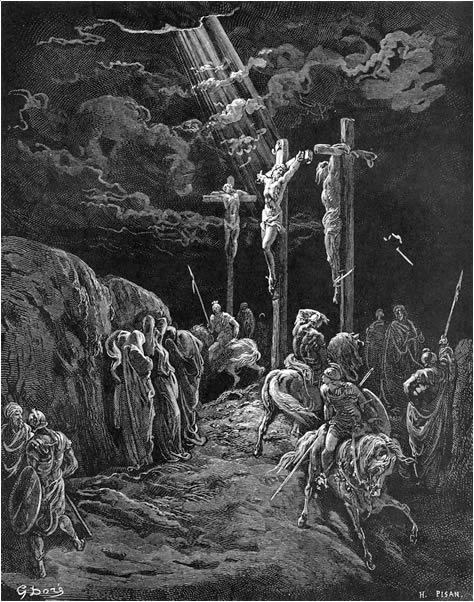
in Matthew 27And sitting down, they kept watch over Him there.
BSB
The same verse in ASV and KJV ▾
ASV
and they sat and watched him there.
KJV
And sitting down they watched him there;
⋯
This verse in Matthew 27
Commentary
12 notes on this verse(Verse 36.) And they kept watch over him while he was sitting. The diligence of the soldiers and priests helps us so that the greater and more evident power of his resurrection may appear.
This site's exposition
they kept watch over Him there
on Matthew 27:36-37
The soldiers sit and keep watch against rescue, and above his head they post the written charge, naming Jesus "THE KING OF THE JEWS". John 19:20 records it in Hebrew, Latin and Greek. At John 19:21-22 the chief priests ask Pilate to make it a claim, and he refuses.
The record, by era
The Church Fathers4 voices
The life and salvation of all things was hung from the tree of life with a thief on his left and a thief on his right. This demonstrates that the entire human race is called to the mystery of the Lord's suffering.
It proceeds, And sitting down, they watched him there. This watchfulness of the soldiers and of the Priests has proved of use to us in making the power of His resurrection greater and more notorious.
They parted the garments, by which such great miracles were done. But they wrought none now, Christ restraining His unspeakable power. And this was no small addition of insult. For as to one base and abject, as I said, and the vilest of all men; so do they dare to do all things. To the thieves at any rate they did nothing of the kind, but to Christ they dare it all. And they crucified Him in the midst of them, that He might share in their reputation.
For after "they had mocked Him, they led Him to crucify Him," it is said, and when they had stripped Him, they took His garments, and sat down and watched Him, when He should die. And they divide His garments amongst them, which sort of thing is done in the case of very vile and abject criminals, and such as have no one belonging to them, and are in utter desolation.
The Medieval Church1 voice
"And they sat and watched him etc.," namely so that he would not be buried; Psalm 21:18: "they have looked and stared upon me."
5 more voices on this verse
The Puritans and the Awakening1 voice
And sitting down, they watched him there.
The Nineteenth Century4 voices
They watched him - To prevent his disciples or relatives from taking away the body or affording any relief to the sufferer.
These verses describe the sufferings of our Lord Jesus Christ after his condemnation by Pilate, his sufferings in the hands of the brutal Roman soldiers, and his final sufferings on the cross. They form a marvelous record. They are marvelous when we remember the sufferer—the eternal Son of God. They are marvelous when we remember the persons for whom these sufferings were endured. We and our sins were the cause of all this sorrow! He “died for our sins” ( 1 Corinthians 15:3 ). Let us observe in the first place the extent and reality of our Lord’s sufferings.
These verses describe the sufferings of our Lord Jesus Christ after his condemnation by Pilate, his sufferings in the hands of the brutal Roman soldiers, and his final sufferings on the cross. They form a marvelous record. They are marvelous when we remember the sufferer—the eternal Son of God. They are marvelous when we remember the persons for whom these sufferings were endured. We and our sins were the cause of all this sorrow! He “died for our sins” ( 1 Corinthians 15:3 ). Let us observe in the first place the extent and reality of our Lord’s sufferings. The catalogue of all the pains endured by our Lord’s body is indeed a fearful one: seldom has such suffering been inflicted on one body in the last few hours of a life. The most savage tribes, in their refinement of cruelty, could hardly have heaped more agonizing tortures on an enemy than were accumulated on the flesh and bones of our beloved Master. Never let it be forgotten that he had a real human body, a body exactly like our own, just as sensitive, just as vulnerable, just as capable of feeling intense pain. And then let us see what that body endured. Our Lord, we must remember, had already passed a night without sleep, and endured excessive fatigue. He had been taken from Gethsemane to the Jewish council, and from the Council to Pilate’s judgment hall. He had been twice placed on his trial, and twice unjustly condemned. He had been already scourged and beaten cruelly with rods. And now, after all this suffering, he was delivered up to the Roman soldiers, a body of men no doubt expert in cruelty, and, of all people, least likely to behave with delicacy or compassion. These hard men at once proceeded to work their will.
A commentator
Albert Barnes1798–1870
Notes, Explanatory and Practical, on the Old and New Testaments (1832-1869)
proposed
They watched him there - That is, the four soldiers who had crucified him. They watched him lest his friends should come and release him.
The words behind it
5 Greek wordsEvery Greek word of this verse in the order it stands, with what it means and the door to its own study. The last column counts the times a word stands in the whole Bible: the rarer the word, the more the places it appears belong together.
| Greek | Sound | Meaning | Word study | In the Bible |
|---|---|---|---|---|
| καὶ | kai | And | G2532 → | 9120 times |
| καθήμενοι | kathemenoi | sitting down | G2521 → | 91 times |
| ἐτήρουν | eteroun | they were guarding | G5083 → | 70 times |
| αὐτὸν | auton | Him | G846 → | 5565 times |
| ἐκεῖ, | ekei | there, | G1563 → | 105 times |
καὶAnd
kaiG2532 →9120 times
καθήμενοιsitting down
kathemenoiG2521 →91 times
ἐτήρουνthey were guarding
eterounG5083 →70 times
αὐτὸνHim
autonG846 →5565 times
ἐκεῖ,there,
ekeiG1563 →105 times
A shaded row is a word that stands 400 times or fewer in the Bible.
The walk
8 stopsEach card is a verse this one points to, and under it the verses that one points to in turn. Where several paths arrive at the same place, that place is listed first: the text keeps returning to it.
Through
Mark 15:39When the centurion standing there in front of Jesus saw how He had breathed His last, he said, “Truly this man was the Son of God!”
it leads to
- Matthew 27:43
He trusts in God. Let God deliver Him now if He wants Him. For He said, ‘I am the Son of God.’”
Reached by 2 separate paths from here.
- Luke 23:47–48
When the centurion saw what had happened, he gave glory to God, saying, “Surely this was a righteous man.”
- Matthew 27:54
When the centurion and those with him who were guarding Jesus saw the earthquake and all that had happened, they were terrified and said, “Truly this was the Son of God.”
- Acts 10:1
At Caesarea there was a man named Cornelius, a centurion in what was called the Italian Regiment.
- Matthew 27:43
Through
Matthew 27:54When the centurion and those with him who were guarding Jesus saw the earthquake and all that had happened, they were terrified and said, “Truly this was the Son of God.”
it leads to
- Mark 15:39
When the centurion standing there in front of Jesus saw how He had breathed His last, he said, “Truly this man was the Son of God!”
- Luke 23:47–49
When the centurion saw what had happened, he gave glory to God, saying, “Surely this was a righteous man.”
- Romans 1:4
and who through the Spirit of holiness was declared with power to be the Son of God by His resurrection from the dead: Jesus Christ our Lord.
- Revelation 11:13
And in that hour there was a great earthquake, and a tenth of the city collapsed. Seven thousand were killed in the quake, and the rest were terrified and gave glory to the God…
- Mark 15:39
Where this verse is studied
On this page
Studies18
About Matthew
This page draws on 11 works. Open the list of works
This page draws on Adam Clarke, Commentary on the Bible; Albert Barnes, Notes, Explanatory and Practical, on the Gospels; Albert Barnes, Notes, Explanatory and Practical, on the Old and New Testaments (1832-1869); Hilary of Poitiers, Commentary on Matthew 23.4-5; J.C. Ryle, Expository Thoughts on the Gospels: Matthew; Jerome, Commentary on Matthew; Jerome, Catena Aurea by Aquinas; John Chrysostom, Homily on the Gospel of Matthew 87; John Gill, Exposition of the New Testament; John Gill, Exposition of the New Testament (1746-1748) and Thomas Aquinas, Commentary on Matthew.