
Matthew 27:44
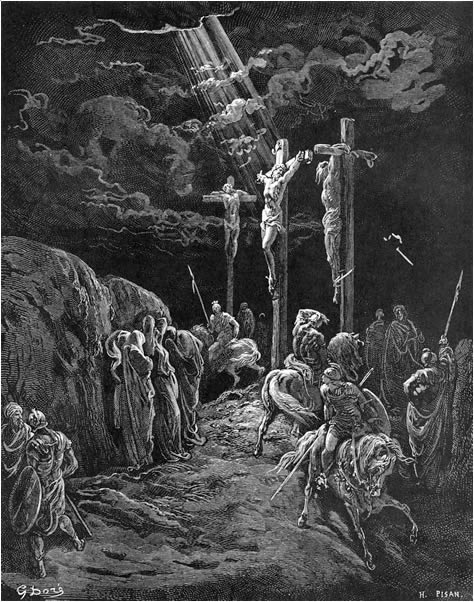
in Matthew 27In the same way, even the robbers who were crucified with Him berated Him.
BSB
The same verse in ASV and KJV ▾
ASV
And the robbers also that were crucified with him cast upon him the same reproach.
KJV
The thieves also, which were crucified with him, cast the same in his teeth.
⋯
This verse in Matthew 27
Commentary
17 notes on this verseOr it may be said that at first both reviled Him; but when the sun had withdrawn, the earth was shaken, the rocks were rent, and the darkness increased, one believed on Jesus, and repaired his former denial by a subsequent confession. Or, in the two thieves both nations, Jews and Gentiles, at first blasphemed the Lord; afterwards the latter terrified by the multitude of signs did penitence, and thus rebukes the Jews, who blaspheme to this day.
This site's exposition
wagging their heads
on Matthew 27:39-44
The passersby's mockery twists Jesus' own words from 26:61 into an accusation, Thou that destroyest the temple, missing that he had spoken of the temple of his body, John 2:19-21 explaining what the false witnesses at his trial had already garbled. The chief priests add their own taunt, he saved others, himself he cannot save, a sentence the bench reads as gospel truth spoken in scorn, since the very reason he will not save himself is that saving others required it. Their final line, let him come down from the cross, and we will believe him, sets the terms of a sign they had already refused at 12:38-39, and even the crucified thieves beside him, men with nothing left to lose, join the same reviling.
The record, by era
The Church Fathers5 voices
(de Cons. Ev. iii. 16.) It may seem that Luke contradicts this, when he describes one of the robbers as reviling Him, and as therefore rebuked by the other. But we may suppose that Matthew, shortly alluding to the circumstance, has used the plural for the singular, as in the Epistle to the Hebrews we have, Hare stopped the months of lions, (Heb. 11:33.) when Daniel only is spoken of. And what more common way of speaking than for one to say, See the country people insult me, when it is one only who has done so. If indeed Matthew had said that both the thieves had reviled the Lord, there would be some discrepancy; but when he says merely, The thieves, without adding 'both,' we must consider it as that common form of speech in which the singular is signified by the plural.
It is appropriate that both thieves be understood to have blasphemed the Lord at first. Afterwards, however, one of them converted and believed because of the wonders he heard performed by the Lord and also, perhaps, because he saw miraculous changes in the heavens and the falling of an untimely darkness.
The thief who was saved may be a sign of those who after many sins have believed on Christ.
That both the thieves cast in His teeth the manner of His Passion, shows that the cross should be an offence to all mankind, even to the faithful.
(Verse 44) Now even the robbers who were crucified with him were reviling him. Here, in a figurative sense known as σύλληψις, both robbers are depicted as blaspheming him. However, Luke asserts that while one blasphemed, the other confessed, and contrary to expectations, rebuked the blasphemer (Luke 23). It is not that the Gospels are inconsistent; rather, both robbers initially blasphemed, but then, as the sun set and the earth shook, and with rocks splitting and darkness descending, one believed in Jesus and rectified his previous denial with a subsequent confession. Among the two thieves, both the Gentiles and the Jews initially blasphemed the Lord. Later, one of them, struck by the magnitude of the signs, repented and to this day scolds the Jews for blaspheming.
10 more voices on this verse
The Church Fathers2 voices
At first both reviled Him, but afterwards not so. For that you should not suppose that the thing was arranged by any collusion, and that the thief was not a thief, he shows you by his wanton reproaches, that even after he was crucified he was a thief and a foe, but was afterwards totally changed.
A commentator
John ChrysostomHomily on the Gospel of Matthew 87 · Written in the 5th century.
proposed
Yet nevertheless, even when these things were said and done, they prevailed nothing, not even at the very time. At any rate, he, who was depraved in such great wickedness, and who had spent his whole life in murders and house-breakings, when these things were being said, then confessed Him, and made mention of a kingdom, and the people bewailed Him. And yet the things that were done seemed to testify the contrary in the eyes of those who knew not the mysterious dispensations, that He was weak and of no power, nevertheless truth prevailed even by the contrary things.
The Medieval Church3 voices
Had He then been prevailed on by their taunts to leave the cross, He would not have proved to us the power of endurance; but He waited enduring their mockery; and He who would not come down from the cross, rose again from the tomb.
"The thieves also that were crucified with him reproached him." But what is it that here it says both reproached him, while in Luke 23:39 only one did? Augustine resolves this by saying that sometimes it is customary in Scripture for the plural to be …
The thieves also, which were crucified with Him, likewise reproached Him. The two thieves were symbolic of the two races, the Jewish and the Gentile, for both races had transgressed the law and reviled Christ, just as both these thieves at first reviled Him. But …
The Puritans and the Awakening1 voice
The thieves also,....
The Nineteenth Century4 voices
The thieves also - cast the same in his teeth - That is, one of the robbers; for one, we find, was a penitent, Luk 23:39, Luk 23:40. See this form of expression accounted for, on Mat 26:8 (note).
These verses describe the sufferings of our Lord Jesus Christ after his condemnation by Pilate, his sufferings in the hands of the brutal Roman soldiers, and his final sufferings on the cross. They form a marvelous record. They are marvelous when we remember the sufferer—the eternal Son of God. They are marvelous when we remember the persons for whom these sufferings were endured. We and our sins were the cause of all this sorrow! He “died for our sins” ( 1 Corinthians 15:3 ). Let us observe in the first place the extent and reality of our Lord’s sufferings.
These verses describe the sufferings of our Lord Jesus Christ after his condemnation by Pilate, his sufferings in the hands of the brutal Roman soldiers, and his final sufferings on the cross. They form a marvelous record. They are marvelous when we remember the sufferer—the eternal Son of God. They are marvelous when we remember the persons for whom these sufferings were endured. We and our sins were the cause of all this sorrow! He “died for our sins” ( 1 Corinthians 15:3 ). Let us observe in the first place the extent and reality of our Lord’s sufferings. The catalogue of all the pains endured by our Lord’s body is indeed a fearful one: seldom has such suffering been inflicted on one body in the last few hours of a life. The most savage tribes, in their refinement of cruelty, could hardly have heaped more agonizing tortures on an enemy than were accumulated on the flesh and bones of our beloved Master. Never let it be forgotten that he had a real human body, a body exactly like our own, just as sensitive, just as vulnerable, just as capable of feeling intense pain. And then let us see what that body endured. Our Lord, we must remember, had already passed a night without sleep, and endured excessive fatigue. He had been taken from Gethsemane to the Jewish council, and from the Council to Pilate’s judgment hall. He had been twice placed on his trial, and twice unjustly condemned. He had been already scourged and beaten cruelly with rods. And now, after all this suffering, he was delivered up to the Roman soldiers, a body of men no doubt expert in cruelty, and, of all people, least likely to behave with delicacy or compassion. These hard men at once proceeded to work their will.
A commentator
Albert Barnes1798–1870
Notes, Explanatory and Practical, on the Old and New Testaments (1832-1869)
proposed
The thieves also - The robbers, or highwaymen. Luke says Luk 23:39 that one of them did it, and that the other reproved him and was penitent. The account in Luke may, however, easily be reconciled with that in Matthew by supposing that “at first both” of them reviled the Saviour, and that it is of this fact that Matthew speaks. Afterward one of them relented and became penitent perhaps from witnessing the patient sufferings of Christ. It is of this one particularly that Luke speaks. Or it may be that what is true of one of the criminals is by Matthew attributed to both. The evangelists, when for the sake of brevity they avoid particularizing, often attribute to many what is said or done by single persons, meaning no more than that it was done by some one or more of them, without specifying the one. Compare Mar 7:17 with Mat 15:15; Mar 5:31 with Luk 8:45; Luk 9:13 with Joh 6:8-9. Cast the same in his teeth - This is a most unhappy translation. It means in the original simply, they upbraided him or reproached him in the same manner.
The words behind it
12 Greek wordsEvery Greek word of this verse in the order it stands, with what it means and the door to its own study. The last column counts the times a word stands in the whole Bible: the rarer the word, the more the places it appears belong together.
| Greek | Sound | Meaning | Word study | In the Bible |
|---|---|---|---|---|
| Τὸ | to | <the> | G3588 → | 19766 times |
| δ᾽ | d᾽ | And | G1161 → | 2765 times |
| αὐτὸ | auto | likewise | G846 → | 5565 times |
| καὶ | kai | even | G2532 → | 9120 times |
| οἱ | hoi | the | G3588 → | 19766 times |
| λῃσταὶ | lestai | robbers | G3027 → | 15 times |
| οἱ | hoi | those | G3588 → | 19766 times |
| συσταυρωθέντες | sustaurothentes | having been crucified | G4957 → | |
| σὺν | sun | with | G4862 → | 128 times |
| αὐτῷ | auto | Him | G846 → | 5565 times |
| ὠνείδιζον | oneidizon | were upbraiding | G3679 → | 8 times |
| αὐτόν.¶ | auton | Him. | G846 → | 5565 times |
Τὸ<the>
toG3588 →19766 times
δ᾽And
d᾽G1161 →2765 times
αὐτὸlikewise
autoG846 →5565 times
καὶeven
kaiG2532 →9120 times
οἱthe
hoiG3588 →19766 times
λῃσταὶrobbers
lestaiG3027 →15 times
οἱthose
hoiG3588 →19766 times
συσταυρωθέντεςhaving been crucified
sustaurothentesG4957 →
σὺνwith
sunG4862 →128 times
αὐτῷHim
autoG846 →5565 times
ὠνείδιζονwere upbraiding
oneidizonG3679 →8 times
αὐτόν.¶Him.
autonG846 →5565 times
A shaded row is a word that stands 400 times or fewer in the Bible.
The walk
8 stopsEach card is a verse this one points to, and under it the verses that one points to in turn. Where several paths arrive at the same place, that place is listed first: the text keeps returning to it.
Through
Matthew 27:38Two robbers were crucified with Him, one on His right hand and the other on His left.
it leads to
- Luke 23:39–43
One of the criminals who hung there heaped abuse on Him. “Are You not the Christ?” he said. “Save Yourself and us!”
Reached by 2 separate paths from here.
- John 19:18
There they crucified Him, and with Him two others, one on each side, with Jesus in the middle.
- John 19:31–35
It was the day of Preparation, and the next day was a High Sabbath. In order that the bodies would not remain on the cross during the Sabbath, the Jews asked Pilate to have…
- Mark 15:27
Along with Jesus, they crucified two robbers, one on His right and one on His left.
- Isaiah 53:12
Therefore I will allot Him a portion with the great, and He will divide the spoils with the strong, because He has poured out His life unto death, and He was numbered with the…
- Luke 23:39–43
Through
Psalms 35:15But when I stumbled, they assembled in glee; they gathered together against me. Assailants I did not know slandered me without ceasing.
it leads to
- Mark 14:65
Then some of them began to spit on Him. They blindfolded Him, struck Him with their fists, and said to Him, “Prophesy!” And the officers received Him with slaps in His face.
- Jeremiah 20:10
For I have heard the whispering of many: “Terror is on every side! Report him; let us report him!” All my trusted friends watch for my fall: “Perhaps he will be deceived so that…
- Matthew 27:27–30
Then the governor’s soldiers took Jesus into the Praetorium and gathered the whole company around Him.
- Mark 14:65
Where this verse is studied
About Matthew
This page draws on 17 works. Open the list of works
This page draws on Adam Clarke, Commentary on the Bible; Albert Barnes, Notes, Explanatory and Practical, on the Old and New Testaments (1832-1869); Augustine of Hippo, Catena Aurea by Aquinas; Hilary of Poitiers, Catena Aurea by Aquinas; J.C. Ryle, Expository Thoughts on the Gospels: Matthew; Jerome, Catena Aurea by Aquinas; Jerome, Commentary on Matthew; John Chrysostom, Homilies on the Gospel of Matthew; John Chrysostom, Catena Aurea by Aquinas; John Chrysostom, Homily on the Gospel of Matthew 87; John Gill, Exposition of the New Testament (1746-1748); Matthew Henry, Commentary on the Whole Bible; Origen of Alexandria, COMMENTARY ON MATTHEW 133; Origen of Alexandria, Catena Aurea by Aquinas; Rabanus Maurus, Catena Aurea by Aquinas; Theophylact of Ohrid, Commentary on Matthew and Thomas Aquinas, Commentary on Matthew.