
Matthew 27:46
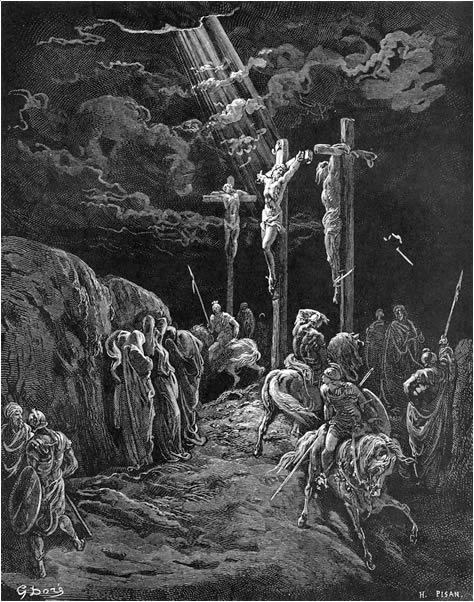
in Matthew 27About the ninth hour Jesus cried out in a loud voice, “Eli, Eli, lema sabachthani?” which means, “My God, My God, why have You forsaken Me?”
BSB
The same verse in ASV and KJV ▾
ASV
And about the ninth hour Jesus cried with a loud voice, saying, Eli, Eli, lama sabachthani? that is, My God, my God, why hast thou forsaken me?
KJV
And about the ninth hour Jesus cried with a loud voice, saying, Eli, Eli, lama sabachthani? that is to say, My God, my God, why hast thou forsaken me?
⋯
This verse in Matthew 27
Commentary
27 notes on this verseHe employed the beginning of the twenty-first Psalm. (Ps. 22:1. Vulg.) That clause in the middle of the verse, Look upon me, is superfluous; for the Hebrew has only 'Eli, Eli, lama sabachthani,' that is, My God, my God, why hast thou forsaken me? It is impiety therefore to think that this Psalm was spoken in the character of David or Esther or Mardocheus, when passages taken out of it by the Evangelist are understood of the Saviour; as, They parted my garments among them, and, They pierced my hands.
The record, by era
The Church Fathers5 voices
But it must be asked, What means this, that Christ is forsaken of God? Some, unable to explain how Christ could be forsaken of God, say that this was spoken out of humility. But you will be able clearly to comprehend His meaning if you make a comparison of the glory which He had with the Father with the shame which He despised when He endured the cross. When He saw darkness over the whole land of Judæa He said this, Father, why hast thou forsaken me? meaning, Why hast thou given Me over exhausted to such sufferings? that the people who were honoured by Thee may receive the things that they have dared against Me, and should be deprived of the light of Thy countenance. Also, Thou hast forsaken Me for the salvation of the Gentiles. But what good have they of the Gentiles who have believed done, that I should deliver them from the evil one by shedding My precious blood on the ground for them? Or will they, for whom I suffer these things, ever do aught worthy of them? Or foreseeing the sins of those for whom He suffered, He said, Why hast thou forsaken me? that I should become as one that, gathereth stubble in the harvest, and gleanings in the vintage. (Mic. 7:1.) But you must not imagine that the Saviour said this after the manner of men by reason of the misery which encompassed Him on the cross; for if you take it so you will not hear His loud voice and mighty words which point to something great hidden.
Night following day marks a division of times. Thus is fulfilled the triad of days and nights, and the hidden mystery of God's work is perceived with astonishment by all of creation. The cry to God in truth is the voice of a body departing, having declared the separation of the Word of God from itself. He wonders why he is being abandoned when he exclaims, "God, my God, why have you forsaken me?" But he was forsaken because his humanity had to pass even through death. It must be considered carefully that he gave up the spirit with a loud cry after he drank from the sponge full of vinegar offered to him on a reed. Wine is the honor and power of immortality, but it soured through the fault of the vessel or through carelessness. Therefore, since this wine had soured in Adam, he himself accepted it and drank from the nations. The fact that it was offered to him to drink from a sponge on a reed signifies that he took from the bodies of the Gentiles the sins which had ruined eternity and transferred our sins to himself, uniting them to his immortality.
(de Trin. x. 50 &c.) From these words heretical spirits contend either that God the Word was entirely absorbed into the soul at the time it discharged the function of a soul in quickening the body; or that Christ could not have been born man, because the Divine Word dwelt in Him after the manner of a prophetical spirit. As though Jesus Christ was a man of ordinary soul and body, having His beginning then when He began to be man, and thus now deserted upon the withdrawal of the protection of God's word cries out, My God, my God, why hast thou forsaken me? Or at least that the nature of the Word being transmuted into soul, Christ, who had depended in all things upon His Father's support, now deserted and left to death, mourns over this desertion, and pleads with Him departing. But amidst these impious and feeble opinions, the faith of the Church imbued with Apostolic teaching does not sever Christ that He should be considered as Son of God and not as Son of Man. The complaint of His being deserted is the weakness of the dying man; the promise of Paradise is the kingdom of the living God. You have Him complaining that He is left to death, and thus He is Man; you have Him as He is dying declaring that He reigns in Paradise; and thus He is God. Wonder not then at the humility of these words, when you know the form of a servant, and see the offence of the cross.
We have, moreover, in that other Gospel a clear revelation, i.e. of the Son's distinction from the Father, "My God, why hast Thou forsaken me? " and again, (in the third Gospel, ) "Father, into Thy hands I commend my spirit.
He exclaims that God had forsaken Him. He commends His spirit into the hands of the Father.
21 more voices on this verse
The Church Fathers3 voices
However, if you persist in pushing your views further, I shall find means of answering you with greater stringency, and of meeting you with the exclamation of the Lord Himself, so as to challenge you with the question, What is your inquiry and reasoning about that? You have Him exclaiming in the midst of His passion: "My God, my God, why hast Thou forsaken me? " Either, then, the Son suffered, being "forsaken" by the Father, and the Father consequently suffered nothing, inasmuch as He forsook the Son; or else, if it was the Father who suffered, then to what God was it that He addressed His cry? But this was the voice of flesh and soul, that is to say, of man-not of the Word and Spirit, that is to say, not of God; and it was uttered so as to prove the impassibility of God, who "forsook" His Son, so far as He handed over His human substance to the suffering of death.
(Verse 46.) And about the ninth hour, Jesus cried out with a loud voice, saying: Eli, Eli, lammasabacthani, which means: My God, My God, why have you forsaken me? He made use of the beginning of the twenty-first psalm, and that which is read in the middle of the verse: Look upon me, for it is useless. For it is read in Hebrew: My God, My God, why have you forsaken me? Therefore, those who think that this psalm is spoken from the perspective of David, Esther, or Mordecai are wicked, since the evangelists also understand the testimonies taken from it concerning the Savior, as in: They divided my garments among themselves, and for my clothing they cast lots. And another thing: They pierced my hands and my feet. Do not be surprised at the lowly words and the complaints of one who is forsaken, when you see the form of a servant and the scandal of the cross.
And for this reason, even after this He speaks, that they might learn that He was still alive, and that He Himself did this, and that they might become by this also more gentle, and He saith, "Eli, Eli, lama sabachthani?" that unto His last breath they might see that He honors His Father, and is no adversary of God. Wherefore also He uttered a certain cry from the prophet, even to His last hour bearing witness to the Old Testament, and not simply a cry from the prophet, but also in Hebrew, so as to be plain and intelligible to them, and by all things He shows how He is of one mind with Him that begat Him.
The Medieval Church4 voices
Or, The Saviour said this as bearing about with Him our feelings, who when placed in dangers think ourselves forsaken by God. Human nature was forsaken by God because of its sins, and the Son of God becoming our Advocate laments the misery of those whose guilt He took upon Himf; there in showing how they who sin ought to mourn, when He who never sinned did thus mourn.
(non occ.) God is said to have forsaken Him in death because He exposed Him to the power of His persecutors; He withdrew His protection, but did not break the union.
"And about the ninth hour, Jesus cried out with a loud voice." Here he sets forth the cry of Christ. And first, the cry is set forth; second, the effect, at "and some that stood there etc." He says therefore "and about the ninth hour, …
And about the ninth hour Jesus cried out with a loud voice, saying, Eli, Eli, lama sabachthani? that is to say, My God, My God, why hast Thou forsaken Me? Jesus speaks prophetically in the Hebrew tongue to show that He does not contend with …
The Puritans and the Awakening2 voices
And about the ninth hour,.... Or three o'clock in the afternoon, which was about the time of the slaying and offering of the daily sacrifice, which was an eminent type of Christ. The Jews say (i), that "every day the daily sacrifice was slain at eight and a half, and was offered up at nine and a half: about which time also the passover was killed, which was another type of Christ; and as they say (k), "was offered first, and then the daily sacrifice."
My God, my God, why hast thou forsaken me? - Our Lord hereby at once expresses his trust in God, and a most distressing sense of his letting loose the powers of darkness upon him, withdrawing the comfortable discoveries of his presence, and filling his soul with a terrible sense of the wrath due to the sins which he was bearing.
The Nineteenth Century10 voices
My God! My God! why hast thou forsaken me! - These words are quoted by our Lord from Psa 22:1; they are of very great importance, and should be carefully considered. Some suppose “that the divinity had now departed from Christ, and that his human nature was left unsupported to bear the punishment due to men for their sins.” But this is by no means to be admitted, as it would deprive his sacrifice of its infinite merit, and consequently leave the sin of the world without an atonement.
In these verses we read the conclusion of our Lord Jesus Christ’s passion. After six hours of agonizing suffering, he became obedient even unto death, and “yielded up the ghost.” Three points in the narrative demand a special notice: to them let us confine our attention. Let us observe in the first place the remarkable words which Jesus uttered shortly before his death: “My God, my God, why hast thou forsaken me?” There is a deep mystery in these words, which no mortal man can fathom.
In these verses we read the conclusion of our Lord Jesus Christ’s passion. After six hours of agonizing suffering, he became obedient even unto death, and “yielded up the ghost.” Three points in the narrative demand a special notice: to them let us confine our attention. Let us observe in the first place the remarkable words which Jesus uttered shortly before his death: “My God, my God, why hast thou forsaken me?” There is a deep mystery in these words, which no mortal man can fathom. No doubt they were not wrung from our Lord by mere bodily pain: such an explanation is utterly unsatisfactory, and dishonorable to our blessed Saviour. They were meant to express the real pressure on his soul of the enormous burden of a world’s sins; they were meant to show how truly and literally he was our substitute—was made sin, and a curse for us, and endured God’s righteous anger against a world’s sin in his own person. At that awful moment the iniquity of us all was laid on him to the uttermast. It pleased the Lord to bruise him and put him to grief ( Isaiah 53:10 ). He bore our sins: he carried our transgressions. Heavy must have been that burden, real and literal must have been our Lord’s substitution for us when he, the eternal Son of God, could speak of himself as for a time “forsaken.” Let the expression sink down into our hearts, and not be forgotten. We can have no stronger proof of the sinfulness of sin, or of the vicarious nature of Christ’s sufferings, than his cry, “My God, my God, why hast thou forsaken me?” It is a cry that should stir us up to hate sin, and encourage us to trust in Christ. Let us observe in the second place how much is contained in the words which describe our Lord’s end. We are simply told, “he yielded up the ghost.” There never was a last breath drawn of such deep import as this. There never was an event on which so much depended.
I do not think that the records of time, or even of eternity, contain a sentence more full of anguish. Here the wormwood, the gall and all the other bitterness are outdone. Here you may look as into a vast abyss—and though you strain your eyes and gaze till sight fails you, yet you perceive no bottom—it is measureless, unfathomable, inconceivable. This anguish of the Savior on your behalf and mine is no more to be measured and weighed than the sin which needed it, or the love which endured it. We will adore where we cannot comprehend.
I do not think that the records of time, or even of eternity, contain a sentence more full of anguish. Here the wormwood, the gall and all the other bitterness are outdone. Here you may look as into a vast abyss—and though you strain your eyes and gaze till sight fails you, yet you perceive no bottom—it is measureless, unfathomable, inconceivable. This anguish of the Savior on your behalf and mine is no more to be measured and weighed than the sin which needed it, or the love which endured it. We will adore where we cannot comprehend. I have chosen this subject that it may help the children of God to understand a little of their infinite obligations to their redeeming Lord. You shall measure the height of His love, if it can be measured, by the depth of His grief, if that can ever be known. See with what a price He has redeemed us from the curse of the Law! As you see this, say to yourselves—What manner of people ought we to be? What measure of love ought we to return to One who bore the utmost penalty that we might be delivered from the wrath to come? I do not profess that I can dive into this deep—I will only venture to the edge of the precipice and bid you look down and pray the Spirit of God to concentrate your mind upon this lamentation of our dying Lord as it rises up through the thick darkness—"My God, My God, why have You forsaken Me?" Our first subject of thought will be the fact, or what He suffered—God had forsaken Him. Secondly, we will note the enquiry, or why He suffered—this word, "why," is the edge of the text. "Why have You forsaken Me?" Then, thirdly, we will consider the answer, or what came of His suffering.
A commentator
Charles Spurgeon1834–1892
The Metropolitan Tabernacle Pulpit, Sermon No. 2803: “The Saddest Cry From the Cross” (lightly modernized text, CCEL edition) · Written before 1892.
proposed
DURING the time that "Moses kept the flock of Jethro, his father-in-law," he, "came to the mountain of God, even to Horeb," and there he saw a strange sight—a bush that burned with fire and yet was not consumed! Then Moses, apparently overtaken by curiosity, was drawing near in order to examine this phenomenon when he heard God's voice say to him, "Draw not near here: take off your shoes from your feet, for the place where on you stand is holy ground."
A commentator
Charles Spurgeon1834–1892
The Metropolitan Tabernacle Pulpit, Sermon No. 2803: “The Saddest Cry From the Cross” (lightly modernized text, CCEL edition) · Written before 1892.
proposed
DURING the time that "Moses kept the flock of Jethro, his father-in-law," he, "came to the mountain of God, even to Horeb," and there he saw a strange sight—a bush that burned with fire and yet was not consumed! Then Moses, apparently overtaken by curiosity, was drawing near in order to examine this phenomenon when he heard God's voice say to him, "Draw not near here: take off your shoes from your feet, for the place where on you stand is holy ground." We also may well feel, as we think of our Lord Jesus in His agony, that the voice of God speaks to us from the Cross and says, "Curiosity—bold, daring, prying intellect—draw not near here! Take off your shoes from your feet, for the place where on you stand is the very Holy of Holies unto which no man may come except as the Spirit of God shall conduct him." I think I can understand the words, "My God, my God, why have You forsaken me?" as they are written by David in the 22nd Psalm, but the same words, "My God, My God, why have You forsaken Me?" when uttered by Jesus on the Cross, I cannot comprehend, so I shall not pretend to be able to explain them. There is no plummet that can fathom this deep! There is no eagle's eye that can penetrate the mystery that surrounds this strange question! I have read that once upon a time Martin Luther sat down in his study to consider this text. Hour after hour, that mighty man of God sat still—and those who waited on him came into the room, again and again, and he was so absorbed in his meditation that they almost thought he was a corpse.
A commentator
Charles Spurgeon1834–1892
The Metropolitan Tabernacle Pulpit, Sermon No. 3507: “Our Lord's Solemn Enquiry” (lightly modernized text, CCEL edition) · Written before 1892.
proposed
IF any one of us, lovers of the Lord Jesus Christ had been anywhere near the cross when he uttered those words, I am sure our hearts would have burst with anguish, and one thing is certain—we should have heard the tones of that dying cry as long as ever we lived. There is no doubt that at certain times they would come to us again, ringing shrill and clear through the thick darkness.
A commentator
Charles Spurgeon1834–1892
The Metropolitan Tabernacle Pulpit, Sermon No. 3507: “Our Lord's Solemn Enquiry” (lightly modernized text, CCEL edition) · Written before 1892.
proposed
IF any one of us, lovers of the Lord Jesus Christ had been anywhere near the cross when he uttered those words, I am sure our hearts would have burst with anguish, and one thing is certain—we should have heard the tones of that dying cry as long as ever we lived. There is no doubt that at certain times they would come to us again, ringing shrill and clear through the thick darkness. We should remember just how they were uttered, and the emphasis where it was placed, and I have no doubt we should turn that text over, and over, and over in our minds. But there is one thing, I think, we should never have done if we had heard it—therefore, I am not going to do it—we should never preach from it. It would have been too painful a recollection for us ever to have used it as a text. No; we should have said, "It is enough to hear it." Fully understand it, who can? And to expound it, since some measure of understanding might be necessary to the exposition—that surely were a futile attempt. We should have laid that by; we should have put those words away as too sacred, too solemn, except for silent reflection and quiet, reverent adoration. I felt when I read these words again, as I have often read them, that they seemed to say to me, "You cannot preach from us," and, on the other hand, felt as Moses did when he put off his shoe from off his foot in the presence of the burning bush, because the place whereon he stood was holy ground. Beloved, there is another reason why we should not venture to preach from this text, namely, that it is probably an expression out of the lowest depths of our Saviour's sufferings. With him into the seas of grief we can descend some part of the way; but when he comes where all God's waves and billows go over him, we cannot go there.
A commentator
Albert Barnes1798–1870
Notes, Explanatory and Practical, on the Old and New Testaments (1832-1869)
proposed
Eli, Eli ... - This language is not pure Hebrew nor Syriac, but a mixture of both, called commonly “Syro-Chaldaic.” This was probably the language which the Saviour commonly spoke. The words are taken from Psa 22:1. My God, my God ... - This expression is one denoting intense suffering. It has been difficult to understand in what sense Jesus was “forsaken by God.” It is certain that God approved his work. It is certain that he was innocent. He had done nothing to forfeit the favor of God. As his own Son - holy, harmless, undefiled, and obedient - God still loved him. In either of these senses God could not have forsaken him. But the expression was probably used in reference to the following circumstances, namely: 1. His great bodily sufferings on the cross, greatly aggravated by his previous scourging, and by the want of sympathy, and by the revilings of his enemies on the cross. A person suffering thus might address God as if he was forsaken, or given up to extreme anguish. 2. He himself said that this was “the power of darkness,” Luk 22:53. It was the time when his enemies, including the Jews and Satan, were suffered to do their utmost. It was said of the serpent that he should bruise the heel of the seed of the woman, Gen 3:15. By that has been commonly understood to be meant that, though the Messiah would finally crush and destroy the power of Satan, yet he should himself suffer “through the power of the devil.” When he was tempted Luke 4, it was said that the tempter “departed from him for a season.” There is no improbability in supposing that he might be permitted to return at the time of his death, and exercise his power in increasing the sufferings of the Lord Jesus. In what way this might be done can be only conjectured. […]
Modern Voices2 voices
A commentator
GK ChestertonThe Everlasting Man, Part 2 Ch. 3: The Strangest Story in the World (1925) (1925)
proposed
There were solitudes beyond where none shall follow. There were secrets in the inmost and invisible part of that drama that have no symbol in speech; or in any severance of a man from men. Nor is it easy for any words less stark and …
Lastly, this truth is yet again true in the case of the common modern attempts to diminish or to explain away the divinity of Christ. The thing may be true or not; that I shall deal with before I end. But if the divinity is …
The words behind it
24 Greek wordsEvery Greek word of this verse in the order it stands, with what it means and the door to its own study. The last column counts the times a word stands in the whole Bible: the rarer the word, the more the places it appears belong together.
| Greek | Sound | Meaning | Word study | In the Bible |
|---|---|---|---|---|
| περὶ | peri | About | G4012 → | 332 times |
| δὲ | de | then | G1161 → | 2765 times |
| τὴν | ten | the | G3588 → | 19766 times |
| ἐνάτην | enaten | ninth | G1766 → | 10 times |
| ὥραν | horan | hour | G5610 → | 106 times |
| ἀνεβόησεν | aneboesen | cried out | G310 → | |
| ὁ | ho | <the> | G3588 → | 19766 times |
| Ἰησοῦς | iesous | Jesus | G2424 → | 908 times |
| φωνῇ | phonea | in a voice | G5456 → | 139 times |
| μεγάλῃ | megale | loud | G3173 → | 243 times |
| λέγων· | legon | saying; | G3004 → | 1325 times |
| ηλι | eli | Eli | G2241 → | |
| ηλι, | eli | Eli, | G2241 → | |
| λεμα | lema | lema | G2982 → | |
| σαβαχθανι; | sabachthani | sabachthani? | G4518 → | |
| τοῦτ᾽ | tout᾽ | That | G3778 → | 1381 times |
| ἔστιν· | estin | is: | G1510 → | 2333 times |
| θεέ | thee | God | G2316 → | 1312 times |
| μου | mou | of Mine | G3165 → | 1936 times |
| θεέ | thee | God | G2316 → | 1312 times |
| μου, | mou | of Mine, | G3165 → | 1936 times |
| ἱνατί | hinati | so why | G2443 →G5101 → | 563 times |
| με | me | Me | G3165 → | 1936 times |
| ἐγκατέλιπες;¶ | egkatelipes | have you forsaken? | G1459 → |
περὶAbout
periG4012 →332 times
δὲthen
deG1161 →2765 times
τὴνthe
tenG3588 →19766 times
ἐνάτηνninth
enatenG1766 →10 times
ὥρανhour
horanG5610 →106 times
ἀνεβόησενcried out
aneboesenG310 →
ὁ<the>
hoG3588 →19766 times
ἸησοῦςJesus
iesousG2424 →908 times
φωνῇin a voice
phoneaG5456 →139 times
μεγάλῃloud
megaleG3173 →243 times
λέγων·saying;
legonG3004 →1325 times
ηλιEli
eliG2241 →
ηλι,Eli,
eliG2241 →
λεμαlema
lemaG2982 →
σαβαχθανι;sabachthani?
sabachthaniG4518 →
τοῦτ᾽That
tout᾽G3778 →1381 times
ἔστιν·is:
estinG1510 →2333 times
θεέGod
theeG2316 →1312 times
μουof Mine
mouG3165 →1936 times
θεέGod
theeG2316 →1312 times
μου,of Mine,
mouG3165 →1936 times
ἱνατίso why
μεMe
meG3165 →1936 times
ἐγκατέλιπες;¶have you forsaken?
egkatelipesG1459 →
A shaded row is a word that stands 400 times or fewer in the Bible.
The walk
8 stopsEach card is a verse this one points to, and under it the verses that one points to in turn. Where several paths arrive at the same place, that place is listed first: the text keeps returning to it.
Through
Psalms 22:1My God, my God, why have You forsaken me? Why are You so far from saving me, so far from my words of groaning?
it leads to
- Mark 15:34
At the ninth hour, Jesus cried out in a loud voice, “Eloi, Eloi, lema sabachthani?” which means, “My God, My God, why have You forsaken Me?”
- Hebrews 5:7
During the days of Jesus’ earthly life, He offered up prayers and petitions with loud cries and tears to the One who could save Him from death, and He was heard because of His…
Reached by 2 separate paths from here.
- Mark 15:34
Through
Mark 15:34At the ninth hour, Jesus cried out in a loud voice, “Eloi, Eloi, lema sabachthani?” which means, “My God, My God, why have You forsaken Me?”
it leads to
- Psalms 22:1
My God, my God, why have You forsaken me? Why are You so far from saving me, so far from my words of groaning?
- Psalms 22:1
Through
Hebrews 5:7During the days of Jesus’ earthly life, He offered up prayers and petitions with loud cries and tears to the One who could save Him from death, and He was heard because of His…
it leads to
- Luke 22:41–44
And He withdrew about a stone’s throw beyond them, where He knelt down and prayed,
- John 17:1
When Jesus had spoken these things, He lifted up His eyes to heaven and said, “Father, the hour has come. Glorify Your Son, that Your Son may glorify You.
- Mark 14:32–39
Then they came to a place called Gethsemane, and Jesus told His disciples, “Sit here while I pray.”
- John 17:4–5
I have glorified You on earth by accomplishing the work You gave Me to do.
- Luke 22:41–44
Through
Isaiah 53:10Yet it was the LORD’s will to crush Him and to cause Him to suffer; and when His soul is made a guilt offering, He will see His offspring, He will prolong His days,…
it leads to
- 2 Corinthians 5:21
God made Him who knew no sin to be sin on our behalf, so that in Him we might become the righteousness of God.
- 2 Corinthians 5:21
Where this verse is studied
On this page
Studies18
On this verse
On this chapter
About Matthew
Who and where
1 name in this verse with a page on the site.
This page draws on 21 works. Open the list of works
This page draws on Adam Clarke, Commentary on the Bible; Albert Barnes, Notes, Explanatory and Practical, on the Old and New Testaments (1832-1869); Charles Spurgeon, The Metropolitan Tabernacle Pulpit, Sermon No. 2133: “"My God, My God, Why Have You Forsaken Me?"” (lightly modernized text, CCEL edition); Charles Spurgeon, The Metropolitan Tabernacle Pulpit, Sermon No. 2803: “The Saddest Cry From the Cross” (lightly modernized text, CCEL edition); Charles Spurgeon, The Metropolitan Tabernacle Pulpit, Sermon No. 3507: “Our Lord's Solemn Enquiry” (lightly modernized text, CCEL edition); GK Chesterton, The Everlasting Man, Part 2 Ch. 3: The Strangest Story in the World (1925); GK Chesterton, Orthodoxy, Ch. 8: The Romance of Orthodoxy (1908); Glossa Ordinaria, Catena Aurea by Aquinas; Hilary of Poitiers, Commentary on Matthew 33.6; Hilary of Poitiers, Catena Aurea by Aquinas; J.C. Ryle, Expository Thoughts on the Gospels: Matthew; Jerome, Catena Aurea by Aquinas; Jerome, Commentary on Matthew; John Chrysostom, Homily on the Gospel of Matthew 88; John Gill, Exposition of the New Testament (1746-1748); John Wesley, Explanatory Notes upon the New Testament; Origen of Alexandria, Catena Aurea by Aquinas; Rabanus Maurus, Catena Aurea by Aquinas; Tertullian, Against Praxeas; Theophylact of Ohrid, Commentary on Matthew and Thomas Aquinas, Commentary on Matthew.