
Matthew 27:54
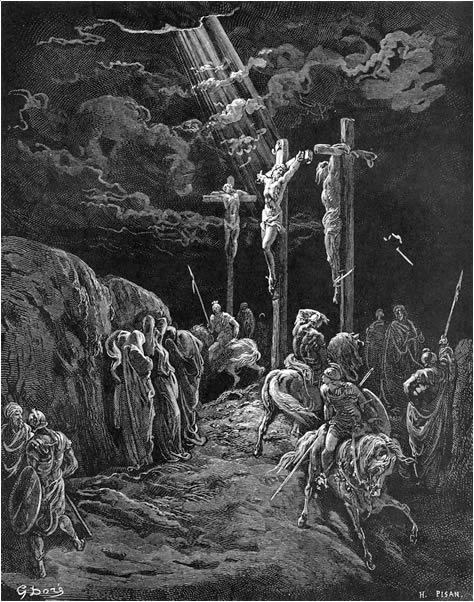
in Matthew 27When the centurion and those with him who were guarding Jesus saw the earthquake and all that had happened, they were terrified and said, “Truly this was the Son of God.”
BSB
The same verse in ASV and KJV ▾
ASV
Now the centurion, and they that were with him watching Jesus, when they saw the earthquake, and the things that were done, feared exceedingly, saying, Truly this was the Son of God.
KJV
Now when the centurion, and they that were with him, watching Jesus, saw the earthquake, and those things that were done, they feared greatly, saying, Truly this was the Son of God.
⋯
This verse in Matthew 27
Commentary
16 notes on this verse(Verse 54) But the centurion and those who were with him, guarding Jesus, when they saw the earthquake and the things that were happening, were very afraid, saying: Truly, this was the Son of God. In another Gospel, after the earthquake, a more clear cause of the centurion's miracle is explained: when he saw him breathe his last, he said: Truly, this was the Son of God. For no one has the power to dismiss the spirit except the one who is the creator of souls.
The record, by era
The Church Fathers5 voices
(Serm. 66. 3.) From this example then of the Centurion let the substance of the earth tremble in the punishment of its Redeemer, let the rocks of unbelieving minds be rent, and those who were pent up in these sepulchres of mortality leap forth, bursting the bonds that would detain them; and let them show themselves in the Holy City, i. e. the Church of God, as signs of the Resurrection to come; and thus let that take place in the heart, which we must believe takes place in the body.
(Verse 53.) And many bodies of saints who had fallen asleep were raised. And coming out of the tombs after his resurrection, they went into the holy city and appeared to many. Just as Lazarus, who was dead, rose again, so too many bodies of saints rose again to show the rising of the Lord (John 11). And yet, although the tombs were opened, they did not rise before the Lord rose, so that he would be the firstborn of the resurrection from the dead. But let us understand the holy city, in which they [the risen ones] were seen, either as the heavenly Jerusalem, or as this earthly one, which was previously holy. Just as Matthew is called a tax collector, not because he still remains a tax collector, but because he retains the former title. The city of Jerusalem was called holy because of the temple and the holy of holies, and in distinction from other cities where idols were worshipped. When it is said 'truly', they appeared to many, it is shown that the resurrection was not general, which would appear to everyone: but specific to many, so that those who were worthy could see. (Verse 54.) But the centurion and those who were with him, guarding Jesus, when they saw the earthquake and the things that were happening, were very afraid, saying: Truly, this was the Son of God. In another Gospel, after the earthquake, a more clear cause of the centurion's miracle is explained: when he saw him breathe his last, he said: Truly, this was the Son of God. For no one has the power to dismiss the spirit except the one who is the creator of souls. But in this place, let us understand spirit as the soul, either because it constitutes a spiritual and vital body, or because the substance of the soul itself is a spirit, according to what is written: 'You will take away their spirit, and they will die' (Psalm 103:29). […]
Observe, that in the very midst of the offence of His passion the Centurion acknowledges the Son of God, while Arius in the Church proclaims Him a creature.
(de Cons. Ev. iii. 20.) It is no contradiction here that Matthew says, that The centurion and they that were with him, watching Jesus, feared when they saw the earthquake, and the things that were done; while Luke says, that he wondered at the giving up the ghost with a loud voice. For when Matthew adds, the things that were done, this gives full scope for Luke's expression, that he wondered at the Lord's death, for this among the rest was wonderful.
And the Centurion too then glorified God, saying, "Truly this was a righteous man. And the multitudes that came together to that sight, returned beating their breasts." So great was the power of the crucified, that after so many mockings, and scoffs, and jeers, both the centurion was moved to compunction, and the people. And some say that there is also a martyrdom of this centurion, who after these things grew to manhood in the faith.
10 more voices on this verse
The Medieval Church3 voices
Whence with good reason by the Centurion is denoted the faith of the Church, which, when the veil of heavenly mysteries had been rent by the Lord's death, immediately asserts Jesus to be both very Man, and truly Son of God, while the Synagogue held its peace.
Now when the centurion, and they that were with him keeping watch over Jesus, saw the earthquake, and those things that were done, they feared greatly, saying, Truly this was the Son of God. The Gentile centurion and those with him believed because of these …
"Now the centurion etc." Here the effect of the miracles is treated. And first, in the Gentiles; second, in the women, at "and there were there many women." Concerning the first, he does three things. First, diligent consideration is set forth; second, fear; third, a …
The Puritans and the Awakening2 voices
Now, when the centurion,.... That was over the band of soldiers, that mocked Christ in Pilate's hall, and who was particularly over the guard of soldiers, set about the cross of Christ: and they that were with him, watching Jesus: the soldiers that were with him, who were set to watch the cross of Christ, lest he should come down, or any should take him down from thence, See Gill on Mat 27:
The centurion - The officer who commanded the guard; and they that were with him feared, saying, Truly this was the Son of God - Referring to the words of the chief priests and scribes, chap. xxvii, xliii, He said, I am the Son of God.
The Nineteenth Century5 voices
The centurion - The Roman officer who superintended the execution, called centurio, from centum, a hundred, because he had the command of one hundred men. Truly this was the Son of God - An innocent, holy, and Divine person; and God thus shows his disapprobation of this bloody tragedy. It is not likely that this centurion had any knowledge of the expectation of the Jews relative to the Messiah, and did not use the words in this sense.
A commentator
Jamieson, Fausset & Brown1802–1910
Commentary Critical and Explanatory on the Whole Bible (1871)
The meaning, then, clearly is that He must have been what He professed to be; in other words, that He was no impostor. There was no medium between those two. See, on the similar testimony of the penitent thief--"This man hath done nothing amiss"--Luke 23.
In these verses we read the conclusion of our Lord Jesus Christ’s passion. After six hours of agonizing suffering, he became obedient even unto death, and “yielded up the ghost.” Three points in the narrative demand a special notice: to them let us confine our attention. Let us observe in the first place the remarkable words which Jesus uttered shortly before his death: “My God, my God, why hast thou forsaken me?” There is a deep mystery in these words, which no mortal man can fathom.
In these verses we read the conclusion of our Lord Jesus Christ’s passion. After six hours of agonizing suffering, he became obedient even unto death, and “yielded up the ghost.” Three points in the narrative demand a special notice: to them let us confine our attention. Let us observe in the first place the remarkable words which Jesus uttered shortly before his death: “My God, my God, why hast thou forsaken me?” There is a deep mystery in these words, which no mortal man can fathom. No doubt they were not wrung from our Lord by mere bodily pain: such an explanation is utterly unsatisfactory, and dishonorable to our blessed Saviour. They were meant to express the real pressure on his soul of the enormous burden of a world’s sins; they were meant to show how truly and literally he was our substitute—was made sin, and a curse for us, and endured God’s righteous anger against a world’s sin in his own person. At that awful moment the iniquity of us all was laid on him to the uttermast. It pleased the Lord to bruise him and put him to grief ( Isaiah 53:10 ). He bore our sins: he carried our transgressions. Heavy must have been that burden, real and literal must have been our Lord’s substitution for us when he, the eternal Son of God, could speak of himself as for a time “forsaken.” Let the expression sink down into our hearts, and not be forgotten. We can have no stronger proof of the sinfulness of sin, or of the vicarious nature of Christ’s sufferings, than his cry, “My God, my God, why hast thou forsaken me?” It is a cry that should stir us up to hate sin, and encourage us to trust in Christ. Let us observe in the second place how much is contained in the words which describe our Lord’s end. We are simply told, “he yielded up the ghost.” There never was a last breath drawn of such deep import as this. There never was an event on which so much depended.
A commentator
Albert Barnes1798–1870
Notes, Explanatory and Practical, on the Old and New Testaments (1832-1869)
proposed
Now when the centurion ... - Centurion, a captain of a hundred soldiers. He was here placed over the band that attended the crucifixion. They feared greatly - They regarded these things as proof that God was angry, and they were terrified at the prospect that vengeance was coming on them. Truly this was the Son of God - They had heard, probably, that Jesus professed to be the Son of God. Seeing these wonders, they believed that God was now attesting the truth of his professions. The centurion was a pagan, and had probably no very distinct notions of the phrase “the Son of God” - perhaps understanding by it only that he was like the pagan heroes who had been deified; but he certainly regarded these wonders as proof that he was “what he professed to be.” In the original it is “a son of a god;” an expression perfectly suitable to a polytheist, who believed in the existence of many gods. Mark Mar 15:39 says that they affirmed that “this man was the Son of God.” Luke Luk 23:47, that they said, “Certainly this was a righteous man.’ These things were said by “different persons,” or at different periods of his sufferings - one evangelist having recorded one saying, and another another.
The words behind it
24 Greek wordsEvery Greek word of this verse in the order it stands, with what it means and the door to its own study. The last column counts the times a word stands in the whole Bible: the rarer the word, the more the places it appears belong together.
| Greek | Sound | Meaning | Word study | In the Bible |
|---|---|---|---|---|
| Ὁ | ho | <the> | G3588 → | 19766 times |
| δὲ | de | And | G1161 → | 2765 times |
| ἑκατόνταρχος | hekatontarchos | the centurion | G1543 → | 20 times |
| καὶ | kai | and | G2532 → | 9120 times |
| οἱ | hoi | those | G3588 → | 19766 times |
| μετ᾽ | met᾽ | with | G3326 → | 461 times |
| αὐτοῦ | autou | him | G846 → | 5565 times |
| τηροῦντες | terountes | keeping guard over | G5083 → | 70 times |
| τὸν | ton | <the> | G3588 → | 19766 times |
| Ἰησοῦν | iesoun | Jesus | G2424 → | 908 times |
| ἰδόντες | idontes | having seen | G1492 → | 374 times |
| τὸν | ton | the | G3588 → | 19766 times |
| σεισμὸν | seismon | earthquake | G4578 → | 14 times |
| καὶ | kai | and | G2532 → | 9120 times |
| τὰ | ta | the [things that] | G3588 → | 19766 times |
| γενόμενα | genomena | were happening | G1096 → | 667 times |
| ἐφοβήθησαν | ephobethesan | feared | G5399 → | 95 times |
| σφόδρα | sphodra | greatly | G4970 → | 11 times |
| λέγοντες· | legontes | saying; | G3004 → | 1325 times |
| ἀληθῶς | alethos | Truly | G230 → | 18 times |
| θεοῦ | theou | God’s | G2316 → | 1312 times |
| υἱὸς | huios | Son | G5207 → | 377 times |
| ἦν | en | was | G1510 → | 2333 times |
| οὗτος.¶ | houtos | this. | G3778 → | 1381 times |
Ὁ<the>
hoG3588 →19766 times
δὲAnd
deG1161 →2765 times
ἑκατόνταρχοςthe centurion
hekatontarchosG1543 →20 times
καὶand
kaiG2532 →9120 times
οἱthose
hoiG3588 →19766 times
μετ᾽with
met᾽G3326 →461 times
αὐτοῦhim
autouG846 →5565 times
τηροῦντεςkeeping guard over
terountesG5083 →70 times
τὸν<the>
tonG3588 →19766 times
ἸησοῦνJesus
iesounG2424 →908 times
ἰδόντεςhaving seen
idontesG1492 →374 times
τὸνthe
tonG3588 →19766 times
σεισμὸνearthquake
seismonG4578 →14 times
καὶand
kaiG2532 →9120 times
τὰthe [things that]
taG3588 →19766 times
γενόμεναwere happening
genomenaG1096 →667 times
ἐφοβήθησανfeared
ephobethesanG5399 →95 times
σφόδραgreatly
sphodraG4970 →11 times
λέγοντες·saying;
legontesG3004 →1325 times
ἀληθῶςTruly
alethosG230 →18 times
θεοῦGod’s
theouG2316 →1312 times
υἱὸςSon
huiosG5207 →377 times
ἦνwas
enG1510 →2333 times
οὗτος.¶this.
houtosG3778 →1381 times
A shaded row is a word that stands 400 times or fewer in the Bible.
The walk
8 stopsEach card is a verse this one points to, and under it the verses that one points to in turn. Where several paths arrive at the same place, that place is listed first: the text keeps returning to it.
Through
Matthew 27:43He trusts in God. Let God deliver Him now if He wants Him. For He said, ‘I am the Son of God.’”
it leads to
- Psalms 22:8
“He trusts in the LORD, let the LORD deliver him; let the LORD rescue him, since He delights in him.”
- Psalms 22:8
Through
Romans 1:4and who through the Spirit of holiness was declared with power to be the Son of God by His resurrection from the dead: Jesus Christ our Lord.
it leads to
- Hebrews 9:14
how much more will the blood of Christ, who through the eternal Spirit offered Himself unblemished to God, purify our consciences from works of death, so that we may serve the living God!
- Hebrews 5:5–6
So also Christ did not take upon Himself the glory of becoming a high priest, but He was called by the One who said to Him: “You are My Son; today I have become…
- Ephesians 1:19–23
and the surpassing greatness of His power to us who believe. These are in accordance with the working of His mighty strength,
- Acts 13:33–35
He has fulfilled for us, their children, by raising up Jesus. As it is written in the second Psalm: ‘You are My Son; today I have become Your Father.’
- 2 Corinthians 13:4
For He was indeed crucified in weakness, yet He lives by God’s power. And though we are weak in Him, yet by God’s power we will live with Him to serve you.
- Hebrews 9:14
Through
Mark 15:39When the centurion standing there in front of Jesus saw how He had breathed His last, he said, “Truly this man was the Son of God!”
it leads to
- Luke 23:47–48
When the centurion saw what had happened, he gave glory to God, saying, “Surely this was a righteous man.”
- Matthew 27:43
He trusts in God. Let God deliver Him now if He wants Him. For He said, ‘I am the Son of God.’”
- Luke 23:47–48
Where this verse is studied
On this page
Studies18
About Matthew
This page draws on 14 works. Open the list of works
This page draws on Adam Clarke, Commentary on the Bible; Albert Barnes, Notes, Explanatory and Practical, on the Old and New Testaments (1832-1869); Augustine of Hippo, Catena Aurea by Aquinas; J.C. Ryle, Expository Thoughts on the Gospels: Matthew; Jamieson, Fausset & Brown, Commentary Critical and Explanatory on the Whole Bible; Jerome, Commentary on Matthew; Jerome, Catena Aurea by Aquinas; John Chrysostom, Homily on the Gospel of Matthew 88; John Gill, Exposition of the New Testament (1746-1748); John Wesley, Explanatory Notes upon the New Testament; Leo the Great, Catena Aurea by Aquinas; Rabanus Maurus, Catena Aurea by Aquinas; Theophylact of Ohrid, Commentary on Matthew and Thomas Aquinas, Commentary on Matthew.