
Matthew 27:47
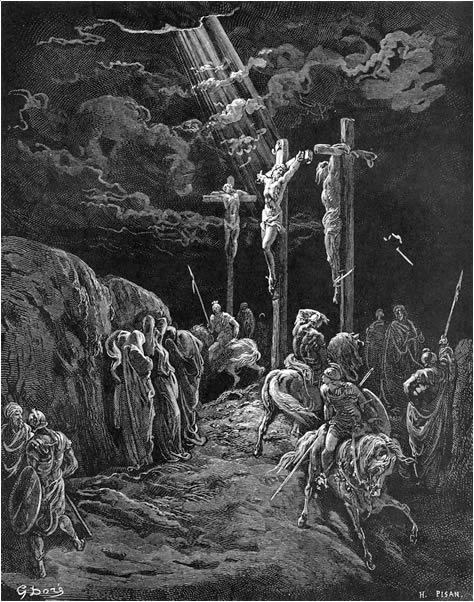
in Matthew 27When some of those standing there heard this, they said, “He is calling Elijah.”
BSB
The same verse in ASV and KJV ▾
ASV
And some of them that stood there, when they heard it, said, This man calleth Elijah.
KJV
Some of them that stood there, when they heard that, said, This man calleth for Elias.
⋯
This verse in Matthew 27
Commentary
10 notes on this verseIt follows, Some of them that stood by, &c.; some, not all; whom I suppose to have been Roman soldiers, ignorant of Hebrew, but from the words Eli, Eli, thought that He called upon Elias. But if we prefer to suppose them Jews, they do it after their usual manner, that they may accuse the Lord of weakness in thus invoking Elias.
The record, by era
The Church Fathers1 voice
(Verse 47.) But some of those standing there, when they heard it, said: This man is calling Elijah. Not all, but some whom I believe were Roman soldiers, not understanding the nature of the Hebrew language, but from what he said: Eli, Eli, thinking that he was calling Elijah. But if we want to understand the Jews who said this, they do this in their usual way, to dishonor the Lord of weakness, who invokes the aid of Elijah.
The Medieval Church3 voices
The soldiers misunderstanding the sound of the Lord's words, foolishly looked for the coming of Elias. But God, whom the Saviour thus invoked in the Hebrew tongue, He had ever inseparably with Him.
Then the effect follows: "and some that stood there etc." And first, the common effect in all is set forth; second, in one of them, at "and immediately one of them running etc." He says therefore "and some of them that stood there and heard, …
Some of them that stood there, when they heard that, said, This man calleth for Elijah. The multitude did not understand His cry, being uncouth and ignorant of the prophets, and thought that He was calling upon Elijah. For not all the Jews knew the …
The Puritans and the Awakening1 voice
Some of them that stood there,.... Near the cross, looking on, and mocking at him, when they heard that; the words, "Eli, Eli", spoken by Christ, said, this man calleth for Elias.
4 more voices on this verse
The Nineteenth Century4 voices
A commentator
Albert Barnes1798–1870
Notes, Explanatory and Practical, on the Old and New Testaments (1832-1869)
This man calleth for Elias - This was done purposely to deride him and his pretensions to be the Messiah. The words “Eli, Eli,” they might easily pretend that they understood to mean Elias, or so pervert them. The taunt would be more cutting, because it was the universal belief of the Jews, as well as the doctrine of Christ, that “Elias” would come before the Messiah.
In these verses we read the conclusion of our Lord Jesus Christ’s passion. After six hours of agonizing suffering, he became obedient even unto death, and “yielded up the ghost.” Three points in the narrative demand a special notice: to them let us confine our attention. Let us observe in the first place the remarkable words which Jesus uttered shortly before his death: “My God, my God, why hast thou forsaken me?” There is a deep mystery in these words, which no mortal man can fathom.
In these verses we read the conclusion of our Lord Jesus Christ’s passion. After six hours of agonizing suffering, he became obedient even unto death, and “yielded up the ghost.” Three points in the narrative demand a special notice: to them let us confine our attention. Let us observe in the first place the remarkable words which Jesus uttered shortly before his death: “My God, my God, why hast thou forsaken me?” There is a deep mystery in these words, which no mortal man can fathom. No doubt they were not wrung from our Lord by mere bodily pain: such an explanation is utterly unsatisfactory, and dishonorable to our blessed Saviour. They were meant to express the real pressure on his soul of the enormous burden of a world’s sins; they were meant to show how truly and literally he was our substitute—was made sin, and a curse for us, and endured God’s righteous anger against a world’s sin in his own person. At that awful moment the iniquity of us all was laid on him to the uttermast. It pleased the Lord to bruise him and put him to grief ( Isaiah 53:10 ). He bore our sins: he carried our transgressions. Heavy must have been that burden, real and literal must have been our Lord’s substitution for us when he, the eternal Son of God, could speak of himself as for a time “forsaken.” Let the expression sink down into our hearts, and not be forgotten. We can have no stronger proof of the sinfulness of sin, or of the vicarious nature of Christ’s sufferings, than his cry, “My God, my God, why hast thou forsaken me?” It is a cry that should stir us up to hate sin, and encourage us to trust in Christ. Let us observe in the second place how much is contained in the words which describe our Lord’s end. We are simply told, “he yielded up the ghost.” There never was a last breath drawn of such deep import as this. There never was an event on which so much depended.
This man calleth for Elias - Probably these were Hellenistic Jews, who did not fully understand the meaning of our Lord’s words. Elijah was daily expected to appear as the forerunner of the Messiah, whose arrival, under the character of a mighty prince, was generally supposed to be at hand throughout the east. See Mal 4:5; Mat 2:2-4; Mat 17:10-12.
The words behind it
11 Greek wordsEvery Greek word of this verse in the order it stands, with what it means and the door to its own study. The last column counts the times a word stands in the whole Bible: the rarer the word, the more the places it appears belong together.
| Greek | Sound | Meaning | Word study | In the Bible |
|---|---|---|---|---|
| Τινὲς | tines | Some | G5100 → | 528 times |
| δὲ | de | then | G1161 → | 2765 times |
| τῶν | ton | of those who | G3588 → | 19766 times |
| ἐκεῖ | ekei | there | G1563 → | 105 times |
| ἑστηκότων | hestekoton | having stood | G2476 → | 153 times |
| ἀκούσαντες | akousantes | listening | G191 → | 425 times |
| ἔλεγον | elegon | were saying | G3004 → | 1325 times |
| ὅτι | hoti | that | G3754 → | 1292 times |
| Ἠλίαν | elian | Elijah | G2243 → | 29 times |
| φωνεῖ | phonei | calls | G5455 → | 43 times |
| οὗτος. | houtos | this [man]. | G3778 → | 1381 times |
ΤινὲςSome
tinesG5100 →528 times
δὲthen
deG1161 →2765 times
τῶνof those who
tonG3588 →19766 times
ἐκεῖthere
ekeiG1563 →105 times
ἑστηκότωνhaving stood
hestekotonG2476 →153 times
ἀκούσαντεςlistening
akousantesG191 →425 times
ἔλεγονwere saying
elegonG3004 →1325 times
ὅτιthat
hotiG3754 →1292 times
ἨλίανElijah
elianG2243 →29 times
φωνεῖcalls
phoneiG5455 →43 times
οὗτος.this [man].
houtosG3778 →1381 times
A shaded row is a word that stands 400 times or fewer in the Bible.
The walk
7 stopsEach card is a verse this one points to, and under it the verses that one points to in turn. Where several paths arrive at the same place, that place is listed first: the text keeps returning to it.
Through
Malachi 4:5Behold, I will send you Elijah the prophet before the coming of the great and awesome Day of the LORD.
it leads to
- Luke 1:17
And he will go on before the Lord in the spirit and power of Elijah, to turn the hearts of the fathers to their children and the disobedient to the wisdom of the righteous—to…
Reached by 2 separate paths from here.
- Matthew 17:10–13
The disciples asked Him, “Why then do the scribes say that Elijah must come first?”
Reached by 2 separate paths from here.
- Mark 9:11–13
And they asked Jesus, “Why do the scribes say that Elijah must come first?”
Reached by 2 separate paths from here.
- Matthew 11:13–14
For all the Prophets and the Law prophesied until John.
- Malachi 3:1
“Behold, I will send My messenger, who will prepare the way before Me. Then the Lord whom you seek will suddenly come to His temple—the Messenger of the covenant, in whom you delight—see, He…
- Luke 1:17
Through
Matthew 11:14And if you are willing to accept it, he is the Elijah who was to come.
it leads to
- Malachi 4:5
Behold, I will send you Elijah the prophet before the coming of the great and awesome Day of the LORD.
- John 1:21–23
“Then who are you?” they inquired. “Are you Elijah?” He said, “I am not.” “Are you the Prophet?” He answered, “No.”
- Malachi 4:5
Where this verse is studied
On this page
Studies18
About Matthew
Who and where
1 name in this verse with a page on the site.
This page draws on 9 works. Open the list of works
This page draws on Adam Clarke, Commentary on the Bible; Albert Barnes, Notes, Explanatory and Practical, on the Old and New Testaments (1832-1869); J.C. Ryle, Expository Thoughts on the Gospels: Matthew; Jerome, Catena Aurea by Aquinas; Jerome, Commentary on Matthew; John Gill, Exposition of the New Testament (1746-1748); Rabanus Maurus, Catena Aurea by Aquinas; Theophylact of Ohrid, Commentary on Matthew and Thomas Aquinas, Commentary on Matthew.