
Matthew 27:37
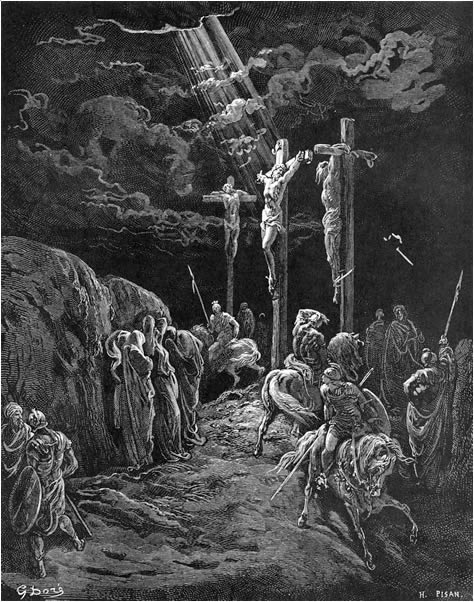
in Matthew 27Above His head they posted the written charge against Him: THIS IS JESUS, THE KING OF THE JEWS.
BSB
The same verse in ASV and KJV ▾
ASV
And they set up over his head his accusation written, THIS IS JESUS THE KING OF THE JEWS.
KJV
And set up over his head his accusation written, THIS IS JESUS THE KING OF THE JEWS.
⋯
This verse in Matthew 27
Commentary
16 notes on this verseAnd they set up over his head his accusation written, This is Jesus, the King of the Jews. I cannot sufficiently wonder at the enormity of the thing, that having purchased false witnesses, and having stirred up the unhappy people to riot and uproar, they found no other plea for putting Him to death, than that He was King of the Jews; and this perhaps they set up in mockery.
This site's exposition
sitting down they watched him there
on Matthew 27:36-37
The guard sits to watch, a standard precaution against rescue attempts or a hastened death by mercy, while above the cross the soldiers fix the titulus, the official charge board Roman practice required at every execution. John 19:20 records it in three languages, Hebrew, Greek and Latin, so the whole city, its Jewish residents, its Greek-speaking world, and Rome itself could read the same words, THIS IS JESUS THE KING OF THE JEWS. Pilate meant the sign as an insult against the priests who had forced his hand, and the priests asked him to soften it to a mere claim rather than a title, John 19:21-22 records, but Pilate refuses, leaving the truest confession in the whole trial nailed above the very man it names.
The record, by era
The Church Fathers5 voices
"Whether in pretense or in truth, Christ is proclaimed," and all literature—whether Greek, Roman or Hebrew—gives evidence of his kingdom. And in place of a crown, "over his head" is written "This is Jesus king of the Jews." There is no other reason for his death (nor was there) than that he was the "king of the Jews." He spoke about this when he said, "I have been made king by him on Zion, his holy mountain." And while the chief priest, in keeping with the letter of the law, wore on his head a type of sign with a petal bearing the inscription "the holiness of the Lord," the true chief priest and king—Jesus on the cross—has a sign that reads "This is the king of the Jews." Rising up to the Father and receiving him in himself, he has for his inscription and title the Father of renown and has the Father as his crown. He has been made worthy of him as a house worthy of God the Father, and he alone can fully possess the Father.
The life and salvation of all things was hung from the tree of life with a thief on his left and a thief on his right. This demonstrates that the entire human race is called to the mystery of the Lord's suffering.
It was divinely provided that this title should be set up over His head, that the Jews might learn that not even by putting Him to death could they avoid having Him for their King; for in the very instrument of His death He not only did not lose, but rather confirmed His sovereignty.
A commentator
John ChrysostomHomily on the Gospel of Matthew 87 · Written in the 5th century.
proposed
They parted the garments, by which such great miracles were done. But they wrought none now, Christ restraining His unspeakable power. And this was no small addition of insult. For as to one base and abject, as I said, and the vilest of all men; so do they dare to do all things. To the thieves at any rate they did nothing of the kind, but to Christ they dare it all. And they crucified Him in the midst of them, that He might share in their reputation.
(Verse 37.) And they placed over his head the charge against him, written, 'This is Jesus, the King of the Jews.' I cannot sufficiently admire the magnitude of the matter, that, for the sake of the redeemed, with a false accusation and having incited the unfortunate people to sedition and outcry, they found no other cause for his execution except that he was the King of the Jews. And perhaps they did this in mockery and ridicule. However, Pilate also responded unwillingly, 'What I have written, I have written.' Whether you want it or not, Jews, a crowd of all nations responds to you: Jesus is the king of the Jews, that is, the emperor of believers and confessors.
9 more voices on this verse
The Church Fathers1 voice
The High Priest also in obedience to the letter of the Law wore on his head the writing, 'Holiness to the Lord,' but the true High Priest and King, Jesus, bears on His cross the title, This is the King of the Jews; when ascending to His Father, instead of His own name with its proper letters, He has the Father Himself.
The Medieval Church3 voices
Then the title follows: "and they put over his head his cause written etc." And it should be noted that what they did for his disgrace, by God's ordinance, turned to his honor. Hence they put his cause, i.e., the cause for which he suffered; …
For because He is at once King and Priest, when He would offer the sacrifice of His flesh on the altar of the cross, His title set forth His regal dignity. And it is set over and not beneath the cross, because though He suffered for us on the cross with the weakness of man, the majesty of the King was conspicuous above the cross; and this He did not lose, but rather confirmed, by the cross.
And set up over His head His accusation written, THIS IS JESUS KING OF THE JEWS. That which the evangelist John calls His "title" (Jn. 19.19), Matthew calls His "accusation." For they wrote down an indictment giving the reason for His crucifixion, namely, that He …
The Puritans and the Awakening1 voice
And set up over his head his accusation written,.... The Evangelist John calls it a "title", Joh 19:19, and Luke, a "superscription", Luk 23:38, and Mark, the "superscription of his accusation", Mar 15:26, it was what contained the sum and substance of what he was accused, and for which he was condemned, and suffered. The Syriac and Persic versions here render it, "the cause of his death".
The Nineteenth Century4 voices
A commentator
Albert Barnes1798–1870
Notes, Explanatory and Practical, on the Old and New Testaments (1832-1869)
And set up over his head - John says Joh 19:19 that Pilate wrote the title and put it upon the cross. Probably Pilate wrote it or caused it to be written, and directed the soldiers to set it up. A man is often said to do what he directs others to do. It was customary to set up over the heads of persons crucified the crime for which they suffered, and the name of the sufferer The accusation on which Jesus had been condemned by Pilate was his claiming to be the King of the Jews.
These verses describe the sufferings of our Lord Jesus Christ after his condemnation by Pilate, his sufferings in the hands of the brutal Roman soldiers, and his final sufferings on the cross. They form a marvelous record. They are marvelous when we remember the sufferer—the eternal Son of God. They are marvelous when we remember the persons for whom these sufferings were endured. We and our sins were the cause of all this sorrow! He “died for our sins” ( 1 Corinthians 15:3 ). Let us observe in the first place the extent and reality of our Lord’s sufferings.
These verses describe the sufferings of our Lord Jesus Christ after his condemnation by Pilate, his sufferings in the hands of the brutal Roman soldiers, and his final sufferings on the cross. They form a marvelous record. They are marvelous when we remember the sufferer—the eternal Son of God. They are marvelous when we remember the persons for whom these sufferings were endured. We and our sins were the cause of all this sorrow! He “died for our sins” ( 1 Corinthians 15:3 ). Let us observe in the first place the extent and reality of our Lord’s sufferings. The catalogue of all the pains endured by our Lord’s body is indeed a fearful one: seldom has such suffering been inflicted on one body in the last few hours of a life. The most savage tribes, in their refinement of cruelty, could hardly have heaped more agonizing tortures on an enemy than were accumulated on the flesh and bones of our beloved Master. Never let it be forgotten that he had a real human body, a body exactly like our own, just as sensitive, just as vulnerable, just as capable of feeling intense pain. And then let us see what that body endured. Our Lord, we must remember, had already passed a night without sleep, and endured excessive fatigue. He had been taken from Gethsemane to the Jewish council, and from the Council to Pilate’s judgment hall. He had been twice placed on his trial, and twice unjustly condemned. He had been already scourged and beaten cruelly with rods. And now, after all this suffering, he was delivered up to the Roman soldiers, a body of men no doubt expert in cruelty, and, of all people, least likely to behave with delicacy or compassion. These hard men at once proceeded to work their will.
His accusation - It was a common custom to affix a label to the cross, giving a statement of the crime for which the person suffered. This is still the case in China, when a person is crucified. Sometimes a person was employed to carry this before the criminal, while going to the place of punishment. It is with much propriety that Matthew calls this αιτια, accusation; for it was false that ever Christ pretended to be King Of The Jews, in the sense the inscription held forth: he was accused of this, but there was no proof of the accusation; however it was affixed to the cross. From Joh 19:21, we find that the Jews wished this to be a little altered: Write, said they, that He said, l am king of the Jews; thus endeavoring, by the addition of a vile lie, to countenance their own conduct in putting him to death. But this Pilate refused to do. Both Luke, Luk 23:38, and John, Joh 19:20, say that this accusation was written in Greek, Latin, and Hebrew. In those three languages, we may conceive the label to stand thus, according to the account given by St. John; the Hebrew being the mixed dialect then spoken. In Hebrew - ΕβραΐϚι: ישוע נצריא מלכא דיהודיא In Greek - ΕλληνιϚι: ΙΗΣΟΥΣ Ο ΝΑΖΩΡΑΙΟΣ Ο ΒΑΣΙΛΕΥΕ ΤΩΝ ΙΟΥΔΑΙΩΝ In Latin - ΡωμαΐϚι: IESUS NAZARENUS REX IUDAEORUM It is only necessary to observe, that all the letters, both of the Greek and Roman alphabets, were those now called square or uncial, similar to these above.
The words behind it
17 Greek wordsEvery Greek word of this verse in the order it stands, with what it means and the door to its own study. The last column counts the times a word stands in the whole Bible: the rarer the word, the more the places it appears belong together.
| Greek | Sound | Meaning | Word study | In the Bible |
|---|---|---|---|---|
| καὶ | kai | And | G2532 → | 9120 times |
| ἐπέθηκαν | epethekan | they put up | G2007 → | 38 times |
| ἐπάνω | epano | over | G1883 → | 19 times |
| τῆς | tes | the | G3588 → | 19766 times |
| κεφαλῆς | kephales | head | G2776 → | 75 times |
| αὐτοῦ | autou | of Him | G846 → | 5565 times |
| τὴν | ten | the | G3588 → | 19766 times |
| αἰτίαν | aitian | accusation | G156 → | 20 times |
| αὐτοῦ | autou | of Him | G846 → | 5565 times |
| γεγραμμένην· | gegrammenen | written: | G1125 → | 189 times |
| οὗτός | houtos | This | G3778 → | 1381 times |
| ἐστιν | estin | is | G1510 → | 2333 times |
| Ἰησοῦς | iesous | Jesus | G2424 → | 908 times |
| ὁ | ho | the | G3588 → | 19766 times |
| βασιλεὺς | basileus | King | G935 → | 114 times |
| τῶν | ton | of the | G3588 → | 19766 times |
| Ἰουδαίων.¶ | ioudaion | Jews. | G2453 → | 192 times |
καὶAnd
kaiG2532 →9120 times
ἐπέθηκανthey put up
epethekanG2007 →38 times
ἐπάνωover
epanoG1883 →19 times
τῆςthe
tesG3588 →19766 times
κεφαλῆςhead
kephalesG2776 →75 times
αὐτοῦof Him
autouG846 →5565 times
τὴνthe
tenG3588 →19766 times
αἰτίανaccusation
aitianG156 →20 times
αὐτοῦof Him
autouG846 →5565 times
γεγραμμένην·written:
gegrammenenG1125 →189 times
οὗτόςThis
houtosG3778 →1381 times
ἐστινis
estinG1510 →2333 times
ἸησοῦςJesus
iesousG2424 →908 times
ὁthe
hoG3588 →19766 times
βασιλεὺςKing
basileusG935 →114 times
τῶνof the
tonG3588 →19766 times
Ἰουδαίων.¶Jews.
ioudaionG2453 →192 times
A shaded row is a word that stands 400 times or fewer in the Bible.
The walk
8 stopsEach card is a verse this one points to, and under it the verses that one points to in turn. Where several paths arrive at the same place, that place is listed first: the text keeps returning to it.
Through
Luke 23:38Above Him was posted an inscription: THIS IS THE KING OF THE JEWS.
it leads to
- Mark 15:26
And the charge inscribed against Him read: THE KING OF THE JEWS.
- John 19:19–22
Pilate also had a notice posted on the cross. It read: JESUS OF NAZARETH, THE KING OF THE JEWS.
- Mark 15:32
Let the Christ, the King of Israel, come down now from the cross, so that we may see and believe!” And even those who were crucified with Him berated Him.
- Luke 23:3
So Pilate asked Him, “Are You the King of the Jews?” “You have said so,” Jesus replied.
- Mark 15:26
Through
Mark 15:26And the charge inscribed against Him read: THE KING OF THE JEWS.
it leads to
- Matthew 2:2
asking, “Where is the One who has been born King of the Jews? We saw His star in the east and have come to worship Him.”
- Zechariah 9:9
Rejoice greatly, O Daughter of Zion! Shout in triumph, O Daughter of Jerusalem! See, your King comes to you, righteous and victorious, humble and riding on a donkey, on a colt, the foal of…
- Luke 23:37–38
“If You are the King of the Jews,” they said, “save Yourself!”
- John 19:18–22
There they crucified Him, and with Him two others, one on each side, with Jesus in the middle.
- Matthew 2:2
Where this verse is studied
About Matthew
This page draws on 16 works. Open the list of works
This page draws on Adam Clarke, Commentary on the Bible; Albert Barnes, Notes, Explanatory and Practical, on the Gospels; Albert Barnes, Notes, Explanatory and Practical, on the Old and New Testaments (1832-1869); Hilary of Poitiers, Commentary on Matthew 23.4-5; J.C. Ryle, Expository Thoughts on the Gospels: Matthew; Jerome, Catena Aurea by Aquinas; Jerome, Commentary on Matthew; John Chrysostom, Homily on the Gospel of Matthew 87; John Gill, Exposition of the New Testament; John Gill, Exposition of the New Testament (1746-1748); Origen of Alexandria, COMMENTARY ON MATTHEW 130; Origen of Alexandria, Catena Aurea by Aquinas; Rabanus Maurus, Catena Aurea by Aquinas; Remigius of Rheims, Catena Aurea by Aquinas; Theophylact of Ohrid, Commentary on Matthew and Thomas Aquinas, Commentary on Matthew.