
Matthew 27:39
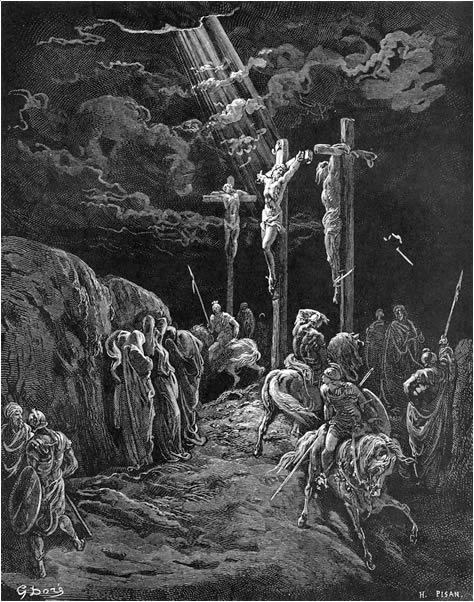
in Matthew 27And those who passed by heaped abuse on Him, shaking their heads
BSB
The same verse in ASV and KJV ▾
ASV
And they that passed by railed on him, wagging their heads,
KJV
And they that passed by reviled him, wagging their heads,
⋯
This verse in Matthew 27
Commentary
13 notes on this verseNo one standing still or directly approaching him blasphemes Jesus. "Those who passed by blasphemed him," and those who stayed behind plucked food from the vineyard wall demolished by God. Concerning this it is written, "Why then have you broken down its walls, so that those who pass along the way pluck its fruit?" Therefore, as long as one does not pass along the way or avoid it and can say to God while standing, "You have set 'my feet upon a rock,' " one does not blaspheme Jesus.
This site's exposition
shaking their heads
on Matthew 27:39-44
Passersby turn his words from 26:61 into a taunt, though John 2:19-21 says he meant his body. The chief priests promise that "we will believe in Him" if he comes down, the sign Jesus refused them at 12:38-39. Even "the robbers who were crucified with Him" join the abuse.
The record, by era
The Church Fathers2 voices
They revile him because they passed by that way, and would not walk in the true way of the Scriptures. They wagged their heads, because they had just before shifted their feet, and stood not upon a rock.
But nevertheless not even here doth their contumely stop, but after having stripped and crucified Him, and offered Him vinegar, they proceeded still further, and beholding Him impaled upon the cross, they revile Him, both they themselves and the passers by; and this was more grievous than all, that on the charge of being an impostor and deceiver He suffered these things, and as a boaster, and vainly pretending what He said. Therefore they both crucified Him publicly, that they might make a show of it in the sight of all; and therefore also they did it by the hands of the soldiers, that these things being perpetrated even by a public tribunal, the insult might be the greater.
The Medieval Church3 voices
And they that passed by reviled Him, shaking their heads, and saying, Thou that destroyest the temple, and buildest it in three days, save Thyself. If Thou be the Son of God, come down from the cross. Likewise also the chief priests mocking Him, with …
Had He then been prevailed on by their taunts to leave the cross, He would not have proved to us the power of endurance; but He waited enduring their mockery; and He who would not come down from the cross, rose again from the tomb.
Then the mockery of the crucified is treated: "and they that passed by blasphemed him"; and first, that which came from the people is treated; second, that which came from the rulers; third, that which came from the thieves. Concerning the first, first the blasphemers …
6 more voices on this verse
The Puritans and the Awakening2 voices
His blood be on us and on our children - As this imprecation was dread. fully answered in the ruin so quickly brought on the Jewish nation, and the calamities which have ever since pursued that wretched people, so it was peculiarly fulfilled by Titus the Roman general, on the Jews whom he took during the siege of Jerusalem.
And they that passed by,....
The Nineteenth Century4 voices
These verses describe the sufferings of our Lord Jesus Christ after his condemnation by Pilate, his sufferings in the hands of the brutal Roman soldiers, and his final sufferings on the cross. They form a marvelous record. They are marvelous when we remember the sufferer—the eternal Son of God. They are marvelous when we remember the persons for whom these sufferings were endured. We and our sins were the cause of all this sorrow! He “died for our sins” ( 1 Corinthians 15:3 ). Let us observe in the first place the extent and reality of our Lord’s sufferings.
These verses describe the sufferings of our Lord Jesus Christ after his condemnation by Pilate, his sufferings in the hands of the brutal Roman soldiers, and his final sufferings on the cross. They form a marvelous record. They are marvelous when we remember the sufferer—the eternal Son of God. They are marvelous when we remember the persons for whom these sufferings were endured. We and our sins were the cause of all this sorrow! He “died for our sins” ( 1 Corinthians 15:3 ). Let us observe in the first place the extent and reality of our Lord’s sufferings. The catalogue of all the pains endured by our Lord’s body is indeed a fearful one: seldom has such suffering been inflicted on one body in the last few hours of a life. The most savage tribes, in their refinement of cruelty, could hardly have heaped more agonizing tortures on an enemy than were accumulated on the flesh and bones of our beloved Master. Never let it be forgotten that he had a real human body, a body exactly like our own, just as sensitive, just as vulnerable, just as capable of feeling intense pain. And then let us see what that body endured. Our Lord, we must remember, had already passed a night without sleep, and endured excessive fatigue. He had been taken from Gethsemane to the Jewish council, and from the Council to Pilate’s judgment hall. He had been twice placed on his trial, and twice unjustly condemned. He had been already scourged and beaten cruelly with rods. And now, after all this suffering, he was delivered up to the Roman soldiers, a body of men no doubt expert in cruelty, and, of all people, least likely to behave with delicacy or compassion. These hard men at once proceeded to work their will.
Wagging their heads - In token of contempt.
A commentator
Albert Barnes1798–1870
Notes, Explanatory and Practical, on the Old and New Testaments (1832-1869)
proposed
Wagging their heads - In token of derision and insult. See Job 16:4; Psa 109:25.
The words behind it
9 Greek wordsEvery Greek word of this verse in the order it stands, with what it means and the door to its own study. The last column counts the times a word stands in the whole Bible: the rarer the word, the more the places it appears belong together.
| Greek | Sound | Meaning | Word study | In the Bible |
|---|---|---|---|---|
| οἱ | hoi | Those | G3588 → | 19766 times |
| δὲ | de | now | G1161 → | 2765 times |
| παραπορευόμενοι | paraporeuomenoi | passing by | G3899 → | |
| ἐβλασφήμουν | eblasphemoun | were denigrating | G987 → | 34 times |
| αὐτὸν | auton | Him | G846 → | 5565 times |
| κινοῦντες | kinountes | wagging | G2795 → | |
| τὰς | tas | the | G3588 → | 19766 times |
| κεφαλὰς | kephalas | heads | G2776 → | 75 times |
| αὐτῶν | auton | of them | G846 → | 5565 times |
οἱThose
hoiG3588 →19766 times
δὲnow
deG1161 →2765 times
παραπορευόμενοιpassing by
paraporeuomenoiG3899 →
ἐβλασφήμουνwere denigrating
eblasphemounG987 →34 times
αὐτὸνHim
autonG846 →5565 times
κινοῦντεςwagging
kinountesG2795 →
τὰςthe
tasG3588 →19766 times
κεφαλὰςheads
kephalasG2776 →75 times
αὐτῶνof them
autonG846 →5565 times
A shaded row is a word that stands 400 times or fewer in the Bible.
The walk
8 stopsEach card is a verse this one points to, and under it the verses that one points to in turn. Where several paths arrive at the same place, that place is listed first: the text keeps returning to it.
Through
Psalms 109:25I am an object of scorn to my accusers; when they see me, they shake their heads.
it leads to
- Psalms 22:6–7
But I am a worm and not a man, scorned by men and despised by the people.
- Romans 15:3
For even Christ did not please Himself, but as it is written: “The insults of those who insult You have fallen on Me.”
- Psalms 69:19–20
You know my reproach, my shame and disgrace. All my adversaries are before You.
- Psalms 69:9–12
because zeal for Your house has consumed me, and the insults of those who insult You have fallen on me.
- Psalms 22:6–7
Through
Lamentations 1:12Is this nothing to you, all you who pass by? Look around and see! Is there any sorrow like mine, which was inflicted on me, which the LORD made me suffer on the day…
it leads to
- Daniel 9:12
You have carried out the words spoken against us and against our rulers by bringing upon us a great disaster. For under all of heaven, nothing has ever been done like what has been…
- Luke 23:28–31
But Jesus turned to them and said, “Daughters of Jerusalem, do not weep for Me, but weep for yourselves and for your children.
- Jeremiah 30:24
The fierce anger of the LORD will not turn back until He has fully accomplished the purposes of His heart. In the days to come you will understand this.
- Lamentations 4:6–11
The punishment of the daughter of my people is greater than that of Sodom, which was overthrown in an instant without a hand turned to help her.
- Daniel 9:12
Where this verse is studied
On this page
Studies18
About Matthew
This page draws on 13 works. Open the list of works
This page draws on Adam Clarke, Commentary on the Bible; Albert Barnes, Notes, Explanatory and Practical, on the Old and New Testaments (1832-1869); J.C. Ryle, Expository Thoughts on the Gospels: Matthew; Jerome, Catena Aurea by Aquinas; John Chrysostom, Homilies on the Gospel of Matthew; John Chrysostom, Homily on the Gospel of Matthew 87; John Gill, Exposition of the New Testament (1746-1748); John Wesley, Explanatory Notes upon the New Testament; Matthew Henry, Commentary on the Whole Bible; Origen of Alexandria, COMMENTARY ON MATTHEW 132; Rabanus Maurus, Catena Aurea by Aquinas; Theophylact of Ohrid, Commentary on Matthew and Thomas Aquinas, Commentary on Matthew.