
Matthew 27:35
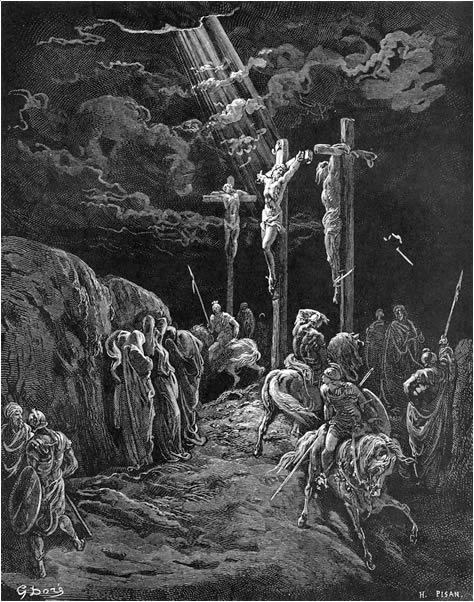
in Matthew 27When they had crucified Him, they divided up His garments by casting lots.
BSB
The same verse in ASV and KJV ▾
ASV
And when they had crucified him, they parted his garments among them, casting lots;
KJV
And they crucified him, and parted his garments, casting lots: that it might be fulfilled which was spoken by the prophet, They parted my garments among them, and upon my vesture did they cast lots.
⋯
This verse in Matthew 27
Commentary
20 notes on this verse(Verse 35.) And when they had crucified him, they divided his garments, casting lots, that it might be fulfilled which was spoken by the prophet, saying: They divided my garments among themselves, and upon my vesture they cast lots. And this was prophesied in the same psalm: They divided my garments among themselves, and upon my vesture they cast lots (Psalm 22:18).
This site's exposition
His garments by casting lots
Matthew states the crucifixion in one clause. The weight falls on the soldiers who "divided up His garments by casting lots," the act Psalm 22:18 describes. John 19:23-24 gives the detail: four soldiers split the outer garments and cast lots for the tunic woven without a seam.
The record, by era
The Church Fathers5 voices
There are those who to this day do not have the Lord with them but do have his "garments"—namely, the words contained in Scripture. They do not have them in full but only in part. Nonetheless the prophet had spoken that prediction which was now fulfilled. Now, as to whether any of his clothes were torn apart when they divided his garments or whether any of them remained intact and just what those items were, nothing is said by the first three Evangelists. But in John we read that "when the soldiers had crucified Jesus they took his garments and made four parts, one for each soldier; also his tunic. But the tunic was without seam, woven from top to bottom; so they said to one another, 'Let us not tear it but cast lots for it.' " Therefore not all but only one of the soldiers who had cast lots received it. Now anyone debating the differences between those who have the Lord's "garments" will doubtless find some people who, although they do not have the Lord in their teachings, do have the "tunic" that was "woven from top to bottom."
Thus on the tree of life the salvation and life of all is suspended.
That they distributed his clothes by casting lots for them rather than by cutting them up signifies the eternal incorruptibility of Christ's body.
The life and salvation of all things was hung from the tree of life with a thief on his left and a thief on his right. This demonstrates that the entire human race is called to the mystery of the Lord's suffering.
This which was now done to Christ had been prophesied in the Psalm, They parted my garments among them, and cast lots upon my vesture. (Ps. 22:18.)
13 more voices on this verse
The Church Fathers4 voices
(Hom. de Cruc. et Lat. ii.) He suffered on a lofty cross, and not under a roof, to the end that the nature of the air might be purified; the earth also partook a like benefit, being cleansed by the blood that dropped from His side. It is to be noted, that this is no small degradation of Christ. For they did this as to one utterly abject and worthless, yet for the thieves they did not the same. For they share the garments only in the case of condemned persons so mean and poor as to possess nothing more.
They parted the garments, by which such great miracles were done. But they wrought none now, Christ restraining His unspeakable power. And this was no small addition of insult. For as to one base and abject, as I said, and the vilest of all men; so do they dare to do all things. To the thieves at any rate they did nothing of the kind, but to Christ they dare it all. And they crucified Him in the midst of them, that He might share in their reputation.
For after "they had mocked Him, they led Him to crucify Him," it is said, and when they had stripped Him, they took His garments, and sat down and watched Him, when He should die. And they divide His garments amongst them, which sort of thing is done in the case of very vile and abject criminals, and such as have no one belonging to them, and are in utter desolation.
(Lib. 83. Quæst. q. 25.) The Wisdom of God took upon Him man, to give us an example how we might live rightly. It pertains to right life not to fear things that are not to be feared. But some men who do not fear death in itself, yet dread some kinds of death. That no sort of death is to be feared by the man who lives aright, was to be shown by this Man's cross. For of all the modes of death none was more horrible and fearful than this. (in Serm. non occ.) Let your holiness consider of what might is the power of the cross. Adam set at nought the commandment, taking the apple from the tree; but all that Adam lost, Christ found upon the cross. The ark of wood saved the human race from the deluge of waters; when God's people came out of Egypt, Moses divided the sea with his rod, overwhelmed Pharaoh, and redeemed God's people. The same Moses changed the bitter water into sweet by casting wood into it. By the rod the refreshing stream was drawn out of the rock; that Amalech might be overcome, Moses' outstretched hands were supported upon his rod; the Law of God is entrusted to the wooden ark of the covenant, that thus, by these steps we may come at last to the wood of the cross. (de Cons. Ev. iii. 12.) Matthew shortly says, They parted his garments, casting lots; but John explains more fully how it was done. The soldiers, when they had crucified him, look his garments, and made four parts, to every soldier a part; and also his coat; now the coat was without seam. (John 19:23.)
The Medieval Church4 voices
Or, according to the practical exposition, the cross in respect of its broad transverse piece signifies the joy of him that works, for sorrow produces straitness; for the broad part of the cross is in the transverse beam to which the hands are fastened, and by the hands we understand works. By the upper part to which the head is fastened is denoted our looking for retribution from the supreme righteousness of God. The perpendicular part on which the body is stretched denotes endurance, whence the patient are called 'long-suffering.' (longamines) The point that is fixed into the ground shadows forth the invisible part of a sacrament.
(non occ.) Having described how Christ was led to the scene of His Passion, the Evangelist proceeds to the Passion itself, describing the kind of death; And they crucified him. (ap. Anselm.) The shape of the cross seems also to signify the Church spread through the four quarters of the earth.
"And after they crucified him etc." But it can be asked why he wished to die by this death in particular. One reason is on the part of the crucifiers, because they wanted him to be defamed by this, according to that saying of Wisdom …
And they crucified Him, and parted His garments, casting lots: that it might be fulfilled which was spoken by the prophet, They parted My garments among them, and upon My vesture did they cast lots. There were many ways to be put to death, but …
The Puritans and the Awakening1 voice
And they crucified him,.... That is, the soldiers: they laid the cross upon the ground, and stretched Christ upon it; they extended his two arms as far as they could, to the transverse part of it, and nailed his hands unto it: his two feet they fixed by each other on a basis, in the body of the cross, through which they also drove nails; and then raising it up, fixed it in the earth, and left him hanging on it till he expired.
The Nineteenth Century4 voices
A commentator
Albert Barnes1798–1870
Notes, Explanatory and Practical, on the Old and New Testaments (1832-1869)
And they crucified him - To “crucify” means to put to death on a cross. The “cross” has been described at Mat 27:32. The usual manner of the crucifixion was as follows: After the criminal had carried the cross, attended with every possible gibe and insult, to the place of execution, a hole was dug in the earth to receive the foot of it. The cross was laid on the ground; the person condemned to suffer was stripped and was extended on it, and the soldiers fastened the hands and feet either by nails or thongs.
These verses describe the sufferings of our Lord Jesus Christ after his condemnation by Pilate, his sufferings in the hands of the brutal Roman soldiers, and his final sufferings on the cross. They form a marvelous record. They are marvelous when we remember the sufferer—the eternal Son of God. They are marvelous when we remember the persons for whom these sufferings were endured. We and our sins were the cause of all this sorrow! He “died for our sins” ( 1 Corinthians 15:3 ). Let us observe in the first place the extent and reality of our Lord’s sufferings.
These verses describe the sufferings of our Lord Jesus Christ after his condemnation by Pilate, his sufferings in the hands of the brutal Roman soldiers, and his final sufferings on the cross. They form a marvelous record. They are marvelous when we remember the sufferer—the eternal Son of God. They are marvelous when we remember the persons for whom these sufferings were endured. We and our sins were the cause of all this sorrow! He “died for our sins” ( 1 Corinthians 15:3 ). Let us observe in the first place the extent and reality of our Lord’s sufferings. The catalogue of all the pains endured by our Lord’s body is indeed a fearful one: seldom has such suffering been inflicted on one body in the last few hours of a life. The most savage tribes, in their refinement of cruelty, could hardly have heaped more agonizing tortures on an enemy than were accumulated on the flesh and bones of our beloved Master. Never let it be forgotten that he had a real human body, a body exactly like our own, just as sensitive, just as vulnerable, just as capable of feeling intense pain. And then let us see what that body endured. Our Lord, we must remember, had already passed a night without sleep, and endured excessive fatigue. He had been taken from Gethsemane to the Jewish council, and from the Council to Pilate’s judgment hall. He had been twice placed on his trial, and twice unjustly condemned. He had been already scourged and beaten cruelly with rods. And now, after all this suffering, he was delivered up to the Roman soldiers, a body of men no doubt expert in cruelty, and, of all people, least likely to behave with delicacy or compassion. These hard men at once proceeded to work their will.
And they crucified him - Crucifixion properly means the act of nailing or tying to a cross. The cross was made of two beams, either crossing at the top at right angles, like a T, or in the middle of their length, like an X. There was, besides, a piece on the center of the transverse beam, to which the accusation or statement of the crime of the culprit was attached, and a piece of wood which projected from the middle, on which the person sat, as on a sort of saddle; and by which the whole body was supported. Tertullian mentions this particularly: Nobis, says he, tota crux imputatur, cum antenna scilicet sua, et cum illo Sedills excessu. Advers. Nationes, lib. ii. Justin Martyr, in his dialogue with Trypho the Jew, gives precisely the same description of the cross; and it is worthy of observation that both he and Tertullian flourished before the punishment of the cross had been abolished. The cross on which our Lord suffered was of the former kind; being thus represented in all old monuments, coins, and crosses. St. Jerome compares it to a bird flying, a man swimming, or praying with his arms extended. The punishment of the cross was inflicted among the ancient Hindoos from time immemorial for various species of theft; see Halhead’s Code of Gentoo Laws, p. 248, and was common among the Syrians, Egyptians, Persians, Africans, Greeks, and Romans: it is also still in use among the Chinese, who do not nail, but tie the criminal to it. It was probably the Romans who introduced it among the Jews. Before they became subject to the Romans, they used hanging or gibbeting, but not the cross. This punishment was the most dreadful of all others, both for the shame and pain of it: and so scandalous, that it was inflicted as the last mark of detestation upon the vilest of people. […]
The words behind it
9 Greek wordsEvery Greek word of this verse in the order it stands, with what it means and the door to its own study. The last column counts the times a word stands in the whole Bible: the rarer the word, the more the places it appears belong together.
| Greek | Sound | Meaning | Word study | In the Bible |
|---|---|---|---|---|
| σταυρώσαντες | staurosantes | having crucified | G4717 → | 46 times |
| δὲ | de | now | G1161 → | 2765 times |
| αὐτὸν | auton | Him | G846 → | 5565 times |
| διεμερίσαντο | diemerisanto | they divided | G1266 → | |
| τὰ | ta | the | G3588 → | 19766 times |
| ἱμάτια | himatia | garments | G2440 → | 60 times |
| αὐτοῦ | autou | of Him | G846 → | 5565 times |
| βάλλοντες | ballontes | casting | G906 → | 121 times |
| κλῆρον, | kleron | lots, | G2819 → |
σταυρώσαντεςhaving crucified
staurosantesG4717 →46 times
δὲnow
deG1161 →2765 times
αὐτὸνHim
autonG846 →5565 times
διεμερίσαντοthey divided
diemerisantoG1266 →
τὰthe
taG3588 →19766 times
ἱμάτιαgarments
himatiaG2440 →60 times
αὐτοῦof Him
autouG846 →5565 times
βάλλοντεςcasting
ballontesG906 →121 times
κλῆρον,lots,
kleronG2819 →
A shaded row is a word that stands 400 times or fewer in the Bible.
The walk
8 stopsEach card is a verse this one points to, and under it the verses that one points to in turn. Where several paths arrive at the same place, that place is listed first: the text keeps returning to it.
Through
Luke 23:34Then Jesus said, “Father, forgive them, for they do not know what they are doing.” And they divided up His garments by casting lots.
it leads to
- Matthew 5:44
But I tell you, love your enemies and pray for those who persecute you,
- Acts 7:60
Falling on his knees, he cried out in a loud voice, “Lord, do not hold this sin against them.” And when he had said this, he fell asleep.
- 1 Peter 3:9
Do not repay evil with evil or insult with insult, but with blessing, because to this you were called so that you may inherit a blessing.
- 1 Peter 2:20–23
How is it to your credit if you are beaten for doing wrong and you endure it? But if you suffer for doing good and you endure it, this is commendable before God.
- Luke 6:27–28
But to those of you who will listen, I say: Love your enemies, do good to those who hate you,
- Matthew 5:44
Through
Psalms 22:18They divide my garments among them and cast lots for my clothing.
it leads to
- Luke 23:34
Then Jesus said, “Father, forgive them, for they do not know what they are doing.” And they divided up His garments by casting lots.
- John 19:23–24
When the soldiers had crucified Jesus, they divided His garments into four parts, one for each soldier, with the tunic remaining. It was seamless, woven in one piece from top to bottom.
- Mark 15:24
And they crucified Him. They also divided His garments by casting lots to decide what each of them would take.
- Luke 23:34
Where this verse is studied
On this page
Studies18
On this verse
On this chapter
About Matthew
This page draws on 18 works. Open the list of works
This page draws on Adam Clarke, Commentary on the Bible; Albert Barnes, Notes, Explanatory and Practical, on the Old and New Testaments (1832-1869); Augustine of Hippo, Catena Aurea by Aquinas; Glossa Ordinaria, Catena Aurea by Aquinas; Hilary of Poitiers, Catena Aurea by Aquinas; Hilary of Poitiers, Commentary on Matthew 23.4-5; J.C. Ryle, Expository Thoughts on the Gospels: Matthew; Jamieson, Fausset & Brown, Commentary Critical and Explanatory on the Whole Bible; Jerome, Commentary on Matthew; Jerome, Catena Aurea by Aquinas; John Chrysostom, Catena Aurea by Aquinas; John Chrysostom, Homily on the Gospel of Matthew 87; John Gill, Exposition of the New Testament (1746-1748); Matthew Henry, Commentary on the Whole Bible; Origen of Alexandria, COMMENTARY ON MATTHEW 128.47; Rabanus Maurus, Catena Aurea by Aquinas; Theophylact of Ohrid, Commentary on Matthew and Thomas Aquinas, Commentary on Matthew.